 On the weekend in the wake of our 250th celebration of Independence Day, our Collect for the 14th Ordinary Sunday offers the image of material creation as an enervated body, weakened by sin, lying in the dust whence it came.
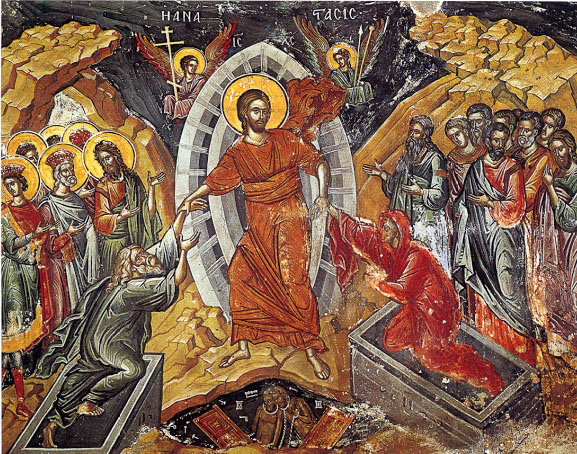
In the Original Sin all creation was wounded. This is evident daily. There ought be harmony between us and the rest of material creation, but our role as nature’s steward has been damaged. Material creation (including us) is in a way captive to an enemy who has beaten us down.
But Christ came as liberator.
Here’s some good “liberation theology“.
Christ rouses us, grasps us, pulls us upward out of sin and death. If we cooperate and get back to our feet, Our Lord aims us again toward the joys possible in this world, first, and in the next, definitively.
Deus, qui Filii tui humilitate iacentem mundum erexisti,
fidelibus tuis sanctam concede laetitiam,
ut, quos eripuisti a servitute peccati,
gaudiis facias perfrui sempiternis.
This prayer is similar to one in the 1962 Missale Romanum for the 2nd Sunday after Easter. The ancient Gelasian Sacramentary has an even earlier version.
 Perfruor (“to enjoy fully”) is one of a handful of deponent verbs usually having its “object” (which is actually more of an instrument) in the ablative: e.g., fruor, “I get fruit/benefit from…”). Gaudium and laetitia both can be translated with “joy”. The Lewis & Short Dictionary says gaudium refers mostly to interior joy whereas laetitia suggests outward expression. That said, gaudium in the plural (as it is in our prayer) can also be “outward expressions of joy”. Souter’s Glossary of Later Latin to 600 A.D. (a supplement to L&S) says gaudium is “everlasting blessedness”, while laetitia is simply “prosperity”. This recalls the spiritual/material distinction. We shouldn’t overtax these nuances. The dictates of ancient rhetoric (and this prayer is pretty old) required a richness of vocabulary, so as to avoid boring repetition.
Erigo is “to raise up, set up, erect” and also “to arouse, excite” while iaceo (in L&S under jaceo) is “to lie” as in “lie sick or dead, fallen” or “to be cast down, fixed on the ground”. In  his dictionary of liturgical Latin, A. Blaise says that humilitas, “lowness”, can have a more theological meaning, namely, the “abasement” of the God Incarnate who took the form of a “slave” (cf Philippians 2:7). Blaise cites this Collect under his headword “humilitas”. And remember that humilitas comes from humus, “dirt, earth, ground”.
LITERAL TRANSLATION:
O God, who by the abasement of Your Son raised up the fallen world, grant holy joy to Your faithful, so that You may cause those whom You snatched from the servitude of sin to enjoy delights unending.
The last phrase reminds me of other well-known Latin prayers. For instance, after the Salve Regina we conclude: “…may we be delivered from present sorrow and enjoy everlasting happiness (aeterna perfrui laetitia).” Note the shift from sorrow to joy. Furthermore, when a priest vests for Mass he traditionally says special prayers as he put on each vestment. For the alb he prays: “Make me white, O Lord, and cleanse my heart, so that having been made white in the Blood of the Lamb, I may enjoy everlasting joys (gaudiis perfruar sempiternis).”
Sacrifice first. Then joy.
We have seen before in our prayers a pattern of descent and ascent, of exit and return. Before the Resurrection, comes the Passion. Before exaltation, there is humiliation. Descent, Passion and humiliation bring the rising, return and joy which will embrace both the interior and the outward, the whole human person.
As mentioned above, today’s Collect is similar to one in the 1962MR. However, the post-Conciliar version says “whom You snatched from the servitude of sin”, and the 1962MR says “whom you have snatched from the perils of everlasting death”.
To be honest, for the spiritually aware “servitude of sin” is terrifying. The wages of sin is death (cf Rom 6:23). Right? And that doesn’t mean just this earthly life, but eternal life… exclusion from the life of heaven. But in practical terms how many people will be afraid of the more nebulous “sin”, which hasn’t been well catechized about for a long time, compared to the cold effect of “perils of everlasting death”. That phrase gets your attention in a way that they other does not.
A polemical but intriguing booklet by Anthony Cekada, The Problems with the Prayers of the Modern Mass (TAN 1991), compares pre-Conciliar versions of prayers with the post-Conciliar, Novus Ordo versions. Cekada opines that the architects of the Novus Ordo intentionally eliminated – from the Latin mind you – concepts like sin, guilt and damnation in favor of the “less threatening idea of deliverance from the ‘slavery of sin’” (p. 14). Cekada is right. I have shown that here on this blog for years. Systematic and comparative reading of the texts shows this pretty quickly. It’s alarming.
This is one thing that certain bishops and others do not get… or do not want to get. They think that people who’ve been crushed by their bishop, who eliminated their TLM, will be just as happy with the Novus Ordo celebrated in Latin. For them, it’s about the Latin. Otherwise, if it is about the theology – which I sincerely doubt they know – then their treatment of people is worse. It’s not about lace, or style of vestment, or birettas, or bells and incense. It’s about the very content of the prayers of the Roman Rite. Why? Because we are our rites! What we pray shapes our belief and, therefore, how we choose to live.
I digress.
Even with the weakening of emphasis in the Latin, the newer Collect is a sound prayer. It is also more clearly translated … now.
OBSOLETE ICEL (1973):
Father, through the obedience of Jesus, your servant and your Son, you raised a fallen world. Free us from sin and bring us the joy that lasts forever.
CURRENT ICEL (2012):
O God, who in the abasement of your Son have raised up a fallen world, fill your faithful with holy joy, for on those you have rescued from slavery to sin you bestow eternal gladness.































Yes, the real problem is the watered down nature of the prayers in the Novus Ordo. Ten years ago when I started attending the Traditional Latin Mass in our parish, now banned by our bishop, and followed the Mass with my Missal what I really noticed was the content and language of the prayers emphasizing the sacrificial nature of the Mass. In fact, although I love the use of the Latin and prefer it to the use of the vernacular, that’s not the fundamental issue, it’s the content of the prayers and in particular the emphasis throughout on sin and sacrifice. I believe that I once read that many of the bishops at Vatican II expected that the result would be that the Mass would be offered translated into the vernacular, with a few adjustments, not an entire rewrite.