
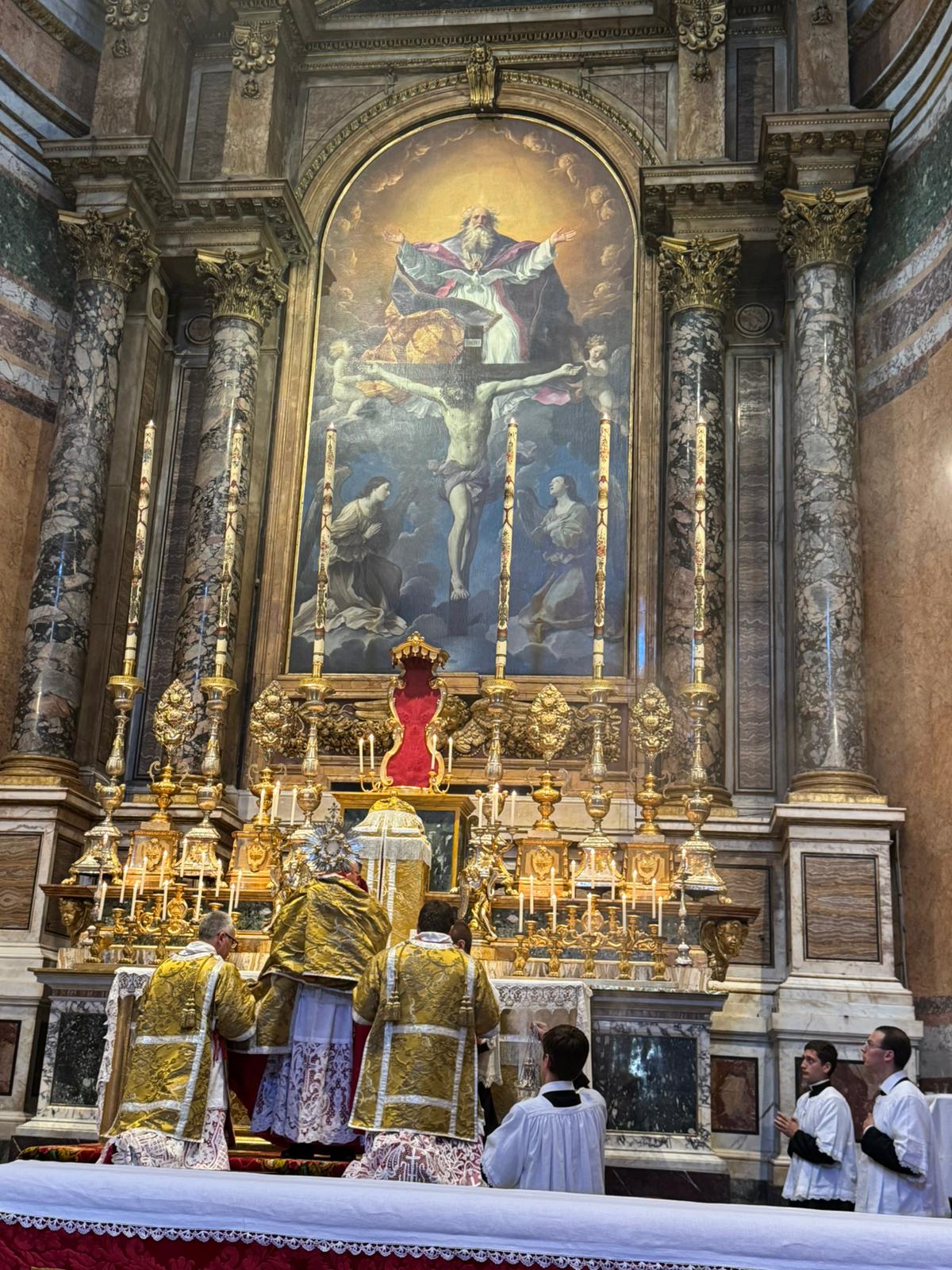
The other day I posted a video of the final Benediction after our Corpus Christi procession. A reader asked in a comment:
QUAERITUR:
Father why were the Divine Praises sung in Italian and not Latin?
I gave a very short answer, which, while accurate, prompts me add a little more for your benefit (even though I am sure you all are reading every single comment).
The Divine Praises, or Laudes Divinae, now so closely associated with Benediction of the Blessed Sacrament, began as a prayer of reparation.
Their author was Luigi Felici, S.J., born in 1736. Felici entered the Society of Jesus in 1756 and was ordained priest on 15 August 1773, the day before the suppression of the Society by Clement XIV of felicitous memory. Felici retained the apostolic spirit of the Jesuits (back when they had one) and, in 1790, founded the “Pia Unione di S. Paolo Apostolo”, a charitable association devoted to the sick, the infirm, prisoners, soldiers, and those in moral danger.
The immediate setting of the Divine Praises was Felici’s work among the sailors of the Ripa Grande in Rome, a big bend in the Tiber not too far from The Parish™. These men were often rough in speech, hostile to religion, and given to blasphemy. In response, in 1797 Felici composed a short Italian prayer, the “Lauda Divina”, beginning “Dio sia benedetto… Blessed be God.” It was intended as an act of praise and atonement whenever the Holy Name, the mysteries of the faith, or sacred persons were insulted by profane speech.
The prayer’s structure is simple and powerful: each sort of blasphemy is answered by a blessing. Against contempt for God, Christ, the Holy Name, the Blessed Sacrament, the Holy Ghost, the Mother of God, and the saints, the Church places on the lips of the faithful a litany of praise. Over time, additional invocations were added, including references to the Immaculate Conception, the Assumption, the Sacred Heart, St. Joseph, and the Precious Blood.
Because Benediction culminates in adoration, that rite became their natural home. After the blessing with the monstrance, the faithful respond to the divine condescension with the solemn cry of reparation “Blessed be God.”
I know some Catholics, as I do myself, when they hear someone use the Holy Name in a blasphemous way, immediately respond “Praise His Holy Name!”
On another point, as I write this, I am thinking that in many places the “Just call me Bob” priests, perhaps with sundry head and/or attraction problems, do not have Eucharistic adoration at their parishes and, therefore, do not provide Benediction and the praying of the Divine Praises, which you know now were intended as reparation for blasphemies. Probably also 15 minutes a week for confessions, too, if that.
What a sad thing to consider: there may be, probably are some newly built churches in these USA which have never, since they were opened, rung with the faithful praying the Divine Praises.
If some of you out there have never been to Exposition and Benediction, handled in the traditional manner, I urge you to seek it and experience it.































Many thanks for this! I have wondered about vernacular rather than Latin use in various devotions, but never yet ventured to ask anyone. Now that I know to look in this case, I see Wikipedia has an article in nine languages, with the English one (“Divine Praises”) referring to an English translation “as presented in a 19th century Raccolta” and providing sets of Latin, Italian, and English parallel texts. Now, I wonder (with too vague recollections of your post about the ‘Fatima prayer’) if there may be variant universally-useful Latin versions of the Laudes Divinae – not least since “additional invocations were added” (of which Wikipedia notes details of six – in English: I have not tried to look at any of the other eight languages, yet).
Interesting history lesson. I remember a priest that always said before starting the Divine Praises, “In reparation for profane speech….” I thought that was just his personal intention. Little did I know that it was the foundation for the prayer.
P.S. Cool new blog feature here to allow editing of comments for 2 minutes.
Is there not a parallel with the Leonine prayers after Low Mass, which were usually in the vernacular? I’m just a bit too young to remember personally, as I was was only about 5 when they were “suppressed”, but my parents and many others assured me that they were in English (in our case) – with everybody responding heartily.
Back in the day, when I was a little girl, my mother belonged to the Altar and Rosary Society at our parish. Usually moms with sons serving at Mass belonged, and helped to launder, starch, and iron the boys surplices. Before Vatican II rolled around, the ladies of the Society would attend a weekly evening Mass together, and after Mass the priest exposed the Blessed Sacrament, and led a rosary (you used to be able to get a plenary indulgence by saying the rosary while the Blessed Sacrament was exposed) and then concluded benediction with the Divine Praises. When I was about seven my mom began taking me with her to these services, and I loved benediction so much. But a couple of years later Vatican II hit, and all of this stopped. Cold. No more Altar and Rosary Society, no more Mass in the evening, no more rosary together in church, and no more benediction. Ever. Just like that.
I didn’t see benediction again until I was in my 40s, and began attending a parish where the Latin Mass was said, and the First Friday devotions were offered. And on First Fridays, after the evening Mass, there was benediction after Mass. And I wept.
I live in a country with around 0.5% Catholics, not many Protestants, and “direct blasphemies” do not exist. There is superstition, and polytheism, but not blasphemies in the way they exist in some countries with a higher Christian population. It is shocking to listen to them in TV or films.
I dit not know the origin of these praises.