For the Roman Stations during Latin there are often reasons why particular readings were chosen for particular places. The ancient compilers of the Roman Mass formularies – back to the 7th c. and likely before – did not usually arrange these texts randomly. They often created connections between the station church and the readings proclaimed there.
So why this Gospel at the Station of Santa Cecilia in Trastevere?
During her life Cecilia prayed that her spiritual god-children, Valerian and Tiburtius, would be enthroned in heaven. Her prayer was granted—but through martyrdom. In the Gospel from Matthew 20, Salome, the mother of James and John, asks Christ that her sons might sit on thrones in His kingdom. The Lord does not reject the desire for glory, but He immediately reveals the cost: “Can you drink the chalice that I shall drink?” Both apostles would indeed suffer. James would be martyred, and John would endure his own share of suffering, including his ordeal at the Latin Gate in Rome, true martyrdom.
Thus the Gospel resonates with Cecilia’s story.
Why the Lesson?
The reading comes from Esther. In early missals the prayer in this passage was sometimes attributed to Esther rather than to Mordecai. If we follow that older attribution, Esther becomes a figure of the Church, like Cecilia, interceding for her people who fast and humble themselves before God. If we take the text as Mordecai’s prayer, he stands as a figure of Christ pleading for the salvation of his people, much as Daniel did last Monday. Either way, the prayer would have struck a deep chord in Rome when these Lenten formularies took shape. In the seventh century the people of the city faced famine, plague, and invasion. Their cry for divine mercy was urgent and immediate.
Consider also the Prayer over the People:
Deus, innocéntiæ restitútor et amátor, dírige ad te tuórum corda servórum: ut, spíritus tui fervóre concépto, et in fide inveniántur stábiles, et in ópere efficáces.
O God, restorer and lover of innocence, direct the hearts of Your servants toward You, so that, filled with the fervor of Your Spirit, they may be found steadfast in faith and rich in good works.
This prayer asks for two things: innocence and perseverance. Both are needed in times of trial.
I think this prayer may have inspired the configuration of saints in Raphael’s painting of the Ecstasy of St. Cecilia.
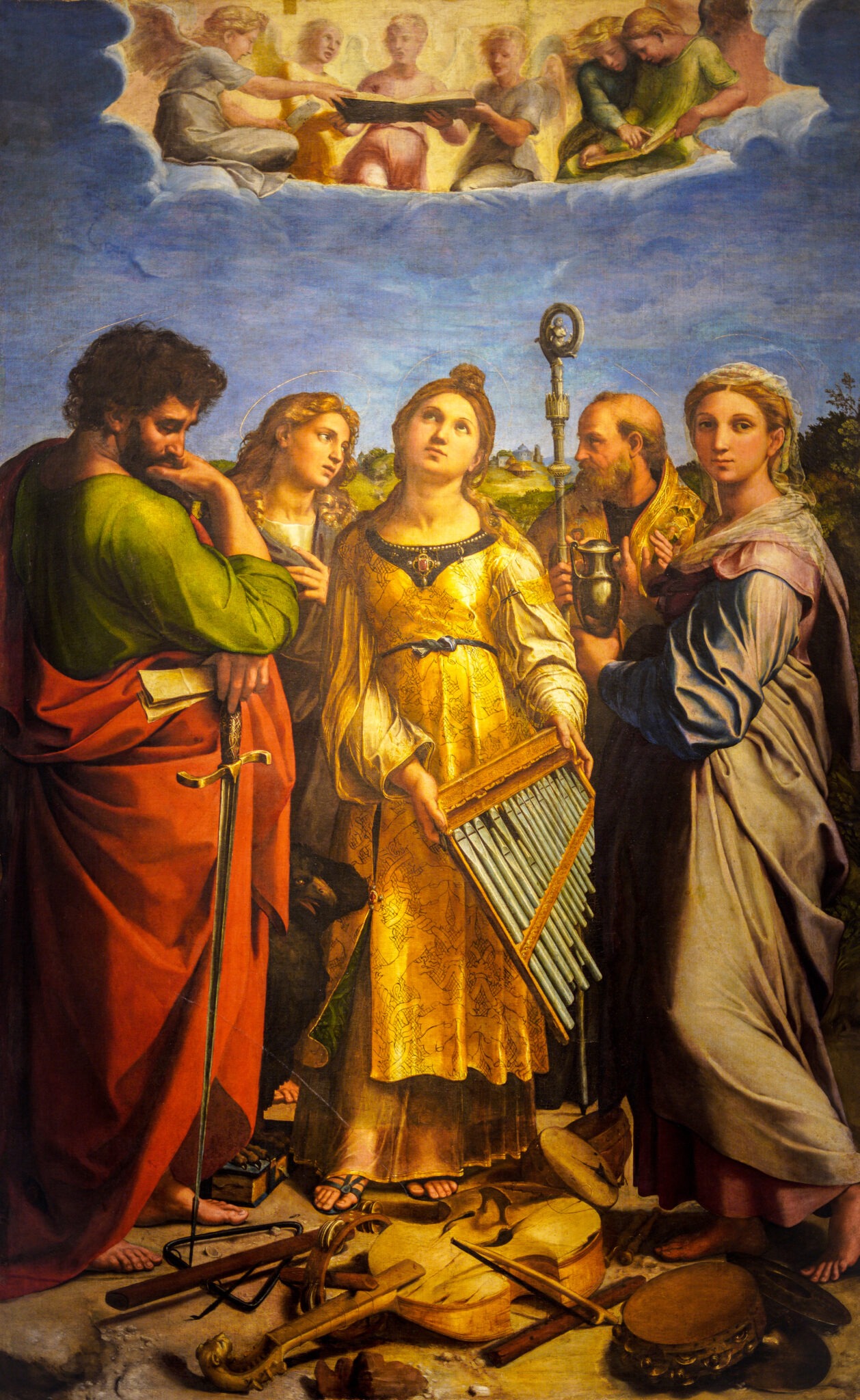
Cecilia is traditionally shown as the patroness of sacred music. In Raphael’s painting the musical instruments lie broken or discarded at her feet, the organ out of sorts slipping from her hands. Earthly music has fallen silent. Her gaze is lifted toward the harmony of heaven, which she is about to enter through martyrdom.
Around her stand four saints: Paul with his sword, John the Evangelist head inclined as at the Last Supper, Augustine in episcopal vestments, and Mary Magdalene with her jar. John looks at Augustine, who looks back: Augustine wrote magnificent commentaries on the Gospel of John and the Letters. Paul contemplates the instruments on the ground as if thinking about the clanging cymbal. Mary looks out towards us to draw us into the painting as participants and to question us.
Paul and John represent innocence preserved; Augustine and Mary Magdalene represent innocence recovered.
All four testify to the same lesson: constancy and perseverance in the path that leads to God.
O God, restorer and lover of innocence, direct the hearts of Your servants toward You, so that, filled with the fervor of Your Spirit, they may be found steadfast in faith and rich in good works.






























Thank you Father Z. Very insightful post. One thing I have learned from your blog is the importance of our Old Testament saints.