Daily Rome Shot 711

Great controversy in St. Louis at the women’s Cairns Cup, as the defender GM Humpy Koneru left the tourney for medical reasons after Round 4.  Chaos in the standings, some losing points as Koneru’s games were voided.

In Norway, Round 8 of hostilities are just getting underway as I write this.    Leader Fabiano Caruana is up against my guy Wesley So, who won his classical yesterday.  Shakh and Magnus should be interesting.  Magnus has not yet won a classical in Norway.

Fabi (2773) started with 1.d4 and Wesley (2765) countered with the Nimzo.

3:16 isn’t just in John.

White to move, win material.

NB: I’ll hold comments with solutions ’till the next day so there won’t be “spoilers” for others.

Please support the good Dominican sisters in Summit.

Chesscomshop Banner


Posted in SESSIUNCULA |
3 Comments

Unintentional good advice.

One of the necessary steps to true Eucharistic renewal is the elimination of Communion in the hand.

Thanks to Fr. D for the image!  Biretta tip (even though I don’t use a pom on my biretta any longer)…  o{]:¬)

Posted in Lighter fare, Our Catholic Identity | Tagged
7 Comments

Daily Rome Shot 710

Up this street every morning for Mass.  *sigh*

Welcome registrants:

N2JIE
ZiaNM2

I received a book from my wish list by Fr. James Mawdsley, fellow cancelled priest,

Crucifixion to Creation: Roots of the Traditional Mass Traced back to Paradise

US HERE – UK HERE

NB: The title seems backwards.  In effect, Fr. Mawdsley points to the foreshadowing of Holy Mass and its effects from Creation all the way through salvation history.  He also has a chapter on the assault on the Mass and the attempts on its “roots”.  I look forward to getting into this one.

I very much like books by priests with long experience of celebrating Mass which are about the individual elements – their origins, their possible symbolic meanings.  There are some greats, such as Gihr, Croegaert, Sheen, Knox, etc.  I’ve contemplated writing one myself.

I note this with interest…

It is undoubtedly so.   More here on SAVE THE LITURGY – SAVE THE WORLD.

Meanwhile, I have another reader to thank, and I don’t know who it is.   One of you sent me some San Pellegrino Bitter (a zero-alcohol aperitif common in Italy).  When the box was delivered it was damaged and the gift slips were gone.  So, thanks who ever you are.  A toast to you.

In chess news, in Round 7 of Norway Chess, we saw the match that Magnus Carlsen would have wanted in another World Championship defense: Carlsen v. Firouzja. In a fun moment, Carlsen went into the “Confessional” I mentioned yesterday and talked about his strange 3. Bd3.

Magnus needs a haircut. At least he got rid of that ratty beard.

Hikaru Nakamura and Shakhriyar Mamedyarov had a crazy QGA in which both players were in theory for over 20 moves. My mind reels. Shakh lost on time. My guy Wesley So defeated Nodirbek with a QGA. Yay! Fabiano is still on top of the heap, even though he flagged in his Armagedon game against young Gukesh… and he was clearly winning! If you want to see the end rush with seconds left… HERE. Wesley moved up to 3rd. There is a good interview with Wesley after his victory. I’ve bookmarked the start. Genuinely nice fellow. HERE.

Yesterday I apprehensive about going to OTB.  Today I am less so.

Also, I got a book of essays by the fellow I mentioned the other day, Raymond Keene.    US HERE – UK HERE  Evocative titles on the contents page… HERE.  This guy can write.


White to move and obtain a winning position.  F7 is a interesting square, isn’t it?

NB: I’ll hold comments with solutions ’till the next day so there won’t be “spoilers” for others.

POSTSCRIPT:

I wish players at the top level would come to matches well-dressed, in a suit. I guess I’m getting old.

Posted in SESSIUNCULA |
2 Comments

TO ALL THE KIDS WHO SURVIVED THE 1930’s, 40’s and 50’s

This came to my email and I have to share it.

Some of you have surely seen it already but repetita iuvant!

I am reminded of what the ancient Roman Martial said: aestate pueri si valent, satis discunt. … if, during the summer, a child is healthy he has learned enough. Epigrams X, 62, 12.

And the days are still getting longer.


TO ALL THE KIDS WHO SURVIVED THE 1930’s, 40’s and 50’s !!

First, we survived being born to mothers who may have smoked and/or drank – While they were pregnant. They took aspirin, ate blue cheese dressing, tuna from a can, and didn’t get tested for diabetes.

Then, after that trauma, we were put to sleep on our tummies in baby cribs Covered with bright colored lead-based paints.

We had no childproof lids on medicine bottles, locks on doors or cabinets, and, when we rode our bikes, we had baseball caps, not helmets, on our heads.

As infants and children, we would ride in cars with no car seats, no booster seats, no seat belts, no air bags, bald tires and sometimes no brakes.

Riding in the back of a pick- up truck on a warm day was always a special treat.

We drank water from the garden hose and not from a bottle.

We shared one soft drink with four friends, from one bottle, and no one actually died from this.

We ate cupcakes, white bread, real butter and bacon. We drank Kool-Aid made with real white sugar. And we weren’t overweight. WHY? Because we were always outside playing…that’s why! We would leave home in the morning and play all day, as long as we were back when the streetlights came on.

No one was able to reach us all day and, we were OKAY. We would spend hours building our go-carts out of scraps and then ride them down the hill, Only to find out that we forgot about brakes. After running into the bushes a few times, we learned to solve the problem.

We did not Have Play Stations, Nintendo and X-boxes. There were No video games, No 150 channels on cable, No video movies Or DVDs, No surround-sound or CDs, No cell phones, No personal computers, No Internet and No chat rooms.

WE HAD FRIENDS And we went Outside and found them!

We fell out of trees, got cut, Broke bones and Lost teeth, And there were No lawsuits From those accidents.

We would get Spankings with wooden spoons, switches, ping-pong paddles, or just a bare hand, And no one would call child services to report abuse.

We ate worms, And mud pies made from dirt, and the worms did not live in us forever.

We were given BB guns for our 10th birthdays, 22 rifles for our 12th, rode horses, made up games with sticks and tennis balls, and although we were told it would happen – we did not put out very many eyes.

We rode bikes or walked to a friend’s house and knocked on the door or rang the bell, or just walked in and talked to them. Little League had tryouts And not everyone made the team. Those who didn’t had to learn to deal with disappointment. Imagine that!!

The idea of a parent bailing us out if we broke the law was unheard of … They actually sided with the law!

These generations have produced some of the best risk-takers, problem solvers, and inventors ever.

The past 60 to 85 years have seen an explosion of innovation and new ideas.

We had freedom, failure, success and responsibility, and we learned how to deal with it all.

If you are one of those born in the 1930’s, 40’s and 50’s, congratulations.

You might want to share this with others who have had the luck to grow up as kids before the lawyers and the government regulated so much of our lives for our own good.

While you are at it, forward this to your kids so they will know how brave and lucky their parents were.

Kind of makes you want to run through the house with scissors, doesn’t it ?

~~~~~~~

The quote of-the month by Jay Leno:

“With hurricanes, tornadoes, fires out of control, mud slides, flooding, severe thunderstorms tearing up the country from one end to another, and with the threat of coronavirus and terrorist attacks, are we sure this is a good time to take God out of the Pledge of Allegiance?”

Posted in Lighter fare, Semper Paratus, TEOTWAWKI, The Coming Storm, The future and our choices | Tagged ,
28 Comments

Daily Rome Shot 709: QGA

In chess news, the women are duking it out in St. Louis.  I haven’t followed that one closely, since Norway is underway.  In Norway, with black Fabi won a classical against Nodirbek.  (I assume you all know their names by now.)  In doing so, he moved into the 2nd highest rating in the world after Magnus.  My guy Wesley So gained points against Shakhriyar Mamedyarov.  Watch the action today at 1100 EDT and 1700 CET.

There was a funny moment in coverage.    Ivanka was taking us into a short break with a phrase like, “We’ll be back in a few minutes with all the exciting action!”  The shot didn’t cut right way and the camera was fixed with a side view of one of the tables where only one of the players was at the board, sitting absolutely dead still.

One of the odd features of the tourney in Norway is “The Confessional”.  It’s really called that.

Use FATHERZ10 at checkout

Norwegian chess organizers and chess.com apparently have more confidence in the Confessional than 80% of Catholic parishes in these USA.

Players can go into this booth and bare their souls to the camera.  Of course what is said in the confessional stays in the confessional… at least as far as the other players are concerned.  Hikaru, the chattiest Kathy of them all, is a frequent confessor.   He’s also doing recaps of his games every day.  I don’t know how he does it.  I haven’t been a huge fan of Hikaru’s live stream because he is so verbally repetitive.  However, his recent recaps have been instructive.  As far as his “confessions” are concerned, it is interesting to hear how he thinks he is doing, compared to the eval bar and the three commentators (including women’s chess legend Judit Polgar).

For all of you…

GO TO CONFESSION!

I’ll make a confession right here, a chessy confession.  I’ve been playing badly.  I am thinking about my first OTB tournament in 50 years.  Scary.

Your use of my Amazon affiliate link is a major part of my income. It helps to pay for insurance, groceries, everything. Please remember me when shopping online. Thanks in advance.  US HERE – UK HERE

Black to move. There are some weak squares around that enemy King.

NB: I’ll hold comments with solutions ’till the next day so there won’t be “spoilers” for others.

Priestly chess players, drop me a line. HERE

Speaking of puzzles, a strong refutation of a series of puzzling pieces by scholars who ought to have know better than to wade into this topic unprepared:

Illusions of Reform – Responses to Cavadini, Healy, and Weinandy
IN DEFENSE OF THE TRADITIONAL MASS AND THE FAITHFUL WHO ATTEND IT

US HERE – UK HERE

I’m an affiliate of the shop of chess.com which is handled by House of Staunton.  I’ve ordered from them and, once, called in to obtain some spare queens for a set – not because it’s pride month and there were Jesuits around – but because the sets only had 32 pieces.  It is really handy to have a couple of extra queens, particularly when there is some interior decoration to be done on the promotion rank.  After all, a promoted queen is really just a trans-pawn, right?  (Trick question: No, it isn’t. It’s a queen.)  Hmmm… I guess that begs the question of why one wouldn’t have a few spare minor pieces.  After all, I know one nasty gambit line that requires under-promotion to a knight to gain a tempo with a check.  Perhaps because by the time you get to promotion, some pieces are off the board.

UPDATE:

I played OTB with the club today and did very well.  I won one with white against a super-aggressor with a really pretty surprise check mate and I won one with black, QGA against perhaps the strongest player.  (I won’t talk about the one before that, QGA where I went to the zoo and did exactly what my prep told me not to do.  Hilarity ensued.)

Posted in SESSIUNCULA |
3 Comments

There is hardly anything crueler that a priest can do than to leave people in doubt about the validity of their sacraments.  

It is extremely VEXING to learn of priests who are so thick… so arrogant… that they can’t or won’t be exacting about the VALIDITY of sacraments.   It isn’t hard.  You “Say The Black and Do The Red” and you use valid matter.

At the Pillar there is a note about how the Archdiocese of Kansas City has laid down the law about what wine can be used for Mass.  It seems that at “parishes” (plural) invalid matter for the Eucharist was used, invalid wine.  Therefore, for years, none of the Masses were valid.  None of the intentions for Masses were fulfilled.  Hence, redress from Rome must be sought to deal with the intentions, etc.

For STUPID!

Priests CANNOT CLAIM IGNORACE about these things because it is fundamental to their tool set.  If they are ignorant about the issue of valid matter for Mass it is culpable ignorance.    It is like running into a doctor who doesn’t know about blood types.

We read in Redemptionis Sacramentum:

wine that is used in the most sacred celebration of the Eucharistic Sacrifice must be natural, from the fruit of the grape, pure and incorrupt, not mixed with other substances…It is altogether forbidden to use wine of doubtful authenticity or provenance, for the Church requires certainty regarding the conditions necessary for the validity of the sacraments. Nor are other drinks of any kind to be admitted for any reason, as they do not constitute valid matter.

There can be some additives as preservatives.

It is of divine institution that the only valid substances for transubstantiation are, for the Host, bread made from wheat and, for the Precious Blood, wine made from grapes or raisins (desiccated grapes).

The grapes used must be ripe, which rules out “wine” such as verjus.

The wine for Mass can be red, white, dry, sweet, whatever.

Some prefer red because it resembles blood.  Some prefer white because it is easier to clean the linens afterward.

Sometimes questions come up about the use of wine which has very low alcohol content, called mustum, a wine which had the fermentation process halted by rapid freezing.  That is a valid substance because it is from grapes and the natural fermentation process began, making it wine.  It has an artificially low alcohol content, but mustum is considered valid wine.

However, there is the other end of spectrum to consider: wine which has an artificially high alcohol content.  Sometimes alcohol distilled from wine is added to wine in order to preserve it against spoiling or changing to vinegar.  This addition of wine alcohol produces “fortified wine”.  The usual types of “fortified wine” we encounter are port, sherry, madeira, marsala, and vermouth.

Unreconstructed Ossified ManualistFortified wines are valid matter so long as the wine-spirit added was distilled from grapes, that the quantity of alcohol added, together natural content from the fermentation, does not exceed 18% and that the additional alcohol is added during the process of fermentation.  You can read a good, brief article on altar wine in the Catholic Encyclopedia.

Also, because we are Unreconstructed Ossified Manualists, we check our old theology manuals, such as Unreconstructed Ossified ManualistTanqueray’s Theologia Dogmatica.

We find in Tanqueray that wine for Mass has to be from ripe grapes, it can be of any color, not corrupted, and not frozen at the time of consecration.  Citing the Missale Romanum we are warned against wine that is turning bad.  As a matter of fact, it was (probably is still) illicit to say Mass with doubtful, soured wine.  And if the priest is not doubtful about it, and it is truly bad, he sins gravely by consecrating it.  “Si fuerit aliquantulum acre… conficiens graviter peccat“, says the Missal.  He would – knowingly – be attempting to consecrate something that is not wine and is therefore invalid matter.

That is not just bad, that is very bad.

By the way, the coffee mug which appears here is great for Mystic Monk Coffee!  It’s swell!

I would rule out vermouth, because herbs and so forth are added.

I would not use sherry because, if I am not mistaken, the addition of the spirits takes place after fermentation.

Marsala seems to be okay, so long as it is 18% or less.

Vin Santo, from desiccated grapes, is fine.  As the name implies, it is wine for the altar!

Port is valid, 18% or under.

All this information provides ample motive to stick with altar wines made by ecclesiastically approved vintners (unless you can’t for some reason).  However, a decent bottle of wine from a sound vintner, even if it is not from an ecclesiastically approved source, will be valid matter.   For example, if I were to open up that bottle of Tignanello that I don’t have, and I were to use it for Mass, it would be valid.  And it would be tasty.

If you have a doubt, Fathers, don’t use it.  Don’t screw around with validity of sacraments.

There is hardly anything crueler that a priest can do than to leave people in doubt about the validity of their sacraments.

Posted in "How To..." - Practical Notes, Liturgy Science Theatre 3000 | Tagged ,
34 Comments

Daily Rome Shot 708: Dalmatic Bling Opportunity

During my recent Roman Sojourn I was shown at the parish some beautiful sets of tassels for dalmatics.  Traditionally, the deacon(s) and subdeacon wear tassels on their dalmatics that descend from their shoulders and hang down their backs.

Before I forget… Welcome new registrant: ILoveMoose

For example…

Here are vestments of the TMSM which were shipped to Assumption Grotto in Detroit for a Pontifical Mass.

In this video from Easter, you can see the tassels (once the lights go up).

YouTube thumbnailYouTube icon

Here’s the deal.

At Ss. Trinità there is a painting over the St. Gregory altar which shows a Cardinal Deacon in his dalmatic with tassels.  Lower left, with a miter next to Pope Gregory.

Want a closer view?

Obviously, the crew had similar tassles made for use in Masses… as one does.   A darker and a lighter pair… several pairs, in fact.  And this is where we get to business.

They are handmade. Quite striking.  They are not exactly like the tassels in the altarpiece but they are fine.

Use FATHERZ10 at checkout

There was only one problem. They accidently ordered twice as many as they could use. They are, therefore, interested in selling a few.

My part in this? I can get you in touch with someone at Ss. Trinita who would be able to organize the sale. Drop me a note if you are interested in this dalmatic bling.

Saving the world, dalmatic tassel by dalmatic tassel.

And here’s a puzzle.

White to move and mate in 2.

NB: I’ll hold comments with solutions ’till the next day so there won’t be “spoilers” for others.

Please remember me when shopping online. Thanks in advance. US HERE – UK HERE  These links take you to a generic “catholic” search in Amazon, but, once in and browsing or searching, Amazon remembers that you used my link and I get the credit.

Help the Summit Dominicans by visiting their online shop and help your chess game by visiting Remote Chess Academy.  I recently had an alert that someone of you readers used my link and got a course.  Yay!

Posted in Liturgy Science Theatre 3000, SESSIUNCULA, The Campus Telephone Pole | Tagged
3 Comments

ASK FATHER… ASK EVERYONE: Find recording of Archbp. Léonard imitating different regional Latin pronunciations

From a reader…

QUAESITUM EST:

A few years ago you posted a YouTube video (audio only) of Archbishop Léonard imitating the accents of various professors speaking Latin: https://zuhlsdorf.computer/2016/03/fun-with-latin-with-archbp-leonard/.

It was hysterical! I actually shared it with students in my Latin oratory course, to appreciate different pronunciation. Plus, it was funny. I mentioned this video to priests at our local FSSP mission, and promised to send a link. (They were over for dinner, and they were joking about how TLM priests from different countries pronounce Latin.) However, when I found the video again, embedded on your site, it is locked.

I have no real understanding of how YouTube works. Would have any idea where I might look to find a copy of this recording, on YouTube or otherwise?

This is an unimportant matter, but any help would be most appreciated.

Yes, that was really funny.  I’ve tried to find another “copy” but I haven’t had any luck.

Anyone? Archbishop André-Joseph Léonard

And it is so true.

Posted in ASK FATHER Question Box, Lighter fare | Tagged
6 Comments

Daily Rome Shot 707 and cool stuff

Photo by Claudius Unitrinus.

It is the Feast of Trinity Sunday and the liturgical anniversary of my ordination in 1991.

I am about to delve into a book with a unwieldy title, but not lacking in descriptive force:

Illusions of Reform – Responses to Cavadini, Healy, and Weinandy
IN DEFENSE OF THE TRADITIONAL MASS AND THE FAITHFUL WHO ATTEND IT

US HERE – UK HERE

You might remember that three rather distinguished Catholic writers, Dr. John Cavadini, Dr. Mary Healy and Fr. Thomas Weinandy (CHW) undertook in a series of articles published by Notre Dame’s Church Life Journal (I know.. never heard of it…) attacking the TLM (and people who attend it) while also painting a picture of post-Conciliar “reforms” that was somewhat overly optimistic.  CHW left many of us scratching our heads.  “WHY?”  “Cui bono?”  Some of my friends thought that they were being political, currying favor.   It was, in addition, embarrassing to see such highly accomplished and respected writers commit one pratfall after another, like people who have never been on ice skates.  They seemed not really to have understood what they were writing about.

There were several responses to CHW.  They are collected in this volume.

There is included a helpful bibliography.

NEXT….

I am compelled to share an Article article with you which, though it deals with chess can be – and should be – read for its brilliant writing.  I admit to feeling waves of envy as I read.  Biretta tip to the mighty Robert Royal for the link: o{]:¬)

Chessmen of letters: Amis and Nabokov

For the puzzle today, I’ll share a bit of the first part of the article, which goes on to describe the weird dynamics and shenanigans behind the grueling Karpov v. Kasparov 1985 championship that lasted 48 games and which was abruptly cut short by the head of FIDE, sparking massive controversy.  Even if you have little or no interest in chess, it’s a great read.

[…]

While I was studying German language and literature at Trinity College Cambridge, I was astonished to receive a letter from Nabokov himself, offering me a hand-drawn diagram of one of his chess compositions, which I promptly forwarded to the Trinity undergraduate magazine. As I write, efforts are underway in the Trinity archives, desperately seeking the original MS of Nabokov’s puzzle.

The following reconstructed diagram and move record — first published on page 32 of The Trinity Review, Lent Term 1969 — pays scant regard to the magnificence of Nabokov’s masterpiece. One must imagine the yellow as a rich, burnished gold; and the green as a deep, regal purple.

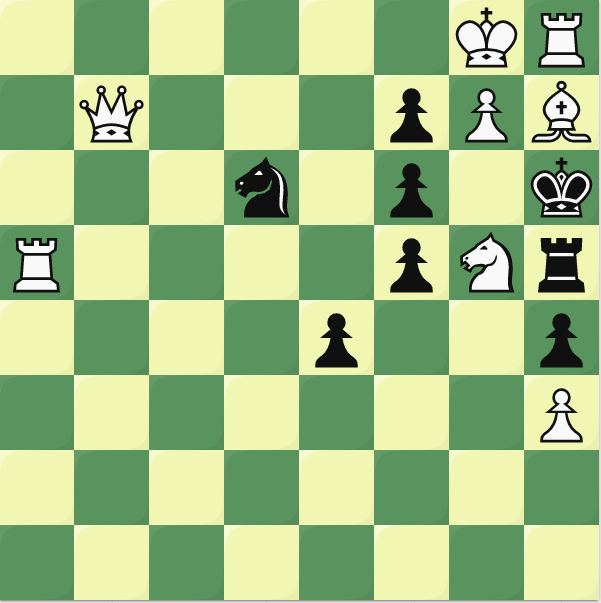
Nabokov wrote to me as follows: “White to mate in two moves.”

Key: 1. Qxe4

The key deceptively prevents the set mate 2. Bxe4 after 1… f4. The interest of the problem lies in the first three variations with the Bishop advancing one step at a time.

    1. a) .. f4                  2. Bg6#
    2. b) .. Rxg5            2. Bxf5#
    3. c) .. fxe4              2. Bxe4#
    4. d) .. Nxe4            2. Nxf7#
    5. e) .. Kxg5            2. Qe3#”

These are the solutions given by Nabokov, but for completeness’ sake, we should also include:

                    f)           1… fxg5              2. Bxf5#

In his 1993 essay collection Visiting Mrs Nabokov And Other Excursions, Amis relates, during the course of an admiring interview with Nabokov’s widow, Véra, that during his time in Berlin during the 1920’s, “Nabokov started playing a lot of chess with Véra’s father.“ The interview took place at the Palace Hotel Montreux, where the Nabokovs had taken up permanent residence since 1961. Little did I realise, when I competed in a grandmaster tournament with Viktor Korchnoi at that selfsame hotel in April 1977 that the Nabokov ménage was living above the tournament on the sixth floor of that very edifice. Nabokov himself died two months later, while Véra Evseevna followed him in 1991.

Amis describes the Nabokovs as “intensely private” and I doubt that even one of the most notorious of Soviet defectors, the twice world championship challenger Korchnoi, was aware of the irony. Namely the presence of his fellow renegade against Soviet rule, the literary Titan,  still revising and perfecting his collected works, several floors above the chess moves being executed by Viktor Lvovich on the mezzanine.

[…]

Do check the whole piece and read to the end for some of the finest invective I’ve read in a long time.

Meanwhile, I adjusted the colors as he mentioned… Not sure that’s better.  What say you.  Of course, I can do metallic gold.

Reminds me of the football team of my native place.

Three points.

  • I once played Viktor Korchnoi in a simul in 1977.  I lost.
  • Nabokov once said that the Devil speaks all languages, but with an Italian accent.
  • Free Shipping over $75 to U.S. 48 states from Chess House.

Speaking of Italian monks of Norcia, Italy make good beer. Get some for yourselves and your priests.

Again speaking of Italian, Italo-American US-player Fabiano Luigi Caruana (30 yrs)  defeated Alireza Firouzja in a classical game (120 minutes for the entire game, with a 10-second increment per move starting on move 41).

Fabi is a beast in this Norwegian battle.  By defeating Alireza, Fabi’s rating went to 2787.9 to make him the #2 ranked player in the world.  Guess who is still #1 with 2842.8.

Today, my guy Wesley So tackles Alireza in what should be a sharp game.  Carlsen v. Giri, which might get dynamic: Carlsen is way behind, in 8th place of 10!

And a shot from my adoptive parish, now physically distant… and I had to leave.  *sigh*

A shot of the blessing of the 17th c. organ I mentioned.  More on that later.

Posted in SESSIUNCULA |
2 Comments

WDTPRS – Trinity Sunday: Are you beautiful at Mass?


At some point we wind up taking a stab at explaining the Trinity to someone.  Results vary.

Today, to get at the mystery of the Most Holy Trinity, let’s use the final prayer at Holy Mass in the venerable, traditional form of the Roman Rite as a crowbar.

Here is the Postcommunio of the Feast of the Most Holy Trinity in the 1962MR.

POST COMMUNION (1962 & 2002MR):

Proficiat nobis ad salutem corporis et animae, Domine Deus noster, huius sacramenti susceptio, et sempiternae sanctae Trinitatis eiusdemque individuae Unitatis confessio.

There is a pleasant rhyme herein of susceptio and confessio, three syllable words preceded by words of four syllables and both deserving a little closer inspectio.

The indomitable Lewis & Short Dictionary indicates that a susceptio is “a taking in hand, undertaking” and “an acceptance”. This is a substantive derived from the verb suscipio. The deponent verb confiteor gives us the noun confessio, which means in its basic meaning “a confession, acknowledgment” and thus also “a creed, avowal of belief” and more specifically in the Latin Vulgate “an acknowledgment of Christ” (Rom 10:10, Heb 3:1) and therefore in the early Church “an acknowledgment of Christ under torture; and hence, “torture, suffering for religion’s sake” (Lactantius, De mortibus persecutorum 1).

A review of vocabulary is important, and can provide new insights into the deeper meaning of a prayer.  The structure or word order can give clues as well.

Today we have one main verb proficiat, coming from proficio (“to profit, derive advantage” and “to be useful, serviceable, advantageous, etc.,”) an old friend of WDTPRS vets. This verb has two subjects, susceptio and confessio. Susceptio is further specified by huius sacramenti (“reception of this sacrament”) and confessio is delineated in two ways, Trinitatis (“of the Trinity”) and Unitatis (“of the Unity”).

Often in Latin we will have a sentence structure of noun and then, frequently at the very end, main verb, with many other clauses and material in between which can be pealed open like layers of an onion. Here, the verb is out front as the very first word and the final subject noun is the last word.

For me, this structure emphasizes the nouns susceptio and especially confessio and the intimate relationship between them as well as the concepts that are attached to them, that is, the intimate bond at the moment of Communion between our reception of Christ’s Body and Blood with our confession of a God who is Triune – Three distinct divine Persons having one indivisible divine nature.

Furthermore, the theme of distinct elements in indivisible unity is even carried into the effect we hope for from the act of Communion in Mass: “health” of both “body and soul”. Latin salus is “a being safe and sound; a sound or whole condition, health, welfare, prosperity, preservation, safety, deliverance” and also in Christian contexts such as the Vulgate “salvation, deliverance from sin and its penalties. It can be rendered as both “health” and “salvation”.

OBSOLETE ICEL (1973):

Lord, God,
we worship you, a Trinity of Persons, one eternal God.
May our faith and the sacrament we receive
bring us health of mind and body
.

SUPER LITERAL TRANSLATION:

May the reception of this sacrament, O Lord our God, and also the confession of our faith in the holy everlasting Trinity and of the undivided Unity of the same, profit us for the salvation of body and soul.

CURRENT ICEL (2011):

May receiving this Sacrament, O Lord our God,
bring us health of body and soul,
as we confess your eternal holy Trinity and undivided Unity
.

Hmmmm…. you decide.

We have pairs of terms in this Latin prayer which underscore relationships: corpus and anima, susceptio and confessio, Trinitas and Unitas. Each element is necessary for and balances the other.

Humans are by God’s design persons comprised of both body and soul (corpus et anima). By contrast, angels are persons having only a soul but no body. The temporary separation of our body and our soul results in death. Their reunion at the end of time produces the resurrection of the flesh.

God loves us so much that he provides sustenance for both constituent elements.

In Holy Communion we have a food which our body transforms into what it is (flesh and blood) and which transforms our souls in to what It is (more perfect images of the Triune God after the Person of the Risen Christ).

For us to participate in this mysterious exchange of transformations we must both inwardly and outwardly conform to the transcendent reality we seek to embrace and be embraced by.

HENCE, before we can receive the transformed and transforming Host in Communion, we must be in an authentic communion of faith both with a larger group of believers and partakers (called the Church) and we must be interiorly disposed to receive the invisible benefits that the outward signs and actions portend. We must make a true confession and profession of faith consistent with our interior landscape. We must also be physically disposed, which is why we are asked to fast before receiving the Eucharist.

And now the moment you’ve been waiting for….

In the mystery of the Unity and Trinity of God we believe that, from all eternity and before material creation and even outside of time itself, the One God who desired a perfect communion of love expressed Himself in a perfect Word, containing all that He is. The Word God uttered was and is a perfect self-expression, also perfectly possessing what the Speaker possesses: being, omniscience, omnipotence, truth, beauty, and even personhood. So, from all eternity there were always two divine Persons, the God who spoke and the Word who was spoken, the God who Generates and the God who is Generated, true God with and from true God, Begetter and Begotten, Father and Son. There was never a time when this was not so. These two Persons eternally regard and contemplate each other. From all eternity they knew and loved each other, each offering the other a perfect gift of self-giving. Since the self-gift of these perfect and divine Persons, distinct but sharing one divine nature, can be nothing other than a perfect self-gift, perfectly given and perfectly received, the very Gift between them also contains all that each of the Persons have: being, omniscience, omnipotence, truth, beauty, and even personhood. Therefore, from all eternity there exist three distinct divine Persons having one indivisible divine nature, Father, Son and the perfect self-gift of love between them, the Holy Spirit.

This is a foundational, saving doctrine we believe in as Christians. At the core of everything else we believe in and hope for, we will find this mysterious doctrine of divine relationship, the Triune God.

By baptism we images of God are brought into a new relationship with this Triune God.

We become the adoptive children of the heavenly Father, members of the Son our Lord Jesus Christ in the Mystical Person of the Holy Church which He founded. The Holy Spirit makes of us His dwelling so that all the divine Persons are present to us and in us, informing all that we are, do and say. Our membership in the Church opens the way to an eternal relationship of glory and praise with the Trinity.

The promise and token of this eternal reward is how we, as members of a Church of believers professing a common Faith, can take into our bodies, and thus into our souls, the already transformed Body and Blood of the Second Person, the one who unites in His divine Person both the eternity divinity of God and the finite two-fold nature of man.

For this to have taken place, and to make it possible for us to “return back” to the Father, the Second Person “went forth” from the Father in a new way, this time in the context of time and space.

In taking us up in our human nature, He made an act of self-empyting. In filling us with divine gifts in Holy Communion, Christ renews (not re-sacrifices) His Sacrifice, His giving forth and His taking back up again.

In Holy Mass we are asked to “take up and give forth” (susceptio et confessio). In our confessio we make an exterior expression, giving forth outwardly what we are within.

“I confess (confiteor) to almighty God…” is just a scratching of the surface, though an important one.

BotticelliFor St. Augustine, in his great prayer and autobiographical “giving forth” (The Confessions), the word confessio carried layers upon layers of meaning. As we learn from the magisterial Augustinus Lexicon, for Augustine confessio simultaneously, and in a fluid way, bore three main concepts: confession of sin, praise of God, and profession of faith.

For Augustine all created things in the universe, even inanimate things, both give witness to God and give Him glory:

Respondent tibi omnia: Ecce vide, pulchra sumus. Pulchritudo eorum confessio eorum… All things respond to you, O God: ‘Behold! See! We are beautiful!’ Their beauty is their hymn of praise/demonstration that you are God/admission that they are not God” (s. 241, 2 – PL 38: 1133).

QUAERITUR:

Are we beautiful at Mass?

What we do outwardly in our bodies, and what we do interiorly in our souls, must conform to the Trinity in whose image we are made.

Receiving Holy Communion is a profound statement of who we are and what we hope to be. The act of reception must be consistent with who we are and what we are about in life. That act of reception must inform and transform all other acts which, in their turn, are a living “confession”, bearing witness, giving praise, and recognizing our true status before God which can often involve confession of sins.

Similarly every act of praise and testimony of the Church in her liturgy should reflect beautifully and accurately all that the Church professes and longs for.

Every liturgical gesture, church building, vestment, and musical prayer, must be like a gift simultaneously coming forth from the Sacred Heart of the Son and given to us for our benefit as well as a response we make to the glory of the Triune God who gives them.

“Their beauty is their praise.”

Posted in SESSIUNCULA | Tagged
1 Comment