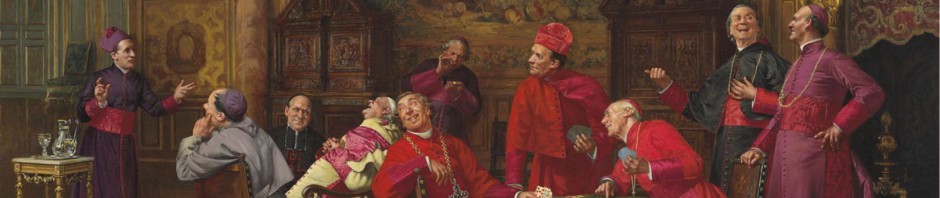
“It was in these cataclysmic days that the people chose a certain Roman Deacon Gregory to be their new Bishop.”

In 589 Deacon Aigulf trekked home to Tours with relics he had collected in Rome. St. Gregory of Tours relates in his Historia Francorum that Aigulf saw with his own eyes the disasters that struck Rome that year. The Tiber rose to such a flood that buildings were washed away, ancient temples destroyed, and the Church’s food storehouses were lost. There was an invasion of snakes, some the size of logs, which were washed to the sea. In November a plague they called “inguinaria” (of the groin) struck. It killed Pope Pelagius I and a great many others.

It was in these cataclysmic days that the people chose a certain Roman Deacon Gregory to be their new Bishop.

Deacon Gregory was from a Senatorial family. He had established many monasteries in and around Rome. He sold his house and all his belongings and gave to the poor, fasting so much that he could barely stand. Gregory begged not to be elected to high office, but he was overridden. Even the Emperor implored him to take the role. At that time, Gregory bade the people to sing psalms and beg God’s mercy for three days. As Aigulf’s eyewitness account runs:

Every three hours choirs of singers came to the church crying through the streets of the city “Kyrie eleison.” Our deacon who was there said that in the space of one hour while the people uttered cries of supplication to the Lord eighty fell to the ground and died. But the bishop did not cease to urge the people not to cease from prayer. It was from Gregory while he was still deacon that our deacon received the relics of the saints as we have said.

When Gregory was making ready to flee to a hiding place he was seized and brought by force to the church of the blessed apostle Peter and there he was consecrated to the duties of bishop and made pope of the city. Our deacon did not leave until Gregory returned from the port to become bishop, and he saw his ordination with his own eyes. (Historia Francorum X.1)

One year after those dire events in Rome, new Pope and future St. Gregory “the Great” (+604) was the only major figure standing who could deal with ongoing plagues, a series of destructive earthquakes that brought down cities, and an invasion of not-so-legal and not-so­-peaceful “immigrants” from the north.

At end of November of 590, the beginning of Advent, Gregory preached a sermon about the very Gospel passage we still read today in the Vetus Ordo for the First Sunday of Advent.

Yes, the same Gospel passage from Luke 21:25-33 – about the signs of the time and Second Coming of Christ at the end – has been read in Roman Catholic churches since before the time of St. Gregory the Great.

Year in and year out. In times dire and in times benign.

Gregory began his Advent sermon:

As our adorable Savior will expect at His coming to find us ready, He warns us of the terrors that will accompany the latter days in order to wean us from the love of this world; and He foretells the misery which will be the prelude to this inevitable time, so that, if we neglect in the quietness of this life to fear a God of compassion, the fearful spectacle of the approaching last judgment may impress us with a wholesome dread.

A short time before He had said: Nation shall rise against nation, and kingdom against kingdom. And there shall be great earthquakes in divers places, and pestilences and famines (Luke 21:10, 11).

Now He added: And there shall be signs in the sun and in the moon and in the stars, and upon the earth distress of nations.

Of all these events we have seen many already fulfilled, and with fear and trembling we look for the near fulfilment of the rest.

As for the nations which are to rise up, one against the other, and the persecutions which are to be endured on earth, what we learn from the history of our own times, and what we have seen with our own eyes, makes a far deeper impression than what we read even in Holy Scripture. With regard to the earthquakes converting numberless cities into lamentable heaps of ruins, the accounts of them are not unknown to you, and reports of the like events reach us still from various parts of the world. Epidemics also continue to cause us the greatest sorrow and anxiety; and though we have not seen the signs in the sun and in the moon and in the stars, mentioned in Holy Scripture, we know, at least, that fiery weapons have appeared shining in the sky, and even blood, the foreboding of that blood which was to be shed in Italy by the invading barbarian hordes. As to the terrible roaring of the sea and of the waves, we have not yet heard it.

However, we do not doubt that this also will happen; for, the greater part of the prophecies of our Lord being fulfilled, this one will also see its fulfilment, the past being a guarantee for the future.

Thus St. Gregory the Great preached to his flock in the hard times they endured.

He underscored that they were to prepare well for the Second Coming of the Lord especially by detaching from the things of this world.

Posted in Patristiblogging | Tagged
1 Comment

ADVENTCAzT 2025 – 02 – Monday 1st Week of Advent

A 5 minute daily podcast to help you in your Advent 2025 preparation.

Today Fr. Troadec has thoughts about Advent.
Card. Bacci talks about purity of heart.
Fulton Sheen turns us inside out.

Posted in ADVENTCAzT, ADVENTCAzT, PODCAzT | Tagged , , ,
2 Comments

Daily Rome Shot 1495 – Happy Feast of St. Andrew…. also!

Please remember me when shopping online and use my affiliate links.  US HEREWHY?  This helps to pay for health insurance, utilities, groceries, etc..  At no extra cost, you provide help for which I am grateful.

White to move and mate in 4.

NB: I’ll hold comments with solutions ’till the next day so there won’t be “spoilers” for others.

It is the Feast of St. Andrew

Posted in SESSIUNCULA |
3 Comments

Your Sunday Sermon Notes – 1st Sunday of Advent – 2025

Too many people today are without good, strong preaching, to the detriment of all. Share the good stuff.

Was there a GOOD point made in the sermon you heard at your Mass of obligation for this 1st Sunday of Advent?

Tell us about attendance especially for the Traditional Latin Mass.

Any local changes or (hopefully good) news?  A taste of what I offered at 1 Peter 5 this week:

[…]

Luke’s Gospel, proclaiming signs in sun, moon, and stars, admonishes believers: “when these things begin to take place, look up and raise your heads, because your redemption is drawing near” (Luke 21:28). Men instinctively duck when something crashes down, but Christ commands us to lift our heads. The Church, like her Lord, must pass through her own Passion, for the disciple is not above the Master. Therefore when winds rattle the house of God, and – BAM – doors slam in unexpected places.  If by opening a door and windows slam, we recall also the Italian proverb “chiusa una porta, si apre un portone… close a door, a larger door is opened”.

We do not cower. Heaven and earth will pass away, but the words of Christ will not pass away.

[…]

Posted in SESSIUNCULA |
3 Comments

ADVENTCAzT 2025 – 01 – 1st Sunday of Advent

A 5 minute daily podcast to help you in your Advent 2025 preparation.

Fr. Z rants a little.
A note about discipline of prayer during Advent.

The book I used, published by TAN, is called Advent and Christmas with the Church Fathers: a seven week Retreat on the Mystery and the Meaning of the Incarnation.

During this podcast you will hear a snip from the album of music for Advent by the Benedictine nuns of Gower Abbey, the Benedictines of Mary, Queen of Apostles.

Click

US HERE – UK HERE

Posted in ADVENTCAzT, ADVENTCAzT, PODCAzT, SESSIUNCULA | Tagged , , ,
4 Comments

ADVENTCAzT 2025 – 00 – Saturday 24th and Last Week after Pentecost

Welcome to the ADVENTCAzTs for the year of our salvation 2025.

A 5 minute daily podcast to help you in your Advent 2025 preparation.

Some remarks about Advents for this “zeroeth” podcast.
St. John Henry Newman describes being watchful.
The Collect for the 24th and Last Sunday after Pentecost.

Posted in ADVENTCAzT, ADVENTCAzT, PODCAzT | Tagged , , ,
4 Comments

Daily Rome Shot 1494

Welcome registrant:

RC_in_Tennessee

Please remember me when shopping online and use my affiliate links.  US HEREWHY?  This helps to pay for health insurance, utilities, groceries, etc..  At no extra cost, you provide help for which I am grateful.

I’d like to know more about this… anyone?  Which Liturgical Press book?


Posted in SESSIUNCULA |
14 Comments

Daily Rome Shot 1493

Why this, today?

Please remember me when shopping online and use my affiliate links.  US HEREWHY?  This helps to pay for health insurance, utilities, groceries, etc..  At no extra cost, you provide help for which I am grateful.


Very cool.

It is much like the beautiful portable altars by St. Joseph’s Apprentice. The “Ultimate Priest Gift”.

Here’s an old post in which I unbox a portable altar which he sent me for my 15th anniversary. HERE One of several images:

And this… a smaller even more portable, with vestments that have a little antependium for the altar! HERE

Interim, motus ad lusorem cum militibus albis pertinent. Scaccus mattus, scilicet mors regis, duobus in motis veniat.

NB: Detineam explicationes in crastinum, ne vestrae interrumpantur commentationes.

Posted in SESSIUNCULA |
10 Comments

MUST READ for those interested in the title Co-redemptrix and the recent DDF document

Diane Montagna posted at her Substack page: HERE

Cardinal Fernández Clarifies: “Co-redemptrix” Off Limits in Official Vatican Documents, Permitted in Private Devotion
In comments on Mater Populi Fidelis, the DDF Prefect explains what the doctrinal Note means in stating the Marian title is “always inappropriate.”

The zaniness continues.

Montagna reports that Fernández has formally clarified that the Marian title Co-redemptrix is no longer permitted in official Vatican documents or liturgical texts.

This “clarification” accompanies the Dicastery’s new doctrinal note—signed by Pope Francis—which states that the term is “ always inappropriate” and “unhelpful” because it can obscure Christ’s unique role as the sole Redeemer. According to Fernandez, a theological expression that repeatedly requires careful explanation in order to avoid misunderstanding does not serve the pastoral needs of the faithful. For this reason, the note concludes that terms such as “Co-redemptrix” and similarly problematic titles like “Mediatrix of all Graces” should not appear in any official ecclesial or liturgical context.

Fernández stressed at the press conference that the document is doctrinal in nature and should be taken with the seriousness due to the Magisterium. While this clarification restricts the term in formal teaching and liturgy, it does not explicitly condemn historical theological uses by saints, theologians, or even earlier papal statements. Rather, the Dicastery is drawing a boundary for contemporary usage in the Church’s authoritative documents, arguing that the term’s potential to sow confusion has become pastorally detrimental.

The article also highlights the controversy generated by this clarification. Many Marian theologians and regular Catholics regard Co-redemptrix as a venerable title expressing Mary’s subordinate but real cooperation in the work of redemption—rooted in her “fiat” at the Annunciation and her intimate participation at Calvary. The Dicastery says that in modern language the prefix “co-” can easily be misread as implying equality with Christ, creating a doctrinal ambiguity that must be avoided. Thus, while the ruling does not directly forbid private devotional uses, it effectively pushes the title to the margins of contemporary ecclesial language, marking a notable shift in the Vatican’s approach to Marian terminology.

The interesting (in an alarming sense) part is the exchange between Montagna and Fernandez.

Montagna pressed Fernández on why the Dicastery had effectively prohibited the Marian title Co-redemptrix when so many saints, theologians, and even popes had used it in the past. She asked how the Vatican could now declare the title “always inappropriate” without implicitly suggesting that earlier magisterial and devotional uses were mistaken. Montagna also challenged the Dicastery’s claim that the term obscures Christ’s unique mediatorship, noting that historically it had always been used in a qualified and subordinate sense. Her questions aimed at clarifying whether the new ruling amounted to a doctrinal correction of earlier tradition.

[…]

MONTAGNA: Yes, but why did you use the term “always” [siempre]? Does this refer to the past, especially given that it was used by the saints, doctors and ordinary magisterium?

FERNANDEZ: No, no, no. It refers to this moment. Just as Pope John Paul II himself used it at one time and then didn’t use it anymore. What we believe is that, in the substance behind that word, there are elements that can be accepted and continue to be upheld.

MONTAGNA: So, does “always” mean “from now on”? [And pro multis means “for all” and 2+2=5]

FERNANDEZ: From now on, certainly. It isn’t meant to judge the past at all. It means “from now on.” And moreover, it means above all that this expression [“Co-redemptrix”] will not be used either in the liturgy, that is, in liturgical texts, or in the official documents of the Holy See. If one wishes to express Mary’s unique cooperation in the Redemption, it would be expressed in other ways, but not with this expression, not even in official documents.

That is something that is known, even if perhaps not very widespread. If you, together with your group of friends, believe you understand well the true meaning of this expression, have read the document, and see that its positive aspects are also affirmed there, and you wish to express precisely that within your prayer group or among friends, you may use the title—but it will not be used officially, that is, either in liturgical texts or in official documents.

MONTAGNA:  Thank you very much. Just one final question, did you (i.e. the DDF) consult any Mariologists for Mater Populi Fidelis?

Yes, many, many, as well as theologians who specialize in Christology.

[…]

As one of my theologian friends remarked…

“They can’t tie their own shoes at DDF.”

Posted in Our Solitary Boast, SESSIUNCULA, What are they REALLY saying? | Tagged
22 Comments

Daily Rome Shot 1492

Welcome registrants:

20Mercy16
Blum
elucio

Please remember me when shopping online and use my affiliate links.  US HEREWHY?  This helps to pay for health insurance, utilities, groceries, etc..  At no extra cost, you provide help for which I am grateful.

Leo… reversing something Francis did…

Leo… reversing another thing Francis did… HERE

In October, Pope Leo XIV issued the decree Coniuncta Cura, a major financial reform that ended the Vatican Bank’s exclusive role in managing Holy See investments and allowed APSA and other accredited intermediaries to handle funds when advantageous. The change, which reverses a 2022 centralization under Pope Francis, aims to diversify management, improve returns, and strengthen the Holy See’s long-term financial sustainability amid rising operational costs.

The future for Charlotte and Knoxville?

Black to move. This is tricky.

NB: I’ll hold comments with solutions ’till the next day so there won’t be “spoilers” for others.

19 year old Javokhir Sindarov from Uzbekistan won the FIDE World Cup. He’s the youngest every to qualify for the Candidates. First Candidates without a Russian… ever.

Posted in SESSIUNCULA |
6 Comments























