
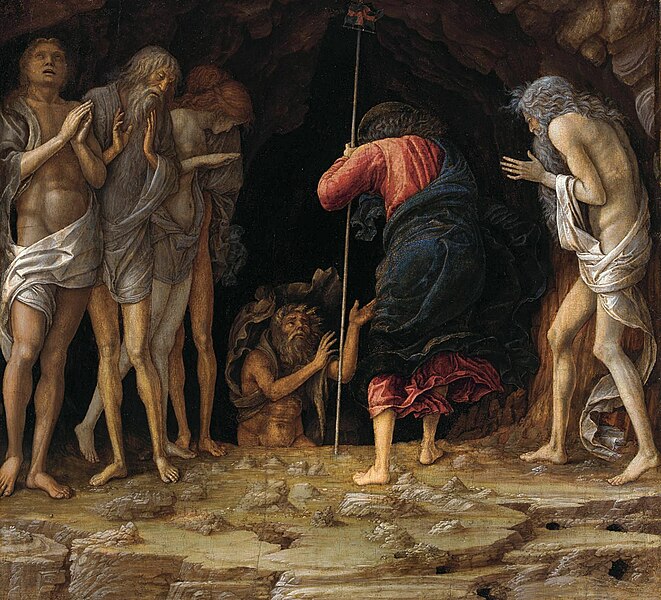
In a comment elsewhere on the blog…
QUAERITUR:
Father, since the Gospels do not record Jesus harrowing hell, where did that phrase of the Creed come from? Is it based on the writings of any of the Early Church Fathers? If so, which ones? It would be interesting to trace the development of this doctrine.
I recently wrote about the harrowing of Hell HERE. There, find CCC references which have footnotes. But I can help you with your homework.
The Church’s teaching about the “harrowing of Hell” rests on two things taken together.
First, the New Testament witnesses that Christ truly entered the state of the dead and proclaimed his victory there. Second, the Church’s interpretation of “hell” in the Creed points to the realm of the dead, not the Hell of the damned. The Catechism states this explicitly: Christ “descended into hell” means that, in his human soul united to his divine person, he went to the abode of the dead, and he did so “not to deliver the damned” but “to free the just who had gone before him.”
The damned cannot be delivered. Ever. Forever. Go to confession.
Scripturally, the locus classicus is 1 Peter 3:18-20, wherein Christ, put to death in the flesh and brought to life in the spirit, goes to preach to the “spirits in prison.” Closely joined to that is 1 Peter 4:6, “the gospel was preached even to the dead,” which the Catechism cites as a reason for the descent. Peter’s Pentecost sermon in Acts 2:27 and 2:31 is also crucial, because Psalm 16 is applied to Christ in terms of not being abandoned to Hades, which presupposes a real descent to the realm of the dead. Romans 10:7 refers to the “abyss” in connection with bringing Christ up from the dead, and Ephesians 4:9 speaks of his descent into “the lower regions of the earth”.
Hence, the biblical case is cumulative rather than dependent on a single unambiguous verse.
Acts 2 gives the language of Hades; 1 Peter gives the strongest picture of Christ’s saving proclamation to the dead; Romans 10 and Ephesians 4 contribute supporting imagery. Christ truly tasted death, entered the condition of the dead, and extended the efficacy of his redemptive work to the righteous who had died before his Passion. That is the precise doctrinal shape of the “harrowing.”
Magisterially, the most basic grounding is the Creed itself. The Apostles’ Creed, in the form used by the Church, explicitly professes: “He descended into hell; the third day he rose again from the dead.” The Catechism treats this credal article as dogmatically normative. It explains its meaning in paragraphs 631-637. The Compendium of the Catechism repeats the same teaching and clarifies that this “hell” is “different from the hell of the damned”; it is “the state of all those, righteous and evil, who died before Christ,” and Christ went down “to the just in hell who were awaiting their Redeemer.”
The Catechism’s doctrinal precision matters. It says that the frequent New Testament affirmations that Jesus was “raised from the dead” presuppose that he first sojourned in the realm of the dead. It then defines the term: “hell” here means Sheol or Hades, the abode of the dead deprived of the beatific vision. It further states that the descent is the final phase of Christ’s messianic mission, by which the reach of his redemption is extended to all the saved of every time and place. That is why the teaching belongs not to pious legend alone, but to the Church’s formal exposition of the Creed.
See also can. 1 of Lateran IV which is especially important because it states the matter in a compact doctrinal form: Christ, “being dead, descended into hell, rose from the dead, and ascended into heaven,” adding the classic clarification that “He descended in soul, arose in flesh.” That formula is a strong magisterial anchor because it specifies the mode of the descent in relation to Christ’s true death.
There is also a liturgical grounding. The Church’s Holy Saturday liturgy preserves and transmits this doctrine in the Office of Readings, whose ancient homily portrays Christ descending to the dead and awakening Adam. While that ancient homily is not, by itself, a dogmatic definition, its inclusion in the Roman liturgy shows that the Church publicly receives and hands on the descent into the abode of the righteous dead (not of the damned) as part of the Paschal mystery.
In summation, the doctrinal content is this. Christ really died. In his human soul united to his divine person He descended to the abode of the dead. He proclaimed there the Good News of salvation. He liberated the just who had awaited Him. He did not empty the Hell of damnation or grant a second chance to the damned.
The chief supports for the above are Acts 2:27-31 and 1 Peter 3:18-20; 4:6, with Romans 10:7 and also Ephesians 4:9. Magisterially, the doctrine is grounded above all in the Apostles’ Creed and expounded authoritatively in Catechism 631-637.
Following the Creed, Fathers of the Church support the doctrine of the harrowing of Hell, as described above.
For example, St. Irenaeus in Against Heresies 5.31.1 he says that Christ “tarried until the third day in the lower parts of the earth,” and speaks of his descent to those who had died, tying it to Ephesians 4:9 and the “heart of the earth.” St. Cyril of Jerusalem in Catechetical Lecture 4.11 he says Christ “went down into the regions beneath the earth, that thence also He might redeem the righteous,” and he names David, Samuel, the prophets, and John the Baptist among those awaiting redemption.
Rufinus in his Commentary on the Apostles’ Creed notes a historical point: the clause “He descended into hell” was present in the creed known at Aquileia, though not then in the Roman form. That matters because it shows the doctrine is older than the universal stabilization of the wording.
Consequently, the doctrine is older than the universal credal wording. The descensus clause was not present in every early local creed in the same form, but the underlying belief is already attested in the Fathers and later receives authoritative credal and conciliar expression.






























