
From a priest… I think…
QUAERITUR:
Preparing for a funeral Mass in the near future;
Is it permissible to chant the Dies Irae sequence in a Latin requiem Mass using the ordinary form? Didn’t see it anywhere in the copy of 1979 graduale simplex I have.
Of course you didn’t find the Dies Irae in the Graduale Simplex. You won’t find it in the Novus Ordo Graduale Romanum or the Missale Romanum either. That’s because the brain-trusts of the Concilium with the approval of Paul VI expunged it from the Church’s Novus-Ordoy prayer life. And, since “we are our rites”, over time and the constant use of white vestments and happy happy happy celebration of lives with balloons and weepy eulogies, what were funeral Masses intended to pray for the souls of the dead have morphed into informal canonizations.
Back to the question: Can you use the Dies Irae in a Novus Ordo funeral Mass. The short answer is “Sure!”. The longer short answer is, “Sure! But it might not be licit.” Another little longer answer might be, “Sure, but you might catch hell for it.”
See what I did there?
There is language in the introduction to the Novus Ordo Graduale Romanum – and I’m going on memories that reach back 40 years or so now – that just barely allows for the option of substituting one contextually appropriate chant for another.
There is no question that the Dies Irae is appropriate, though the progressivists will deny that to their death.
However, this is a question not so much of substituting another chant as inserting between the Gradual/Tract and the Gospel.
One can make a case that that is pastorally appropriate. Given the malleable rigidity of the Novus Ordo (whereby a despotic bishop can stretch and bend one option among many legitimate choices to force people into a lockstep uniformity alien to the entire ethos of the Roman Rite because – you know – Befehl ist Befehl – right?) just about anything goes. Sure, yes, of course now on paper it is absurdly claimed that there is one unique expression of the Roman Rite, which everyone knows is a lie. Heck, on Sunday here in Rome just up the street where I live there is a church used by the Congolese. I can’t describe what I heard and saw going on in there and I don’t have a video. It was a unique expression alright.
In fact, quaeritur, how many unique expressions of the Roman Rite can there be until there isn’t a unique expression anymore?
There is the serious issue of what to do in the Novus Ordo when you want to have a classical musical setting of the Requiem… which can be done contrary to to the wishes of Oregon Catholic Press…. which makes me think of something a priest friend sent today…
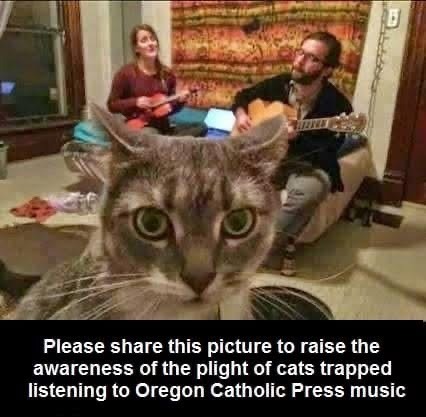
… I digress.
Mozart’s Requiem has a Dies Irae. It is one of the most important, known bits of his Requiem. So, get the choir and orchestra ready (along with their checks) and then … what?… omit the Dies Irae? That would be just plan stupid. I would argue that if something is just plain stupid – like passing in front of a tabernacle and the Blessed Sacrament and ignoring it – as the Novus Ordo bids – ignore the rubric and do something that makes sense. Ergo, you sing Mozart’s Dies Irae in a Novus Ordo Requiem and you genuflect before the Presence of GOD when you walk in front of the tabernacle.
This was my old mentor Msgr. Schuler’s position all those years after the Council. There was no one who knew the legislation and the intent of the legislation about sacred music better than he. Period. Each year when 2 November came around the Twin Cities Catholic Chorale (still exists) and members of the Minnesota Orchestra did Mozart’s Requiem with the Dies Irae because you just can’t leave it out. That would be stupid. But we are to take seriously some yoyo who claims that it isn’t appropriate and that it is VERBOTEN? That type shouldn’t be allowed to make decisions about ordering soft drinks much less governing sacred liturgical ars celebrandi.
I am reminded of the great scene in the movie Amadeus, about Mozart (sort of). The Emperor forbade ballet in opera at the advice of people who hated Mozart. So, Mozart has a rehearsal without the music for the dancing and the Emperor shows up.

BTW… the Dies Irae can be found in the Novus Ordo liturgical books, but chopped up into pieces in the Liturgy of the Hours. So, technically, it is still in the Novus Ordo and, technically, available for “substitution” purposes in a Requiem.
Those were dark time, dear readers, and we are still suffering the effects. We are especially suffering the effects now because that “we are our rites” principle, that lex orandi – credendi – vivendi principle, takes time to take shape, as Bugnini/Lercaro/understood in one way and Ratzinger/Benedict understood in another.
The liturgical progressivist excludes the Dies Irae and claims he is obeying the Council’s explicit principle for funerals: the burial rites were to express “more clearly the paschal character of Christian death.” That phrase from Sacrosanctum Concilium became one of the master principles for revising the funeral rites. On that reading, a funeral liturgy ought to foreground Christ’s victory over death, baptismal incorporation into His Passover, and the hope of resurrection more emphatically than the older Requiem did. Nota bene: that is an admission that the TLM does highlight victory, joy, etc.
This is a key problem with the Novus Ordo: it emphasizes eschatological joy, which is okay, but it doesn’t tell you how to attain it. The TLM does.
The lib liturgist/terrorist would say that the Dies Irae places too much affective weight on terror, doom, and forensic dread. Bugnini’s own summary is the classic evidence here: some reformers judged texts like Dies irae and Libera me to reflect a “negative spirituality inherited from the Middle Ages” and to “overemphasize judgment, fear, and despair,” so they preferred texts that urged Christian hope and expressed faith in the resurrection more effectively. That is the nearest thing to an explicit programmatic rationale from the reforming camp.
Again, how do you attain the Beatific Vision? By having a steady and balanced dose of the Four Last Things and not a little dread of the loss of Heaven and the pains of Hell.
The lib liturgist would argue that the funeral liturgy is for the consolation and catechesis of the living as well as intercession for the dead. Well, maybe not so much about that last depressing bit. Therefore, the rite should speak in a register pastorally intelligible to modern congregations, many of whom are only tenuously catechized. You know, balloons and sing-along jingles about the flapping appendages of raptors. In that frame, a lengthy medieval poem centered on cosmic dissolution, strict judgment, trembling and fear might be seen as pastorally counterproductive. Instead of petitions about saving the Earth from greenhouse gases, plastic bottles and ICE agents, “Graciously grant that I be not burned up by the everlasting fire” could cause a few puzzled looks, especially at a parish where not a single word has been spoken about Hell or the Sacrament Penance for the last 60 years.
The Council’s broader rationale for revising sacramental rites was precisely that some features inherited from the bad old days (read: Tradition) had come to obscure their nature and purpose for people of the present day. Remember the recent business about the “recent magisterium”? Life really began anew at that Second Pentecost, 1965! Never mind that people do not change, essentially, from age to age. They are still human beings with impulses do to Original Sin and the good qualities of being wrought in the image of God. But the progressivists think that people have evolved out of such dire things like, for example, it really is possible that you can go to Hell and that, having been all grown up, we stand for Communion and stick our hand out to take rather than to receive.
“But Father! But Father!, the now-awakened libs moan, you are distorting everything about the new springtime we are in! The reform did not suppress echsta…. extraol… that ology stuff. It relocated and rebalanced it with and within and around the unspoken metatext between the printed lines of the Über-Council! The current and unique is rooted in resurrection hope. We are now an Easter People, an Alleluia Assembly not a Dies Downer! HA! But you … you and your kind … you must be forced into solitude and silenced because … because we… we…because we have to Council harder! More, not less, Council. But you don’t conform, no no… because you HATE VATICAN III…. er…. VATICAN II!”
I don’t hate Vatican II. What has been done in the name of Vatican II makes me immensely sad.
At the same time, I am more and more convinced that God truly is in charge of the Church because of what we have seen in the wake of Vatican II. There’s no other explanation and that fills me with resolve.
So, use the Dies Irae. You might catch some flack for it. Be ready.































Although it would be literally outside its correct place in a requiem Mass, the Dies Irae is indeed a song, and much more suitable as meditation song/music before Mass than a lot of other stuff.
Singing it in English is not as nice as in Latin, but text accessibility would be nice for such a purpose. And honestly, the drama and beauty of the song would work in any language, while hearing the full text would help people understand that it is not meant to be “scary,” but rather, is serious and thoughtful.
If people want you to sing songs at a funeral home service, that would also be a nice choice, because chant is intimate enough without losing dignity.
“Malleable rigidity” is a great phrase. Similar to “strict liberalism” or “flexible consistency”, “all opinions but YOURS”….
We recently attended a funeral for the parent of a family friend, and it was the first Novus Ordo funeral the kids had attended. It was so jarring to them we had to have a discussion in the car afterward about how much was changed between the traditional funeral Mass and this new version. It was even a fairly reverent Novus Ordo Mass with a fairly conservative priest offering it, but all the changes in the rubrics, structure, colors, and prayers were impossible not to notice. It just felt grossly inappropriate, and so much of the language was, “Yes, [Name] is now able to be with his wife in Heaven.” The focus could not have further away from “pray for his soul.”
This is a true travesty that has been done in the name of Vatican II. I used to not hate Vatican II, but the past five years have definitely made me sick to death of Vatican II. I’ll keep the rest of my opinions on that ill-fated council to myself.
Every Nov. 2 we do it. And don’t think anything about it. And no one complains.
If you are challenged on the use of Dies Irae in the funeral Mass just cast a withering look at the challenger and with one arched eyebrow say, “Oblige me”. It worked for the Emperor Joseph II apparently.
When my aunt/godmother died in 2013 she had reluctantly decided against a TLM requiem out of “pastoral concern” for the majority of the family: “nobody will understand it, and they’ll think it was all your [the Archlaic’s] doing”. Our pastor and I came up with the obvious “pastoral” solution: the N.O. ad orientem at the high altar, with readings, etc. – anything addressed to the congregation – in English but pretty much everything which is normally sung at a traditional requiem – including of course the Dies Irae – chanted in Latin. Bells, incense (as appropriate), properly vested grand-nephews serving, Canon sotto voce, Communion at the rail… It was probably pretty close to what the more sensible Council Fathers envisioned. To say that folks were blown away would be an understatement. At least half of the mourners had grown up with the TLM (and a large number of those had drifted away from regular observance – strange coincidence – during the previous ~40y) and the comments were very positive… my favorite was the spry octogenarian who told Father: “I didn’t understand a word of it, but it was beautiful!” When Father reminded him that the readings, etc. had been in English he just shook his head… “Naah, that was the same Latin Mass I grew up serving!”
What is truly sad is that this should even be a question.
60 years of liturgical mess. Lord, deliver us.
I was the lector for my stepmother’s NO funeral Mass. I was this close **holds two fingers close together** to reciting the Dies Irae in its proper place without giving anyone, except the choir director, prior warning. I was going to tell him, “By the way, I’ll recite the sequence after the second reading, so don’t jump in too quickly with the Alleluia.”
I didn’t do it, because when I read those words, I often weep. I couldn’t make myself do something that would lead to me openly weeping in front of the congregation (especially since it was something that I wasn’t supposed to do).
I could have gotten around the weeping by reading it in Latin (I’m actually really good at it), but for once in my life I felt that the English translation was more powerful and appropriate. I would have felt different if it was sung or chanted, but I have a terrible singing voice, and the choir director didn’t know it.
It was an amazing Mass, for the record. I went out of my way to make it as traditional as possible.
I’ve also seen it used as an offertory hymn. Libera me for communion and In Paradisum for a recessional and you can licitly stick in most of the music.
I’m smiling as I recall the Novus Ordo funeral Mass for my mother in Advent 1995. I had the responsibility and pleasure of planning the Mass. It was to be celebrated by Fr. Patrick R. Shaules, SJ, my dear now deceased friend who celebrated a monthly Tridentine Mass for us at another parish in another city of the diocese.
I had prepared a printed program for the mostly Latin Mass and suggested to Father that my buddy and I planned to sing the Sequence before the Mass. I showed him where I had printed the Sequence as a frontispiece of the program. Father with a grin said “No! Sing it at the right place.” – which we did!
(I believe that at that time, there was some confusion about where to sing a Sequence in the Novus Ordo. Anyway, no one complained.)
Although out of place, nothing prevents the priest from chanting it after the Gospel and giving a brief catechesis about it in the place where the sermon would go. It would be far more valuable to the deceased than the reflection usually offered in that spot.
This was a very instructive rant! I have to admit that I mostly only know this prayer through its place in the classical music canon, via Verdi and Mozart, but I think I remember my spiritual director (a Franciscan) saying that it was written by a Franciscan.
One thing I’ve always found curious about the Dies Irae is the very first line: “Dies irae, dies illa, solvet saeculum in favilla, teste David cum Sibylla.” I know it’s poetic but the appeal to the Sybils, pagan prophets, seems a bit unusual for a Catholic liturgical text.
The opening melody of Dies Irae,
“The day of wrath, that day,
will dissolve the world in ashes.”
It’s eerily similar to Donald Trump’s opening melody on truth social today; a ‘Dies Iran’, if you will:
“A whole civilisation will die tonight, never to be brought back again.”
Threatening imminent nuclear genocide while standing on the world stage is pure, unadulterated evil.
How then is a vision of a future world reduced to ash by the hand of God somehow deemed good medicine for mankind?
In my opinion, injecting that into people’s minds, starting in their youth, serves only one purpose: to put the fear of God into people for a lifetime, and by extension, to cause them to fear by association, those acting on this earth in persona Christi, ie, Catholic priests.
As a Catholic born in the 60’s, I thank God for Vatican II and the end of the spiritual reign of terror inflicted by church leadership on the faithful in previous times. Inducing existential fear in people is a horrible Christian model. I much prefer trusting in Christ’s love and sacrifice, obtaining the grace found in confession and communion in the NO church, and living the motto popularized by St John Paul II, “Be not Afraid.”
Catholics deserve better than to live in fear of a world turned to ash as promulgated by Catholic clerics.
So too do the Iranian people, as similarly promulgated by America leadership.
I don’t know who Ultrarunner is, but someone quickly send him a comforting felt banner before he hyperventilates.
In other news, my wife’s funeral was TLM, and it was probably the most ecumenical congregation our pastor had ever seen. Relatives from the Deep South attended, including Novus Ordo Catholics, Methodists, Baptists, Presbyterians, and even (grudgingly) an Episcopal “Bishop.” Without exception, each one of her relatives took time afterwards to tell me how beautiful and striking they found the funeral. Some even commented that it was the most amazing funeral they’d ever attended.
All those who claim it can’t/shouldn’t/musn’t be done should be gently – or not so gently – referred to the funeral service of Otto von Habsburg. Cardinal Schönborn (yes, him of all people) celebrated this NO Mass.
Best of all, it had the most beautiful (in my book at least) Dies Irae of them all, that of Michael Haydn, from the Missa pro defuncto Archiepiscopo Sigismondo
(Though Michael Haydn’s daughter died around that time too, and it seems the mass was as much for her as for the archbishop)
https://www.youtube.com/watch?v=v5KFS1hbLt8&list=RDv5KFS1hbLt8&start_radio=1
Full Mass, lower video quality, but there’s no denying the evidence after it: https://www.youtube.com/watch?v=ZfSju3dPZ5c
Ultrarunner,
If you are not attempting a parodic or satirical comment, I refer you to the Prophet Zephaniah (and Our Lord Himself in the Gospels, for that matter).
As an aside, for all Bugnini’s complaint about negative “medieval” spirituality in the Dies Irae, there are striking references to Sacred Scripture therein; I wonder if he was ignorant of them, aggressively indifferent, or simply hubristic. I hate to choose the latter, but the imprecatory Psalms were also quashed at the same time—too negative!!
WVC,
I agree with your sentiment about coming to such a sour position on Vatican II. Maybe I could call it “council-fatigue,” at best. Over the last five years or so, I’ve really come to dread any time it comes up. So much for promoting unity by squashing the VO—and I attend the NO 99+% of the time due to life circumstances!
And I have to agree the NO “Mass of the Resurrection” is one of the most obvious instances of the inadequacy of the “irreversible” “reform.” I feel particularly robbed of Catholic tradition whenever I’m at such Masses.
When I was in my mid-20s and hanging out at goth/industrial nightclubs rather than church youth groups, I had several “Christian Goth” friends. The young woman who was the most devoutly Christian of the Christian goths eventually married a “rivethead” in a cemetery chapel, to the soundtrack of The Nightmare Before Christmas, in which Danny Elfman very deliberately models the themes around the tune of Dies irae.
So I would say that even if you’re planning a cemetery wedding, catacomb-ordination, or a thoroughly Modernist funeral, you could achieve some good quality Dies irae feels through judicious application of John Williams’ Star Wars IV: A New Hope, or The Shining, or even “The Bells of Notre Dame” from the eponymous 1996 Disney film (which would be fantastic timing with the Second Sunday of Easter!)
Post Catholic – and anyone else surprised or needing or welcoming as much of a ‘refresher’ as I was a couple minutes ago – both Patrick Healy’s 1912 “Sibylline Oracles” and the more detailed current form of the Wikipedia article of the same title make fascinating reading, and the latter includes a specific citation from Flavius Josephus’s Antiquities of the Jews, Book I, referring to the Tower of Babel which H. St. J. Thackeray’s translation in the Loeb edition gives as “This tower and the confusion of the tongues of men are mentioned also by the Sibyl in the following terms: ‘When all men spoke a common language, certain of them built an exceeding high tower, thinking thereby to mount to heaven. But the gods sent winds against it and overturned the tower and gave to every man a peculiar language; whence it comes that the city was called Babylon.'” And the traditional readings of Virgil’s Eclogue IV are also worth recalling in this context.
Orlando di Lasso’s composition “Prophetiae Sibyllarum” has its own Wikipedia article with text and translation and there seem to be scads of performances to try on YouTube.
I suppose Ultrarunner is not a pen-name of the Holy Father taken in order to comment here, but Deborah Castellano Lubov, in her Vatican News article, “Pope: The threat against the entire Iranian people is unacceptable” says “speaking in Italian, he said, ‘Today, as we all know, there has also been this threat against the entire people of Iran. And this is truly unacceptable! There are certainly issues of international law here, but even more, it is a moral question concerning the good of the people as a whole, in its entirety.'” If that’s all the Holy Father said, he and Ultrarunner seem to exhibit the same astonishing inability to read or recall the words “God Bless the Great People of Iran!” with its obvious distinction between “People” and “civilization” and the metaphorical use of “die”.
Consider a thought experiment or two:
1. How many pop songs by folks like Elton John are allowed at funerals, or people wearing items by designers like Bunch-of-the-laga or whatever that devil-worshipping fashion house calls itself are allowed, and what if you just suggested Dies Irae as a pop-tune selection?
2. How many of the current regime seem to have never heard of Paschal’s Wager, and don’t we seem to have some kind of “Pastoral Parlay” running on that right now? If the new OCP hippy-drippy way is what’s intended by the Holy Spirit, then won’t the folks pining for Tradition be merely cajoled a little at the Final Judgement, told to lighten up, and be welcomed anyway? Whereas, if Tradition is what’s intended by the Holy Spirit, where are the ultra-OCP folks going to be? Just as Paschal described, one is a potential infinite benefit at a “cost” of faith and reflection and self-discipline and large families and happy parish and so on, vs. comparative ease now, with a waste of time every Sunday, a distant mob arriving late and leaving early, no discipline, asceticism, challenge to the mind or soul, nothing, just “ease”, at potentially infinite eternal cost. It boggles the mind.
Thank you Phil_NL2 for posting that video. Absolutely beautiful! It was the perfect remedy (salvation) from having that jingle about flapping appendages of raptors being stuck in my head all night!
At the Novus Ordo Requiem Mass for Otto von Habsburg celebrated by Cardinal von Schoenborn the Dies Irae was sung.
Reading the question, I immediately thought: Mozart’s Requiem! Of course, Fr Z was way ahead of me. Or use Verdi’s Requiem: the opening of his Dies Irae will make the whole congregation sit up and pay attention.
In Amadeus, Mozart, on his deathbed, dictates the Confutatis of his Requiem to Salieri.
“‘Flammis acribus addictus.’ How would you translate that?”
“Consigned to flames of woe.”
Mozart dictates, part by part, voices, strings and tympani, creating the terrifying chorus. Then in stark contrast, ‘voca me cum benedictis’, soft and gentle.
If it’s good enough for Hollywood, it should be good enough even for an Novus Ordo Requiem Mass.
Towards the end of the movie we hear the concluding section of the Dies Irae, the Lacrimosa, played over scenes of Mozart’s own funeral. At the final Amen, we cut to the crucifix being held by Salieri’s confessor. These days, one hears the Lacrimosa played everywhere, sometimes in the most inappropriate context. Let people hear it in the right context.
Then there’s Gregorian chant. Everyone know the opening eight notes of the Dies Irae: F-E-F-D, E-C-D-D. The haunting melody is heard many times throughout the sequence. Once again, I reckon everyone will appreciate hearing the chant in its proper context.
Elizium23,
It is striking how widely and variously the ‘Dies Irae’ chant is, and has long been, embraced throughout the cultural ‘spectrum’ from ‘pop’ to ‘high-brow’ – I think an LP of Berlioz’s Symphonie Fantastique as a teenager may have been my first conscious experience of this – but Maria’s playful use of it in Die Trappe-familie (1956) in its 1961 dubbed US version also springs to mind (0nly encountered recently thanks to YouTube!). Some efforts at Aggiornamento seem ‘more equal’ than others.
JMody,
You remind me, sadly, of a dear lady’s funeral where the late Leonard Cohen’s “Hallelujah” was one of the ‘selections’ – not a subtle contrafactum, just the grotesquely inappropriate thing itself.
Ultrarunner writes
“ Catholics deserve better than to live in fear of a world turned to ash as promulgated by Catholic clerics.”
I suggest those who agree with this sentiment read the words of Our Lord as reported in the VO gospels for the 24th Sunday after Pentecost and the first Sunday of Advent. You might find that it is not Catholic clerics who are responsible for the idea of a scary judgement day, but Jesus himself, who also offers us a way to be saved from it, if we truly want to be saved.
By the way, I find the Dies Irae very comforting because it summarizes how we can be saved (if we want to) and encourages us to pray for the poor souls.
Interestingly, the Anglican Ordinarates, established by the apostolic constitution “Anglicanorum coetibus” of Pope Benedict XVI, revived the Dies Irae in “Divine Worship: The Missal,” if only in “the King’s English” (page 1025-26).
On this, I would say YES you can according to the Ordo Cantus Missae 1970 — on page 155 (of course, there is no page number on THAT page, you have to count it out) — “CANTUS GRADUALIS ROMANI (EDIT. 1908)
QUI AD LIBITUM SERVARI POSSUNT
Ut cantus huius Gradualis Romani eiusque additionum, sic cantus Propriorum particularium ad libitum servari possunt.”
reference: https://archive.ccwatershed.org/media/pdfs/14/05/05/11-25-06_0.pdf