30 May – St. Joan of Arc, Virgin: Martyrology, Marvelous reading, Movies

It is not only the Feast of Corpus Christi (the real feast, although I don’t object to its transfer or observance to Sunday), it is the Feast of St. Joan of Arc.

St. Joan is a great model for young people of both sexes (yes, there are only two).  And there is nothing “woke” or “trans” about her!

She is an antidote to evil stupid.

I have a link to the Joan Movie Marathon.  Since I posted that I have seen also the two films by Jacques Rivette starting Sandrine Bonnaire, which are quite well done.    HERE

OLDIE POST ___

Today we celebrate the feast of the quintessential “¡Hagan lío!” gal.

Today, in the 2005 Martyrologium Romanum we find interesting saints, including St. Petronilla and St. Ferdinand III, King of Castille.  We also find Otto Neururer, a priest who died in Buchenwald (more HERE), and Luke Kirby, a priest who died on the Tyburn Tree along with William Filby, Lawrence Johnson and Thomas Cottam during the reign of Elizabeth I.  There are also William Scott, Richard Newport in the reign of James I.   Matthis Kalemba was killed by Muslims in Uganda.  In ancient times St. Gabinus died a martyr in Sardinia.  St. Dymphna died in Brabant.

So much death.  So much glory.

My Roman Curia calendar also says it is the Novus Ordo Feast of Ferdinand of Castille.

The most interesting, to me at least, is that of St. Joan of Arc.

Her entry.  Perhaps some of you readers would like to try your hand…

Rothomagi in Normannia Galliae, sanctae Ioanne d’Arc, virginis, puellae Aurelianensis nuncupatae, quae, cum fortiter pro patria dimicasset, tandem in hostium potestatem tradita iniquo iudicio condemnata est et igne cremata.

I have long thought that St. Joan of Arc is a fine saint to inspire young people, including boys, because of her martial spirit.

A friend of mine in the Swiss Guard has Joan etched on his breastplate… and some of you, dear readers, made that happen!  Remember that project? We had a campaign here to raise money for his armor.  Here’s a shot from last 6 May 2016 during the swearing in of the new Guards.  And there’s Joan!

17_05_06_Giuramento_01

On the other side is St. Joseph.  Very cool.

Pope Benedict spoke of St. Joan in a General Audience in 2011. Here is the VIS account of the audience.  My emphases and comments.

JOAN OF ARC: BRINGING THE LIGHT OF THE GOSPEL INTO HISTORY

St. Joan of ArcVATICAN CITY, 26 JAN 2011 (VIS) – During this morning’s general audience, celebrated in the Paul VI Hall in the presence of 3,000 people, Holy Father dedicated his catechesis to St. Joan of Arc (1412-1431), whom he described as “one of the ‘strong women’ who, at the end of the Middle Ages, fearlessly brought the splendid light of the Gospel into the complex events of history”. [I wonder if many Catholics today haven’t been cowed by the relentless secularism and relativism and even open anti-Catholic bigotry we find in the public square.  And now we have anti-Catholic behavior from highly visible leaders of the public square and in the Church.  We need a revitalization of our Catholic identity.  It won’t be accomplished with what we have been doing.  It’s time for a change.]

The life of Joan of Arc, who was born into a prosperous peasant family, took place in the context of the conflict between France and England known as the Hundred Years War. At the age of thirteen, “through the ‘voice’ of St. Michael the Archangel, Joan felt herself called by the Lord to intensify her Christian life and to act personally to free her people”.

She made a vow of virginity and redoubled her prayers, participating in sacramental life with renewed energy. “This young French peasant girl’s compassion and commitment in the face of her people’s suffering were made even more intense through her mystical relationship with God. One of the most original aspects of her sanctity was this bond between mystical experience and political mission”. said Benedict XVI.

Joan’s activities began in early 1429 when, overcoming all obstacles, she managed to meet with the French Dauphin, the future King Charles VII. He had her examined by theologians of the University of Poitiers who “delivered a positive judgment, they discovered nothing bad in her, and found her to be a good Christian”.

On 22 March of that year Joan dictated a letter to the King of England and his men, who were laying siege to the city of Orleans. “Hers was a proposal of authentic and just peace between two Christian peoples, in the light of the names of Jesus and Mary”, said the Holy Father. But the offer was rejected and Joan had to fight for the liberation of the city. Another culminating moment of her endeavours came on 17 July 1429 when King Charles was crowned in Reims.

Joan’s passion began on 23 May 1430 when she fell into the hands of her enemies at Compiegne and was taken to the city of Rouen. There a long and dramatic trial was held which concluded with her being condemned to death on 30 May 1431.

The trial was presided by two ecclesiastical judges, Bishop Pierre Cauchon [Somehow appropriate.] and the inquisitor Jean le Maistre, but in fact it was conducted by a group of theologians from the University of Paris. These “French ecclesiastics, having made political choices opposed to those of Joan, were predisposed to hold negative views of her person and mission. The trial was a dark page in the history of sanctity, but also a shining page in the mystery of the Church which is, … ‘at the same time holy and always in need of being purified’“.

“Unlike the saintly theologians who illuminated the University of Paris, such as St. Bonaventure, St. Thomas Aquinas and Blessed Duns Scotus, … the judges were theologians who lacked the charity and humility to see the work of God in this young girl. Jesus’ words come to mind, according to which the mysteries of God are revealed to those who have the hearts of children, but hidden from the wise and intelligent. Thus Joan’s judges were radically incapable of understanding her, of seeing the beauty of her soul“, the Pope said.

Joan died at the stake on 30 May 1431, holding a crucifix in her hands and invoking the name of Jesus. Twenty-five years later a trial of nullification, instituted by Pope Callixtus III, “concluded with a solemn sentence nullifying the condemnation and … highlighting Joan of Arc’s innocence and perfect faithfulness to the Church. Much later, in 1920, she was canonised by Pope Benedict XV“.  [I am happy to have a relic of St. Joan, which: ashes collected at the time and place of her execution by burning.]

The Name of Jesus invoked by this saint in the last instants of her earthly life was as the continual breath of her soul, … the centre of her entire life”, the Holy Father explained. “This saint understood that Love embraces all things of God and man, of heaven and earth, of the Church and the world. … Liberating her people was an act of human justice, which Joan performed in charity, for love of Jesus, hers is a beautiful example of sanctity for lay people involved in political life, especially in the most difficult situations”.  [In his first Message for the World Day for Peace, Pope Benedict spoke of the need of military intervention at times in order to establish the foundation upon which peace can be fostered.]

“Joan saw in Jesus all the reality of the Church, the ‘Church triumphant’ in heaven and the ‘Church militant’ on earth. In her own words, ‘Our Lord and the Church are one’. This affirmation … takes on a truly heroic aspect in the context of the trial, in the face of her judges, men of the Church who persecuted and condemned her”.

“With her shining witness St. Joan of Arc invites us to the highest degree of Christian life, making prayer the motif of our days, having complete trust in achieving the will of God whatever it may be, living in charity without favouritisms or limitations, and finding in the Love of Jesus, as she did, a profound love for His Church”.

Furthermore, if you have never read Mark Twain’s superb novel about St. Joan do try to get it soon? Twain, not exactly friendly toward the Church, thought it was his finest work.

This would be terrific summer reading also for young people who can read a little above their age.
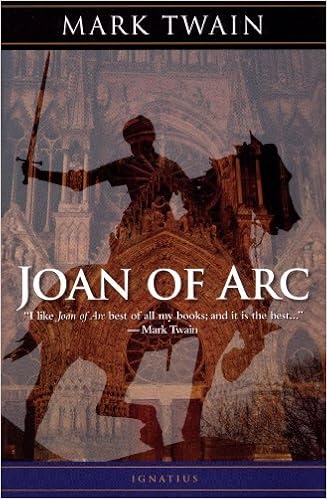
US HERE – UK HERE

It is on Kindle, too, for $0.99!   With Prime.

If you are not a Prime member, HERE  [Also… Try Prime Discounted Monthly Offering

Some years ago, I spent an evening watching some of a Joan of Arc movie marathon. I wrote about it HERE.

St. Joan, pray for us!

Finally, I have a relic of St. Joan.  This is of the ashes from her pyre.

Yes, I know it should be “ex pulvere”.  I am happy to have it.

Finally, finally, honorable mention goes to The Miracle of the Bells with Frank Sinatra as a priest and Fred MacMurray.

Frank sings in Polish and Fred helps an ill-fated woman get cast in a movie as St. Joan.   1948.

1948, the same year as the Ingrid Bergman version.

Posted in Linking Back, Saints: Stories & Symbols, SESSIUNCULA |
2 Comments

Explaining what Francis really meant, etc.

A few items caught my eye…

First, I’ve been reading the explanations of what Francis really meant to say when he explicitly complained that in Italian seminaries there was excessive “faggotry” and that “fags/queers” (checche) shouldn’t be in seminary, even those who are “semi inclinati”.

For those of you who read Italian, here is a shot of a newspaper page today.  The article at the bottom quotes bishops doing cartwheels to explain what Francis really meant.  Right click and open in a new tab for larger.

It’s predictable, but still clever.  One guy blames his brother bishop for telling what had been said.  Another, he’s from South America and doesn’t know what words mean.  Another, he’s just worried about the happiness of future priests.  About checche in seminaries, to which Francis has in the past said “no”:  “Non c’è un ‘no’ a priori…. There is no a priori ‘no'”.  So, it all depends on what “no” means.  Ask 60 Minutes.  Another guy, it was a confidential conversation and personal observations were mixed with general considerations.  Whatever that means.  Another, we ought to pay attention to what he does not only what he says.  I remind everyone that speaking is doing something too.   Another, he simply used “un linguaggio più scherzoso… a playful tone”.  Yeah, he was just kidding around.    The same fellow offered this as well: “One part of the Church is, instead, convinced that there exist sinners and non-sinners.”  The issue here is not whether anyone out there is or isn’t a sinner.  That’s been answered already.  The issue is a particular kind of sin and inclination toward that sin.  However, I am mindful of old descriptions of the characteristics a man should have when considering entering the seminary.  One of them was/is: Can you live for extended periods of time in the state of grace?   So, I guess sin might matter.

At Jesuit run Amerika there is a piece that reassumes much of this in English.

Then there are the usual suspects.

At Fishwrap we find Michael Sean Winters (aka Madame Defarge) went to the zoo and found the most exotic of excuses.

The fact that the pope may have used a vulgar Italian word, frociaggine — translated as “queerness” in most media accounts but I suspect “campiness” is closer to what was meant — when discussing the subject suggests he might have had in mind precisely such a situation.

This elicited gales of laughter from my Italian friends.  No: frociaggine is “faggotry”.  That’s what Francis was talking about, not only a penchant for show tunes, sibilants, and pink high top sneakers (as one guy had in our day in St. Paul).

He goes on to tie this gaffe control with spaghetti against the wall: into how the Church treats women and how we have to listen to the Holy Spirit and get into the “synodal (walking together) process”.

As the many negative reactions to Fiducia Supplicans demonstrated, the church has not reached any kind of consensus on issues related to ministry to gay men and women. Here is where the promise of synodality emerges. It aims to attune everyone in the church to listen to the promptings of the Holy Spirit, to relativize what I want or you want with what God wants. Discerning God’s will is something the church must do together. The whole must judge the parts.

You knew that Jesuit homosexualist James Martin would have to pipe up.  I was sent a piece from Breitbart with his quotes.

“In my 25 years as a priest and almost 40 as a Jesuit, I’ve known hundreds of holy, faithful and celibate gay priests,” Father Martin wrote on X. “They’ve been my superiors, my teachers, my confessors, my mentors, my spiritual directors and my friends.”

The Jesuit order, in fact, is known to have a remarkably high percentage of homosexual members, making it unsurprising that Father Martin has had gay priests as superiors, confessors, mentors, teachers, and spiritual directors.

According to the estimates of one of Martin’s Jesuit brothers, some 50 percent of the members of the Jesuit order are homosexual.

“Roughly half of the Society under the age of fifty shuffles on the borderline between declared and undeclared gayness,” wrote Jesuit Father Paul Shaughnessy in a 2002 essay in the Weekly Standard, titled, “Are the Jesuits Catholic?”

In his piece, Father Shaughnessy added that “the majority of Jesuit formatores, Jesuits in charge of training, are homosexual as well.”

For Catholics, Father Martin continued, gay priests have “celebrated Masses for you, baptized your children, heard your confessions, visited you in hospitals, presided at your weddings and buried your parents.”

“The church would be immeasurably poorer without them,” he concluded.

How wonderful the Jesuits are!  However, this begs us to ask: If they are so great this way, how much greater would they be if they were all straight?


Posted in Sin That Cries To Heaven, The Drill |
7 Comments

Daily Rome Shot 1034

Never mind about the inaccuracies in the audio, this is great.

White to move and mate in 3.

NB: I’ll hold comments with solutions ’till the next day so there won’t be “spoilers” for others.

In chessy News, Norway Chess continues and it is not going well for Magnus.  After 3 rounds Praggnanandhaa Rameshbabu (Pragg) leads after beating world #1 Magnus Carlsen for the first time in classical chess. Fabi beat Dign and Hikaru beat Firouzja (yay!).

Posted in SESSIUNCULA |
1 Comment

Daily Rome Shot 1033

The World’s Best Sacristan™ sent me a little video of entering the church, so I found some photos and zipped it up with music by Domenico Zipoli who in 1715 was the organist at the Jesuits great Church in Rome, the Gesù. He eventually went to Paraguay to work in the Jesuit Reductions among the Guarani (think The Mission). The images and video were of uneven resolutions, so, it will fuzzy if you blow it up.  I rendered it at 640×360.

In Norway yesterday, Magnus beat Hikaru.   Just recalled that Star Trek’s Sulu was named Hikaru.  Hmmm.  Magnus is in the lead.  In other news, water is still wet.   Ding beat Pragg and, alas, Firouzja bested Fabi when the world #2, who was winning, blundered into a nasty fork with under 2 minutes on the clock.   Can you see it?  Black to move.

It’s not to hard.  Time pressure is dreadful.  I find it consoling, however, that even these titans of the game will occasionally do this.  I wish it had been the other way around, however.

Because of the great news from Norcia, I’ll plug them again.  Yesterday, one of our regular commentators said that the Norcia beer was some of the best he has ever had.

Meanwhile, in Eccles brackets for Catholic leaders, I am going down in flames against His Eminence Robert Card. Sarah. One of my correspondents congratulated me for being the only non-bishop in the field and I that I might have had a chance in the quarters against Vigano. “Tough draw.”  Tough field!  I’d still like to make a good race of it, not that I can do anything about it, of course.  Maybe we could arm wrestle for it?

How do you choose?  Really!  How?   In the case of Card. Sarah and the undersigned, it isn’t so hard, I suppose.  Maybe if I had earlier revealed my status as a Monsignor in pectore?  And, come to think of it, I did win in the non-bishop category.

Meanwhile, thank you to C&ML for the gift card from my wish list.  Also, Roman Sojourn Donors, who are still in my regular prayers.

Please remember me when shopping online and use my affiliate links.  US HERE – UK HERE  WHY?  This helps to pay for health insurance (massively hiked for this new year of surprises), utilities, groceries, etc..  At no extra cost, you provide help for which I am grateful.

Posted in SESSIUNCULA |
2 Comments

I’d watch THIS movie anytime!

Keep watching to the end. It’s not long.

I simply could not not share this.

Posted in Just Too Cool, Lighter fare |
4 Comments

TERRIFIC NEWS! Norcia, Italy’s San Benedetto monastery is now an ABBEY!

By a decree of 25 May 2024, the Priory of Saint Benedict in Monte near Norcia, Italy, was elevated to an Abbey!

The new Abbot is Dom Benedict Nivakoff, OSB, the first Abbot there since 1792.

This is great news.  The monastery is liturgically traditional, using the Vetus Ordo.  This is on par with the elevation of the Benedictines at Gower Abbey in Missouri.

Let us all thank God for this great gift to the whole Church.

Here is a shot of the founder, Dom Cassian Folsom, making his obeisance to the new Abbot.

These are the Benedictines who make the wonderful beer I keep pushing.

Get some beer to celebrate and help them!

Posted in SESSIUNCULA | Tagged
6 Comments

What the Council Fathers intended about Latin. v. What we got.

What the Council Fathers intended about Latin. v. What we got.

Peter K links to a piece at NLM:

The Lie That Was Told to Over 2,000 Council Fathers at Vatican II

[…]

Some Council Fathers were worried about the loopholes. But the relator, that is, the rapporteur tasked with speaking to the assembly on behalf of the committee working on the document, reassured them that total vernacularization was out of the question.

[…]

The Latin Mass and the Intellectuals: Petitions to Save the Ancient Mass from 1966 to 2007

US HERE and UK HERE

Posted in SESSIUNCULA |
6 Comments

Daily Rome Shot 1032

Norway Chess is underway, men and women (separate). I think all the men’s classical games drew and winners for the round were determined by armageddon. Hence, Hikaru beat Fabi, Prag beat Firouzja (yay!) and Magnus beat Ding. The Magnus Ding match was strange. Carlsen, who often is late to his board in a dishevelled state, was half an hour early. Then, after a few moves, Magnus left the board and didn’t return for 15 MINUTES. Hikaru said:

Black to move.

NB: I’ll hold comments with solutions ’till the next day so there won’t be “spoilers” for others.

Please remember me when shopping online and use my affiliate links.  US HERE – UK HERE  WHY?  This helps to pay for health insurance (massively hiked for this new year of surprises), utilities, groceries, etc..  At no extra cost, you provide help for which I am grateful.

Support the sisters!

I had a nice note from them. They wrote to say that they are sending me candles for the chapel:

Our community is doing well and continuing to steadily grow, praise God. We have a new postulant right now and a number of young women in various stages of the discernment process. We’ve also had several sisters transfer here recently. The Master of the Order visited us yesterday which was a big excitement for us, and we had such a nice visit with him.

We continue to keep you in our prayers! Please pray for us as well.

Posted in SESSIUNCULA |
Comments Off on Daily Rome Shot 1032

“I’m not voting, but I’d have to abandon you this once.”

As a friend wrote to me today:

“I’m not voting, but I’d have to abandon you this once.”

It’s hard to disagree!

And also…

Posted in SESSIUNCULA |
2 Comments

Francis to Italian bishops: excessive “f******y” in certain Italian seminaries

I was sent a piece from the Italian news agency ANSA about an address Francis gave to the Italian bishops, whose plenary is at this time of year.   My contacts in Italy say the press is going bananas over this.

In a nutshell, in no uncertain terms, Francis said that… well… here’s the top of the story from ANSA.

Durissimo attacco di Papa Francesco contro la presenza di omosessuali nei seminari.

Nell’incontro a porte chiuse con gli oltre 200 vescovi italiani, che lunedì scorso ha aperto nell’Aula del Sinodo l’assemblea generale della Cei, il Pontefice su questo argomento si è lanciato in serratissimi richiami verso una maggiore selezione negli accessi ai seminari, non senza usare termini anche coloriti e puntando persino il dito – come ha riferito il sito Dagospia, seguito poi da altri media – contro l’eccesso di “frociaggine”.

Very harsh attack by Pope Francis against the presence of homosexuals in seminaries.

In the closed-door meeting with over 200 Italian bishops, which opened the general assembly of the CEI in the Synod Hall last Monday, the Pontiff made very strong calls on this topic for greater selection in access to seminaries, not without using colorful terms and even pointing the finger – as reported by the Dagospia website, followed by other media – against the excess of “faggotry”.

Il severo intervento del Pontefice, che non ha mancato di sorprendere i presenti, è confermato da diverse fonti. Per Bergoglio, quindi, non vanno ammessi omosessuali nei seminari. Dal “chi sono io per giudicare” a una posizione ora molto più tranchant, se non altro per quanto riguarda la selezione e formazione dei sacerdoti. Il tema è oggetto di dibattito da molti anni, e già un’istruzione del dicastero vaticano per il Clero del 2005 – sotto Benedetto XVI – confermata nel 2016 con papa Francesco, stabiliva che “la Chiesa, pur rispettando profondamente le persone in questione, non può ammettere al Seminario e agli Ordini sacri coloro che praticano l’omosessualità, presentano tendenze omosessuali profondamente radicate o sostengono la cosiddetta cultura gay”. The severe intervention of the Pontiff, which did not fail to surprise those present, is confirmed by various sources. For Bergoglio, therefore, homosexuals should not be allowed in seminaries. From “who am I to judge” to a now much more trenchant position, if only with regards to the selection and training of priests. The topic has been the subject of debate for many years, and an instruction from the Vatican Dicastery for the Clergy in 2005 – under Benedict XVI – confirmed in 2016 with Pope Francis, established that “the Church, while profoundly respecting the people in question, does not can admit to the Seminary and Holy Orders those who practice homosexuality, have deeply rooted homosexual tendencies or support the so-called gay culture”.
I vescovi italiani, da parte loro, nell’ultima assemblea svoltasi ad Assisi avevano dibattuto sulla possibilità di restrizioni più sfumate, sentendosi incoraggiati proprio dalle passate aperture di Bergoglio sul tema dell’omosessualità. Pur tra molte contestazioni, era stato quindi approvato un emendamento che si limitava a distinguere tra “atti” e “tendenze”, ribadendo l’obbligo del celibato per tutti i seminaristi, omosessuali ed eterosessuali, e aprendo così la porta dei seminari ai candidati gay al sacerdozio impegnati però nell’opzione del celibato. Ma nel confronto di un’ora e mezza con i presuli, di fatto il Papa ha sbarrato la strada: quindi rispetto, sì, per la persona gay che bussa alle porte del seminario, ma ponendo dei fermi paletti all’accesso per evitare che l’omosessuale che sceglie il sacerdozio finisca per fare una doppia vita, con tutte le conseguenze negative del caso. E per rafforzare il suo parere ed essere chiaro anche con una battuta, Francesco avrebbe recriminato esplicitamente sull’eccesso di “frociaggine” in certi seminari italiani. The Italian bishops, for their part, in the last assembly held in Assisi had debated the possibility of more nuanced restrictions, feeling encouraged by Bergoglio’s past openness on the topic of homosexuality. Despite many protests, an amendment was therefore approved which limited itself to distinguishing between “acts” and “tendencies”, reiterating the obligation of celibacy for all seminarians, homosexual and heterosexual, and thus opening the door of the seminaries to gay candidates to the priesthood committed however to the option of celibacy. But in an hour and a half confrontation with the prelates, the Pope effectively blocked the way: therefore respect, yes, for the gay person who knocks on the doors of the seminary, but by placing firm barriers at access to prevent the The homosexual who chooses the priesthood ends up leading a double life, with all the negative consequences that entails. And to strengthen his opinion and be clear even with a joke, Francis would have explicitly complained about the excess of “faggotry” in certain Italian seminaries.
[…] […]

The Jesuits and Fishwrap were unavailable for comment.

The Italian word “frocio”, even worse in its Roman version “froscio”, has uncertain roots.  One believable explanation is that it derives ultimately from Latin ferox.  There are other less polite origins.

The moderation queue is on.

Posted in Seminarians and Seminaries, SESSIUNCULA, Sin That Cries To Heaven |
18 Comments






















