13 May 609 – Exorcism, screaming demons, people fainting from fear – Dedication of Santa Maria ad martyres (the Pantheon)

Dear readers, this is the sort of thing that Popes do!  They fight against the forces of Hell and they work for the salvation of souls.

For example, when the ancient obelisk that was in the Circus of Caligula off to the side of St. Peter’s Basilica was moved to the center of the piazza in 1586, Pope Sixtus V caused to be inscribed on its base words from the Rite of Exorcism.  And he exorcized the thing to stand against the approach to the basilica of demons and the possessed  Priests were asked to repeat the words from the exorcism as they approached.   Pope Sixtus took a pagan thing, exorcized it, and made it a bulwark against the demonic.

That was then.

Now, demon idols are brought into the Basilica and placed on the ALTAR over the bones of the first Vicar of Christ.

Here’s another things Popes do.

In 609 Pope Boniface IV took a pagan thing… the pagan thing… exorcised it and made it into a church!

This is the pattern, by the way.  One might say, “This is the way.”  Before things are consecrated, they are exorcized.

There is a constant supernatural battle going on around us, between the holy angels and apostate demons.  We have many helps in this battle, including sacramentals and, especially, the sacraments.

One sacramental is the Rite of Exorcism.  There are “major” exorcisms and “minor”.  Exorcisms can be done over people, things and places.

Church building ought to be exorcized inside and out before they are consecrated.  In the traditional rite of the consecration of a church, first, the building is exorcized at three ascending levels, each with a procession around the building (in the same pattern/direction, btw, as the priest swings incense in circles over the gifts on the altar at the offertory).  The process is repeated inside the church.  Only then are the faithful allowed to enter.  THAT’s “pastoral” (for you libs, so you can understand, pástoral is a more serious version of your “pastóral” or, in extreme cases, “pastórial”).

In 609 the Emperor Phocas gave the magnificent ancient Roman Pantheon, the temple to “all the gods” to the Church. Pope Boniface IV got rid of all the pagan stuff and consecrated it to the Mother of God and the martyrs on this day, 13 May.

Of course before anything is to be consecrated, it first had to be exorcized. This is especially the case with a pagan temple that had been dedicated to demons.

We have an account of the exorcism of the Pantheon before it was consecrated this day.  In Italian HERE.

“In 608 the Byzantine emperor Phoca gave [the temple] to Pope Boniface IV and there was organized an evocative ceremony to consecrate it to the Christian God.   On 13 May 609 a huge crowd gathered near the Pantheon to witness the event. Chronicles recount chaos and chilling screams that were felt from within: the pagan demons were aware of what was about to happen. The doors were thrown open and the Pope, in front of the entrance, began to recite the formulas for the exorcism. The screams from the idols increased in intensity, and the commotion deafened the ears of the onlookers.  Fear gripped the crowd and no one was able to stand on their feet, looking and hearing that terrible spectacle. Only Boniface IV resisted and, undaunted, prayed and consecrated the Pantheon to Christ. It is said that the demons left the ancient temple chaotically and with a great din, fleeing from the open “eye” of the dome or from the main doors.  Once the ceremony was over, the Pope dedicated the building to the Madonna dei Martiri, in memory, perhaps, of the many Christians killed in honor of those filthy idols … “

Messa in Latino also calls to mind a vision of Catherine Ann Emerich:

One of the visions of Bl. Catherine Emmerich was precisely about the exorcism and consecration of the Pantheon: “…  I saw again the whole ceremony of the consecration of the temple: the holy martyrs assisted with Mary at their head.  The altar was not placed in the middle, but was was up against the wall.  I saw carried into church more than 30 carts of holy bones.  Many of these were put into the walls.  Others could be seen, where there were round holes in the wall, closed up with something that looked like glass. (p. Schmoeger, ‘Vie d’Anne Catherine Emmerich’, tomo III, pp. da 69 a 71)

Battles with the Enemy are fought on many levels.  Let us not forget that demons are territorial and legalistic.  Once they claim a toehold, it requires effort to break their hold and get rid of them from places, things and persons.

Pachamama is a DEMON. Use of those demon idols was idolatry.

Posted in Hard-Identity Catholicism, Just Too Cool, Linking Back |
1 Comment

Daily Rome Shot 1020: Magnus Effect

Nice people! Great service!

White to move and mate in 2.

NB: I’ll hold comments with solutions ’till the next day so there won’t be “spoilers” for others.

Interested in learning?  Try THIS.

I had a note from a friend in Rome:

I hope you’re well back in the USA. Sorry we didn’t get to meet up while you were here, we’ll make up for that lacuna next time you’re in town…

I’ll owe you big if you help me with something. Wednesday morning I am running a 100-mile ultramarathon from Rome to Assisi (not “in stages” but “straight up” – should take around 26 hours). It’s to raise money for a small Catholic medical clinic in Malawi… Dirt poor, no infrastructure, etc. (I am simultaneously working on trying to set up a tobacco company in the same diocese… the Bishop is very excited, it’s the big industry there, and when farmers leave that crop it’s often to grow marijuana – so even the scrupulous will hopefully see the value. The younger generation doesn’t even use it, they need the money from selling it to export. Anyway, it’s to give them a long-term revenue source that’s connected with their own people and the local economy… rather than hand-outs. I can’t run 100 miles all the time and shouldn’t have to.)

The donation page is:

www.stfrancis100.com/mzuzu

Malawi is especially “hot” right now after their strong response to Fiducia Supplicans… that’s one reason I chose to fund this project rather than another, it’s “been in the news.”

I have an interview with Rome Reports this afternoon. Hopefully a bump from EWTN at least on their Facebook page, and also a story on CNA after the run – successfully completed or not. (I’ve been training for a year, but stuff happens…) But nothing compares with the blog of Fr. Z and his readers!

There’s a WhatsApp group for live updates and location tracking here:

https://chat.whatsapp.com/JvNWvWhVRt8FEcD6aZZ1OA

Seems worth support to me!

Click!

In chessy news, yesterday was a big day for that force of nature Magnus Carlsen.  He emerged as victor in Warsaw at the Rapid and Blitz by .5 over Wei Yi.  He made up a 2.5 deficit in nine rounds of blitz.  While Magnus snatched one win after another in end games, there was one game between Prag (Rameshbabu Praggnanandhaa) and Wei Yi in which it rained blunders. Computer analysis at the end gave them 79.1% and 74.0% percent accuracy, which more like my games than theirs.  At this level, play is about 97-99.  HERE

It wasn’t over for Magnus.  Also yesterday, was the final of the online chess.com Divison I Classic in the Champions Chess Tour.  Magnus defeated German GM Vincent Keymer who also was playing OTB in Poland.

UPDATE:

Speaking of the Magnus Effect…

Posted in SESSIUNCULA | Tagged
Comments Off on Daily Rome Shot 1020: Magnus Effect

13 May: St. Robert Bellarmine – Pray for us!

Today I greet readers and friends who are blessed with the name “Robert”.  Happy Vetus Ordo Name Day.

You get two Name Days, since the Novus Ordo  day is 17 September.

In particular I remember in prayer His Excellency Most Reverend Robert C. Morlino, the Extraordinary Ordinary, Bishop of Madison.  I am, sincerely, not worried about the state of his soul, but God knows what to do with prayers, which are never in vain.

I have a couple other Roberts to pray for and to congratulate.

Let’s have a look at St. Robert’s entry in the post-Conciliar Martyrologium Romanum of 2005.

Sancti Roberti Bellarmino, episcopi et Ecclesiae doctoris, e Societate Iesu, qui praeclare de theologicis temporis sui controversiis peculiari ac subtili habitu disputavit; cardinalis renuntiatus, ad ministerium pastorale in Ecclesiae Capuana magnopere sese impendit et tandem Romae ad Apostolicae Sedis et fidei doctrinae defensionem plurimos suscepit labores.

Would you all like to stretch your Latin muscles?

St. Robert’s body may be venerated in Rome at the Church of St. Ignatius, Sant’Ignazio, which is a must visit for many reasons.

St. Robert was a Jesuit (a good one), a Cardinal, theology and profession and rector at the Roman College, archbishop of Capua, He was a major figure in the implementation of the Council of Trent and in the Counter-Reformation. He also took a major role in the matters of Giordano Bruno and Galileo Galilei.  He was a splendid teacher in difficult times who refuted errors much like those we see cropping up in the Church today.  Stories of his great humility can be multiplied.

Not long ago, I was privileged to see a letter with a signature of St. Robert Bellarmine.  HERE

St. Robert Bellarmine was a prolific writer, but a great deal of his work has not yet been translated into English. In recent years there have been good efforts to do just that. One of those efforts has left me a bit in awe.

Behold Controversies of the Christian Faith translated by the erst-while of Homiletic and Pastoral Review Fr. Kenneth Baker, SJ.  US HERE probably unavailable– UK [nope]

It’s hardcover only, I believe.  But… look at the size of this thing!

The pages, from fairly subtle paper, are jammed with text.

“But Father! But Father!”, you terrified liberals are quaking, “Ho… ho… how long is this book?!?  How many pages of so-called ‘sound teaching’ are there?  If you are happy about this book, it must be rigid and ossified and … and… AGAINST VATICAN II!  JUST LIKE YOU!”

To which I respond: Tremble, heretics, women’s ordination fans, and Fishwrap schismatics.

Seriously, I am in awe of the discipline it took to translate this opus magnum.

It begins with a Forward and a brief life of the saint.  Fr. Baker says that he did it in a year.  Holy cow.

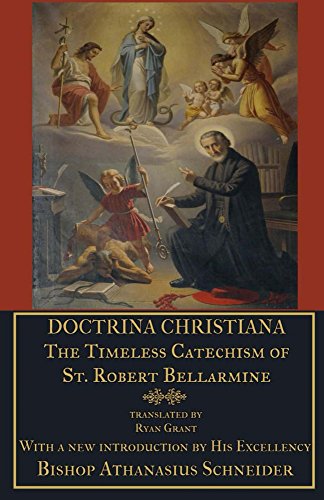
Next, available also on Kindle (don’t have a Kindle yet? US HERE), Doctrina Christiana: The Timeless Catechism of St. Robert Bellarmine translated by Ryan Grant with an introduction by the great Bp. Athanasius Schneider. US HERE – UK HERE

A while back I posted an entry with suggestions for different catechisms.  I think this should be on the list.  This takes the form of a dialogue, rather than simply prose explications of bullet points.

In the forward we read:

In our time of an enormous and general confusion in matters of Catholic faith we do need urgently a crystal-clear, absolute reliable and at the same time simple catechetical text. Such a text represents the famous catechism of St. Robert Bellarmine, which notwithstanding being written 400 years ago, remains nevertheless up to date. This catechism had until the 20th century about 400 editions and has been translated into 60 languages. It was a favorite catechetical tool for the missionaries in the past centuries.

The countries of the so-called Western civilization became today almost neopagan societies and there are even people who named themselves Catholics but are living like pagans. It is therefore obvious that we are living in a missionary. Both inside and outside the church.

The translator adds these interesting notes, which make reference to the first work by Bellarmine with which I started this entry, above:

St. Robert Bellarmine composed two catechisms under the title of Doctrina Christiana(Christian Doctrine), one called his “Small Catechism” which he had written for children and simple souls. This second one, written as a dialogue, called his “Long Catechism,” was intended for teachers and for the well instructed to deepen their understanding of the truths of the faith. The Shorter Catechism was translated in 1614, but the Long, at least to our knowledge, had never been rendered into English until now.

The translation was made from the Latin edition published in Prague in 1732. It seemed to be the most accurate, and it was compiled and edited into a text version book by Anton Repko, whom I especially thank as many of the copies available in electronic form have defects, missing pages etc. Still, as sometimes the Latin edition used complicated phrases from 16th century vernacular Latin that simply would not render into English well, it was necessary to consult Bellarmine’s original Italian to simplify.

This Catechism was written at the express command of Pope Clement VIII, and approved by him in 1598. It quickly became more popular than the Saint’s Controversies, which he is principally known for today. It was also specifically approved by Pope Benedict XIV, and its importance was so great that Pius XI, in his bull of canonization for the Saint, declared of this Catechism:

“Nor may we pass over in silence his sacred sermons and also his catechetical works, especially that catechism, which the use of the ages as well as the judgment of a great many bishops and doctors of the church has approved. Indeed, in that same catechism, composed at the command of Clement eight, the illustrious holy theologian expounded for the use of the Christian people and especially of children, the Catholic truth in a plain style, so brilliantly, exactly and orderly that for nearly three centuries in many regions of Europe and the world, it most fruitfully provided the fodder of Christian doctrine to the faithful.”

In his introduction, the great Bp. Schneider penned, and we cannot but agree:

The corruption of morals and depravity of life is already so great, and ever increasingly greater, not only among uncivilized peoples but even in those very nations that are called Christian. The Apostle Paul, writing to the Ephesians, repeatedly admonished them in these words: “But immorality and every uncleanness or covetousness, let it not even be named among you, as become saints; or obscenity or foolish talk” (Eph. 5:34). He also places the foundation of holiness and sound morals upon a knowledge of divine things—which holds in check evil desires: “See to it therefore, brethren, that you walk with care: not as unwise but as wise. . . Therefore, do not become foolish, but understand what the will of the Lord is” (Eph. 5:15-16).” (Encyclical Acerbo nimis from April 15, 1905).

A good and solid knowledge of the Catholic faith has as its aim a virtuous life through which alone with the help of God’s grace one can achieve eternal salvation. Saint Pius X teaches therefore: “Christian teaching not only bestows on the intellect the light by which attains truth, but from it our will draws that ardor by which we are raised up to God and joined with Him in the practice of virtue” (Encyclical Acerbo nimis from April 15, 1905).

The true knowledge of the Catholic faith fills the human mind with a light and this light, in spite of being sometimes obfuscated by a bad will, is usually the effective means of salvation.

The content of our Catholic Faith is not just words and formulae to be memorized.  The true, interior content of the Faith is a Person, the divine Person of the Eternal Word made Flesh, Christ Jesus.  We can have a relationship with a Person.  Coming to know the Faith leads to knowledge of Christ and, in turn, hope and love.  Furthermore, as the bishop pointed out, even if one loses love, that is charity, and loses hope, faith remains long after.  That faith can help to bring you back to hope and to charity.


Posted in SESSIUNCULA |
1 Comment

Daily Rome Shot 1019

Nice people! Great service!

Please remember me when shopping online and use my affiliate links.  US HERE – UK HERE  WHY?  This helps to pay for health insurance (massively hiked for this new year of surprises), utilities, groceries, etc..  At no extra cost, you provide help for which I am grateful.

Yesterday in chessy news, it was a tough day for Magnus Carlsen. He played in the Rapid and Blitz – in the Blitz phase – in Warsaw and then played in the chess.com Classic. Wei Yi leading in Poland and Magnus is in 2nd. However, in one game against Nodirbek, in a time scramble Magnus hanged his queen and went from completely winning to completely losing in an instant. The moment.

White to move and mate in 2.

NB: I’ll hold comments with solutions ’till the next day so there won’t be “spoilers” for others.

Posted in SESSIUNCULA |
1 Comment

Your Sunday Sermon Notes: Sunday after Ascension (N.O. 7th of Easter OR Ascension) 2024

Too many people today are without good, strong preaching, to the detriment of all. Share the good stuff.

Was there a GOOD point made in the sermon you heard at your Mass of obligation for the Sunday after Ascension Thursday?  Novus Ordo – 7th Sunday of Easter… OR… Ascension Thursday Sunday.  Not confusing at all.

Tell about attendance especially for the Traditional Latin Mass.

Any local changes or (hopefully good) news?

A taste of my thoughts from the other place: HERE

[…]

Some context helps.  Shavuoth is a spring harvest festival.  Like all Jewish feasts, and our own Christian feasts, they simultaneously look backward to commemorate some great event in salvation history, and they look forward to its eventual fulfillment by God.  In this case, for Pentecost in the 1st century they would have celebrated how Moses and the twelve tribes arrived at Mount Sinai after Passover after passing though the waters (Exodus 19).  Three days after their arrival the fiery cloud of glory descended, and God was with Moses.

In the Upper Room the Apostles, by Christ’s intention twelve, looking back to the twelve tribes, reflect on Jesus as the new Moses, ascending to the presence of God and awaiting the descent of a fire cloud of glory.  Jesus had commanded them to stay in Jerusalem and wait to be clothed in power.  What did that mean, clothed in power?  Like Moses on the Mount?  Jesus had told them at the Last Supper, “John baptized with water, you shall be baptized in the Holy Spirit.”

[…]

Posted in SESSIUNCULA |
2 Comments

WDTPRS – Sunday and Ascension (Novus Ordo): Christ is not insensible to our sufferings.

Today’s prayer – for Sunday with Ascension – because that’s what it is – survived the Consilium’s scissor and gluepot ministrations to live in the 2002 Missale Romanum as the alternative Collect for Mass on the day of Ascension. Rather, the Collect rose to new life in the 2002 edition. It wasn’t in the 1970MR or 1975MR.

We can spin this positively: someone considered Ascension Thursday Sunday important enough to merit special attention. In a sense, it was brought into greater continuity with the pre-Conciliar Missale Romanum (of John XXIII).

Today’s Collect is ancient, and is found in the Liber sacramentorum Gellonensis.

Concede, quaesumus, omnipotens Deus: ut, qui hodierna die Unigenitum tuum Redemptorem nostrum ad caelos ascendisse credimus; ipsi quoque mente in caelestibus habitemus.

Our hard working Lewis & Short Dictionary can have a little rest today, I think. There is nothing especially noteworthy in the vocabulary. Let us therefore move on to a straight-forward…

LITERAL RENDERING:

Grant, we beseech You, Almighty God, that we, who believe Your Only Begotten Son our Redeemer to have ascended on this day to heaven, may ourselves also dwell in mind amongst heavenly things.

Bl. Abbot Columba Marmion, OSB (+1923), wrote in Christ in His Mysteries that “of all the feasts of Our Lord … the Ascension is the greatest, because it is the supreme glorification of Christ Jesus.”

Then, speaking about the very Collect we are looking at today, Bl. Columba says,

“This prayer first of all testifies to our faith in the mystery in recalling the title ‘Only-begotten Son’ and ‘Redeemer’, given to Jesus, the Church shows forth the reasons for the celestial exaltation of her Bridegroom;—she finally denotes the grace therein contained for our souls. … The mystery of Jesus Christ’s Ascension is represented to us in a manner suitable to our nature: we contemplate the Sacred Humanity rising from the earth and ascending visibly towards the heavens.”

It is not only Christ’s humanity but our humanity that ascended into heaven.

Preaching on 1 June 444 St. Pope Leo I “the Great” said,

“Truly it was a great and indescribable source of rejoicing when, in the sight of the heavenly multitudes, the nature of our human race ascended over the dignity of all heavenly creatures, to pass the angelic orders and to be raised beyond the heights of archangels. In its ascension it did not stop at any other height until this same nature was received at the seat of the eternal Father, to be associated on the throne of the glory of that One to whose nature it was joined in the Son.”

Leo says in another sermon of 17 May 445:

“This Faith, reinforced by the Ascension of the Lord and strengthened by the gift of the Holy Spirit, has not been terrified by chains, by prison, by exile, by hunger, by fire, by the mangling of wild beasts, nor by sharp suffering from the cruelty of persecutors. Throughout the world, not only men but also women, not just immature boys but also tender virgins, have struggled on behalf of this Faith even to the shedding of their blood. This Faith has cast out demons, driven away sicknesses, and raised the dead.”

The knowledge that our humanity is now enjoying heaven can work wonders for us in the hour of need. Keep this in mind in time of trial.

We Catholics know that what was not assumed, was not redeemed (St. Gregory of Nazianzus).

Our humanity, body and soul, was taken by the Son into an unbreakable bond with His divinity. When Christ rose from the tomb, our humanity rose in Him. When He ascended to heaven, so also did we. In Christ our humanity now sits at the Father’s right hand. His presence there is our great promise and hope. It is already fulfilled, but not yet in its fullness. That hope informs our trials in this life.

When the Lord ascended to heaven He did not lose touch with us His people in this vale of tears.

Christ is not insensible to our sufferings.

St. Augustine in s. 341 talks about Christ’s presence in every word of Scripture as Word equal to the Father; or as the mediator in the flesh dwelling in our midst; or Christ as the Head and Body together as in a spousal relationship, Christ and His Church intimately bound.

Our faith in this unbreakable bond of Head and Body calls us to be clean and worthy of this saving intimacy.

Posted in EASTER, WDTPRS | Tagged
3 Comments

Daily Rome Shot 1018

I received some mail from the TMSM PO BOX.  Included was a book by a longtime reader who is its author.  It is full of clever things to exercise your mind… and patience.

101 Enigmatic Puzzles: Fractal Mazes, Quantum Chess, Anagram Sudoku, and More

US HERE – UK HERE

There are hard puzzles in this book.

A few of the puzzles are chess related.  Here is one of them.

This is a different kind of puzzle.  I am puzzled by the punch line (the intersection of the diagram, obviously) although the observation about Baptists is funny.  Who can help me with this?  Frankly, I couldn’t care less about Taylor Swift and wouldn’t know a song of hers if it bit me on the leg.  But the notion that there is any connection between her and Aristotle… other than both being carbon-based lifeforms… I dunno.

Please remember me when shopping online and use my affiliate links.  US HERE – UK HERE  WHY?  This helps to pay for health insurance (massively hiked for this new year of surprises), utilities, groceries, etc..  At no extra cost, you provide help for which I am grateful.

A somewhat more conventional puzzle… white to move and mate in 2.

Nice people! Great service!

NB: I’ll hold comments with solutions ’till the next day so there won’t be “spoilers” for others.

In chessy news, I am sad to report that my guy Wesley So got bumped down into Division 2 of the chess.com Classic where he also had a rough day. I’m a bit surprised, given his opponents. Also strange was world #4 Nepo losing to world #282 Denis Lazavik and world #2 Fabi losing to Velimir Ivic #204, who also beat world #20 MVL.  These are not over-the-board (OTB) games, but rather online.  The players are supposed to have additional video cams behind them or viewing them to prevent outside help.   The games are also broadcast on a delay.

50% off on premium memberships at chess.com right now.  HERE

And speaking of broadcasts, I’m hoping against hope that one of the commentators tomorrow will not be Tania.  When she isn’t just repeating what others say, she can offer some excellent comments.  However, there are times when her voice quite simply etches multiple glass surfaces.  I have to either keep the volume low or, when I am not multitasking keep my finger over the mute button when things get tense.  That’s when the volume and pitch go way up.  Every other word is pumped up.  To be fair, along the lines of those last qualities, Danny and Danya get every bit as screechy as teenage girls when there are time rush blunders.  Chess is hard.

Meanwhile, in Warsaw, OTB Rapid concluded with Round 9.  The players go on to 18 rounds of Blitz.   China’s Wei Yi (#10) is in the lead with 5 straight wins and undefeated Magnus is second, one point behind.

I miss Rome.  In any event, thank you, O Lord, for this new day.

UPDATE:

I found an open source equalizer to add to my computer to scale down the upper-range.  It doesn’t solve the problem but it helps.

I was a little surprised not to find an equalizer built into Windows.  Strange.


Posted in SESSIUNCULA | Tagged
3 Comments

10 May: St. Job

Many of the figures in the Old Testament are commemorated by Holy Church as saints.

Here is the entry in the 2005 Martyrologium Romanum:

1. Commemoratio sancti Iob, admirandae patientiae viri in terra Hus.

We could talk about Job all day and into next week or next year.


Posted in SESSIUNCULA |
3 Comments

Daily Rome Shot 1017: revived

In the street projecting from The Parish™ in Rome, there is a tiny chapel, associated with the aforementioned Parish but somehow through time acquired and controlled by the office of the Italian government now housed in the old Monte di Pietà (a sort of loan institution which countered the loan operations in the nearby Jewish quarter back in the day).

This chapel was dedicated to Maria Succurre Miseris… Mary, Help of the Wretched.  At some point the beautiful painting of Mary was relocated to the Parish, where it is now, and a rather stingy image of the Pietà was unceremoniously put in its place.

Recently, an agreement was reached whereby the Parish would take care of the chapel.  Hence, cleaning and sprucing and the placing of flowers.   The flowers will surely attract the eyes of the many… many… people who pass on that busy walking route.

Photos from The World’s Best Sacristan.

Here is the painting that was in the chapel.  It receives a great deal of attention from people.  Many people light candles on a daily basis.

A prayer.

Please remember me when shopping online and use my affiliate links.  US HERE – UK HERE  WHY?  This helps to pay for health insurance (massively hiked for this new year of surprises), utilities, groceries, etc..  At no extra cost, you provide help for which I am grateful.


Yesterday was day 2 in the chess.com Classic.  This determines in what divisions players will compete.  In a rather surprising turn, Maxime Vachier-Lagrave, Fabiano Caruana and my guy Wesley So were knocked down to Division 2 by lower rated players. Head-scratching results, frankly.

This puzzled left me puzzled until I puzzled it out. The solution involves a tactic.  Black to move.

NB: I’ll hold comments with solutions ’till the next day so there won’t be “spoilers” for others.

Posted in SESSIUNCULA | Tagged
1 Comment

9 May: Feast of St. Isaiah, Old Testament Prophet

Today is the feast of St. Isaiah.  Yes, that is Isaiah the Prophet.  Many of you might not know that great figures of the Old Testament are considered saints by the Church, though they are not remembered at the altar for Mass.

Here is the entry about Isaiah from 9 May in the Martyrologium Romanum.  Maybe one or more of you you can take a crack at it?  It isn’t too difficult.

1. Commemoratio sancti Isaiae, prophetae, qui, in diebus Oziae, Iotham, Achaz et Ezechiae, regum Iudae, missus est ut populo infideli et peccatori Dominum fidelem et salvatorem revelaret, ad implementum promissionis David a Deo iuratae.  Apud Iudaeos sub Manasse rege martyr occubuisse traditur.

There are quite a few interesting depictions of Isaiah and one of the most dramatic moments for the great prophet, the purification of his lips by a seraph with a burning hot coal.

Here is Marc Chagall’s rendering. Note the Cross in the background to the left.

Isaiah 6 we have the calling of the prophet.  In 740 BC Isaiah had a vision of Heaven while he was in the Temple.   He is terrified and says (v. 5):

“Woe is me! For I am lost; for I am a man of unclean lips, and I dwell in the midst of a people of unclean lips; for my eyes have seen the King, the Lord of hosts!”

A seraph comes to him with a burning coal from the Temple altar and touches it to Isaiah’s mouth saying: “Behold, this has touched your lips; your guilt is taken away, and your sin is forgiven” (v. 7). God then asks whom he can send as a prophet to his people and Isaiah responds: “Here I am! Send me”.

First, purification.  Then, then commissioning.

During Holy Mass (Vetus Ordo) the priest reads the Gospel at the altar, because the reading is also a sacrifice.   Before he reads, or the deacon sings, they says two prayers, one about purification and the other about the mission of reading:

Cleanse my heart and my lips, O almighty God, who didst cleanse the lips of the prophet Isaias with a burning coal, and vouchsafe, through Thy gracious mercy, so to purify me, that I may worthily announce Thy holy Gospel. Through Christ our Lord. Amen.

Give me Thy blessing, O Lord. The Lord be in my heart and on my lips, that I may worthily and in a becoming manner, proclaim His holy Gospel. Amen.

I still have that painting by Chagall in my mind’s eye, with a view of the Cross, therefore the Eucharistic Sacrifice, in the background, rather, in the future.

The altar of Sacrifice is the prime locus of the raising heavenward of the Word to the Father.  Ancient Greek Fathers saw a connection between the coal of Isaiah and the Eucharist and the theme of “deification”, whereby by God’s work in us we become more like God in whose image and likeness we are made.  This is what the Eucharist does when received in the state of grace.  We convert normal food into what we are.  The food of the Eucharist converts us more into what HE is.  Appropriately, we celebrated today also the Feast of the Ascension, which reminds us that our human is seated at the right hand of the Father in an indestructible bond with the Son’s divinity.  St. John Damascene wrote in An Exposition of the Orthodox Faith 4.13.  Earlier, St. John discourses on wood and fire and charcoal.  Here he is expounded on reception of the Eucharist.  Note that this includes a description of Communion on the hand.  HOWEVER, it also describes touching it to the eyes, etc., which indicates not so much a literal description of how Communion was received but rather a spiritualized description:

Wherefore with all fear and a pure conscience and certain faith let us draw near and it will assuredly be to us as we believe, doubting nothing. Let us pay homage to it in all purity both of soul and body: for it is twofold. Let us draw near to it with an ardent desire, and with our hands held in the form of the cross let us receive the body of the Crucified One: and let us apply our eyes and lips and brows and partake of the divine coal, in order that the fire of the longing, that is in us, with the additional heat derived from the coal may utterly consume our sins and illumine our hearts, and that we may be inflamed and deified by the participation in the divine fire. Isaiah saw the coal.  But coal is not plain wood but wood united with fire: in like manner also the bread of the communion is not plain bread but bread united with divinity. But a body which is united with divinity is not one nature, but has one nature belonging to the body and another belonging to the divinity that is united to it, so that the compound is not one nature but two.

This might be a good time to remind you, before Sunday, to …

GO TO CONFESSION!

Posted in GO TO CONFESSION, Patristiblogging, Saints: Stories & Symbols | Tagged
3 Comments