From Catholic World Report:
Durbin declines Chicago Archdiocese award after global backlash over pro-abortion views
U.S. Sen. Dick Durbin, D-Illinois, will decline an award from the Archdiocese of Chicago after global backlash over his strong pro-abortion views that included comments from Pope Leo XIV and criticism from U.S. bishops.
Chicago archbishop Cardinal Blase Cupich announced Durbin’s decision in a Sept. 30 statement, revealing that Durbin informed the prelate that he “decided not to receive [the] award” at the archdiocesan Keep Hope Alive celebration on Nov. 5. Durbin was scheduled to receive a “Lifetime Achievement Award for support to immigrants” at the event. [This let’s Cupich off the hook, of course.]
Cupich’s announcement brings an end to a chaotic late September in which his brother bishops in the U.S. criticized the decision to grant Durbin the award, citing the Democratic senator’s long track record of pro-abortion politics.
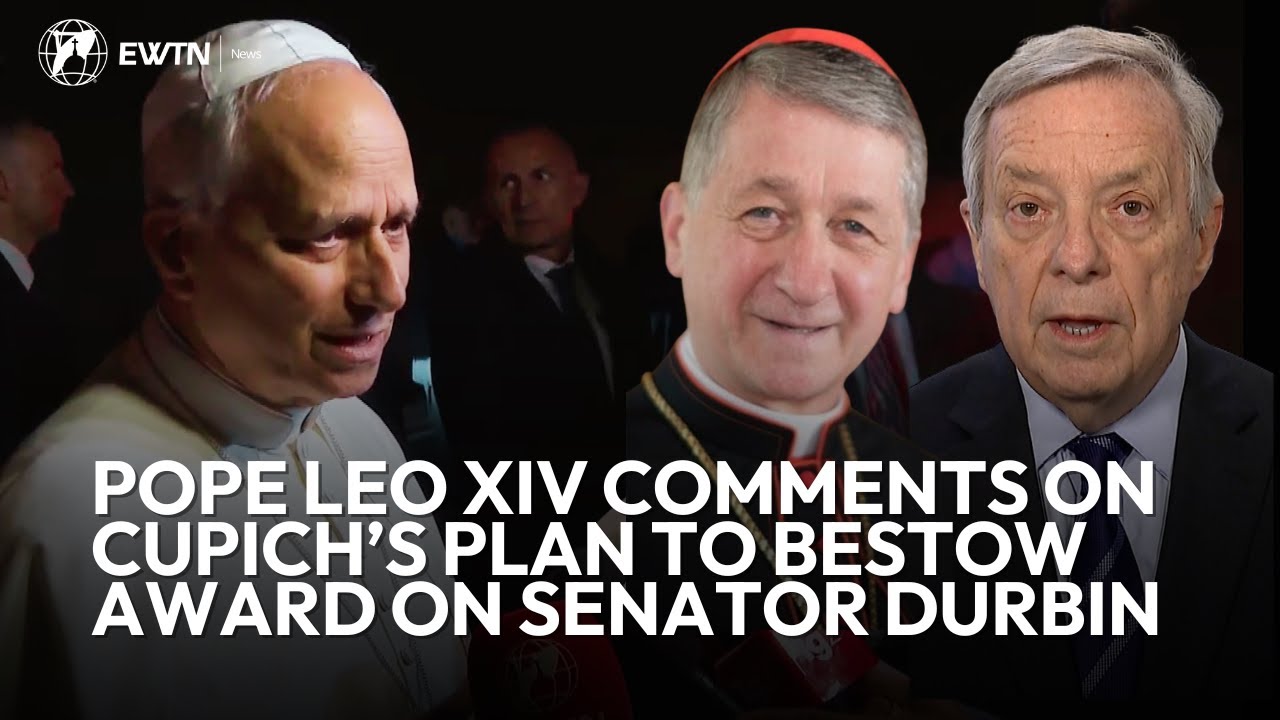
The controversy even reached the Vatican itself, where on Sept. 30 Pope Leo XIV — responding to a question from EWTN News — said it was “important to look at the overall work that a senator has done [during] 40 years of service in the United States Senate.” [This seems to have been an off-the-cuff remark]
“I understand the difficulty and the tensions,” the Holy Father said. “But I think as I myself have spoken in the past, it’s important to look at many issues that are related to the teachings of the Church.”
Multiple U.S. bishops and archbishops criticized the decision. Springfield, Illinois, Bishop Thomas Paprocki, who presides over Durbin’s home diocese, described the senator as “unfit to receive any Catholic honor.”
[…]
Read the rest there.
Here’s the video of the Q&A between EWTN and Pope Leo:

TRANSCRIPT (my emphases):
EWTN: Can I ask a question in English just quickly? One question in English. Thank you. Thank you for speaking with us. I just wanted to ask one thing that has become a bit of a divisive subject in the US right now with Cardinal Sup giving an award to Senator Durbin. Some people of faith are having a hard time understanding this because he is for legalized abortion. How would you help people of faith right now decipher that, feel about that? And how do you feel about that?
LEO XIV: I’m not terribly familiar with the particular case. I think that it’s very important to look at the overall work that a senator has done during, if I’m not mistaken, 40 years of service in the United States Senate. I understand the difficulty and the tensions, but I think, as I myself have spoken in the past, it’s important to look at many issues that are related to what is the teaching of the Church. Someone who says, “I’m against abortion,” but says, “I’m in favor of the death penalty,” is not really pro-life. So, someone who says, “I’m against abortion,” but is in agreement with the inhuman treatment of immigrants who are in the United States—I don’t know if that’s pro-life. So, they’re very complex issues. I don’t know if anyone has all the truth on them, but I would ask first and foremost that there be greater respect for one another and that we search together both as human beings—in that case as American citizens or citizens of the state of Illinois—as well as as Catholics, to say we need to really look closely at all of these ethical issues and to find the way forward as Church. The Church’s teaching on each one of those issues is very clear.
Thank you. Thank you very much.
Speaking of the Church’s teaching, very soon St. John Henry Newman will be declared to be a Doctor of the Church.
Again at Catholic World Report we find a piece by Edward Feser, an expert on the Church’s teaching about capital punishment.
After clarifying that the teachings of Doctors are not coterminous with the official doctrinal declarations of the Church though they are of highly value, Feser exposes what Newman thought about capital punishment. He includes an overview of Catholic writers who have written in defense of capital punishment. He goes through what Newman thought. Here is the conclusion.
Newman on capital punishment
[…]
Similarly, to say that the death penalty is intrinsically wrong, or that it is not sanctioned by scripture, or that it is never permitted by the higher standards of Christian morality, would contradict and reverse what scripture and tradition have consistently said. Hence, to teach such things would, by Newman’s criteria, not count as a development of doctrine, but rather as what he calls a “corruption” of doctrine that attempts to “correct” rather than corroborate it, and which “obscures” rather than illuminates it.
Newman, then, gives no aid and comfort whatsoever to Catholics who would like a doctrinal reversal on this matter. On the contrary, his words clearly condemn them.
 The day brightened considerably at 7:04.