REMINDER: USA – Tour with a magnificent relic, the arm of the Apostle St. Jude

Just a reminder that, right now, there is a tour around these USA with a magnificent relic, the arm of the Apostle St. Jude, widely known as the patron of impossible causes.

There is a web site with a description and schedule.  HERE

I think right now he is in California, Santa Rosa.

There is also a link to a donation page.

Posted in Just Too Cool | Tagged
9 Comments

Your Sunday Sermon Notes – 13th Sunday after Pentecost (N.O.: 20th) 2024

Too many people today are without good, strong preaching, to the detriment of all. Share the good stuff.

Was there a GOOD point made in the sermon you heard at your Mass of obligation for this 13th Sunday after Pentecost, or the 20th Sunday of Ordinary Time?

Tell us about attendance especially for the Traditional Latin Mass.

Any local changes or (hopefully good) news?

A couple thoughts about the sign of the cross: HERE  A taste…

The Law in Leviticus 13:45-46 required that people with “leprosy” must wear torn clothing, live outside the camp, leave their hair unkept, cover the lower part of their face and cry our “Unclean! Unclean”.

This treatment hasn’t yet made its way into Holy See’s documents oppressing the faithful who desire the Traditional Latin Mass.  Time will tell.

The word in Hebrew for what is commonly translated as “leprosy”, tsara’ath, can mean a variety of things, skin diseases certainly, but also even mildew on the wall, mold on something.  As far as skin diseases are concerned, it could mean conditions people recover from such as contact dermatitis or shingles.  Hence, there were laws governing how people who did recover from tsara’ath could be ritually purified and returned to the community.  Those in the ancient world with true leprosy, Hanson’s Disease, generally didn’t recover.  Hence, their being cured was instantly recognizable as miraculous.

[…]

Posted in SESSIUNCULA |
6 Comments

WDTPRS – 13th Sunday after Pentecost: “E ‘n la sua volontade è nostra pace!”

Piccarda Philipp Veit DanteToday’s Collect for the 13th Sunday after Pentecost in the Vetus Ordo survived the redactors to live on in the Novus Ordo as the Collect for the 30th Sunday of Ordinary Time.

It is an ancient prayer, found in the Veronese and the Gelasian Sacramentary.

COLLECT (1962MR):

Omnipotens sempiterne Deus, da nobis fidei, spei et caritatis augmentum: et, ut mereamur assequi quod promittis, fac nos amare quod praecipis.

The verb assequor, according to our splendid tool the Lewis & Short Dictionary, means mainly “to follow one in order to come up to him, to pursue”, and by extension “to gain, obtain, procure.”

Have you noticed that sometimes in our prayers we call God aeterne or also sempiterne?

Our French dictionary of liturgical Latin Blaise/Dumas says aeternus and sempiternus are both “eternal”, that is, not “temporal” or that which endures only for a time.  But in the philosophy and theology (indistinguishable from each other in late antiquity) of the era when today’s prayer was composed, much thought was dedicated to figuring out time and God’s relationship to time.

If we want to get at what our ancient prayer really says, we must hear “eternity” and “sempiternity” as different concepts. 

First, eternity can be thought of as completely independent of time, entirely outside of time.  Another kind of eternity has no beginning or end.  Boethius (+c.526) gave shape to the thought of St. Augustine (+430) on time and distinguished eternity as the simple simultaneous possession of life by God.  It is not a drawn out process.  It is a simple possession.   Sempiternity, a term occurring in ancient Latin but only as a synonym of eternity, was famously redefined by Boethius as the “eternal now”.  It is “everlastingness”.

Indulge me, dear readers.  Occasionally one of you will write saying that I lose you in what seem to be nitpicking digressions.  Let me be clear: I’m not trying to be a psilological doryphore.  I drill into these texts to help people understand, after decades of banal prayers purged of content and color, that our language of liturgical prayer is rooted deeply in ancient pondering, man’s great questions before God and the cosmos.

The words themselves are treasures, carefully weighed and finely polished, handed down with centuries of love by our forefathers… to you.   Every syllable belongs to you.  Each exquisite term is your millennial patrimony.

LITERAL TRANSLATION:

Almighty everlasting God, grant us an increase of faith, hope and charity, and cause us to love what You command so that we may merit to obtain what You promise.

Let’s have a glance at the current English translation of the same prayer intended for the 30th Sunday of Ordinary Time:

CURRENT ICEL (2011 – 30th Sunday):

Almighty ever-living God, increase our faith, hope and charity, and make us love what you command, so that we may merit what you promise.

Pretty close to the WDTPRS version. As a contrast, here is the version from the old incarnation of

OBSOLETE ICEL (1973 of the 1970MR):

Almighty and ever-living God, strengthen our faith, hope, and love. May we do with loving hearts what you ask of us and come to share the life you promise.

See how the the old ICELese strips the prayer of the concepts “command”, reduced to a request, and “merit”, dissolved into a vague sharing?

In what the prayer really says, we ask God the Father for an increase of the theological virtues faith, hope and charity, given at baptism, with a view to what we merit after doing His will.

Let’s get out the theological drill and look into these concepts.

The German writer Josef Pieper (+1997) describes our supernatural life as having three main currents.

First, we have some knowledge of God surpassing what we can know about Him naturally because He reveals it to us (faith).  Second, we live by the patient expectation that what we learn and believe God promises will indeed be fulfilled (hope).  Third, there is an affirmative response of love of the God whom we come to know by faith as well as love for neighbor (charity).

Natural human virtues are acquired through education and discipline.  The three theological virtues faith, hope and charity are given to us by God.  They perfect and elevate everything virtuous which man can do naturally.  Considered one at a time, charity is the greatest of the three, followed by hope and then faith.  But they are all three intimately woven together.  St. Augustine (+430) says, “There is no love without hope, no hope without love, and neither love nor hope without faith” (enchir 8).

The goal of the virtuous life, as we read in the Catechism of the Catholic Church (1803), is to become like God.  Living the theological virtues concretely reveals in us the image of God and the grace He gives to His adopted children. “The practice of all the virtues is animated and inspired by charity, which ‘binds everything together in perfect harmony’” (CCC 1827).  Virtues must be gained, naturally on our own or supernaturally with God’s help.  They can also be lost.  That is entirely our own doing.  Today we pray for their increase in what God gave us in baptism and what we maintain when we are in the state of grace.

We also pray this Sunday to love what God commands.  In the natural spheres of our lives, doing what another commands is not always pleasant.  Our wills and passions rebel. We prefer to command rather than to be commanded.  It is easy, from the worldly point of view, to think that by being the one who commands we can find peace.

Without doubt each one of us desires peace and happiness.  We long to find the means to attain them.  When we attach our happiness to the created things of this world we are inevitably disappointed.  All created things, including people, can be lost.  They are all passing, not enduring, temporal not eternal.  Not even our most beloved spouses, children, or friends can be the foundation of lasting peace.   Even the fear of losing them lessens our peace in this life.  God alone provides the lasting peace we desire.  Because He alone is eternal and unchanging He is perfectly trustworthy.  We cannot lose God unless we ourselves reject Him.  God must be in command of our happiness.  Our peace must be entrusted to Him alone.

In Canto III of the Paradiso of Dante’s Divine Comedy the Poet is in the Heaven of the Moon. There he encounters the soul of Piccarda.  Dante queries her about the happiness of the blessed in Heaven.  He wants to know if somehow, even in Heaven, souls might be disappointed that they do not have a higher place in celestial realm. In response Piccarda utters one of the greatest phrases ever penned and or recited (l. 85):

In His will is our peace.
It is that sea to which all things move,
both what it creates and what nature makes…. 

We are all made in God’s image and likeness, made to act as God acts.  He reveals something of His will to us.  When we obey Him we act in accordance with the way He made us and what He intended for us.

All things that live and move and have their being must come to rest in God or forever be in conflict with themselves and the cosmos.  St. Augustine, who authored the unforgettable “our hearts are restless until they rest in Thee”, described us and our love as working like gravity, which in the thought of the ancients was a force within a thing that sought to go to its proper place of balance in relation to all other things.  “Amor meus pondus meum” (conf 13, 9, 10) said Augustine, “My love is my weight” drawing the restless soul to God, the only source of lasting peace.

E ‘n la sua volontade è nostra pace.  In His will is our peace.  His peace is His promise.

Our Collect prays that we may “love what You command”.  This is a prayer for happiness.

Posted in SESSIUNCULA |
Comments Off on WDTPRS – 13th Sunday after Pentecost: “E ‘n la sua volontade è nostra pace!”

Daily Rome Shot 1099

Photo by The Great Roman™

I note that this new book is back in stock!

On The Demonic by Archbp. Fulton J. Sheen.

US HERE – UK HERE (not yet)

The forward explains that, toward the end of his life, Sheen was ever more convinced that we are living in a demonic age and that we may be seeing the “first cells of the Anti-Christ”.

He wrote that he wanted to write a book about the demonic, but he passed away before he could accomplish it.   The editor of this book has gone through all of Sheen’s material and collated what he found about the topic.

The forward explains that, toward the end of his life, Sheen was ever more convinced that we are living in a demonic age and that we may be seeing the “first cells of the Anti-Christ”.

He wrote that he wanted to write a book about the demonic, but he passed away before he could accomplish it. The editor of this book has gone through all of Sheen’s material and collated what he found about the topic.

Please remember me when shopping online and use my affiliate links.  US HERE – UK HERE  WHY?  This helps to pay for health insurance (massively hiked for this new year of surprises), utilities, groceries, etc..  At no extra cost, you provide help for which I am grateful.

Posted in SESSIUNCULA |
Comments Off on Daily Rome Shot 1099

Daily Rome Shot 1098

Photo by The Great Roman™

Welcome registrant:

Ter

Please remember me when shopping online and use my affiliate links.  US HERE – UK HERE  WHY?  This helps to pay for health insurance (massively hiked for this new year of surprises), utilities, groceries, etc..  At no extra cost, you provide help for which I am grateful.

In chessy news:

Here’s an interview with Wesley about his games today. You’ll like what he says.

YouTube thumbnailYouTube icon

Meanwhile, I’m reading Brant Pitre’s new book.

US HERE – UK HERE

Jesus and Divine Christology

Generations of scholars have asserted, with little evidence other than their hermeneutic of suspicion, that Christ in His earthly life never made any claim to be divine.  Pitre tackles this point and demonstrates that Christ did, in fact, make divinity claims.  One strong point in favor of divinity claims is that the early Church started out with a “high” Christology.  Pitre has great expertise in the context of 1st c. Judaism and uses it to reexamine the issue.  This is not a “popular” book. Rather, it is more scholarly in approach and method, which would challenge quite a few readers (some clergy included, I think, and for more than one reason, given how they say Mass, preach, and neglect the confessional).

It is an important book.

Meanwhile,   black to more and mate in 4.

NB: I’ll hold comments with solutions ’till the next day so there won’t be “spoilers” for others.

Priestly chess players, drop me a line. HERE

I am a Chess.com affiliate.  Join and play.  Maybe we can get a group together.

Hey Fathers!  How about a clerical Guayabera shirt for the hot summer days?

Posted in SESSIUNCULA |
Comments Off on Daily Rome Shot 1098

Just so that you know…

I wonder what sort of people are in charge of this?

This is on the Vatican site today for the Feast of the Assumption.

I don’t like the semi-defiling of my site by his “art”, but I thought you should know what they are continued to post week after week after week after week, feast after feast.

Posted in What are they REALLY saying?, You must be joking! |
21 Comments

Daily Rome Shot 1098

Please remember me when shopping online and use my affiliate links.  US HERE – UK HERE  WHY?  This helps to pay for health insurance (massively hiked for this new year of surprises), utilities, groceries, etc..  At no extra cost, you provide help for which I am grateful.

White to move and mate in…?

NB: I’ll hold comments with solutions ’till the next day so there won’t be “spoilers” for others.

Nice people! Great service!

Buy great beer. Help the monks.

In chessy news, my guy Wesley So won yesterday against the tough Nodirbek to move up in the standings in St. Louis at the Rapid and Blitz. Nepo and “Puer” are tied in 1st with lots on their heels except poor Pragg who is struggling.

Ding and Gukesh will square off for the Big Title on an island off of Singapore at a resort. There will be an open during the match. 20 Nov- 15 Dec.

Meanwhile, yesterday I mentioned that I could take some Mass intentions. I have received some requests. I am careful in how they are addressed. Whenever you address a priest for Mass intentions, keep in mind a few things. First, if he is in a parish, most of the time he has to take the intention from the parish. He will have some days off when he can take intentions, but don’t automatically assume that he can. Ask and find out IF he can, BEFORE sending him a stipend. When a priest accepts a stipend for an intention, it is like a binding contract. He is obliged morally and by law to celebrate the intention or find someone else who can if he is impeded. I don’t take large numbers of intentions at a time because, frankly, were I to keel over, I don’t know who would straighten them out for me right now. That’s the fruit of being semi-cancelled. Also, I like to be able to take intentions that are pressing, if I can. Some of the intentions I have recently received are quite moving. Friends, please pray for an increase in vocations and foster them when you can. We need more good priests. The shortage makes it hard for people to have Masses said. That’s just one more – one more important – problem in the modern Church of the Glorious Springtime. Anyway, requests  HERE

Posted in SESSIUNCULA |
Comments Off on Daily Rome Shot 1098

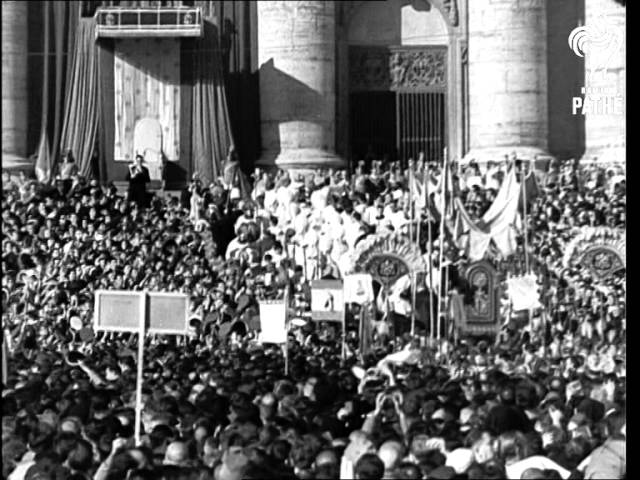
VIDEO: 1950 – Pius XII infallible proclamation of the Assumption of the Blessed Virgin Mary

In 1950 my late pastor, Msgr. Schuler, was in Rome on a Fulbright working on the manuscripts of Giovanni Maria Nanino, the successor of Palestrina for the Sistine Chapel.  He had great stories about being a priest in Rome in that Holy Year and, specifically, of the Proclamation of the Dogma of the Assumption.

It was a different world.  Think about it: the war had ended just 5 years before.

YouTube thumbnailYouTube icon

There is moment when a woman is holding up a mirror so she can see over the crowd.  For a moment I thought, “Is that a… time traveller caught on film?!?”

Posted in Just Too Cool, Linking Back, Our Solitary Boast | Tagged
4 Comments

4th Glorious Mystery: The Assumption – Patristic Rosary Project

Some years ago, I made something called the Patristic Rosary Project, reflecting on the mysteries of the Holy Rosary especially with quotes from the Fathers of the Church.  Here is the entry for today’s beautiful feast:

4th Glorious Mystery: The Assumption

Although Ven. Pius XII refers carefully to Mary having completed the course of her life, rather than explicitly to her death in the document whereby he declared infallibly the dogma of the Assumption, and St. John Paul II adverts to the end of Mary’s life in a General Audience in 1997 – as do other saintly writers – we do not have from the Church a definitive or infallible teaching beyond a shadow of a doubt whether Mary died and then was assumed body and soul into heaven at that moment or if she was assumed without dying.  That said, it was certainly fitting that, if her Divine Son tasted death, then she would as well.  On the other hand, it is possible that in some manner like to perhaps what unfallen man might have been able to do, Mary’s love for God could no longer be contained and went to God by loving choice rather than experiencing the punishment of the Original Sin she did not have.

Even in the Eastern tradition, which speaks of the Dormition, the Sleeping, of Mary we have a sub-current of death.  Sleep is certainly a euphemism for death and they are closely related. Greek ???????? gives us ??????????? or Latin coemeterium, whence English “cemetery”, which is a “sleeping place”. Traditions are divided about her last earthly breaths. Some authors hold that she did not die before her Assumption. There is also a strong tradition that she was buried.  That said, no one really knows where, though the cult of the burial places of the holy has always been strong, even in the days before Christ.

Perhaps a good explanation is that Our Blessed Mother, desiring to be like her Son, who did die, chose herself to die though Satan had no hold on her.  It was fitting that she, the daughter of her Son and disciple of Her Lord, should be as He was.  So, after a brief interval during which no corruption touched her, her soul and body were reunited in heaven in the presence of God.

In any event, we know with our Catholic faith, and by infallible authority, that at the end of her earthly life, the Mother of God was assumed into heaven and no stain of the corruption of the grave touched her.

Our humanity is seated at the right hand of the Father in the divine Person of our Lord, but now also in the human person of our Lady.

Christ is consubstantial with the Father. Christ is consubstantial with His Mother.

Mary is Mother of a divine Person with two natures. She is not Mother of part of Christ, but Mother of all of Christ in His integrity. And so, we can call her Mother of God and Mother of the Church. Her heavenly Assumption was fitting.

There are not elaborate reflections in the writings of the Fathers on the Assumption, because it was not a main point of reflection. Still, we can find their thoughts on some passages of Scripture which help us to understand Mary’s role in the plan of our salvation.

As a perfect model for our own Christian discipleship, we can consider, among many texts, Proverbs 8:

And now, my sons, listen to me: happy are those who keep my ways. Hear instruction and be wise, and do not neglect it. Happy is the man who listens to me, watching daily at my gates, waiting beside my doors. For he who finds me finds life and obtains favor from the LORD; but he who misses me injures himself; all who hate me love death.

While this concerns Wisdom, in a sense it harks to Mary, Wisdom’s seat. Here is the reflection of Athenagoras on this section of Proverbs:

[The Son] is the first offspring of the Father, I do not mean that He was created, for, since God is eternal mind, He had His Word within Himself from the beginning, being eternally wise. Rather did the Son come forth from God to give form and actuality to all material things, which essentially have a sort of formless nature and inert quality, the heavier particles being mixed up with the lighter. The prophetic Spirit agrees with this opinion when He says, “The Lord created me as the first of His ways, for His works.” Indeed we say that the Holy Spirit Himself, who inspires those who utter prophecies, is an effluence from God, flowing from Him, and returning like ray of the sun. Who, then, would not be astonished to hear those called atheists who admit God the Father, God the Son, and the Holy Spirit, and who teach their unity of power and their distinction in rank? … We affirm, too, a crowd of angels and ministers, whom God, the maker and creator of the world, appointed to their several tasks through His Word, He gave them charge over the good order of the universe, over the elements, the heavens, the world, and all it contains. [A plea regarding Christians 10]

This fellow sounds a bit like a subordinationist, but he is fascinating. This passage is interesting also for its hints at the cosmology and physics of late antiquity. Also, it aims at the spiritual hierarchy in which our wondrous Lady has a privileged place.

Consider that the reward of assumption into the beatific vision stems as well from her perfect act of free will when she gave her “Fiat” to God’s will as expressed by the angel. Here is St. Augustine speaking of the impact of free will:

Man in paradise was capable of self-destruction by abandoning justice by an act of will; yet if the life of justice was to be maintained, his will alone would not have sufficed, unless He who made Him glad had given him aid. But, after the fall, God’s mercy was even more abundant, for then the will itself had to be freed from the bondage in which sin and death are the masters. There is no way at all by which it can be freed by itself, but only though God’s grace, which is made effectual in the faith of Christ. Thus, as it is written, even the will by which “the will itself is prepared by the Lord” so that we may receive the other gifts of God through which we come to the Gift eternal – this too comes from God. [Enchiridion 28.106]

God’s grace and Mary’s “Fiat” which was by grace. Mary was drawn with love into God’s plan and, later, into God’s presence. The Fathers made frequent use of the Song of Songs. St. Gregory the Great writes about the exchanges of heaven and earth which marked the plan of salvation:

The Church speaks through Solomon: “See how he comes leaping on the mountains, bounding over the hill!” … By coming for our redemption the Lord leaped! My friends, do you want to become acquainted with these leaps of His? From heaven He came to the womb, from the womb to the manger, from the manger to the Cross, from the Cross to the sepulcher, and from the sepulcher He returned to heaven. You see how Truth, having made Himself known in the flesh, leaped for us to make us run after Him. [Forty Gospel Homilies 29]

Our Lady, who would feel Christ leap beneath her heart, herself leapt after Christ in her heart by her “Fiat”. She leapt to begin His public ministry when she said at Cana “Do whatever He tell you.” She leapt up Calvary with Him when the Blood and water flowed down. Her motherly and Christian heart leapt in joy in seeing Him gloriously risen. She leapt to Him in heaven when her earthly life was concluded.

In heaven Mary shines with the glory God shares with her. In the book of Revelation we have a description chapter 12 of the woman clothed with the sun. The Fathers speak about this image. They will mostly consider the woman as an image of the Church. We cannot reduce the Church to Mary. Nor in talking of the Church as Christ’s Body reduce Christ to the Church. But the three, Christ, Mary and Church are intimately associated. Hippolytus (+245) writes:

By the “woman clothed with the sun”, he meant most manifestly the Church, endued with the Father’s Word, whose brightness is above the sun. And by “the moon under her feet,” he referred to [the Church] being adorned, like the moon, with heavenly glory. And the words “upon her head a crowd of twelve stars” refer to the twelve apostles by whom the Church was founded.

Of course Christ founded the Church on the Apostles, and chiefly upon the Rock who is Peter. The description of the woman, however, fits Mary the Mother of the Church as well as the Church herself. Here is an extended piece by someone not too many in the West may read, Oecumenius (6th c.) called the “Rhetor” who wrote the earliest Greek commentary on Revelation:

The vision intends to describe more completely to us the circumstances concerning the antichrist…. However, since the incarnation of the Lord, which made the world his possession and subjected it, provided a pretext for Satan to raise this one up and to choose him [as his instrument] – for the antichrist will be raised to cause the world again to fall from Christ and to persuade it to desert to Satan – and since moreover His fleshly conception and birth was the beginning of the incarnation of the Lord, the vision gives a certain order and sequence to the material that it is going to discuss and begins the discussion from the fleshly conception of the Lord by portraying for us the mother of God. What does he say? “And a sign appeared in heaven, a woman clothed with the sum and the moon was under her feet.” As we said, it is peaking about the mother of our Savior. The vision appropriately depicts her as in heaven and not on the earth, for she is pure in soul and body, equal to an angel and a citizen of heaven. She possesses God who rests in heaven – “for heaven is my throne” – it says yet she is flesh, although she has nothing in common with the earth nor is there any evil in her. Rather, she is exalted, wholly worthy of heaven, even though she possesses our human nature and substance. For the Virgin is consubstantial with us. Let the impious teaching of Eutyches, which make the fanciful claim that the Virgin is of another substance than we, be excluded from the belief of the holy courts together with his other opinions. And what does it mean that she was clothed with the sun and the moon was under her feet? The holy prophet Habakkuk, prophesied concerning the Lord, saying, “The sun was lifted up, and the moon stood still in its place for light.” calling Christ our Savior, or at least the proclamation of the gospel, the “sun of righteousness”. When He was exalted and increased, the moon – that is, the law of Moses – “stood still” and no longer received any addition. For after the appearance of Christ, it no longer received proselytes from the nations as before but endured diminution and cessation. You will, therefore, observe this with me, that also the holy Virgin is covered by the spiritual sun. For this is what the prophet calls the Lord when concerning Israel he says, “Fire fell upon them, and they did not see the sun.” But the moon, that is, the worship and citizenship according to the law, being subdued and become much less than itself, is under her feet, for it has been conquered by the brightness of the gospel. And rightly does he call the things of the law by the word “moon”, for they have been given light by the sun, that is, Christ just as the physical moon is given its light by the physical sun. The point would have been better made had it said not that the woman was clothed with the sun but that the woman enclothed the sun, which was enclosed in her womb. However, that the vision might show that the Lord, who was being carried in the womb, was the shelter of His own mother and the whole creation, it says that He was enclothing the woman. Indeed, the holy angel said something similar to the holy Virgin: “The Spirit of the Lord will come upon you, and the power of the Most High will overshadow you.” For to overshadow is to protect, and to enclothe is the same according to power. [Commentary on the Apocalypse 12.1-2]

Take careful note of the image drawn on by the interesting Oecumenius, which also speaks to the cosmology of late antiquity. First, Oecumenius either knew that the sun gave light to the moon, as it does, or he extrapolates this from the glory that Christ gives to Mary.

All our Marian feasts, all our reflection, to keep the sunlight and moon theme going, always must draw us back to the Person of the Lord. We reflect on the face of the Lord who is reflected in the face of His Mother.

Our recitation of the Rosary brings us to know the Lord more and more and, in turn, know ourselves better.

We reflect His image and likeness and He came into the word to reveal us more fully to ourselves.

Posted in Our Solitary Boast, Patristiblogging, Patristic Rosary Project | Tagged
1 Comment

ASK FATHER: Is Baptism valid if one person says the words and another person pours the water?

From a priest friend (summarized):

QUAERITUR:

At Gloria.TV there is a story about aberrations in Germany [Imagine my shock!]. One was a Baptism problem: the priest said the words while the godfather poured the water. Is this a valid Baptism?

No.

The matter (water) must be administered by the one and the same minister at the same time as the words (proper Trinitarian form) of Baptism is pronounced.

St. Thomas Aquinas wrote (Summa Theologiae, III p., q. 67, a. 6 to 3):

[I]t must be stated that the integrity of baptism consists in the form of the words and the use of the matter. Consequently, he who only pronounces the words does not baptize, nor he who immerses. Wherefore if one pronounces the words and the other immerses, no form of the words can be fitting.”

In the Roman Ritual (Tit. 2, cap. 1, n. 10) we read:

[I]dem sit aquam adhibens et verba pronuntians…. [L]et the same man be the one applying the water and pronouncing the words.

The question was laid before the Sacred Congregation for Discipline of the Sacraments in 1916 (AAS 08 (1916), p. 478):

Doctrina catholica certissime tenet ab uno eodemque ministro poni debere materiam simulque formam baptismatis proferri … Catholic doctrine most certainly holds that the matter ought to be placed by one and the same minister at the same time as the form of the baptism is offered.

Since we are unreconstructed ossified manualists, we also include the issue of how the water is administered (whether by pouring, sprinkling or immersing): Does it have to be three times, corresponding to the names of the Trinity in the form?

No.  Once is sufficient for validity, so long as it flows (moves) on the head of the one being baptized.  However, the obligation of a threefold pouring (etc.) is grave, as is, in the tradition of the Church, to use Baptismal Water or at the very least Holy Water.  In necessity, regular water can be used.

Heribert Jone says in his Moral Theology (trans. Adelman – 1962).  This also addresses the question of two people dividing the action of pouring and speaking:

467. — 3. The proximate valid matter of Baptism consists in the actual washing of the person to be baptized by the one baptizing.

The washing may be done by immersion, aspersion or infusion.

A definite quantity of water is not required; it suffices Lat the water flow over the one being baptized. Several authors hold the flowing of one or two drops insufficient. — Baptism is doubtful and must be repeated conditionally if administered by rubbing wet fingers across the forehead or by merely making the sign of the cross thereon with a wet finger. The same holds for the use of a damp cloth, sponge or wet hand when the water does not actually flow. Likewise, if administered by aspersion as when sprinkling with holy water if the drops do not flow over the skin but remain when they fall.

The water must touch the one to be baptized. Baptism is invalid if the water merely comes in contact with the clothes, or the uterus or fetal membrane in case of uterine Baptism. It is likewise invalid if only a head scab or a mucuous excretion on the head is contacted. — If the hair alone and not the skin is touched the baptism is doubtful.

Baptism is certainly valid if administered on the head (if the hair is very thick it would be better to baptize on the forehead). Baptism is valid even if the head is entirely covered with sores. It is probably valid if one were to baptize on the breast, neck or shoulder; probably invalid if administered on the hand, arm or the foot.

Validity also requires that one and the same person apply the water and pronounce the words. The washing may be done by infusion or by holding the one to be baptized in standing or flowing water (e.g., in a spring or in the rain).


Posted in "How To..." - Practical Notes, ASK FATHER Question Box, Mail from priests, Our Catholic Identity | Tagged
5 Comments