Daily Rome Shot 1044

Hey! p***.********@rocket.com! I was alerted that your email service is ending. New email? Please let me know.

Welcome registrant:

ad.nutum.meum

On this date in 1889, the iconic, anti-Catholic statue of the heretic Giordano Bruno, burned at the stake in 1600, was unveiled in the Campo de’ Fiori in Rome.

Many times a day you will hear tour guides deliver to gullible tourists all manner of dopiness about what a great guy Bruno was and how narrow and cruel the Church is, and against science.

The transcripts of Giordano Bruno’s trial at the Holy Office were destroyed sometime after Napoleon demanded files from the Vatican Archives be sent to Paris in 1810, and 1815 when the files were being returned to Rome.  We have only a summary of the trial written in 1598, two years before Bruno’s execution. It was rediscovered in 1940 by Cardinal Angelo Mercati, Prefect of the Vatican Archives.

Please remember me when shopping online and use my affiliate links.  US HERE – UK HERE  WHY?  This helps to pay for health insurance (massively hiked for this new year of surprises), utilities, groceries, etc..  At no extra cost, you provide help for which I am grateful.

Along the top of the plinth are eight medallions with bust reliefs; they depict the Venetian Paolo Sarpi, the Calabrian Tommaso Campanella, the French Petrus Ramus, the Roman Lucilio Vanini, the Italian Aonio Paleario; the Spaniard Michele Serveto, the English John Wycliffe, and the Bohemian Jan Hus. In 1991, it was rediscovered that the medallion with a bust of Vanini, also had a small portrait of Martin Luther.

At the unveiling, a radical politician Giovanni Bovio gave a speech surrounded dozens of Masonic flags. The Vatican, in anticipation of the thousands of anti-Catholics and Masons coming to Rome for the event, closed the museum and told local churches and parishes to lock the doors. Pope Leo XIII commented on the statue in an 1890 encyclical against Freemasonry:

that eminently sectarian work, the erection of the monument to the renowned apostate of Nola, which, with the aid and favour of the government, was promoted, determined, and carried out by means of Freemasonry, whose most authorised spokesmen were not ashamed to acknowledge its purpose and to declare its meaning. Its purpose was to insult the Papacy; its meaning that, instead of the Catholic Faith, must now be substituted the most absolute freedom of examination, of criticism, of thought, and of conscience: and what is meant by such language in the mouth of the sects is well known.

We read of insults to the papacy now on a daily basis.

There was once an app which showed the statue.  Hit a button and it started on fire.  It doesn’t work any more.


Meanwhile, white to move and mate in 2.

NB: I’ll hold comments with solutions ’till the next day so there won’t be “spoilers” for others.

Since roasting seems to be a theme of today’s post, try some coffee and support Carmelites in Wyoming.

I’m now an affiliate of chess.com. Sign up!

Posted in SESSIUNCULA | Tagged
9 Comments

WDTPRS – 3rd Sunday after Pentecost: “As soldiers, traveling through enemy territory…” (NO and VO comparison)

In the older, traditional calendar of the Roman Rite, today is the 3rd Sunday after Pentecost.

This is a yummy oration.  Let’s have a taste.

COLLECT (1962MR):

Protector in te sperantium, Deus, sine quo nihil est validum, nihil sanctum: multiplica super nos misericordiam tuam; ut, te rectore, te duce, sic transeamus per bona temporalia, ut non amittamus aeterna.

There is a pleasant alliteration in lines 2-3 of the collect. We can find a pair of pairs: nihil validum, nihil sanctum and some great ablative absolutes te rectore, te duce.

In the Novus Ordo Missale this prayer – sort of – is used on the 17th Sunday of Ordinary Time.

Where does this prayer really come from?

The first part, Protector in te sperantium deus, seems to be a fairly common introductory phrase in ancient Roman prayers. But after that, we find the whole prayer as it appears in the 1962MR in the Liber sacramentorum Gellonensis or Gellone Sacramentary, one of the Frankish “newer Gelasian” type sacramentaries, an attempt at a complete service book in the late 8th century, and in the Liber sacramentorum Romanae ecclesiae or Book of the Sacraments of the Church of Rome, which is another “Gelasian” type book.  However, the snipping and pasting experts employed by the Council’s Consilium hacked off the end of the “Pian” edition’s ancient prayer and for the “Pauline” version of the Missale Romanum, glued on a chunk of another ancient prayer in the Veronese Sacramentary or Leonine Sacramentary or for good measure Codex sacramentorum vetus Romanae ecclesiae a sancto Leone papa I confectus, for the month of July, perhaps on the 13th of the month, and perhaps as part of a preface formula: Vere dignum: qui mutabilitatem nostram ad incommutabilia ita iustus et benignus erudis, ut nec fragilitatem destituas et coherceas insolentes: quo pariter instituti pia conversatione et caelestibus sacramentis, sic bonis praetereuntibus nunc utimur, ut iam possimus inherere perpetuis. They even tinkered with that.

Tinker tinker tinker!

COLLECT (2002MR – Novus Ordo):

Protector in te sperantium, Deus, sine quo nihil est validum, nihil sanctum: multiplica super nos misericordiam tuam; ut, te rectore, te duce, sic bonis transeuntibus nunc utamur, ut iam possimus inhaerere mansuris.

Many people don’t realize that very few of the prayers of the 1962 Missale made it into the Novus Ordo without alterations.  Sometimes those alterations took the prayers back to an more ancient version.  Mostly, they just fiddled around with them.

According to the valuable research of Matthew Hazell:

[A] mere 13% (165) of the 1,273 prayers of the usus antiquior  found their way unchanged into the reformed Missal of Paul VI. Another 24.1% (307) were edited in some way before their inclusion. A further 16.2% (206) were centonised with other prayers – effectively combining parts of multiple prayers together into a new oration. [Get out your safety scissors and paste pots!] Fully 52.6% (669) of the prayers in the traditional Roman Rite have been excised from the modern liturgy, memory-holed by the Consilium ad exsequendam.

It seems to me that of the 17% remaining intact, about 3% are in the same place they in the Vetus Ordo.

Let’s have some vocabulary.

Protector is, according to our always valid Lewis & Short Dictionary, from protego, meaning “to cover before, or in front, cover over” and obviously also “to shield from danger” as well as things like “put a protecting roof over”.  Amitto is “to lose” in the sense of “let slip”.  A Latin dux is a “leader, guide”, and also “commander, general-in-chief”.  This is why Benito Mussolini was in Italian called “il Duce”.  A rector is pretty much the same as the first sense of dux, but it can also be a “helmsman” or “governor”.  Interestingly enough, gubernator means “helmsman” also, while an English “governor” is a moderator.

St. Andrew’s Bible Missal (1962):

O God, guardian of those who trust in you, without whom nothing is strong, nothing holy, increase your mercy towards us. With you as our ruler and guide, may we pass through the good things of this world, so as not to lose those of the world to come.

LITERAL VERSION (1962MR):

O God, protector of those hoping in You, without whom nothing is efficacious, nothing holy, multiply Your mercy upon us, so that, You being our guide and leader, we may pass through temporal goods in such a way that we do not lose the eternal.

We have the image of a people asking God to cover them over abundantly with mercy.  We are acknowledging how we need a roof over our heads to protect us, so we want God’s mercy upon us. Also, since a protector is something or someone that covers us in front, God is our shield before us.  In His mercy He guards us from the attacks we face as soldiers in the Church Militant.

We must never forget that we are members of the Church Militant, the part of the Church which is in the world, on the march, as a pilgrim people.  We must be clear in our minds that the Lord says this world has its prince (cf. John 10:31 and 14:30).  Satan and his fallen angels desire our everlasting damnation and agony with them in Hell.  Jesus broke their power over us, but for a time we are still in this world which they dominate. We are living in a state of “already, but not yet.”

As soldiers, traveling through enemy territory, we need strong shields.  We need a sure leader to set our feet on the right path out of the danger zone. We need a sturdy roof over us when we rest.  We need some way to grasp what is holy and what is deception.

God is the one without whom nothing is worthwhile or holy. He must provide for us all that we need on the march.

Because of the wounds to our nature from the Fall, we are susceptible to the passing things of this world and vulnerable to the attacks of hell.  We need shielding, protection, so that we are not overly mired or stained, lest we lose track of our pilgrim route to heaven.

LITERAL TRANSLATION (2002MR):

O God, protector of those believing in You, without whom nothing is efficacious, nothing holy, multiply Your mercy upon us, so that, You being our guide and leader, we may so use things that pass away as to be able to cleave to those that endure.

Notice the slightly different emphasis.

This version also contrasts the passing things of this world with those that do not pass away.  This version also stresses that we must cling to, or not let slip, eternal things, so that we lose heaven.  However, whereas the older version seems to take a position of suspicion about the dangerous nature of worldly, temporal things, the newer version indicates that we use them correctly.  The structure is ita with a result following in the subjunctive: in such a way that….

Lest anyone get their shift all in a twist about how the Novus Ordo version obviously reflects the dangerous modernism of the Second Vatican Council’s Constitution on the Church in the Modern World, Gaudium et spes, remember that the final two lines are also essentially from an ancient prayer.  After all, our ancestors also were concerned actually to use the things of the world, which remain good.

They are bona temporalia.

OBSOLETE ICEL (1973): 

God our Father and protector, without you nothing is holy, nothing has value. Guide us to everlasting life by helping us to use wisely the blessings you have given to the world.

This is so bad that one might laugh, if it weren’t for the fact that God’s people were so cheated for so many years.

CURRENT ICEL (2011):

O God, protector of those who hope in you, without whom nothing has firm foundation, nothing is holy, bestow in abundance your mercy upon us and grant that, with you as our ruler and guide, we may use the good things that pass in such a way as to hold fast even now to those that ever endure.

Posted in WDTPRS |
Comments Off on WDTPRS – 3rd Sunday after Pentecost: “As soldiers, traveling through enemy territory…” (NO and VO comparison)

9 June: Bl Anna Maria Taigi – mystic, wife, mother

Today is the feast of Bl Anna Maria Taigi (+1837).  Her tomb is in San Crisogono, just across the Tiber in Trastevere.    She was a wifre and mother and then a tertiary of the Trinitarians.  During her life she received locutions from the Lord.  For many decades after her death she was incorrupt.  She was praised highly by St. Vincent Pallotti (a saint of my neighborhood).

She foretold the two World Wars and made predictions about “3 days of darkness”.

“After the three days of darkness, St. Peter and St. Paul, having come down from Heaven, will preach in the whole world and designate a new Pope. A great light will flash from their bodies and will settle upon the cardinal who is to become Pope. Christianity, then, will spread throughout the world. He is the Holy Pontiff, chosen by God to withstand the storm. At the end, he will have the gift of miracles, and his name shall be praised over the whole earth.”

“Whole nations will come back to the Church and the face of the earth will be renewed. Russia, England, and China will come into the Church.”

San Crisogono:


Bl. Anna Maria Tiagi is here.

Posted in SESSIUNCULA |
5 Comments

Your Sunday Sermon Notes: 3rd Sunday after Pentecost (N.O. 10th Ordinary) 2024

Too many people today are without good, strong preaching, to the detriment of all. Share the good stuff.

Was there a GOOD point made in the sermon you heard at your Mass of obligation for this 3rd Sunday after Pentecost, or the 10th Sunday of Ordinary Time?

Tell about attendance especially for the Traditional Latin Mass.

Any local changes or (hopefully good) news?

A couple thoughts about the sign of the cross: HERE  A taste…

[…]

There are so many ways to intoxicate the mind available in this technological jungle which is filled with roaring and slithering.  Peter wasn’t just talking about wine.  He was also talking about the allurements of the world which the pagans indulged in.  He would be today, if I may be so bold, talking about these little telescreens in our hands.  Have you seen how some people watch their phones?  It borders on obsessive adoration.  Is there a more effective lion of soul-ripping teeth than something which can pour evil and addictive images along with sheer idiocy into our minds like hot and old running cocaine?  These are dangerous times for the life of the mind and for the health (salvation) of souls.

[…]

Posted in Sermons | Tagged
7 Comments

Daily Rome Shot 1043

The vestition of new members of the Archconfraternity of the Most Holy Trinity of the Pilgrims and Convalescents, which was founded by St. Philip Neri.

Please remember me when shopping online and use my affiliate links.  US HERE – UK HERE  WHY?  This helps to pay for health insurance (massively hiked for this new year of surprises), utilities, groceries, etc..  At no extra cost, you provide help for which I am grateful.

Meanwhile, white to move and mate in 3.

Nice people! Great service!

NB: I’ll hold comments with solutions ’till the next day so there won’t be “spoilers” for others.

In Norway, Magnus emerged victorious in the open section. Ju Wenjun prevailed in the women’s section. Alas, Ding Liren in his last battle against Firouzja drew in classical with 1 hour and 37 on his clock and then, in armageddon, resigned with more time on his clock than he started with. In the last round Carlsen had to win his armageddon against Fabiano to knock Nakamura mathematically out of the possibility of catching him.

Posted in SESSIUNCULA |
1 Comment

Is this a joke?

This… given the topic, one is forced to ask, “Is this a joke?”

Notice anything?

There is at least one person in there who is not funny. And two whose inclusion is appalling. (Not mutually exclusive.)

The must be some confusion about “James Martin”, which doesn’t include “SJ”. There is a chap in the UK who has a Saturday morning program, named James Martin. However, this invitee is listed as American.

Maybe some one can explain this.

Posted in Lighter fare |
13 Comments

The Beauty of Tradition

I warmly recommend that you savor a smartly written piece by Anthony Esolen at Crisis.   It is a devastating critique of modernity’s moral vagueness.

Some tastes…

[…]

The vagueness is like a noxious spreading mist. When you don’t have a firm grasp on what simply is good and what simply is evil, but resolve them into pleasant or unpleasant attitudes, you won’t be likely to write the greatest novels or direct the greatest films. Sigrid Undset could not be a vague “I’m OK, You’re OK” modern church lady and still write Kristin LavransdatterThe Master of Hestviken, and all the other golden works she has given us.

[…]

Having finally read Kristan, I get that.

[…]

What has most baffled me about the miserable saga of Marko Rupnik is not that such a monster could exist. Monstrous evil is common enough in human history. But the stubborn persistence of awful taste is something else; it is not like hammering someone else’s foot, but like hammering one’s own, deliberately, over and over. Somehow, there were still people in high ecclesiastical places who thought that Rupnik’s soulless pseudo-primitive human figures were capable of moving anybody.

[…]

Did you know that the Vatican is STILL using Rupnik’s trash for their liturgical ceremonies news.  This can’t be an accident.

[…]

When you are not interested in the actual arguments someone makes, because the pursuit of truth at all costs does not excite you, you do not sharpen your mind; and lassitude sets in. So those who love tradition must have all the strong arguments and must attract the most powerful minds, if only because the attitude of those on the other side hamstrings the intellect. If it does not matter whether an argument is coherent but only whether the person making it has the authority to demand that you accept it, then expect the argument to be coherent only occasionally and by happenstance.

[…]

Also, try his book…

No Apologies: Why Civilization Depends on the Strength of Men

US HERE – UK HERE

Posted in SESSIUNCULA | Tagged
Comments Off on The Beauty of Tradition

“Heresy thrives on a combination of amnesia, anarchy and novelty.” ACTION ITEM! VIDEO!

I was given a manuscript of a new book by Bp. Schneider to look over. It is about heresies. Just as he put out a book about the truths of the Faith that are to be believe, now he has a book about errors to be avoided.   More about this book later.
That leads me to something that really perked my ears.

I have an action item for you.

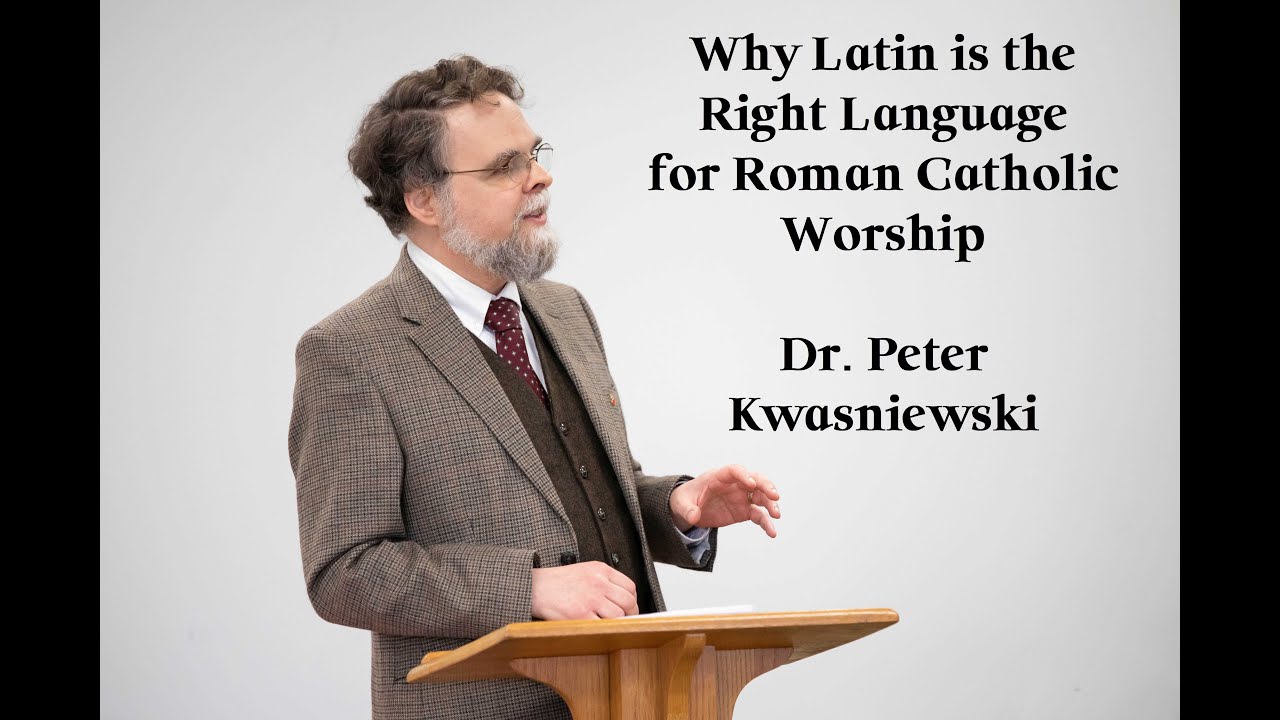
I just finished watching a video of a talk given in Cleveland by Peter Kwasniewski about “Why Latin is the right language for Roman Catholic worship.”

The radical progressives who waged war against Latin in the mid 20th century knew very well what they were doing. They wanted to blow up the bridge that connected Catholics with their heritage their tradition their collective memory. The vaunted modernization of the Church could be carried out only if the past were forgotten, sealed inaccessibly behind a wall of incomprehensibility. The loss of Latin has therefore had ramifications far beyond the sanctuaries of our churches even if that is where we most notice its presence or absence. Heresy thrives on a combination of amnesia, anarchy and novelty. The liturgical crisis is only one part of the larger crisis of Catholic identity which has more to do with language than most people realize.

Peter knocks dinger after dinger out of the park in this talk. He says many of the things I’ve been saying over the years in a concise speech, deftly reasoned, fluidly connected.

He spins out in his own words the phrases that I use often, such as “We are our rites”, “Liturgy is doctrine”.

I invite you to listen to the talk.

YouTube thumbnailYouTube icon

Before I leave you to it, also take note of how he obliterates the absurdly ignorant proposition that people who attend the Vetus Ordo can have all the smell and bells and vestments and chant and Latin in the Novus Ordo.

Firstly, that’s just dumb. The content of the prayers of the rites are different. However, Peter has another approach which was quite good in explaining how that doesn’t work. He starts with the premise that the Novus Ordo was created for maximum comprehensibility. You should be able to see, hear, and grasp everything without effort. There are microphones, the priest faces the people, the vernacular is used, only one thing happens at a time. Of course this has nothing to do with “worship” in the history of humanity and the transcendent. When people say, you can have the Novus Ordo in Latin,

“they’re completely missing the point. The Novus Ordo in Latin falls between two stools to use a saying of Joseph Shaw’s. It has neither the instant accessibility for which it was designed nor the grandeur, solemnity, symbolic richness and ceremonial depth of the Tridentine rite which augments our awareness of mystery and our receptivity to truth that cannot be put into simple linguistic packages. So the Latin Novus Ordo fails. It fails from both angles.”

The Q&A is also good, and extensive.  My experience in giving talks – back when people still wanted me to give talks!  LOL! – people often enjoy the Q&A as much as if not more than the talk.

Posted in Fr. Z KUDOS, Liturgy Science Theatre 3000, Our Catholic Identity, Save The Liturgy - Save The World, SESSIUNCULA | Tagged
1 Comment

Daily Rome Shot 1042

Hey, vb*****@cox.net! My thank you email note was kicked back as undeliverable. New email? Let me know!

Welcome registrant:

michaeld16670

In the Norway Chess battle, yesterday the struggling world champ Ding Liren brought down Hikaru Nakamura, which helped Magnus stay on top of the standings.  I was delighted to watch Magnus beat Alireza Firouzja.  Today is the last day.  Pragg, mathematically, still has a chance to win.

Interested in learning?  Try THIS.

White to move and mate in 3.

NB: I’ll hold comments with solutions ’till the next day so there won’t be “spoilers” for others.

Please remember me when shopping online and use my affiliate links.  US HERE – UK HERE  WHY?  This helps to pay for health insurance (massively hiked for this new year of surprises), utilities, groceries, etc..  At no extra cost, you provide help for which I am grateful.

Posted in SESSIUNCULA |
2 Comments

ASK FATHER: Can we eat meat today, Friday, Feast of the Sacred Heart or must we abstain?

People have asked about Friday abstinence from meat for today, Feast of the Sacred Heart.


Canon 1251 of the Code of Canon Law for the Latin Church says:

Can. 1251 Abstinence from meat, or from some other food as determined by the Episcopal Conference, is to be observed on all Fridays, unless a solemnity should fall on a Friday. Abstinence and fasting are to be observed on Ash Wednesday and Good Friday.

Today, 7 June 2024 is…

a) a Friday, in fact a 1st Friday
b) the Feast of the Most Sacred Heart of Jesus, and as such
c) a Solemnity (Novus Ordo calendar – 1st Class in the Vetus Ordo), and therefore it is
d) NOT a day for obligatory abstinence from meat, etc.

Some printed trad calendars not withstanding, we go by the Code of Canon Law.  And that’s the Code as it is now, not as it was or as we think it ought to be.

Hence,…

If you want to eat meat today, you can do so with a light heart, even if it goes straight to your left anterior descending.

If you don’t want to eat meat today, you can abstain with a light heart, even if it is vegan.

Obligatory abstinence on such a joyful feast as today is seems contrary to our Catholic identity.

I think I’ll be a “glad trad” today and have a cheeseburger for lunch.


Posted in SESSIUNCULA |
5 Comments






















