Daily Rome Shot 493, etc.

I use this portable router and WIFI hotspot when I travel in these USA and abroad.  Fast enough for Zoom.  I can also connect my DMR (ham radio) through it.  If you use my link, they reward me with more data.  I’m taking it with me on my upcoming Italian sojourn.

KEEPGO!

Posted in SESSIUNCULA | Tagged
Comments Off on Daily Rome Shot 493, etc.

@fatherz on Twitter

It would be nice to get over 50K again after that weird “purge” that Twitter inflicted on me and others before the last big campaign.  @fatherz

As I write, followers are at 49,996

TwitterTwitter is pretty awful in some respects.  I find that I have to use the “mute” and “block” feature, especially on the craven and usually deviant knuckleheads.   Still, it has its uses.   I hope that Elon Musk’s involvement will improve it.

Posted in SESSIUNCULA | Tagged
1 Comment

Daily Rome Shot 492, etc.

This year’s Giuramento…

YouTube thumbnailYouTube icon

Posted in SESSIUNCULA | Tagged
Comments Off on Daily Rome Shot 492, etc.

YOUR URGENT PRAYER REQUESTS

PLEASE use the sharing buttons! Thanks!

Registered here or not, will you in your charity please take a moment look at the requests and to pray for the people about whom you read?

Continued from THESE.

Let’s remember all who are ill, who will die soon, who have lost their jobs, and who are afraid.

I get many requests by email asking for prayers. Some are heart-achingly grave and urgent.

As long as my blog reaches so many readers in so many places, let’s give each other a hand. We should support each other in works of mercy.

If you have some prayer requests, feel free to post them below.

You have to be registered here to be able to post.

I ask a prayer for myself.  I’m dealing with a lot of challenges right now.

Posted in Urgent Prayer Requests | Tagged
20 Comments

FLORIDA OPPORTUNITY ALERT: Treasures of the Church

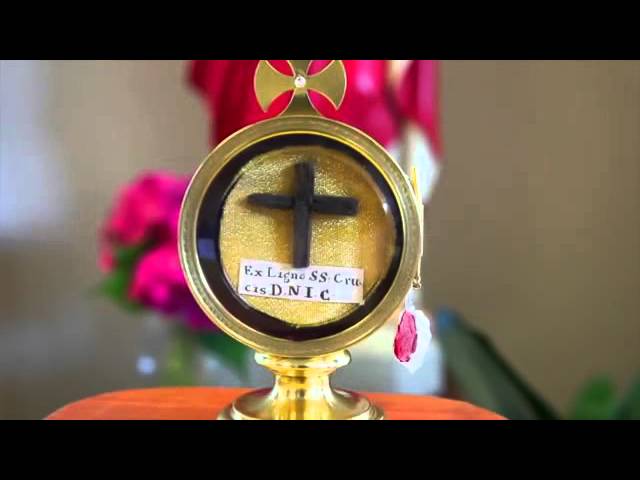
An FYI for you readers in FLORIDA.  Fr. Carlos Martins, who had the apostolate with relics of saints called “Treasures of the Church” is presently in Florida, making a circuit of the states, pretty much a different city and parish every day during May.

His schedule is HERE

You will not be sorry to have attended his presentation.

As I write this he is in Belleview, FL.  He will be in Sarasota, Naples, Tampa, Ave Maria, Miami, lots of places.   Check it out.

YouTube thumbnailYouTube icon

Posted in Events, The Campus Telephone Pole | Tagged ,
2 Comments

Daily Rome Shot 491, etc.

Please remember me when shopping online. Thanks in advance.

US HERE – UK HERE

Posted in SESSIUNCULA | Tagged
Comments Off on Daily Rome Shot 491, etc.

5 May: “O God, who deigned to choose blessed Pius to be Pontifex Maximus in order to smash the enemies of Thy Church to tiny bits” – UPDATED

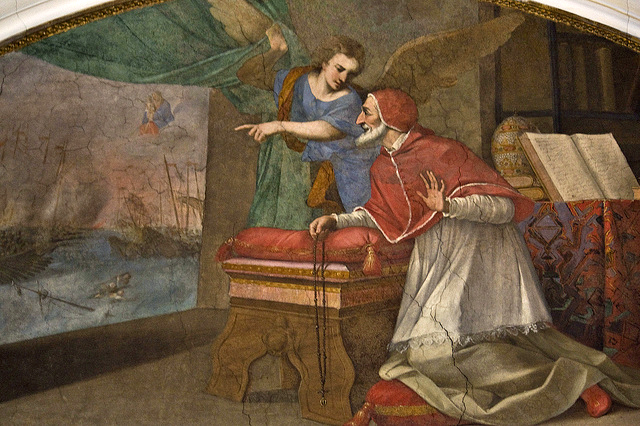
In the traditional Roman calendar, used with the 1962 Missale Romanum, the Vetus Ordo, today is the feast of St. Pope Pius V (+1572).

I made a PODCAzT about him some years ago, and about his famous document Quo primum.

084 09-04-30 St. Pius V and Quo primum

Here is a list of some of the accomplishments of St. Pius, who reigned for only a bit more than 6 years, and in tumultuous times.

1) began his pontificate by giving large alms to the poor (he did not just talk about them)
2) as Pope, continued the life of penance and virtue he had lived as a mendicant friar
3) made two meditations during the day ON BENDED KNEES in the presence of the Bl. Sacrament
4) visited hospitals and sat by the bedside of the sick
5) washed the feet of the (non-Muslim) poor and embraced the lepers
6) always opposed Protestantism and the Turks (Islam)
7) excommunicated Elizabeth I
8) instituted the Feast of the Holy Rosary
9) reformed the curia and the Church, leaving, after he died, “the memory of a rare virtue and an unfailing and inflexible integrity”
10) Closed the Council of Trent
11) Issued the Missale Romanum
12) Arranged the Holy League that fought at Lepanto
13) Instituted the Feast of Our Lady of Victory
14) Declared St. Thomas Aquinas Doctor of the Church
15) Reformed the Roman clergy
16) Reconstructed the Roman water supply
17) Condemned the teachings of Michael Baius
18) Reformed the Roman Breviary
19) Issued the Roman Catechism
20) Tried 8 French Bishops for heresy

St. John Henry Newman wrote:

“St. Pius V was stern and severe, as far as a heart burning and melted with divine love could be so … Yet such energy and vigour as his were necessary for the times. He was a soldier of Christ in a time of insurrection and rebellion, when in a spiritual sense, martial law was proclaimed.”

Let’s drill into the Collect for this saint:

Deus, qui, ad conterendos Ecclesiae tuae hostes et ad divinum cultum reparandum, beatum Pium Pontificem maximum eligere dignatus es: fac nos ipsius defendi praesidiis et ita tuis inhaerere obsequiis; ut, omnium hostium superatis insidiis, perpetua pace laetemur.

Contero is, “to grind, bruise, pound, to crumble, separate into small pieces”.  That word alone is a hint that this is a great prayer.  Obsequium, in the plural here, is a little tricky to get into English just right.  First, it has to do with God: it’s with tuis.  It has to do with how God is indulgent, toward us.  I want to say “cleave to your indulgences”, but that sounds like the use of the indulgences the Church grants from the treasury of the merits of Christ and the saints.  So, we have to put it another way.

Slavishly Literal Attempt:

O God, who deigned to choose blessed Pius to be Pontifex Maximus in order to smash the enemies of Your Church to bits and to renew the divine worship, cause us to be defended by his protections and to cleave with obedience to what You will in such way that, once the plots of all our enemies are overcome, we may rejoice in perpetual peace.

This is martial and bold.  This is exactly the attitude we need more of in the Church right now!

We are in a constant state of war with the world, flesh and the Devil.  And the Devil uses human agents (his “catch-farts”) in his deadly design.  The Church is best from within and from without, by enemies internal and external.

What do you think Pius would say today about the state of the Church?  The teachings of the Council he closed, Trent, are nearly abandoned in some parts, our sacred worship is in shambles, there is heresy and indifference, the Church’s external enemies, such as Communists and homosexualists, are rising with little or no guidance or outcry.

Sometimes, friends, we have to have the fight.  Then we can have the peace.

Note especially the point about “renewal of worship”.  I contend that nothing will change for the better in the Church until we undertake a serious revitalization of our sacred liturgical worship of God.   Alas, those in charge seem particularly set against that.  Revealing.

St. Pius V, pray for us.

And while we are at it…

Sts. Nunilo and Alodia, pray for us.
St. Lawrence of Brindisi, pray for us.
St. Peter Damian, pray for us.

UPDATE

From the great Fr. Hunwicke:

S Pius V and the liars

Today, his Feast Day, is the 450th anniversary of the Heavenly Birthday of Papa Ghislieri, Saint Pius V, Bishop of Rome.

Two BIG UNTRUTHS in particular are told about him, poor fellow.

Lie Number 1: he issued a radically revised version of the Roman Missal, just as S Paul VI was to do after Vatican II.

Fact: S Pius’s edition of the Missal was so light a revision that it was still possible, after its promulgation, to continue to use your old Missal.

Lie Number 2: although permitting some exceptions, S Pius ordered his edition to be used by everybody.

Fact: he ORDERED all rites older than 200 years to be kept in use. (He only permitted churches with 200-year-old-or-more rites to change over to his own new edition if the Diocesan Bishop and the unanimous chapter agreed).

I hope that is clear enough. But … so many people … Popes … Cardinals … Bishops  … have such trouble with all this … so … here’s another simple way of explaining the difference between S Pius V and Pope Francis:

(a) Pope Pius V ORDERED Rites older than 200 years to be RETAINED;

(b) Pope Francis is TRYING TO EXTERMINATE a Rite which is centuries more than 500 years old.

If people you are talking to really are so thick that they can’t understand the difference when you’ve tried both these ways of explaining things, give up.

Posted in Hard-Identity Catholicism, Saints: Stories & Symbols, SESSIUNCULA | Tagged
3 Comments

St. Monica, her incipient alcoholism, the intervention that saved her, some Latin

From Serge Lancel’s Augustine, the best biography I know of the great Bishop of Hippo (p. 8 ff – emphases mine):

Before devoting himself entirely to Mother Church, as he approached the age of forty, Augustine had had a concubine for about fifteen years, of whom he had been very fond and who had given him a son; then, at the same time as a fleeting engagement, a second short-lived liaison.  But only one woman really counted in his life, and that was his natural mother, Monica.

As we may guess from reading a few pages of Book IX.8 of the Confessions, Patricius – Augustine’s father – had taken a wife in Thagaste from a milieu close to his own.  He had married Monica, as his would describe it in a phrase borrowed from Virgil, “in the fullness of her nubility”, which means that he had not married a child, a practice that was in any case more rare then in Africa that in Rome itself.  The couple had three children, in what order we do not know: a girl, who remains anonymous to us, but who, once widowed, would later become the superior of a community of nuns, and two boys, Augustine and Navigius, whom we shall find with his brother in Italy, at Cassiciacum, then at Ostia at their dying mother’s bedside.  …

So Monica had been born into a Christian family and was, as we would say today, a practicing believer.  The religious practices of Christians at that time, in North Africa, sometimes included aspects that would be surprising to us, such as the custom of taking offerings of food to the tombs of martyrs, for agapes that only too often degenerated into orgies; an obvious survival of the pagan festival of the Parentalia.  Of course, Monica did not indulge in those excesses.  If the baskets she brought to the cemetery contained, besides gruel and bread, a pitcher of unadulterated wine, when the time came to share libations with other faithful, she herself would take only a tiny amount, diluted with water, sipped from a goblet in front of every tomb visited.  Was this sobriety a memory of some experience in her early youth?  Augustine tells this story which he says he heard from the lady herself.  Raised in temperance by an old serving-woman who enjoyed the complete trust of Monica’s parents, she had fallen into a bad habit.  Well-behaved girl that she was, she was sent to the cellar to fetch wine from the cask, but before using the goblet she had brought to fill the carafe she would just wet her lips with the wine, not because she liked it, says Augustine, but out of childish mischief.  But gradually she had acquired a taste for it, to the point where she was drinking entire goblets of it with great gusto.  Fortunately she had cured herself of this incipient liking for drink in a burst of pride: the maidservant who accompanied her to the cellar, having fallen out one day with her young mistress insultingly called he a “little wine bibber”.  Stung to the quick, Monica had immediately stopped her habit.

Think now about the spiritual works of mercy: admonish the sinner.  Consider how that servant affected WESTERN CIVILIZATION because of what she did for the future mother of St. Augustine, arguably one of the most influential figures in history.

CLICK

Here’s the Latin from conf 9.8.18.  A few interesting words in bold:

8. 18. Et subrepserat tamen, sicut mihi filio famula tua narrabat, subrepserat ei vinulentia. [“an inclination for getting drunk on wine slithered into her”] Nam cum de more tamquam puella sobria iuberetur a parentibus de cupa vinum depromere, submisso poculo, qua desuper patet, priusquam in lagunculam funderet merum, [wine uncut with water – in the ancient world wine was always cut and it drinking merum was a sign of low manners, etc, as Cicero accused Mark Antony] primoribus labris sorbebat exiguum, quia non poterat amplius sensu recusante. Non enim ulla temulenta [archaic word for wine] cupidine faciebat hoc, sed quibusdam superfluentibus aetatis excessibus, qui ludicris motibus ebulliunt et in puerilibus animis maiorum pondere premi solent. Itaque ad illud modicum quotidiana modica addendo; quoniam qui modica spernit, paulatim decidit; in eam consuetudinem lapsa erat, ut prope iam plenos mero caliculos inhianter hauriret. [with a gaping mouth she quaffed whole cups of uncut wine] Ubi tunc sagax anus [wise old woman] et vehemens illa prohibitio? Numquid valebat aliquid adversus latentem morbum, nisi tua medicina, Domine, vigilaret super nos? Absente patre et matre et nutritoribus tu praesens, qui creasti, qui vocas, qui etiam per praepositos homines boni aliquid agis ad animarum salutem. Quid tunc egisti, Deus meus? Unde curasti? Unde sanasti? Nonne protulisti durum et acutum ex altera anima convicium tamquam medicinale ferrum [reproach like a cautering iron] ex occultis provisionibus tuis et uno ictu putredinem illam praecidisti? Ancilla enim, cum qua solebat accedere ad cupam, litigans cum domina minore, ut fit, sola cum sola, obiecit hoc crimen amarissima insultatione vocans meribibulam. [The old servant woman threw this crime (at Monica) with the bitterest reproach calling her a drunk (“wine-swiller”).] Quo illa stimulo percussa respexit foeditatem suam confestimque damnavit atque exuit. Sicut amici adulantes pervertunt, sic inimici litigantes plerumque corrigunt. Nec tu quod per eos agis, sed quod ipsi voluerunt, retribuis eis. Illa enim irata exagitare appetivit minorem dominam, non sanare, et ideo clanculo, aut quia ita eas invenerat locus et tempus litis, aut ne forte et ipsa periclitaretur, quod tam sero prodidisset. At tu, Domine, rector caelitum et terrenorum, ad usus tuos contorquens profunda torrentis, fluxum saeculorum ordinans turbulentum, etiam de alterius animae insania sanasti alteram, ne quisquam, cum hoc advertit, potentiae suae tribuat, si verbo eius alius corrigatur, quem vult corrigi.

In the online Pusey translation… a little dated:

And yet (as Thy handmaid told me her son) there had crept upon her a love of wine. For when (as the manner was) she, as though a sober maiden, was bidden by her parents to draw wine out of the hogshed, holding the vessel under the opening, before she poured the wine into the flagon, she sipped a little with the tip of her lips; for more her instinctive feelings refused. For this she did, not out of any desire of drink, but out of the exuberance of youth, whereby it boils over in mirthful freaks, which in youthful spirits are wont to be kept under by the gravity of their elders. And thus by adding to that little, daily littles (for whoso despiseth little things shall fall by little and little), she had fallen into such a habit as greedily to drink off her little cup brim-full almost of wine. Where was then that discreet old woman, and that her earnest countermanding? Would aught avail against a secret disease, if Thy healing hand, O Lord, watched not over us? Father, mother, and governors absent, Thou present, who createdst, who callest, who also by those set over us, workest something towards the salvation of our souls, what didst Thou then, O my God? how didst Thou cure her? how heal her? didst Thou not out of another soul bring forth a hard and a sharp taunt, like a lancet out of Thy secret store, and with one touch remove all that foul stuff? For a maid-servant with whom she used to go to the cellar, falling to words (as it happens) with her little mistress, when alone with her, taunted her with this fault, with most bitter insult, calling her wine-bibber. With which taunt she, stung to the quick, saw the foulness of her fault, and instantly condemned and forsook it. As flattering friends pervert, so reproachful enemies mostly correct. Yet not what by them Thou doest, but what themselves purposed, dost Thou repay them. For she in her anger sought to vex her young mistress, not to amend her; and did it in private, either for that the time and place of the quarrel so found them; or lest herself also should have anger, for discovering it thus late. But Thou, Lord, Governor of all in heaven and earth, who turnest to Thy purposes the deepest currents, and the ruled turbulence of the tide of times, didst by the very unhealthiness of one soul heal another; lest any, when he observes this, should ascribe it to his own power, even when another, whom he wished to be reformed, is reformed through words of his.
Posted in Patristiblogging, Saints: Stories & Symbols | Tagged , ,
2 Comments

4 May – St. Monica: Intercessor for children who who have fallen away from the Faith

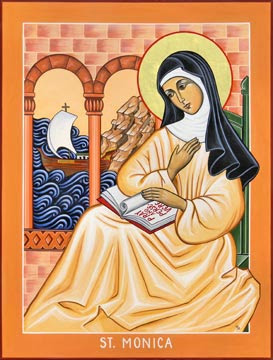
In the older, traditional Roman calendar today is the feast of the mother of St. Augustine, St. Monnica, widow.  She died in Ostia (Rome’s port) in 387, when she and her family were heading back to North Africa after Augustine’s conversion and baptism by St. Ambrose.  She caught a fever during a blockade of the port.

Yes, you can spell her name “Monnica”, with two n’s which is consistent with her Punic origins.

I have a first-class relic of this marvelous woman as well as one of her son, Augustine and also of Ambrose.

20130504-094844.jpg

In the post-Conciliar calendar, her feast was moved to be next to that of her son.

As she lay dying in Ostia near Rome, Monnica told Augustine (conf. 9):

“Lay this body anywhere, let not the care for it trouble you at all. This only I ask, that you will remember me at the Lord’s altar, wherever you be.”

She was buried there in Ostia. Her body was later moved to the Church of St. Augustine in Rome across the street from where I lived for many years.

May she pray for us, for widows and for parents of children who have drifted from the Church.

Be sure to pray for the departed. Pray for them! Don’t just remember them. Don’t just think well of them. Don’t just, as the case may be, resent or be angry at them.

Pray for them!

Prayer for the dead is a spiritual work of mercy.

Also, I’ll remind you of a fine book on Augustine:

REVIEW: The book on Augustine which Pope Benedict would have wanted to write.

Also, if you want a really interesting book on the Doctor of Grace, check out Serge Lancel‘s volume.

UK HERE

BTW… read about how Monica’s original Latin epitaph inscription was found in Ostia by some kids who wanted to play basketball.  HERE

Posted in Saints: Stories & Symbols | Tagged ,
2 Comments

Daily Rome Shot 490, etc.

Photo by The Great Roman™

Posted in SESSIUNCULA | Tagged
Comments Off on Daily Rome Shot 490, etc.