From a reader…
QUAERITUR:
One of the most used terms regarding problems in the Church is that it is indefectable, implying that there is no need to worry about this or that issue, soon God will resolve it. But there seems to be a drive to change doctrine more and more to such an extent some (perhaps me) find it difficult to recognize whether the Church is the same Church as it was a thousand years ago. Is it possible for the administrative structure of the Church to be the “wrong” church, while the true Church is elsewhere? I suppose it is not according to Catholic theology, but if the Church is rejecting traditional Catholic theology, can it really be the Church? Or is it possible the Apostolic See could largely be a part of the tares at the end of time?
I suspect that quite a few Catholics are asking themselves something similar these days. I also suspect that some are afraid even to ASK question, lest they be accused of schism, disobedience, or some other ecclesiastical Thoughtcrime and wind up Unpersoned.
A couple things come to mind.
First, a while back – I wrote about it HERE – Fr. Thomas G. Weinandy, OFM, Cap., with whom I am still annoyed, wrote something that got him in hot water. He suggested that suggested that Francis was in schism with himself, since he was out of step with what popes do.
Also, Blessed Archbishop Fulton Sheen prophesied – I think that is the right word – during a radio broadcast on 26 January 1947 something at the time no one thought possible. He said that the Devil was too smart to show up in red skin, horns and a tail. The Enemy would, basically, hide so that people would cease to believe that he existed. Consequently, they would cease to believe in Hell and, thereafter, Heaven, good and evil and so forth. Sheen said the anti-Christ would set up a counter-Church
“which will be the ape of the Church because, he the devil, is the ape of God. It will have all the notes and characteristics of the Church, but in reverse and emptied of its divine content. It will be a mystical body of the anti-Christ that will in all externals resemble the mystical body of Christ.”
So, yes, I think this can happen to the Church in her earthly particulars. I think that a parish or diocese or larger structure have the outward signs of being something, but deep down they aren’t. Similarly, I think that certain phenomena, such as a claimed apparition, can produce some good, but really be a head fake of the Enemy.
Let’s boil this down to the bone.
Can the visible structures of the Church become a false Church while the true Church survives elsewhere?
Ven. Pius XII observes in Mystici Corporis 66 that human weakness can be found even among the most exalted members of the Mystical Body. This addresses issue without conceding that the visible Catholic Church can entirely cease to be Christ’s Church.
First, we must be clear about what indefectibility means.
Indefectibility is Christ’s promise that His Church will endure until the end of time, preserving her essential constitution, her apostolic faith, her sacraments, and her mission of salvation.
However, indefectibility is not a guarantee that every Pope will be prudent, every bishop orthodox, every ecclesiastical policy wise, or every document emanating from Rome a masterpiece of theological precision. Still less does it mean that whenever a crisis arises we should fold our hands, smile complacently, and wait for God to tidy things up. The divine promise to the Church doesn’t cancel out human irresponsibility.
Christ promised His Church indefectibility. He also commanded His Apostles to teach, to correct, to guard the flock, and to beware of wolves (rather than run from them… see what happens when a shepherd runs from the wolves…?). Those commands would be pointless if the divine guarantee made vigilance unnecessary.
Leaving aside more recent history, consider what happened during the Arian crisis. Great numbers of bishops were compromised by heresy or confusion, St. Athanasius suffered exile, St. Hilary of Poitiers endured persecution, etc. The faithful sometimes found themselves defending the orthodox faith against men who occupied positions of ecclesiastical authority. St. Jerome wrote of that time in his Dialogue against the Luciferians “The whole world groaned, and was astonished to find itself Arian.”
Yet the Church did not cease to be the Church.
Here is the distinction we must hold firmly: the indefectibility of the Church does not entail the indefectibility of individual churchmen. Think about the great Churches of Asia Minor and North Africa. Gone. There is no guarantee that the Church will endure in some place.
Your question, however, goes further. Could the institutional Church itself become a false Church while the true Church continued somewhere else, perhaps among a relatively small number of faithful Catholics?
The Church founded by Christ is a visible, hierarchical society as well as His Mystical Body. We cannot simply detach the mystical Church from her visible constitution and relocate the true Church wherever we judge that orthodoxy has survived. The Church’s apostolic succession, sacraments, and communion with the Successor of Peter belong to her divinely established constitution.
Vatican II taught this in Lumen gentium 8:
Christ, the one Mediator, established and continually sustains here on earth His holy Church, the community of faith, hope and charity, as an entity with visible delineation through which He communicated truth and grace to all. But, the society structured with hierarchical organs and the Mystical Body of Christ, are not to be considered as two realities, nor are the visible assembly and the spiritual community, nor the earthly Church and the Church enriched with heavenly things; rather they form one complex reality which coalesces from a divine and a human element. For this reason, by no weak analogy, it is compared to the mystery of the incarnate Word. As the assumed nature inseparably united to Him, serves the divine Word as a living organ of salvation, so, in a similar way, does the visible social structure of the Church serve the Spirit of Christ, who vivifies it, in the building up of the body.
At this point I will add that Christ’s human body had its limits. He was hungry after He fasted, He suffered greatly during His Passion. He fell more than once under His Cross and needed human help to complete the way.
The human dimension of the Church is supported by the divine will in the essentials of her constitution, but not in all the details. Moreover, the Enemy is very good at being an enemy.
That said, it seems to me that the proposition that if the entire visible Catholic Church could defect and be replaced in secret by an invisible association of the doctrinally sound, then Christ’s promise concerning Peter and the Church would lose its intelligible meaning.
However, there is another distinction.
The visible Church is not identical with the totality of the ecclesiastical bureaucracy. The Roman Curia, episcopal conferences, diocesan chanceries, commissions, committees, and the seemingly inexhaustible production of documents are instruments of governance, some necessary, others merely useful, and others perhaps useful chiefly to those who draw salaries from them. Their policies can be imprudent, judgments can be mistaken, even downright stupid. Their occupants can behave scandalously. They can even be promoters of confusion and error.
The failure of an ecclesiastical entity or personage does not equate with the failure of the Church.
In Vatican I’s Pastor aeternus 4 there is something enormously important:
The Holy Spirit was not promised to Peter’s successors so that they might disclose new doctrine through His revelation, but so that, with His assistance, they might sacredly guard and faithfully expound the revelation handed down by the Apostles, namely, the deposit of faith.
The Pope is the guardian of the deposit of faith, not its proprietor. He has no authority to reverse divine revelation. Neither does an ecumenical council. Neither does an episcopal conference or a local bishop. Authentic doctrinal development preserves identity with what has been handed down.
A contradiction cannot be made into a authentic development simply by sticking the word “pastoral” into it.
When an apparently novel teaching seems to conflict with what the Church has always taught, Catholics have every reason and right to seek clarification. One must examine precisely what is being taught, with what authority, and whether the supposed contradiction is real or just seems to be contradictory. Not every papal remark, prudential judgment, disciplinary measure enjoys the charism of infallibility.
Even less so do entities established with a vague framework and goal.
At the same time, we must avoid setting ourselves up as private judges over the entire Magisterium, accepting only those teachings that pass our individual inspection. That road has its own perils.
You also ask whether the Apostolic See could be largely populated by the tares of the Gospel. Could there be many unfaithful men in positions of ecclesiastical authority, even very high authority?
Certainly!
Our Lord Himself chose twelve Apostles, one of whom literally betrayed Him to His death. Judas did not invalidate the apostolic college.
Could the Church undergo a terrible trial involving widespread apostasy, religious deception, and the apparent triumph of evil?
Certainly!
Grounded in Scripture, the Catechism of the Catholic Church 675–677 explicitly teaches that the Church must undergo a final trial before Christ returns.
Before Christ’s second coming the Church must pass through a final trial that will shake the faith of many believers. The persecution that accompanies her pilgrimage on earth will unveil the “mystery of iniquity” in the form of a religious deception offering men an apparent solution to their problems at the price of apostasy from the truth. The supreme religious deception is that of the Antichrist, a pseudo-messianism by which man glorifies himself in place of God and of his Messiah come in the flesh.
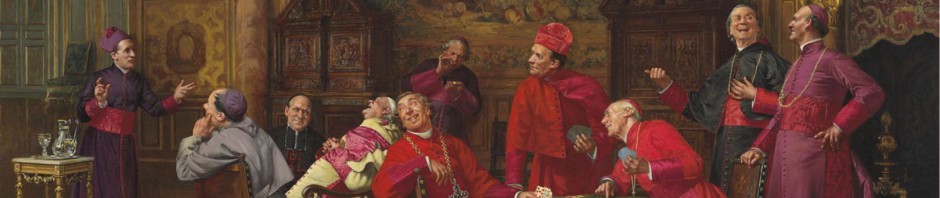
The parable of the wheat and the tares, employed by St. Augustine against the Donatists, should make us alert. The two grow together until the harvest. The Church’s visible communion contains sinners as well as saints. Some of those sinners may wear miters. Some may wear red hats.
Again, the Enemy is good at being an enemy. He makes use of crises of faith. When faithful Catholics see confusion promoted by those charged with dispelling it, they can be tempted toward despair. The Enemy can strike and strike hard to promote dissension and division, schism and apostasy. Those afflicted might imagine that fidelity to Catholic Tradition requires abandoning the visible communion of the Catholic Church.
The very Tradition they wish to preserve teaches the necessity of the Church’s visible unity.The Church belongs to Christ. Churchmen are stewards. Some are faithful, some are negligent, some are even wicked infiltrators with a destructive mission. They will answer to the Master.
Indefectibility does not guarantee that we, here and now, shall be spared a terrible storm. It guarantees that the Barque of Peter will not ultimately sink. There may come a day when we have to throw cargo overboard, man the pumps, bend every sail – even our handkerchiefs – and run like smoke n’ oakum before the wind.
But not today.
So, what to do?
- Hold fast to what the Church has always taught. Learn your catechism.
- Read the older magisterial documents.
- Distinguish levels of magisterial authority.
- Receive the sacraments in the state of grace.
- Pray for the Pope, bishops and priests, especially those whose words or actions trouble you.
- Support good priests.
- Resist error with charity, clarity, and courage.
- Remember that the obligation to obey legitimate ecclesiastical authority does not include an obligation to embrace falsehood.
- Do not surrender your Catholic identity to those who seem determined to make Catholicism unrecognizable.


 prayfatima on ROME 26/10– Day 14: Great scissors: “Beautiful sky. It reminds me of a poem: October’s Bright Blue Weather by Helen Hunt Jackson O suns and skies…”