St. Teresa of Avila Calendars, Chess, and You

Today is the Feast of St. Teresa of Avila (+4 Oct 1582).

A few weeks ago I posted – HERE – that recently the tomb of St. Teresa was opened for examination and her body was found to be incorrupt.

In 1582, the ancient Julian calendar (organized by, yes, Julius Caesar and still observed by many Orthodox Christians) officially was terminated on Thursday 4 October by the command of Gregory XIII (1572–1585, Ugo Boncompagni) via the papal bull Inter gravissimas.

At midnight of 3-4 October the calendar skipped automatically to a day named Friday 15 October.

The famed Jesuit mathematician Christopher Clavius (+1612) worked out the calculations for this change.  He chose October for the moment of the jump because it had the fewest feast days.

He also did his calculations without the use of the decimal point!

St. Teresa of Avila died on the very night on which His Holiness had commanded that the calendar shift from 4 October to 15 October, which is why her feast is celebrated on the 15th rather than the 3rd or 4th.

Moreover, St Teresa bumped St. Hedwig from the 15th to the 16th.  I’m sure St. Hedwig didn’t mind, given the circumstances.

St. Teresa is know, of course, for being a reformer of the Carmelites.   Perhaps it is even more important that she is the Patroness of Chess Players… oh yeah… and she’s a Doctor of the Church, which is why she is often depicted with the doctoral biretta.

This is from The Way of Perfection 16 by St. Teresa of Avila, Doctor of the Church and Patroness of Chess Players.


1.But you may be sure that anyone who cannot set out the pieces in a game of chess will never be able to play well, and, if he does not know how to give check, he will not be able to bring about a checkmate. Now you will reprove me for talking about games…[but] if we play it frequently, how quickly we shall give checkmate to this Divine King! He will not be able to move out of our check nor will He desire to do so.

It is the queen which gives the king most trouble in this game and all the other pieces support her. There is no queen who can beat this King as well as humility can; for humility brought Him down from Heaven into the Virgin’s womb and with humility we can draw Him into our souls by a single hair. Be sure that He will give most humility to him who has most already and least to him who has least. I cannot understand how humility exists, or can exist, without love, or love without humility, and it is impossible for these two virtues to exist save where there is great detachment from all created things…

This is an error which we all make: if a person gets so far as to spend a short time each day in thinking about his sins, as he is bound to do if he is a Christian in anything more than name, people at once call him a great contemplative; and then they expect him to have the rare virtues which a great contemplative is bound to possess; he may even think he has them himself, but he will be quite wrong. In his early stages he did not even know how to set out the chess-board, and thought that, in order to give checkmate, it would be enough to be able to recognize the pieces. But that is impossible, for this King does not allow Himself to be taken except by one who surrenders wholly to Him.”

1. Y no os parezca mucho todo esto, que voy entablando el juego, como dicen. Pedísteisme os dijese el principio de oración; yo, hijas, aunque no me llevó Dios por este principio, porque aún no le debo tener de estas virtudes, no sé otro. Pues creed que quien no sabe concertar las piezas en el juego de ajedrez, que sabrá mal jugar, y si no sabe dar jaque, no sabrá dar mate. Así me habéis de reprender porque hablo en cosa de juego, no le habiendo en esta casa ni habiéndole de haber. Aquí veréis la madre que os dio Dios, que hasta esta vanidad sabía; mas dicen que es lícito algunas veces. Y cuán lícito será para nosotras esta manera de jugar, y cuán presto, si mucho lo usamos, daremos mate a este Rey divino, que no se nos podrá ir de las manos ni querrá.

2. La dama es la que más guerra le puede hacer en este juego, y todas las otras piezas ayudan. No hay dama que así le haga rendir como la humildad. Esta le trajo del cielo en las entrañas de la Virgen, y con ella le traeremos nosotras de un cabello a nuestras almas. Y creed que quien más tuviere, más le tendrá, y quien menos, menos. Porque no puedo yo entender cómo haya ni pueda haber humildad sin amor, ni amor sin humildad, ni es posible estar estas dos virtudes sin gran desasimiento de todo lo criado….

4. Mas contemplación es otra cosa, hijas, que éste es el engaño que todos traemos, que en llegándose uno un rato cada día a pensar sus pecados (que) está obligado a ello si es cristiano de más que nombre), luego dicen es muy contemplativo, y luego le quieren con tan grandes virtudes como está obligado a tener el muy contemplativo, y aun él se quiere, mas yerra. En los principios no supo entablar el juego: pensó bastaba conocer las piezas para dar mate, y es imposible, que no se da este Rey sino a quien se le da del todo.


It is interesting that St. Teresa talks about the queen.  That is a piece with a truly fascinating history.

A chessy history book:

Birth of the Chess Queen: A History

US HERE – UK HERE

The author is a feminist, but the book is pretty good history.  It was really interesting.

Posted in Saints: Stories & Symbols, SESSIUNCULA | Tagged
1 Comment

Rome 24/10 – Day 15: Anger and good food

At 7:21 the sun rose and it will set at 18:30.

The Ave Maria Bell, marking the end of the ecclesiastical work day, would ring at 18:45.

Thank you, Lord, for this day.

Since it is also the Ides of October, today in ancient Rome would have been their “Oktoberfest”… day of the October Horse.  More on that below.

Today is the Feast of the Patroness of Chess, St. Teresa of Avila, Doctor of the Church.

St. Teresa, pray for us.

St Teresa, a great many of us are fed up with the … shenanigans!

Pray for the Church’s pastors who are persecuting traditionally-minded women religious.  Intercede with God to blunt the mania of aimless process for the sake of process.  Ask God to curb, even with chastisement if necessary, the insanity of gender-bending sex confusion and the appalling acts that it involves.

Her relic at The Parish™ which The World’s Best Sacristan™ prepared for exposition at the altar for the Masses today.

Last night was the “cena di congedo” for my friends who returned to home after the celebration of their 50th anniversary.  La Signora desired some of my green risotto and I was happy to oblige, thus the swoop out of the side.   Proof that we do more than take photos of prepared plates.  We eat the food, too.

The light wasn’t the best, but I think you get the idea.    “Fiorentina”.

After, amaro (one I had not tried before) and ciambelline made in house.

I am spectacularly irritated at Acqua Nepi for bastardizing their label on their .65 l bottle. The nerve.

They went whoring after modern and zippy only to lose their class and identity. It’s good water but I want the company to suffer for this impudent and useless innovation. The other bottles have still a decent label but… what the fresh hell is going on?!? Are they – sorry – testing the waters?

The offending close-up.

They need to get some bad feedback. The last time they tried this crap, I called them up and gave them a piece of my mind and, as they told me then, they scrapped their update that excluded the motto.

It is not to be borne. One more change…. I shall write to them a serious nastygram.

What is the motto, you ask?

Nepe civitas, nobilis atque potens, in cuius fertilissimis agris balnea scaturiunt salutifera.

Can you imagine? They took off the best part, their motto ribbon and Latin phrase.

Please remember me when shopping online and use my affiliate links.  US HERE – UK HERE  WHY?  This helps to pay for health insurance (massively hiked for this new year of surprises), utilities, groceries, etc..  At no extra cost, you provide help for which I am grateful.

In churchy news… this.

I promised more about the October Horse and ancient Rome.

One of the annual rituals of ancient Rome was the rite of the October Horse.  On this day there was a race between two-horse chariots held in the Campus Martius (at that time open fields).  The right hand horse of the victorious pair would be sacrificed by the flamen (priest) of Mars on an altar there in the Campus Martius (Martius… Mars… right?).  After the sacrifice, people who lived in the Via Sacra neighborhood would fight the people who lived in the Suburra and Francis Ford Coppola for the horse’s head. If the Sacravienses won, would display it on the Regia (where the Roman kings had been). If the Suburrenses won, it was displayed at the Turris Mamilia (a long-gone tower in the rough and tumble Suburra low zone along the slopes of the Viminal and Esquiline Hills). Meanwhile, the horse’s cauda (both tail and genitals) would taken to the Regia to drip its blood on a the sacred hearth.  The Vestal Virgins got some of the blood for use at the Parilia festival on 21 April which was associated with the Birthday of Rome.

The Australian writer Colleen McCullough penned a series of books set in ancient Rome beginning with the rise of Gaius Marius in The First Man in Rome and going all the way through the time of Caesar into the whole Anthony and Cleopatra train wreck.  One of the books is The October Horse which concerns the assassination of Julius Caesar and the rise of Octavian.  The books are admirably well-researched for historical novels.  She explains where she takes any liberties and why.  They stick well to the history of the devolution of the Republic and give great explanations of the events, Roman law, religion, culture, the fierce politics and dynamics of families and tradition, the role of the military.

In the first volume, on Gaius Marius, she gets her feet wet. She hits her stride in The Grass Crown, about Lucius Cornelius Sulla.  Yes, there are objectionable passages, blahhhaity blah blaaaaah.  Skip them and don’t get worked up.  They are historical novels, but they have a great deal of just straight history in them.

We like straight.

In straight chessy news… HERE

(Black to move and straight away and straight mate in 3)

Posted in SESSIUNCULA |
3 Comments

Adoremus: 12 points of “anti-liturgical heresy” and their counters

With a biretta tip to Peter K for the link… o{]:¬)

At the liturgical review Adoremusthis…

The Voice of Tradition: Prosper Guéranger’s “Anti-Liturgical Heresy”

Never mind that an odd character appears every once in a while. Odd characters always appear once in a while (this time, some й for é).

What’s this about?

Guéranger summarized the errors which he and many future proponents of the Liturgical Movement sought to correct in popular approaches to the liturgy through what he called the “anti-liturgical heresy.

The development of the liturgy can be measured according to Guéranger’s description of this heresy as he found it in the early Church, the Protestant Revolution, and through the errors of the Jansenists and Gallicans of Guéranger’s own time, as well as the varied threads of this heresy which were woven into the Liturgical Movement in the 20th century. Guéranger divided the anti-liturgical heresy into 12 distinct criteria: (1) hatred of Tradition; (2) substitution of ecclesiastical formulae for readings exclusively from Scripture; (3) fabrication of innovative formulae; (4) antiquarianism; (5) demystification of the liturgy; (6) “pharisaical coldness”4 in liturgical prayer; (7) removal of all intermediaries (Marian devotion, communion of saints, etc.); (8) replacement of sacred languages with the vernacular; (9) simplification of rites and easing of religious duties; (10) rejection of papal authority; (11) laicization, denying the sacramental nature of the ministerial priesthood; and (12) confusion of the roles of priests and laity in liturgical reform.

Pow!

The article spins these out.   I recommend it.

As we move along in it…

From Guéranger’s negative criteria of the anti-liturgical heresy, Dom Alcuin Reid deduced positive principles which clarify and affirm liturgical tradition: “[corresponding to criteria 1 and 2] [to] protect the place of non-scriptural texts in the organic whole of the Liturgy; [3] innovate rarely and only where necessary; [4] reject antiquarianism out of respect for the living, developed Liturgy; [5] protect all that speaks of the supernatural and of mystery in the Liturgy; [6] similarly, protect the nature of Liturgy as prayer and worship lest it be reduced to a didactic exercise; [7] treasure the role of the Blessed Virgin and of the saints in the Liturgy; [8] reject vernacularism; [9] resist the temptation to sacrifice the Liturgy for the sake of speed; [10] rejoice in liturgical unity with the Church of Rome; and, [11 and 12] to respect the particular liturgical roles and authority of the ordained.”

We are our rites.

Posted in Hard-Identity Catholicism, Liturgy Science Theatre 3000, The Drill, The future and our choices | Tagged ,
6 Comments

Rome 24/10 – Day 13 & 14: A day of marvels

Busy post today, as I catch up. A combination of factors yesterday kept me from posting the usual.

Today over Rome received first sunshine at 7:20. It will diminish at 18:32. The Ave Maria rings at 18:45.

Yesterday, 13 Oct, the 287th day of the civil calendar and 21st Sunday after Pentecost, had lots going on.

Anniversary of the Miracle of the Sun at Fatima.
Anniversary of the Message of Akita Japan.
Anniversary of Leo XIII’s vision.
Perhaps the Anniversary of the Crucifixion of St. Peter.
243rd Birthday of the United States Navy

Today is the Feast of St. Calixtus whose tomb is across the river from me at Santa Maria in Trastevere.

Yesterday I had two powerful encounters with the supernatural.

I attended the Sunday Solemn Mass at The Parish™.   The altar was simple, with portapalme and no relics.   The ceremonies were effectively flawless, smooth, comfortable.  Nothing was rushed.  No hesitations or doubts or ooopses.

The “moment” came at the Consecration.

From my viewpoint, on the side in choir, there was a moment of harmony which exemplified the perfection of the Roman Rite.

The Subdeacon knelt at the lowest step.  The Deacon knelt at the Celebrant’s right to elevate the edge of the vestment slightly.  The Celebrant’s arms were raised, first with the Host, then the Chalice, above the Corporal.  There was a perfect line from the Subdeacon’s paten, through Deacon’s arm and the edge of the chasuble upward through the back of the vestment continuing in the priest’s upraised arms through the Host and Chalice to the figure of the Crucified Savior on the altar Cross.   If that weren’t enough, Guido Reni’s Trinity was then also directly in line, in my opinion the most beautiful of all the altar pieces of Rome.  I know from having celebrated Mass at the main altar that when you raise the Host and Chalice, you see “through” the altar Crucifix to Christ’s Body on the Cross in the painting, his face above the Host and Chalice, his torso framing them.

It was a perfect moment when everything came together, goodness, truth, beauty, the Church’s teachings and faith expressed in the liturgical rite, the movement and sudden fleeting stillness that crystalized the coalesced image of them all.

It was overwhelming.

I’ve seen and celebrated a great many Solemn Masses in my 30+ years as a priest (though not recently… thanks, you dear dear dear bishops for your moral integrity and fortitude in the face of opposition), but this was something special.  Perhaps it was also special because it was fueled by my interior hunger.

Hence, I’ll take a moment here to thank my dear Roman Donors who put me in that choir stall at the moment.

The second supernatural encounter had a rather difference impact.

Saying Mass privately in the evening, as I often do here on Sunday, there was outside in the street a “musician” of such appalling skills that I was dubious that I could maintain my concentration.   I determined two things, firstly, to ask Jesus the High Priest to send Holy Angels to silence the fellow and, next, that I would say all the prayers with a full voice to drown out in my head the ghastly cacophony in competition for my mind.

I started Mass and, shortly after, whattsits outside stopped “singing” (if that’s what it was) and the guitar was quieter and quieter.   I proceeded to the necessary end.

Mass accomplished, I went out to meet friends (at Cafe Taba at the Campo de’ Fiori if you have to know).  As I passed by the guy who had been playing, silent in that moment, I heard him say to my back:  “Al demonio non piace… the demon doesn’t like that” or “the demon doesn’t like you”.

I immediately enjoyed with extra enjoyment a gin and tonic and a cigar with friends.

Lord thank you for that day.  Lord thank you for this day.

This is another cool thing that happened.


Now for some Rome stuff.

Incensation of the altar during the Mass I mentioned above.

YouTube thumbnailYouTube icon

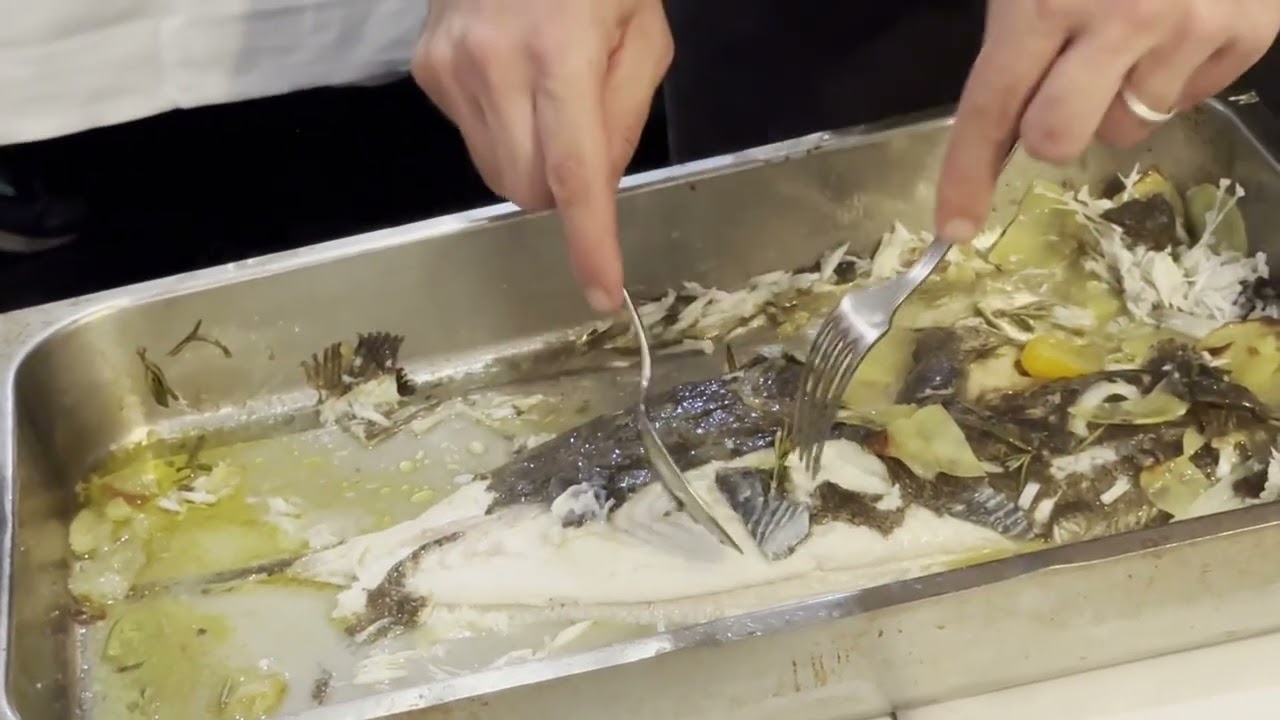
Soon to be eaten flat fish for a 50th wedding anniversary supper.

YouTube thumbnailYouTube icon

Nice people! Great service!

In churchy news… another summit meeting with “trans” took place. Scandal, anyone?

Not only that, something odd came out of the Roman “vicariate” office (which runs the Roman diocese). An edict came forth stating that, from now on, with the appointment of the new diocesan Cardinal Vicar General, his name must now be added to the Eucharist Prayer of Mass after Francis’. That isn’t too weird, since the Novus Ordo permits, according to the determinations of bishops conferences (I think), that names of auxiliaries etc. can be mentioned along with the name of the local diocesan bishop. Remember that in Rome the local diocesan bishop is the Pope. Hence, when saying, for example, the Roman Canon, you just pass over the bit about “our bishop” as redundant. But! Not now in Roma! Now the Cardinal Vicar’s name is to be said. But! But! Not his actual name is to be said, Baldassare (In Latin Baldássar) but rather simply “Baldo”, which is not quite a diminutive, I think, like “Bob” is for “Robert”, but just a shortening… but not even. So, we were trying to figure out the Latin for “Baldo”. We came up with “Baldolus”.  I dunno.  I’m glad for the silent Canon.

Please remember me when shopping online and use my affiliate links.  US HERE – UK HERE  WHY?  This helps to pay for health insurance (massively hiked for this new year of surprises), utilities, groceries, etc..  At no extra cost, you provide help for which I am grateful.

In chessy news… HERE

White to move and mate in 3.

Posted in SESSIUNCULA |
1 Comment

WDTPRS – 28th Ordinary Sunday (Novus Ordo): Authentic “walking together”

One of my “classic” WDTPRS posts, but appropriate given all the gas right now about “walking together”.  This is about God’s walking together with us in the deepest sense… the one which can bring us to salvation instead of virtue signaling.


The elegant Collect for the 28th Ordinary Sunday has been used for centuries on the 16th Sunday after Pentecost according to the traditional Roman calendar.  This is a lovely prayer to sing.

Tua nos, quaesumus, Domine, gratia semper et praeveniat et sequatur, ac bonis operibus iugiter praestet esse intentos.

The separation of tua and gratia in the first line is an example of the figure of speech called hyperbaton: unusual word order to produce a dramatic effect.  That et… et construction is snappy.

This prayer was in manuscripts of the Gregorian Sacramentary which results from the 10th c.   The prayer must have struck a chord with Thomas a Kempis in the 15th c., for he quotes it in the Imitation of Christ, Bk. III, 55: Liber internae consolationis.    It may also have been echoed earlier, in the a 12th c. Commentarium in Ruth e codice Genouefensi: Ex quo motandum est nec fortes stare nec posse debiles proficere, si non superna gratia et praeveniat et sequatur.

st-alphonsus-liguoriThe pair of verbs praeveniat…sequatur reminds me of a prayer I heard at my home parish every Tuesday night after the communal recitation of the Novena of Our Mother of Perpetual Help by St. Alphonsus Liguori (+1787).

In the Rituale Romanum for blessings of people who are sick:

“May the Lord Jesus Christ be with you that He may defend you, within you that He may sustain you, before you that He may lead you, behind you that He may protect you, above you that He may bless you. In the name of the Father, and of the Son, and of the Holy Spirit.”

Beautiful.  Gotta suppress that one!

As long as we are into the weeds, let’s really dig and root using especially our wondrous Lewis & Short Dictionary.

Intentus, -a, -um is from intendo, “to stretch out, extend” as well as “to turn one’s attention to, exert one’s self for”.

Our Collect has both semper (“always”) and iugiter (the adverbial form of iugis) meaning “always” in the sense of “continuously.”  A iugum is a “yoke”, like that which yokes animals together.  Iugum, or in English “juger”, was a Roman measure of land, probably because it was plowed by yoked oxen, and it is also the name of the constellation Libra, Latin for a “scale, balance”, which has a beam, a kind of yoke. The Roman measure of weight called the “pound” still today has abbreviation “lbs”.

The iugum was an infamous ancient symbol of defeat.  The Romans would force the vanquished to pass under a yoke to symbolize that they had been sub-jug-ated.  Our adverb iugiter means “always” in a continuous sense probably because of the concept of yoking things together, bridging them, one after another in an unending chain.  We hear this iugiter also in the famous prayer written by St. Thomas Aquinas (+1274) which is the Collect for Corpus Christi and is also used at Benediction of the Blessed Sacrament:

“O God, who bequeathed to us a memorial of Thy Passion under a wondrous sacrament, grant, we implore, that we may venerate the sacred mysteries of Thy Body and Blood, in such a way as to sense within us constantly (iugiter) the fruit of Thy redemption.”

LITERAL TRANSLATION:

We beg, O Lord, that Your grace may always both go before and follow after us, and hence continuously keep us intent upon good works.

OBSOLETE ICEL (1973):

Lord, our help and guide, make your love the foundation of our lives. May our love for you express itself in our eagerness to do good for others.

Look what we had to endure for so long.  What slop.

CURRENT ICEL (2011):

May your grace, O Lord, we pray, at all times go before us and follow after and make us always determined to carry out good works.

Let’s be super picky for a moment about the conjunctions.

That et…et is a classic “both…and” construction, joining praeveniat and sequatur. Here we see et…et…ac…   That ac (short for atque) sometimes informs us that what follows is of greater importance than what precedes it. If that is the case here, then our Collect presents a logical climax of ideas.  This is why I added a “hence” to my literal version.

Tua gratia, “your grace”, is the subject of all these verbs. 

We want God, by means of grace we do not merit, always to be both before and behind us.  We want His help so that we, fallen and weak, may be always attentive to the good works which, informed by faith and God’s grace, will help us to heaven and benefit our neighbor.

All our good initiatives come from God.  If we choose to embrace them and cooperate with Him, He guides them to completion.

Grace goes before.  Grace follows after.

Grace goes before.  God starts things.  Even those initial glimmerings of faith that come before full fledged acts of will based on knowledge come from God.  Like a gardener, he prepares the mind to have faith. This is prevenient grace, for it “goes before”.    Thus, “In every good work, it is not we who begin… but (God) first inspires us with faith and love of Him, through no preceding merit on our part.”  (cf. C. Orange II, can. 25)

That is for the beginnings of faith.  But after faith we can fall and lose sanctifying grace and the gifts and fruits.  That’s when God also “goes before” by offering us graces to convert, glimmers in our soul that bring us to repent and seek forgiveness.  He disposes us by prevenient grace to return to Him.  (Cf. C. Trent, Session 6, ch. 5: “a Dei per Dominum Christum Iesum praeveniente gratia … a going-before (predisposing) grace of God through the Lord Jesus Christ”).

God’s grace goes before.   God’s grace follows after.

Praeveniat… sequatur.

Our good works have merit for heaven because God inspires them, informs them, and completes them through us, His knowing, willing, and loving servants.

The deeds and their merits are ultimately God’s but, because we cooperate and because He loves us, they are also truly ours.

Augustine

As St. Augustine of Hippo (+430) wrote, God crowns His own merits in us (ep. 194.19 to Sixtus, later Pope Sixtus III).

They are truly His.  They are also truly ours and, because He makes His ours, ours are meritorious.

They are meritorious not by us, but by Him who goes before and after.

Sunday’s Collect reminds us how important our good works are for our salvation. They are all manifestations of God’s grace.

Just as we hope God will lavish His graces on us, so too we should be generous with our good works for others.

Posted in Linking Back, Liturgy Science Theatre 3000, WDTPRS | Tagged
2 Comments

Your Sunday Sermon Notes – 21st Sunday after Pentecost (N.O.: 28th) 2024

Too many people today are without good, strong preaching, to the detriment of all. Share the good stuff.

Was there a GOOD point made in the sermon you heard at your Mass of obligation for this 21st Sunday after Pentecost, or the 28th Sunday of Ordinary Time?

Tell us about attendance especially for the Traditional Latin Mass.

Any local changes or (hopefully good) news?

A couple thoughts about the sign of the cross: HERE  A taste…

[…]

Hell is pain.  There are different kinds of pain available – obligatory – in Hell.

First, there is the pain of loss.  If we cannot imagine what the joy of Heaven is, because “eye hath not seen nor ear hath heard” (1 Cor 2:9), that counts for Hell too.  To know, without doubt, that Heaven’s happiness will never be ours would itself be a hideous and unhealing torment of the mind and heart.   The pain of loss includes loss of Heaven and loss of the vision of God, the whole point of why we were created.  Thus, St. Thomas Aquinas reasons that the torments of the damned are infinite, because they involved the loss of the infinite Good who is God.

Second, there is the pain of sense.

[…]

Posted in SESSIUNCULA |
4 Comments

Rome 24/10 – Day 12: Some flowers for Mary

What happened at 07:17?   What is going to happen at 18:35?

What about at 18:45?

Welcome registrant:

KatherineK38

Lately I’ve celebrated masses with intentions for:

VD
A (leukemia)
FSSP

Also, for my benefactors
Also, a 1 year anniversary Requiem.
Also, a couple whose 50th anniversary is today.  YAY!

I can take some intentions.  HERE

Thank you Lord for this day.

Speaking of 50th anniversary, while this might be the most flattering shot of Pippo, it did catch him in one of his moments wherein he revels in what he does.  These 50 roses are for Mary at The Parish from the Golden Couple today.

Pinna and Peppa looked on, slightly interested at what Pippo was upp to.

Pippo gave me some peppers.  As I walked around I felt like Diogenes.   Near the apartment, I had wry remarks from the neighbors, like “Buona PASTA!”

YouTube thumbnailYouTube icon

On my way to the ATM (thank you donors) there was this with lovely light at the Mons Pietatis.

In churchy news… what’s going on?  Oh, yes, *yawn*… walking together about walking togetherity.

Today is the Feast of Carlo Acutis.  It is also Columbus Day.  I, however, used Mary on Saturday with added orations for Thanksgiving.  But we could use Carlo Acutis, once proclaimed a saint and on the universal calendar.

Far more interesting than anything going on with walking together is this purple rock on Mars:

Hey Fathers!  How about a clerical Guayabera shirt?

In chessy news… HERE

I stopped at the chess guys yesterday in the P.za der Fico.  They are about the same.  I note that they had been there for hours by this point.

Play
Posted in SESSIUNCULA |
9 Comments

UPDATE AND THANKS

I received quite a few notes about prayers from you readers for my mother in Florida. Where she is was much affected, very badly. There were multiple deaths, huge damage all around and the power is still out.

The issue was tornadoes. Many and, at least one, massive. I saw horrifying video of the one that hit her neighborhood. I saw via fakebook photos of a street two blocks from my mom’s place with water up to the mail boxes.

I got a message from her that she had gone to stay with a friend (with a generator) and they weathered the storm. There was no damage to her house. Sections of her fence were blown out.

It seems that all is otherwise intact.

Under another post there was a comment from a reader who is a meteorologist about storms and prayer. HERE The parish priest prayed and had a procession against the storm. It inexplicably split and went around the parish.

I had the exact same experience once in Wisconsin when a storm bank with tornadoes was barreling down on my exact location, as indicated on the TV coverage with radar, right down to the addresses and time stamps. I went onto the porch, put on my stole, and recited the Litany with the prayers against the storm. Back inside, I watched as a baffled weather man said that the storm had split. The really bad went to the south and to the north around me. I’ve recounted this before.

Also, just a while ago, I wrote of an Italian priest who used the older ritual against a flood and it subsided, BAM!

When I say that bishops and priests should pray with the Litany, I mean it.

Thank you for your prayers. Please keep them going, now for those with losses and for the safety of those who must deal with the aftermath.

Posted in SESSIUNCULA | Tagged , ,
10 Comments

Rome 24/10 – Day 11: ‘shrooms

At Rome (how said in Latin?) the sun rose at 7:16. The sun will set at 18:37. Clouds moving in. Will we see it?

The Ave Maria Bell has, according to the Vatican that never sounds it, shifted to the 18:45 cycle.

The Vatican calendar indicates today at the Feast of John XXIII. However the Vetus calendar has today as the Feast of the Maternity of Mary. It is also the Feast of St. Philip the Deacon.

Thank you for this day, O Lord.

Sauteed porcini mushrooms.

On the way home the other night.

In a nearby church is this lovely tribute to Out Lady.  There is a detail at the bottom….

… which should not be missed.  Click for larger.  HERE  The heretics Pelagius Mohammed and Luther are identified by heresies.  Mohammed was long considered a Christian heretic (as in Dante).  There are hell-critters near them, which is only proper.  I see a couple of cardinals too, which also seems proper right now.

The restaurants of the Campo are aggressively pushing into the space these days.  They are not all tourist traps.  Some are quite good.

In churchy news… I really haven’t been following much since I was mostly focused on what happened in Florida.

What’s going on?

Are they still “walking together”? Oh,… yes, there was something. The Jesuits hosted a meeting for sodomite luv at their HQ, replete with some Cardinals, one of whom is a Jesuit (I thought they were suppose to decline… oh well…) from Hong Kong. Jasmine was there of course. I’m sure it was a gay ol’ time.

This is why I often don’t even want to know the news. But it is better to know some things than not.

In chessy news… HERE

(White to play and mate in 3)

Posted in SESSIUNCULA |
6 Comments

Rome 24/10 – Day 10: She saw the list

From the nearby S. M. in Monserrato.

She saw the consistory list.

The white roses are gone and the red are going.  But I added some alstroemeria.    I thank those who earmarked donations for flowers.  They cheer me up,  and I need cheering.

Last night’s chicken.  Browned a bit with some little tomatoes and some frozen veg I intended for soup but… hey.   An onion was sauteed after the spatchcocked chicken was given some color.  A little white wine.  Into the oven where I already had potatoes roasting, cut in chunks, soaked in salt water for a while, then given olive oil and rosemary.

And so I ate my supper and worried about Florida.

For good reason.

I’ve been texting people hoping that they have working cellular, begging them to check on my mom at her house (if she’s there).  I have no info since all the power is out there.   It’s nerve wracking.  That neighborhood was hit by a massive tornado. There are fatalities not far away and I saw in a fakebook posting that a street about 2 blocks from her place had water up to the mailboxes.

There are the usual post-tornado photos going around, which you can imagine.  It was really slammed hard.

Meanwhile, in churchy and chessy news… frankly, today….

I ask for your prayers.

Posted in SESSIUNCULA |
5 Comments