
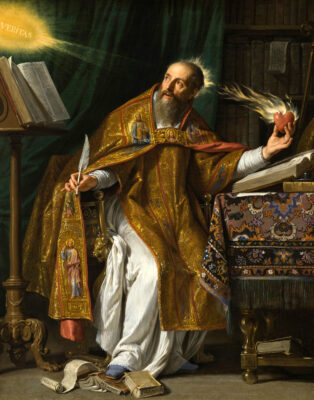
 I was recently prompted by some new accounts to review what St. Augustine thought about military service, the Christian vocation, and prayer. Hence, ep. 189.
Context is helpful and here is a broad view of the letter as a whole.
In a nutshell, Letter 189 belongs to Augustine’s later years, around 417–418. He wrote to Boniface, a senior military officer in Africa battling against the Vandals, later the comes Africae. Augustine says he had already written once, but then a messenger named Faustus arrived and reported that Boniface especially wanted something spiritually useful for his salvation. Augustine therefore sent a second, more direct exhortation.
Bluntly, Boniface is fighting the Vandals in Roman Africa. He wants to quit fighting and join a monastery. Augustine is not amused, as his brevity suggests.
The dense letter is pastoral in purpose. Boniface was a Christian officer, a man of rank, arms, and public responsibility, asking a bishop how to live faithfully in that condition. Augustine writes to Boniface as a pastor. The Bishop of Hippo reduces the Christian life to the twofold commandment of charity, love of God and love of neighbor, and then applies it to military service, discipline, humility, and the right use of force.
The opening shows that the letter is meant as a practical spiritual rule for a busy commander rather than a full theological treatise.
There is also a larger African ecclesiastical and political context. Boniface had already been in contact with Augustine during the Donatist controversy. In Augustine’s earlier Letter 185, Boniface appears as the official charged with enforcing imperial penalties against Donatists. Augustine there explains and defends coercive legislation against schism. That earlier connection helps explain why Boniface would turn to Augustine again. He was operating in a province where religion, public order, coercion, and imperial law were tightly bound together.
A central move in Letter 189 is Augustine’s reordering of Boniface’s horizon. Boniface was a man of command, always in danger of letting urgent worldly business eclipse the final end. Augustine therefore lifts the question above office, reputation, and imperial service to the vision of God and the hope of the heavenly kingdom. A commander who forgets his final end will also misuse his temporal means. Charity is thus given as the governing interior principle broad enough to guide command decisions, violence, prayer, and daily conduct.
Augustine also addresses Boniface’s anxiety about whether a soldier can please God. He answers yes.
Augustine points to David, the centurion praised by Christ, Cornelius, and the soldiers who asked John the Baptist what to do and were told not to extort, not to accuse falsely, and to be content with their wages. He does not tell Boniface to leave military service. He legitimizes Christian service in arms while giving it a moral compass. In Boniface’s case this was immediately relevant, since he already held coercive and defensive responsibilities in Africa.
Augustine then places Boniface’s office within a wider ecclesial division of labor. Some Christians fight invisible enemies by prayer, while Boniface fights visible enemies, the barbarians. In this way he serves the peace of the Church and the Christian people. Yet Augustine sharply defines the ethos of such service: “Peace should be the object of your desire; war should be waged only as a necessity.” Even promises to enemies must be kept, and the defeated or captive are to receive mercy when peace can be secured. Force may be used, but never with hatred or delight in violence.
The letter closes by turning from public duty to private discipline: chastity, sobriety, moderation, detachment from riches, thanksgiving, humility, prayer, and readiness to forgive. Augustine says the letter is more a mirror than a manual, since he had already heard a good report of Boniface. At this stage, before Boniface’s later crises, Augustine was trying to strengthen what seemed a promising Christian military vocation.
With this background in mind, here is an interesting passage from ep. 189.5 about the men in his monastery, that is, those who have abandoned secular employments. Augustine founded a convent for women, one for men, and his own house, a monastery that wound up as seminary for bishops. Here is a key passage, also touching on indifference or even positive support concerning false religions whom he associates with the Devil and fallen angels :
5. They occupy indeed a higher place before God who, abandoning all these secular employments, serve Him with the strictest chastity; but every one, as the apostle says, has his proper gift of God, one after this manner, and another after that (1 Corinthians 7:7). Some, then, in praying for you, fight against your invisible enemies; you, in fighting for them, contend against the barbarians, their visible enemies. Would that one faith existed in all, for then there would be less weary struggling, and the devil with his angels would be more easily conquered; but since it is necessary in this life that the citizens of the kingdom of heaven should be subjected to temptations among erring and impious men, that they may be exercised, and tried as gold in the furnace (Wisdom 3:6) we ought not before the appointed time to desire to live with those alone who are holy and righteous, so that, by patience, we may deserve to receive this blessedness in its proper time.
Did you notice that Augustine tells Boniface that the monks are PRAYING for his success in battle?
It is good idea to delve into Augustine in the midst of current events.































My baptismal patron is St. George. I have spent long moments contemplating images of St. George, especially those icons which depict him slaying a dragon, while a chaste maiden prays nearby.
The patroness of my birth is St. Agatha, and when I recently began to understand that St. Agatha herself doesn’t represent me, I began to worry that St. George doesn’t represent me, either, so much as the dragons he slayed.
I often struggle with identity, and I also struggle with understanding the reality of my soul, in its original innocence, being distinct from the sins which tarnish it, and the demons who torment me.
As much as I enjoy the I.T. industry, as well as space flight and big fiery rocket launches, I also understand that all these interests tie directly into the military-industrial complex. I greatly enjoyed Matthew Broderick in Wargames as much as I enjoyed Val Kilmer in Real Genius.
I strive to be a peaceful and nonviolent fellow, and I never wish to encourage wars of aggression, and ultimately, I embrace the duty to cooperate with our Holy Father and our US bishops who are unanimously, and stridently, calling for peace, and disarmament, and dialogue and diplomacy.
Thank you Father Z. This should be taught to all military members.
To train in the Art of war without training in the spiritual is a disservice.
God bless our military.
I like the your quote of St. Augustine that our objective is peace with war being only used as a necessity or last resort. Is the current conflict a necessity? I don’t know. But the saint’s exhortation of mercy to the defeated, keeping one’s word to your enemies, and not celebrating violence and death should be part of our behavior and mindset in this conflict.
As a side comment, in Isaac Asimov’s sci-fi novels of the Foundation trilogy, one of characters had the saying “Violence is the last refuge of the incompetent.”
Thank you for posting this, very encouraging and enlightening. As an economist by profession, I am impressed that the division of labor among Christians with different gifts or calls is emphasized. This is something those of us who want a Church that includes room for the VO ought to recognize. There is room for independent Mass sites, diocesan sites, the ICKSP, FSSP, SSPX, traditional monasteries and convents as well as Catholics happy with the NO who are willing to pray for us because they recognize the current situation is unjust.
Thank you for this – new to me despite a conscious interest in such matters for nearly half-a-century! I have happily followed up by reading the whole of J.G. Cunningham’s translation of Letter 189 as handily “Revised and edited for New Advent by Kevin Knight” – though I am left thinking I should take the next step and look up the original Latin. Meanwhile, I have started with St. Luke 3:14 and trying to get a fine sense of “concutiatis” (Vulgate) and “daseisete” (Septuagint).
Tangentially, I happened recently to encounter this discussion and summary by the Nineteenth-century English historian (and ‘Anglican’ clergyman!) Mandell Creighton:
“Pius II. actually attempted to convert to the Sultan by his eloquence. As rhetoric was the only contribution to a crusade which the Pope saw his way towards making, he seems to have resolved to try its effects to the uttermost. It is a strong testimony to the tolerant spirit of the Turks that stories were rife of the Sultan’s willingness to listen to Christian teaching. It is no less characteristic of the temper of the early Renaissance that Pius II. should have thought that all subjects admitted of reasonable discussion. He wrote a long letter to the Sultan pointing out the advantages that would follow from his acceptance of Christianity. Already the spread of the Turkish arms had led Cardinal Cusa to write an elaborate examination of the Koran, from which Pius II. borrowed many of his theological arguments. His letter dwelt first upon the horrors of war, and his desire to avert them; he does not hate the Sultan, though his foe, hut rather wishes him well. The conquest of Europe is not like that of Asia; it is impossible to the Turkish forces; yet Mahomet may obtain all the glory that he wishes without bloodshed by means simply of the little water needed for baptism. If he accepted that the Pope would recognise him as Emperor of Asia and of Greece; what he now possessed by violence would become lawfully his: by this means, and by this only, might the golden age be brought back to the world. The Sultan might object that the Turks would refuse to follow him if he abandoned his religion. The Pope reassured him by the examples of Clovis and Constantine. How great is the glory that he might so attain! All literature, Latin, Greek, and Barbarian alike, would extol his name. More than this, he would gain the heavenly promise, and would be able to add to the virtues of a philosopher the three theological virtues of faith, hope, and charity, without which no man can be perfect. The Pope then unfolded to him the Christian scheme, and discussed the points in which it differs from the Koran; he expatiated on the superiority of the law of Christ over that of Mahomet, and again exhorted the Sultan to consult his own interests, both here and hereafter, by accepting Christian baptism.” Sadly, I have been unable to find an edition of the text of the letter (or a translation) – though I did find photos in the Internet Archive of an illuminated manuscript in the Newberry Library described as “Pius episcopus seruus seruorum dei illustri mahumeti principi turchorum timorem diuini nominis et amorem”!
Locally tangentially, the Wikipedia “Pieds-noirs” article includes re. a 2013 article about Camus “The American author Claire Messud remembered seeing her pied-noir father, a lapsed Catholic, crying while watching Pope John Paul II deliver a Mass on his TV. When asked why, Messud père replied: ‘Because when I last heard the mass in Latin, I thought I had a religion, and I thought I had a country.'”