 This Sunday, in the Novus Ordo calendar, is called the 3rd Sunday of Easter. Let’s have a look at the Collect.
This Sunday’s Collect, it seems to me, reflects a conscious attempt on the part of Holy Church to remind us of the Easter Vigil. As a matter of fact, let’s see if I can give you a new way to look at that Paschal candle which burns in the sanctuary during Mass in this Easter season.
The prayer has antecedents in both the Veronese and Gelasian sacramentaries, though it is not in pre-Conciliar editions of the Missale Romanum.
Semper exsultet populus tuus, Deus, renovata animae iuventute, ut, qui nunc laetatur in adoptionis se gloriam restitutum, resurrectionis diem spe certae gratulationis exspectet.
Vocabulary similar to our Collect is found in the works of St Ambrose (+397), such as his Exposition of Psalm 118 and his De mysteriis, a post-Easter explanation of the sacred, liturgical mysteries to the newly baptized. For example, “… adulescens vel certe renovatus aquilae iuventute per baptismatis sacramenta…” (ex. Ps. cxviii, 18, 26).
Adoptio is, of course, “adoption” in the sense of “to take as one’s child.” We find the phrase “adoptionem filiorum Dei … adoption of the sons of God” in the Latin Vulgate (cf Romans 8:23, Gal 4:5, Eph 1:5).
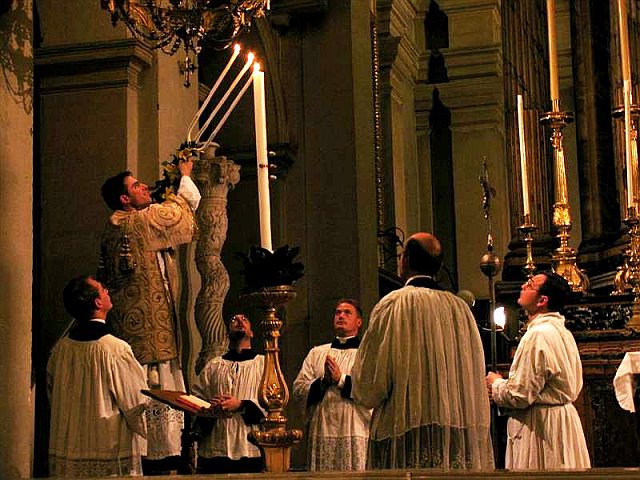
The words exsultet and adoptio bring our mind’s ear and eye to the Vigil of Easter, the deacon’s great moment to shine as he sings the Praeconium Paschale or Exsultet before the Paschal candle as the people hold their candles. The Vigil is when many new Christians are by baptism made the Father’s sons and daughters through a spiritual adoption.
The Exsultet was composed perhaps as early as the fifth century. Parts may go back to St Ambrose. In this great proclamation there are many images of light and darkness. One image concerns the fiery light of candles: beeswax nourishes the divided and yet undiminished flame. Pope Benedict in his sermon for the Easter Vigil of 2010 remarked that
“the cooperation of the living community of believers in the Church in some way resembles the activity of bees. It builds up the community of light. So the candle serves as a summons to us to become involved in the community of the Church, whose raison d’être is to let the light of Christ shine upon the world.”

VERY COOL POINT: Another meaning of adoptio in classical Latin is the “admission of a bee into a new hive.”
Look at what we lose when we lose our Latin.
What a marvelous way to think of sincere and observant Catholic Christians!
May all our works and words reflect the cooperation of God’s grace and love of neighbor!
May we be bright like kindled candles, honey sweet!
Some of you may be thinking, “But Father! But Father! This is over the top. You’ve gone too far this time in making those connections. All this… ancient stuff is not relevant to us. As a matter of fact, that was a time of PATRIARCHY, which is bad! “FATHERS” of the Church. Get it? You posts are triggering me! And I even called you “Father”! See what you’ve done? Your are an angry and hate-filled micro-aggressor and YOU HATE VATICAN II!”
Our prayers flow down to us from an ocean of ancient culture, pagan and Christian. Dare I say it flows down to us like honey from the comb?
Our vocabulary retains overtones of the Roman military, of agriculture, philosophy and religion. In previous centuries, people not yet gifted with glowing screens and text messaging more easily heard connections between fleeting phrases. They needed as a hook only a few words of a psalm, or even a single unusual word to evoke a massive interior meaning. For them, certain words and phrases were like the TARDIS: bigger on the inside. In the Gospels, Our Lord constantly alludes to psalms and the prophets. His (often hostile) listeners caught these allusions immediately. People of seemingly simpler oral/aural cultures are better at this than we O so technologically sophisticated denizens of the West. Our memories and attention spans are shrinking with each apparent advance.
But I digress. What was I talking about, again?
SLAVISHLY LITERAL ATTEMPT:
O God, let your people rejoice always, the youth of spirit having been renewed, so that they (the people) who rejoice now that they have been restored in the glory of spiritual adoption, may in the hope of true thanksgiving await the day of the resurrection.
OBSOLETE ICEL (1973):
God our Father, may we look forward with hope to our resurrection, for you have made us your sons and daughters, and restored the joy of our youth.
CURRENT ICEL (2011):
May your people exult for ever, O God, in renewed youthfulness of spirit, so that, rejoicing now in the restored glory of our adoption, we may look forward in confident hope to the rejoicing of the day of resurrection.


 It was a controversial painting in its day. When it was revealed the “popolani”, your basic Joe Bagodonuts, were pretty excited about it. Descriptions of the time say, “ne fu fatto un estremo schiamazzo… there was a real fracas”. It could partly be explain because some thought the model for the Blessed Mother was an not-unknown “call girl”. Whether … that, or an honest girl or Cavaraggio’s main “date” at the time, her name seems to have been “Lena” and she was also the model for Mary in the Madonna dei Palafrenieri in the Borghese collection in which Christ uses her foot to crush the head of a snake. Mighty powerful stuff. Some of the art experts and commentators of the time were outraged that there should be unidealized, strongly naturalistic figure, replete with wrinkles and dirt and tattered clothes. In fact, as one scholar of the painting I’ve read reveals, the model was an ancient sculpture known as the Tusnelda, which also helps to explain Mary’s ivory complexion… she who the Litany of Loreto names as “Tower of Ivory.” Her hands, holding the Child, are based on the hands of the ancient Venus pudica statues which calls to mind the overlapping concepts of both fertility and virginity. She is in a doorway, because if Christ is the primary door, she is the doorway to the doorway to heaven. Another Litany title for Mary is Ianua caeli… Gate of Heaven.



 April 20th, 2023


 In Roma in this 110th day of the year, the sunset will be at 1958, having risen at 0621.





 The sun rose at 0624 and set at 1956. The Ave Maria is at 2015.