ROME 25/10 – Day 25: Bear with me

Hey Fathers!  How about a clerical Guayabera shirt? This month 50% off. (There are shirts for lay people, too.)

Mass intentions recently celebrated came from:

DM, AH, JA, JY, SU, MF, ESS

Welcome Registrants:

fac
Gio. M
Praying in the D
Sal Fulminata
Conor

Please remember me when shopping online and use my affiliate links.  US HERE – UK HERE  WHY?  This helps to pay for health insurance (massively hiked for this new year of surprises), utilities, groceries, etc..  At no extra cost, you provide help for which I am grateful.

This is going to be an ever worsening problem.

In St. Louis the 2025 U.S. Chess Championship had the the second rest day, yesterday. Wesley So and Fabiano Caruana are tied for first, Levon Aronian is the only player now trailing by half a point. Hostilities resume today. Wesley plays Sam Sevian and Fabi plays Sam Shankland and Levon plays the youngster Mishra.

I love the space news…

White to move and mate in 2.

NB: I’ll hold comments with solutions ’till the next day so there won’t be “spoilers” for others.

Meanwhile… looking down toward the V dell’Orso.

And the Fontana dell’Orso… leaves are turning and starting to fall.  My time here is drawing to an end.

YouTube thumbnailYouTube icon

Posted in SESSIUNCULA |
Comments Off on ROME 25/10 – Day 25: Bear with me

Cupich on “Dilexi te” and and what it means for LITURGY!

Card. Cupich’s essay on Dilexi te!  In the NEWS section of Vatican.va.

Cupich’s op-ed reflection on Dilexi te offers yet another example of what happens when ideology substitutes for theology and historical revisionism obscures fidelity to the Second Vatican Council.

His argument pivots on a false equivalence: that “noble simplicity” in liturgy equals solidarity with the poor.

From this shaky premise, he proceeds to draw sweeping conclusions about the purpose of the Council and the nature of the post-Conciliar liturgical reform.  What results is not so much a coherent theological meditation, but rather more a justification for the decades-long desacralization of Catholic worship in the name of social relevance.

I should observe that no one I can think of with respect will not take seriously the Church’s perennial teaching about the poor (based on the Lord’s own Matthew 26:12 and Matthew 25:40) and treat a papal document about the same with due attention.  That is a given.  What is objectionable is how Card. Cupich weaponized Dilexi te for his own agenda: disdain for the most marginalized of Catholics in the Church today: those who desire traditional liturgical worship.

Also, no one who has a solid foundation in, say, the Fathers of the Church will deny that there is, in fact, a connection between the Church’s liturgical life and care for the poor.  As Leo XIV quotes in Dilexi te 29 onward this is evident.  For example, an early Father, Justin Martyr, said that “it is not possible to separate the worship of God from concern for the poor.”

So, the issue one should take with Card. Cupich is not about whether or not there is a link between the Church’s (and smaller units, parishes, families, individuals) worship and the Church’s (ditto) care for “the poor”.  How to care for the poor is a contingent point about which people can have different solutions.  The issue is justifying perpetrating imprudent and even sacrilegious changes to our many centuries of liturgical sacred worship – which has a superb track record – in the name of social relevance.   Modernism in its essence is the reduction of the supernatural to the natural, the transcendent to the immanent, the vertical to the horizontal.

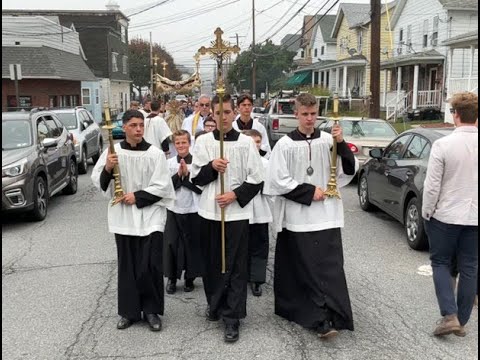
As a foretaste of what Card. Cupich is pushing for, you might look at this Chicago parish’s video from Sunday.  HERE  This is probably what he has in mind for what post-Conciliar liturgy should be like… otherwise he would suppress it.  Right?

Let’s have a look have an in depth look at the op-ed, with my emphases and comments.  His lofty position elicits a close reading and careful pondering of his words, does it not?


Cupich on ‘Dilexi te’: the Liturgy as a place of solidarity with the poor

Cardinal Cupich, Archbishop of Chicago, reflects for Vatican News on Pope Leo XIV’s first Apostolic Exhortation. In his meditation he recalls the words of Saint John XXIII before opening the Second Vatican Council: the Church must be the Church of all and “particularly the Church of the poor.”

By Cardinal Blase Cupich, Archbishop of Chicago

Of the many insights gained from reading Dilexi Te (DT), I was particularly struck by Pope Leo’s observation that “The Second Vatican Council represented a milestone in the Church’s understanding of the poor in God’s saving plan,” and that this milestone shaped the entire direction of the Council and its reforms.

[Hang on.  “entire direction”?  The Council Fathers spoke of the poor, yes, but primarily in the context of Gaudium et Spes 1-3, 27, 63-72 and Lumen Gentium 8, etc., where poverty is seen in the light of the Incarnation and the Beatitudes, not as an organizing hermeneutic for the entire Council.  It is a leap from acknowledging Christ’s preferential love for the poor to saying, as Cupich will soon (below) approvingly quote Leo XIV (cf. 84) quoting ultra-liberal Card. Lercaro, that “the mystery of Christ in the Church… is in a particular way the mystery of Christ in the poor” and “in some sense the only theme of the Council as a whole.” Lercaro’s claim is flashy but it is also historically and theologically off the mark. The Council’s overarching theme as Pope John XXIII and later Paul VI made abundantly clear, was the renewal of the Church’s understanding of herself as sacramentum salutis, the universal sign and instrument of salvation. To reduce that mystery to socio-economic concern is to substitute the Gospel for a manifesto of liberation theology avant la lettre.   John XXIII in “Gaudet Mater Ecclesia” said “The greatest concern of the Ecumenical Council is this: that the sacred deposit of Christian doctrine be guarded and taught more efficaciously.”  Back to Cupich…]

He [Leo XIV] notes that while the theme of the poor was only marginally alluded to in the preparatory documents, Saint Pope John XXIII called attention to it in a radio address a month before the opening of the Council, stating “the Church presents herself as she is and as she wishes to be: the Church of all and in particular the Church of the poor.”

These comments, according to Pope Leo, spurred theologians and experts to give the Council a new direction, which Cardinal Lercaro, the Archbishop of Bologna summed up in his intervention of December 6, 1962. [So now we are are all, from Leo XIV down, about Lercaro?  Fr. Louis Bouyer, a close friend of Pope Paul VI had this to say about Cardinal Lercaro who was officially in charge of the Consilium:

Unfortunately, on the one hand a deadly error in judgment placed the official leadership of this committee into the hands of a man who, though generous and brave, was not very knowledgeable: Cardinal Lercaro. He was utterly incapable of resisting the maneuvers of the mealy-mouthed scoundrel that the Neapolitan Vincentian, Bugnini—a man as bereft of culture as he was of basic honesty—soon revealed himself to be.]

He [Lercaro] stated: “The mystery of Christ in the Church has always been and today is, in a particular way, the mystery of Christ in the poor….this is not simply one theme among others, but in some sense the only theme of the Council as a whole.[?!?]

Lecaro later commented that in preparing his intervention he came to see the Council differently: “This is the hour of the poor, of the millions of the poor throughout the world,” he wrote. “This is the hour of the mystery of the Church as mother of the poor. This is the hour of the mystery of Christ, present especially in the poor.” [This – mind you – is “the hour of Lercaro”, not of the Council. This affirms a preferential place for the poor, but it does not reduce the entire Council to that single theme. The Council documents concentrate primarily on the mystery of the Church, the sacraments, revelation, the liturgy, and the Christian’s place in the world. Cupich’s Lercaro-inspired reduction of the Council’s purpose to “poverty-solidarity” constitutes a non sequitur and a selective reading of the Council’s agenda. Going on…watch the slight of hand.  Cupich next ties this “hour of the poor” to the reform of the liturgy. He will soon suggest that the Council’s call for “noble simplicity” was not, as he puts it, “antiquarianism or simplicity for simplicity’s sake,” but a means of embodying the Church’s solidarity with the poor. Back to Cupich….]

It is in this context that DT [Dilexi te] offers a particularly revealing comment that provides us with a fresh understanding of the Council Father’s reform of the liturgy.  “There was a growing sense of the need for a new image of Church, one simpler and more sober, embracing the entire people of God and its presence in history. A Church more closely resembling her Lord than worldly powers [even though today she more resembles a NGO, more worldly by far than anything seemingly royal] and working to foster a concrete commitment on the part of all humanity to solving the immense problem of poverty in the world.”  [See where he’s going?]

In other words, the noble simplicity that Sacrosanctum Concilium pursued in calling for the restoration of the liturgy was not just some antiquarianism or simplicity for simplicity’s sake. Rather, it was in tune with this “growing sense of the need for a new image of the Church, one simpler and more sober…” [Repeating the phrase doesn’t strengthen the position. But get this next part…] The liturgical reform aimed at allowing God’s activity for us in the liturgy, particularly the Eucharist, to shine forth more clearly[“allowing”?  What had God been doing in the Church up until the Second Vatican Council’s sudden revelation about “the poor” and how that is the point of sacred worship?] The renewal of our worship was pursued in keeping with the Council Fathers’ desire to present to the world a church defined not by the trappings of world power [again?] but marked by sobriety and simplicity, [again?] enabling it to speak the [sic] people of this age in a way that more closely resembles the Lord and allowing it to take up in a fresh way the mission of proclaiming good news to the poor.  [Hang on.  Jesus just used blunt language everyone understood, right?  No chance of misunderstandings.  Never mind people often observed that they didn’t understand (cf. John 6).  And there is the Lord’s use of “Amen! Amen!” a unique style of speech that meant to emphasize the solemn importance of his words. This repetition, which only Jesus is known to have used in this way, solemnly signaled His divine authority and the absolute reliability of his statements. In the Gospel of John, he uses it 25 times to preface significant claims.

Meanwhile, the Council Fathers explicitly rejected the idea that the liturgy should imitate secular forms or reflect the aesthetics of poverty. They sought intelligibility, not impoverishment. Cupich’s rhetoric about “sobriety and simplicity” conflates the evangelical virtue of poverty with aesthetic minimalism.  This is an inversion that betrays the very spirit of the Roman Rite, whose solemnity has always expressed divine majesty, not bourgeois ostentation.

Let’s pay the game again for the zillionth time.  He linked the reform of the liturgy to Lercaro’s “hour of the poor” vision and says the call for “noble simplicity” in the liturgy  in Sacrosanctum Concilium was primarily intended to express solidarity with the poor and de-emphasize “worldly powers.” But the actual text of SC itself sets a very different emphasis:

“The rites should be distinguished by a noble simplicity; they should be short, clear, and unencumbered by useless repetitions; they should be within the people’s powers of comprehension, and normally should not require much explanation.” (SC §34)

The emphasis here is on comprehension, clarity, brevity and avoiding useless repetitions. Regardless of what one might think about those aims, it does not explicitly tie noble simplicity to social justice or solidarity with the poor. Moreover, as a real expert on liturgy, my friend Fr. Uwe Michael Lang, CO, commented:

“The ‘noble simplicity’ of the Roman Rite must not be confused with a misunderstood ‘liturgical poverty’ … which can lead to the ruin of solemnity, foundation of divine worship.” HERE

Therefore, Cupich’s inference — namely that sobriety and simplicity in the liturgy were primarily social-symbolic gestures of solidarity with the poor — is a category error, conflating liturgical form and social mission.  Back to Cupich…]

The liturgical reform benefited from scholarly research into liturgical resources, [Like the research which got major points wrong such as dominant ancient versus populum worship and widespread Communion in the hand?] identifying those adaptations, introduced over time, which incorporated elements from imperial and royal courts. That research made clear that many of these adaptations had transformed the liturgy’s aesthetics and meaning, making the liturgy more of a spectacle rather than the active participation of all the baptized for them to be formed to join in the saving action of Christ crucified.  [This is a classic post-conciliar anachronism. Sacrosanctum Concilium §34 calls for “noble simplicity” so that the rites may “be within the people’s powers of comprehension,” not so that the Church might appear less “imperial” and more “proletarian.”]  By purifying the liturgy of these adaptations, the aim was to enable the liturgy to sustain the Church’s renewed sense of herself, which St. Pope Paul VI noted in his address for the opening of the Council’s second session was in keeping with his predecessor’s inspiration in calling the Council, “to open new horizons for the Church and to channel over the earth the new and yet untapped spring waters of Christ our Lord’s doctrine and grace.”  [Cupich claims that many adaptations of the liturgy derived from “imperial and royal courts” and thus turned worship into “spectacle,” which the reform needed to purge. Yet the classical liturgical historian Josef A .Jungmann in Missarum Sollemnia (The Mass of the Roman Rite) presents a far more nuanced picture of the Roman Rite’s development:

“The monumental greatness of the Roman Mass lies in its antiquity which reaches back to the Church of the martyrs, and in its spread …” (op.cit., I,165)

He shows that many ceremonial features grew organically in the Christian tradition, not simply borrowed from palaces for power display. Cupich’s almost dismissive portrayal of “imperial” liturgical forms thus risks caricature rather than honest historical engagement. On the other hand, research shows that the Novus Ordo was an artificially, rather than organically produced product of committees.  Experience shows that it was suddenly and even brutally imposed causing enormous damage.  Joseph Ratzinger wrote (Collected Works, Ignatius Press 2014):

What happened to a great extent after the Council has quite a different significance: instead of the developed liturgy, some have set up their self-made liturgy. They have stepped out of the living process of growing and becoming and gone over to making. They no longer wanted to continue the organic becoming and maturing of something that had been alive down through the centuries, and instead they replaced it—according to the model of technical production— with making, the insipid product of the moment.

For more on how the it was a “fabrication” go HERE.  For the sake of space let’s stipulate that individuals can make a total wreck of any liturgy, Vetus or Novus.  However, the Novus is more open to abuse.  It is also open to respectful use, as my personal experience at St. Agnes in St. Paul bears out.]

It [I think “it” is “the Council”] was also designed to empower the Eucharist to once again, as St. Pope John Paull [sic] II stated in his Apostolic Letter, Mane Nobiscum Domine, to be “a project of solidarity with all of humanity”, making those who participate in it [the Eucharist, I think] “a promotor of communion, peace and solidarity in every situation. More than ever,” he continued, “our world (troubled)…with the spectre of terrorism and the tragedy of war, demands that Christians learn to experience the Eucharist as a great school of peace, forming men and women who, at various levels of responsibility in social, cultural and political life, can become promotors of dialogue and communion.” [Did I miss concern for “the poor” in there?  Let’s go on…] The saintly pope concluded in a way that foreshadows the teaching of Pope Leo by noting that it will be “by our mutual love and, in particular, by our concern for those in need [“need” means a lot more than just physical poverty (cf. Mother Teresa’s Noble Prize speech HERE] (that) we will be recognized as true followers of Christ (cf. Jn 13:35; Mt 25:31-46). This will be the criterion by which the authenticity of our Eucharistic celebrations is judged.”  [Cupich writes that the Eucharist is “a project of solidarity with all of humanity,” quoting from Mane nobiscum Domine (though his quotation is partial). He thereby implies the Eucharist is first and foremost about horizontal solidarity and social action. But the encyclical Ecclesia de Eucharistia by Pope John Paul II insists otherwise:

“For the most holy Eucharist … contains the Church’s entire spiritual wealth: Christ himself, our Passover and living Bread.” (EDE §1)

And again:

“… the Eucharist draws the Church into communion with the Father and the Son in the Holy Spirit.” (EDE §53)

These passages emphasize the vertical dimension – worship, adoration and communion with God – as primary. Social solidarity flows from that, not the other way around!  Cupich’s inversion (turning the Eucharist into a social action first) constitutes a theological inversion of the order of ends.  Back to Cupich…]

With the recovery of the ancient sobriety of the Roman Rite the Eucharist is once again the locus of genuine peace and solidarity with the poor in a fractured world.  [Good grief.  Firstly, the jury is still out on the efficacy of the Novus Ordo while the Vetus Ordo has a vast track record of success in nourishing missionary work, apostolates of works of mercy for the poor, the betterment of this vale of tears.  That cannot be disputed.  During the time of the Novus Ordo, many of those efforts have been enervated or have disappeared, and new efforts which have sprung up hardly fill the gap left gaping.   Moreover, “sobriety” in the true praxis of the Novus Ordo over the years (including Chicago)?  Are you kidding?  Compare the relative stumbling around of a suburban parish with the reverent precision of ceremony in any TLM, Low or Solemn.  Which is the more “sober” and “noble” in simplicity?  Another key error in Cupich’s argument is the assumption that liturgical reform is validated by social criteria (solidarity with the poor). The Directory on Popular Piety and the Liturgy (2001) warns:

“The Sacred Liturgy … can never be reduced to a mere aesthetic reality. Neither can it be considered simply as a means to pedagogical or ecumenical ends. Before all else, the celebration of the sacred mysteries is an act of praise to the Triune God.” (DPPL §2)

While the Directory also states (ibid), “Were the Liturgy not to have its effects on life, it would become void and displeasing to God”, that “effects on life” is in no way limited to the poor.  In fact, the Directory seems to emphasize popular devotions rather than the liturgical celebration of sacraments when seeking to uplift the poor. In any event, any argument that treats the liturgy primarily as a social tool undermines the liturgy’s intrinsic identity as worship, not of the poor but of the Triune God. Cupich’s emphasis on social mission over worship avoids this fundamental point.]

That concludes Cupich.

In short, Cupich’s article is a piece of rhetorical flattery about social-causes cloaked in liturgical language. It falls apart under scrutiny. He skews the Council’s texts and intents, conflates liturgical simplicity with socio-economic symbolism, caricatures the historical liturgy as “imperial,” and inverts the finality of the Eucharist from worship to social action. He forces liturgy to become an instrument of solidarity rather than exalting it as the sacrificial worship of the living God.

The result? A Church celebrated for being of the poor, but one that risks being poor of mystery.

If the poor truly deserve the fullness of the faith, they will find it not in truncated assemblies of social justice, but in the solemn beauty of the Mass.  Cupich seems to treat beauty (a transcendental with truth) as non-essential. Liturgy is thus reduced to social engineering.

On the other hand the poor deserve the radiant splendor of Christ, sacramentally manifested in sacred liturgical worship in which they are free to participate and benefit from interiorly.  What they do not need is a watered-down social-justice aesthetic meant to comfort the middle-class conscience.

Moreover, what is Cupich’s motive here, other than the obvious. Is it to pit one Pope against other Popes?   In that case, we can review what other Popes have said about tradition and solemn liturgical worship.

Pope Benedict XVILetter to the Bishops (accompanying his Motu Proprio Summorum Pontificum), 7 July 2007:

“What earlier generations held as sacred, remains sacred and great for us too, and it cannot be all of a sudden entirely forbidden or even considered harmful. It behooves all of us to preserve the riches which have developed in the Church’s faith and prayer, and to give them their proper place.”

Pope Benedict XVI — same Letter to the Bishops:

“In the history of the liturgy there is growth and progress, but no rupture.”

Pope St. John Paul II — Encyclical Ecclesia de Eucharistia (17 April 2003), §48:

“Like the woman who anointed Jesus in Bethany, the Church has feared no “extravagance”, devoting the best of her resources to expressing her wonder and adoration before the unsurpassable gift of the Eucharist.  … 49. With this heightened sense of mystery, we understand how the faith of the Church in the mystery of the Eucharist has found historical expression not only in the demand for an interior disposition of devotion, but also in outward forms meant to evoke and emphasize the grandeur of the event being celebrated. This led progressively to the development of a particular form of regulating the Eucharistic liturgy, with due respect for the various legitimately constituted ecclesial traditions. On this foundation a rich artistic heritage also developed. Architecture, sculpture, painting and music, moved by the Christian mystery, have found in the Eucharist, both directly and indirectly, a source of great inspiration.

“Noble simplicity” has mostly given rise to churches that look like municipal airports, art and vestments reminding us the left-overs after a Pier 1 store close-out.

About music…

Pius X – Tra le sollecitudini (22 Nov 1903)

“[T]he more closely a composition for church approaches in its movement, inspiration and savor the Gregorian form, the more sacred and liturgical it becomes; and the more out of harmony it is with that supreme model, the less worthy it is of the temple.”

Here’s noble simplicity in Chicago.

This.

BUT… the TLM has to be suppressed. Because!

Wait… there’s more!

In closing, in The Screwtape Letters, near the end of Letter 23, Screwtape urges Wormwood to make his patient “interested in the poor” but in the abstract rather than in “the poor man who happens to be at his door.”

Card. Cupich, the poor are at your door.  They want traditional sacred liturgical worship.

Please Pope Leo, help these suffering people.

Posted in Liturgy Science Theatre 3000, Save The Liturgy - Save The World, The Drill, The future and our choices, The Last Acceptable Prejudice |
14 Comments

John Paul II and the beggar priest on hard times

Today is the anniversary of the solemn inauguration of the Pontificate of Pope St John Paul II.

Here’s is a good way to celebrate that anniversary.

I’ve heard this story before and have zero doubt about its veracity. I can only add, “there but for the grace of God go I”.

Posted in Cancelled Priests, Just Too Cool, Priests and Priesthood, Saints: Stories & Symbols | Tagged
2 Comments

Diocese of Scranton: Good News – TLM community given a great new church

I received a note that a FSSP TLM personal parish in the Diocese of Scranton has been given a lovely church for their use, St. Lucy.

I’ve tried to open diocesan links but, at the time of this writing none of them will open.

Looking at Facebook for the Diocese of Scranton I found THIS:

We’ll see how the clergy and parishioners of Saint Michael the Archangel Parish in Scranton recently celebrated the closing Mass of Saint Michael Church and the first official Mass at their new home at Saint Lucy’s Church.

I did a little searching for images of St. Lucy’s in Scranton.  It looks like a huge place and quite suited.   It has its roots in the massive influx of Italian (legal) immigrants back in the day.

Do I sense here, perhaps, the heavenly intercession of the late, great, “Extraordinary Ordinary”, Bishop Robert C. Morlino… born in Scranton…?

AGAIN…. it is to be asked…

If Scranton… why not Charlotte?  Why not Knoxville?  Why not Monterey?  Why not Detroit?    

If I were a member of the faithful in those places I’d be asking … WHY there and not HERE?

UPDATE:

YouTube thumbnailYouTube icon

Posted in Save The Liturgy - Save The World | Tagged ,
5 Comments

ROME 25/10 – Day 24: Big mushrooms

When it was 7:27 the Sun rose in Rome.

It was 18:21 when it changed its mind on the other side of the sky.

The Ave Maria Bell… still not ringing but now in its 18:30 cycle.

In the new calendar it is the Feast of St. Gaspar del Bufalo, a favorite.  I have a 1st class relic.

Please remember me when shopping online and use my affiliate links.  US HERE – UK HERE  WHY?  This helps to pay for health insurance (massively hiked for this new year of surprises), utilities, groceries, etc..  At no extra cost, you provide help for which I am grateful.

I am making preparations, slowly, to come back around Christmas.   It has been a long time since I’ve been here for Christmas and when I was I was so unspeakably downtrodden that was a minor miracle that I made it through.   Memories to purify.

IVY REPORT!   Shot at the same place as last time.  Yes, I know it is a kind of creeper, but I don’t care.  Last time HERE

A nice basket of funghi porcini.

Things are being tidied up at the Campo de’ Fiori.

Supper was really simple.   Tomato, garlic, salt, pepper, chopped basil, olive oil, pepperoncino for heat.   Pasta: mezze maniche.   At the last moment, more basil and a squeeze or two of a juicy Sicilian lemon.

Yes.

Enough to ruin your appetite.

On the ascendance… in Rome? I wonder if this heralds the acceptance of his resignation. Just speculating, which is a time-honored clerical prerogative.

Today he had a piece at Vatican.va – News in which he tried to used Dilexi te as a way to justify further destruction of the Roman Rite. How so? “The poor”, something. It’s something about the “poor”. And, the Council, something something. I have a fully fisked version ready to go, but I want to sleep on it. And I’ve had enough of him today.

There are still figs in the market here… there’s still time for me to get figs for prosciutto.

Speaking of figs did you know that the word sycophant means, in Greek “fig shower/revealer”? The Greek word sykophant?s is a combination of s?kon (“fig”) and phainein (“to reveal”). This was the type of person who tattled on people growing figs which in the ancient world were taxed. He showed the figs and got a cut of the fine.

Also, I stopped by at the P.za der Fico but I was early, and none of the regular chess players were there under the large fig tree (fico).

Speaking of chess. The chess world is still rocked by the sudden death of Danya Naroditsky (29).

It’s an off day in St. Louis for the US Championship. I can get more rest tonight.

NB: I’ll hold comments with solutions ’till the next day so there won’t be “spoilers” for others.

Priestly chess players, drop me a line. HERE

White to move and mate in 3.


Posted in SESSIUNCULA |
Comments Off on ROME 25/10 – Day 24: Big mushrooms

Three years ago today, the Vatican-venerated demon idols went into the Tiber drink

Ideally they should have been broken and/or burned and then thrown into the river. That’s what you do with items of black magic or demon worship.

And Francis ordered that a bowl of the same demon-cult be placed on the main alter of St. Peter’s Basilica. Think about that.

Posted in SESSIUNCULA |
8 Comments

21 October: Feast of Bl. Karl von Habsburg

Posted in Saints: Stories & Symbols | Tagged
2 Comments

ROME 25/10 – Day 23: Dynamite meal and sad news

I was purposely still asleep at sunrise, which was at 7:26.

I was purposely not asleep for sunset which was at 18:23.

The Ave Maria Bell would not have rung at 18:30 whether I was awake to hear it or not.

Please remember me when shopping online and use my affiliate links.  US HERE – UK HERE  WHY?  This helps to pay for health insurance (massively hiked for this new year of surprises), utilities, groceries, etc..  At no extra cost, you provide help for which I am grateful.

I was out for light lunch yesterday and the star of the show was the starter.

Roasted octopus with mango reduction and red cabbage. DANG!  I’ll go back for THIS.

This was exquisite.   I had a mixed green salad after.  Done.  The sopping up needed either bread rather than focaccia or a sauce spoon.

I had a long walk to today.   More than I am used to.

A couple shots.

I think it is the smallest official street in Rome, though I may have confused it with another.

I forget.  My dining companion had this.

A lovely sole… rombo.

I prefer mine meunière or “alla mugnaia”.  Hard to beat when good.

Now, sad chessy news…


He seemed like a good young man. How sad. Only 29.

Darn Adam, anyway!

In happier chessy news… Fabi smashed Niemann. I think Niemann might be getting some personal life coaching (along with growing up a little). Even better news, my guy Wesley defeated Andy Woodward, young but still dangerous or he wouldn’t be there. That puts him at the top with Fabi. On the women’s side, young Alice Lee, from my native place of Minneapolis, has vaulted into first. Hence I root for her… homie.

Posted in SESSIUNCULA |
1 Comment

A review of the Sacrament of Penance in view of the Jubilee Year as well as your regular Sunday Mass

While in Rome during a Jubilee Year. Many people – Rome is jammed – are coming to Rome for the experience such as entering the Major Basilicas through the Holy Door.  That’s a perk and a novelty that most may never repeat.

It is, however, just a walk through a hole in the wall if you are not in the state of grace.

Going to Communion in the state of mortal sin compounds your sins with sacrilege.

Not being in the state of grace means that none of your acts of mercy are meritorious.

I suspect that a great many Catholics have never heard this from a pulpit, most converts are not told this, and quite a few priests are unaware of it.

That said, and given that I often push people into confessionals on this blog, it behooves me to flesh out some things about the Sacrament of Penance.  It is usually called “Reconciliation” today, perhaps because that doesn’t make people have too many thoughts about sin and doing penance.   That also was the point of the editing of most of the orations of the Novus Ordo.   Thus, I tend to stick to “Sacrament of Penance”.

Some basics.   I can’t say everything there is to say about all aspects of this sacrament in a blog post, but I can hit the more important ones.

In every sacrament there is both a visible, outward sign, a form of words pronounced and and a personal encounter.

Personal: Grace is not transmitted through wires or screens, but through presence, real and embodied, presence.  So it is with the Sacrament of Penance. Absolution must be received from a priest who is really physically present to the penitent as Christ Himself acting through His ordained minister. The Church, faithful to the realism of the Incarnation, teaches that forgiveness of sins is not a virtual event. The Word became flesh, not a signal (cf. John 1:14). Hence, the confessor and the penitent must share the same moral space.

This is important in this age of Artificial Intelligence.  As AI grows in capability, and people grow more dependent (enslaved? subservient?) on it, this will be even more important to communicate.  No circuit will ever be able to absolve a sin, even the least.  Absolution is through a priest.

The old moral theologians were strong about this. St. Alphonsus Liguori wrote that absolution given to someone more than twenty paces away would be doubtful, since the sacramental sign requires true human presence:

“Si poenitens esset longe plusquam viginti passus, esset dubium an absolutio esset valida” (Theologia Moralis, Lib. VI, n. 440).

“Phone absolutions” or “Zoom confessions,” however sentimental the intention, simply do not satisfy the incarnational logic of the sacrament. Pius XII, addressing a Congress on Pastoral Liturgy, reminded confessors that

“The Sacraments are sensible signs; they must be administered through direct contact of minister and recipient” (Allocution Vous Nous Avez Demandé, 22 Sept 1956, AAS 48 [1956] 713).

The priest’s hand of blessing, his voice uttering Ego te absolvo, are the very instruments of the healing Christ.

Keep this in mind.  You can confess your sins to anyone!   A bartender… your psychiatrist… your best friend.  But they cannot absolve you.

What about a person who is unconscious, unable to make a confession?

When a man lies dying, perhaps unable to speak but presumed to desire mercy, the Church provides for a conditional absolution.  In the form of absolution the priest says,  si capax es, “if you are capable”, that is, capable of receiving the sacrament.  In that moment the priest says the form of the sacrament, trusting that the grace of Christ can reach where human consciousness cannot. St. Augustine explained this generous principle:

“Deus sacramentis alligavit nos, sed ipse non est alligatus sacramentis”—“God binds us to the sacraments, but He is not bound by them” (De Baptismo contra Donatistas 5.27.38; PL 43:185).

The visible Church acts and the invisible Spirit breathes life where He wills (cf. John 3:8). There is hardly a greater manifestation of the Church as Mother than these instances of urgency and need.  Also, in cases where a person is unresponsive, it is possible to administer the Sacrament of Anointing, which in same cases also has the power to forgive sins.  More on that HERE.

The effects of the Sacrament of Penance are breathtaking. Through absolution the soul is cleansed of guilt; the eternal punishment due to mortal sin is wiped away; the soul is strengthened to resist temptations.

The sinner, who by his own will in committing a mortal sin, separated from God is restored to supernatural friendship. St. Thomas Aquinas explains that the words of absolution do not merely declare forgiveness but cause it:

“Verba absolutionis effectum suum habent ex ipsa significatione, sicut forma sacramenti”—“The words of absolution have their effect by their very signification, as is proper to a sacramental form” (Summa Theologiae III, q. 84, a. 3, ad 3).

The confessional, in that sense, is like to a courtroom where penitent is the prosecutor of himself and the Judge is Mercy Himself. If the penitent dies after valid absolution without returning to mortal sin, he dies in the status gratiae, the state of grace, and is thereby capable of eternal beatitude, though perhaps through the purifying fire of Purgatory (cf. CCC 1472–1473).

Absolution also restores the penitent to full communion with the visible Church, enabling him to receive the Eucharist worthily and to act again as a living member of Christ’s Body. What is broken is repaired; what is lost is found.   I have a bit more on this HERE concerning the common absolution form we use during Holy Mass.

Let it not go unsaid: We should confession all the mortal sins we can remember in both kind (what sort of sin) and number (how many times or frequency).  This is why a habitual daily examination of conscience is important: we remember better and we learn more about who we really are and who we really are not.  More on kind and number HERE.

Yet some sins, because they wound not only the soul but the visible order of the Church, carry penalties or censures that cannot be removed by any priest at random. For these, there exist the reserved cases, those to be absolved only by the Holy See, the bishop, or a priest delegated by him (cf. CIC 1983, cc. 1355–1357).  Again, this is about reserved censures not reserved sins.    The sins that incur these censures are very grave.  For example, purposely throwing away the Eucharist or taking it for a nefarious reason, breaking the Seal of Confession, consecrating bishops without Apostolic Mandate, etc.

Such laws may seem severe until we remember that they exist to guard the sanctity of the sacrament itself. The juridical structure of the Church protects the integrity of mercy, just as the walls of a chalice guard the Precious Blood.

Absolution remits guilt and eternal punishment, but not automatically the temporal punishment due to sin. That debt, rooted in in justice and due to the disorder sin leaves behind, remains to be satisfied by penance, prayer, and charity. St. Catherine of Siena likened this process to fire purifying gold:

“Il fuoco della divina carità consuma la ruggine del peccato; ma la giustizia vuole che l’anima sia purgata secondo la misura”—“The fire of divine charity consumes the rust of sin, yet justice wills that the soul be purified according to measure” (Dialogo, ch. 60; ed. Tommasini, p. 208).

This is why the priest in normal circumstances assigns a penance before absolution. It is not a penalty but a remedy. It is the application of Christ’s Cross to the wounds of the soul. The confessional is a tribunal, but it is also a clinic. The priest is judge and physician acting as Christ, declaring sentence but also applying medicine.  More on vague or strange or unreasonable penances or forgetting what you were assigned HERE.

For absolution to be valid, the penitent must confess all mortal sins not yet absolved, must be sincerely contrite, and must resolve not to sin again (cf. CIC 987–988).

The confession need not be eloquent; it need only be honest. God requires truth, not rhetoric (cf. Ps 50:8 [51:6]).

The Act of Contrition, whether memorized or spontaneous, must express sorrow for sins and a desire to change.  I have more on the Act of Contrition HERE.

St. Alphonsus again reminds us that even imperfect contrition, when joined to the sacrament, becomes sufficient:

“Attritio, quamvis imperfecta, conjuncta cum Sacramento sufficit ad remissionem peccatorum” (Theologia Moralis VI, n. 444).

Grace supplies what weakness lacks.

Then comes the moment itself: the formula of absolution.

The modern form begins, “Deus, Pater misericordiarum, qui per mortem et resurrectionem Filii sui mundum sibi reconciliavit…” and concludes, “Ego te absolvo a peccatis tuis, in nomine Patris, et Filii, et Spiritus Sancti.”

The beginning recounts the economy of redemption. Father, Son, and Spirit, Cross and Resurrection, the Church’s ministry, are compressed into a single sacramental act.

Réginald Garrigou-Lagrange, O.P., commented that the priest

“ne se borne pas à annoncer le pardon, il le cause instrumentellement, par une puissance dérivée de l’humanité du Christ”—“does not merely announce forgiveness; he causes it instrumentally, by a power derived from Christ’s humanity” (De Gratia, t. II, ch. 8, p. 245).

The same Christ who touched lepers and said “Be thou clean” (Matt 8:3) now touches through the hand of His priest. When the confessor raises his right hand and traces the sign of the Cross, he is not simulating pardon, he is performing it.

In the older Roman Ritual, the theology is expressed with great precision:

“Dominus noster Iesus Christus te absolvat; et ego, auctoritate ipsius, te absolvo ab omni vinculo excommunicationis (suspensionis) et interdicti, in quantum possum et tu indiges. Deinde ego te absolvo a peccatis tuis…” (Rituale Romanum Tit. III, cap. I, n. 1).

The structure moves from petition to declaration, from deprecative to indicative.

First, the priest prays that Christ may absolve. Then, by Christ’s authority, he does absolve. The twofold movement reveals both humility and confidence. The minister is suppliant and judge, intercessor and instrument.

The Council of Trent fixed this forever: “Forma huius sacramenti sunt verba absolutionis, ‘Ego te absolvo,’ quibus significantur et efficiuntur remissiones peccatorum”—“The form of this sacrament consists in the words of absolution, ‘I absolve thee,’ by which the forgiveness of sins is both signified and effected” (Sess. XIV, De Poenitentia, cap. 3; Denz. 1671 = DS 1671).

The post-Conciliar reform retained this essential core while giving more prominence to God’s fatherly mercy. The Catechism of the Catholic Church notes:

“This formula expresses the essential elements of the sacrament: the Father of mercies is the source of all forgiveness; he brings about reconciliation through the Paschal mystery of his Son and the gift of his Spirit, through the prayer and ministry of the Church” (CCC 1449).

Both forms, ancient and modern, are equally valid, equally divine. One emphasizes the priest’s delegated authority, the other the Father’s overflowing mercy. Both converge in the same sacramental reality: Christ forgiving through His Church.

Before absolution in the traditional form, the Ritual provides brief preparatory prayers, echoes of the Confiteor (I mentioned, above, and linked more on this):

“Misereatur tui omnipotens Deus, et dimissis peccatis tuis, perducat te ad vitam aeternam.”

And again:

“Indulgentiam, absolutionem, et remissionem peccatorum nostrorum tribuat nobis omnipotens et misericors Dominus.”

These can be omitted for a just reason, but many priests retain them as gentle thresholds to mercy. Some also preserve a venerable addition once printed in the pre-1970 Ritual:

“Passio Domini nostri Iesu Christi, merita beatae Mariae Virginis et omnium Sanctorum, quidquid boni feceris et mali sustinueris, sint tibi ad remissionem peccatorum, augmentum gratiae et praemium vitae aeternae.”

“May the Passion of Our Lord Jesus Christ, the merits of the Blessed Virgin Mary and of all the saints and also whatever good you do or evil you endure be cause for the remission of your sins, the increase of grace and the reward of life everlasting. Amen.”

How rich a theology is distilled there! The Passion, the Communion of Saints, the cooperation of human merit within divine grace.  It’s a miniature Summa Theologiae whispered in the quiet of the confessional.

The priest,father, physician, teacher, judge, is in the confessional the living extension of the mercy of God.

He does not speak in his own name.  He does, and he doesn’t.   The “I” of Ego te absolvo is the “I” of Christ the High Priest. But it really is also the priest speaking.

St. John Chrysostom marveled at this dignity:

“Hanc potestatem Deus neque Angelis neque Archangelis dedit… Quae sacerdotes hic agunt, Deus in caelo confirmat”—“This power God has given neither to angels nor archangels… What priests do here on earth, God confirms in heaven” (De Sacerdotio III.5; PG 48:643).

When the words fall from the priest’s lips, heaven bends low, the chains of sin drop, the soul stands radiant again.

It is the greatest of quiet miracles.

God returning a fallen soul to the state of grace is a greater act than God creating the universe out of nothing.

Given what is at stake, shouldn’t there be more priests?  Shouldn’t there be more priests for more Masses, of course, but for more confessions?  To reduce the odds that you might face your final moments without the last sacraments?

Promote vocations!   Through the ordained you may path to a peaceful passing.

The confessional may seem small and human but in that smallness the infinite mercy of God breaks through.

When the priest lifts his hand and says Ego te absolvo, one may imagine the roar of joy of the holy angels and saints in Heaven.

What was the last time you heard those words?

“I absolve you…”.

Posted in "How To..." - Practical Notes, GO TO CONFESSION, Hard-Identity Catholicism, Priests and Priesthood, Seminarians and Seminaries | Tagged , , ,
5 Comments

ROME 25/10 – Day 22: Development of Chicken

When the sun rose over Rome it was 7:25.

It set awhile ago at 18:24.

The Ave Maria Bell was to ring at 18:45.

This is the 19th Sunday after Pentecost.

Welcome registrants:

Livingstone33
uncle051

Please remember me when shopping online and use my affiliate links.  US HERE – UK HERE  WHY?  This helps to pay for health insurance (massively hiked for this new year of surprises), utilities, groceries, etc..  At no extra cost, you provide help for which I am grateful.

And this…

Last night.

I think this is self-explanatory.

Get it?

I got it.  And I have left overs.

This was spotted tonight on the way home.  A massive gathering at the P.za Farnese.  And there was another a block in the piazza were I used to live.  This is bothersome… no… troublesome.

Posted in SESSIUNCULA |
6 Comments