Mass schedules… then and now

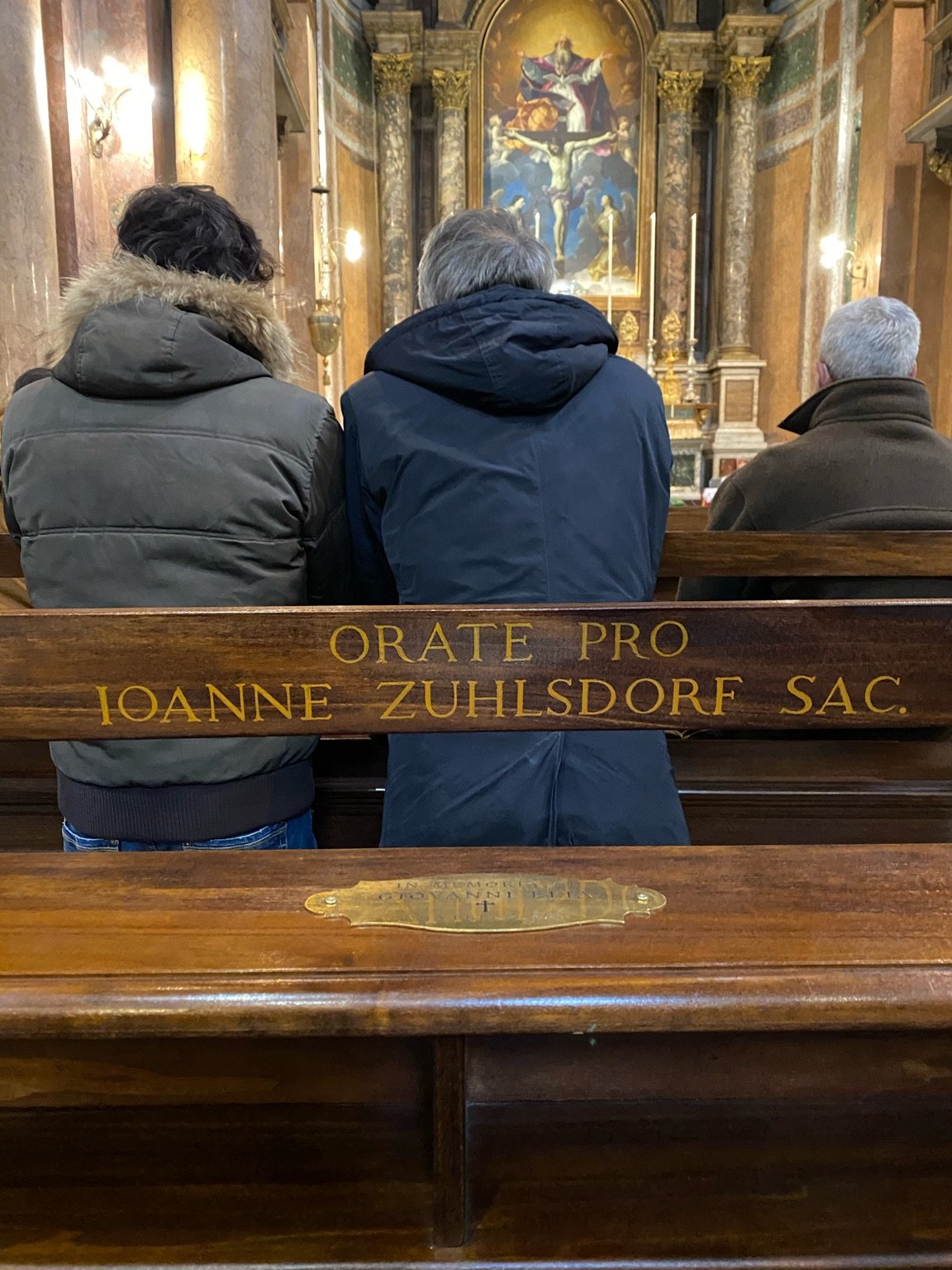
Not all parishes need to have a schedule like this, which is near to Penn Station in Manhattan.

But it does tell you something about the state of the Faith then and now.

One thing that catches my is is the schedule for devotions.

I’ve been arguing for the return of these old-fashioned devotions for a long time. They are very important for those who, for one reason or another, can’t receive Holy Communion. They are important for people with heavy petitions. They are just IMPORTANT.


Posted in SESSIUNCULA |
13 Comments

GOOD NEWS: “Key” available for Scanlon’s “Latin Grammar: Grammar Vocabularies, and Exercises in Preparation for the Reading of the Missal and Breviary”

There is some GOOD NEWS.

It’s down below.  Meantime…

I’ve been ranting for years about the need for clerics to know the language of their Latin Church, Roman Rite.

In most cases that means that priests and seminarians have to work on their own because they were cheated and lied to in seminary (which is required by canon law to provide for competence in Latin).   Learning Latin seems to many like an insurmountable task.  It isn’t.  Priests of yesteryear were not any brighter than today’s and a whole lot were a lot dimmer.  They did it.

On approach to learning Latin for the Mass and Breviary is the system referred to as Scanlon.

Latin Grammar: Grammar Vocabularies, and Exercises in Preparation for the Reading of the Missal and Breviary

US HERE – UK HERE

on Kindle!

Second Latin: Preparation for the Reading of Philosophy, Theology and Canon Law

US HERE – UK HERE

Or else…

Latin Grammar (Ecclesiastical Latin) (Volume 1)

US HERE – UK HERE

Second Latin (Ecclesiastical Latin) (Volume 2)

US HERE – UK HERE

Here’s the news.

Frequent commentator here, Fr Augustine Thompson, OP, informs me that there is a KEY now to Scanlon, which would be a great help to those who have to learn on their own.

In my years of teaching Latin, I am convinced that the best book for liturgical Latin remains Cora and Charles Scanlon’sLatin Grammar for Reading the Missal and Breviary, first published in 1944 by B. Herder Book Co., and still in print from TAN Books.

The one problem with this book is that there was no available full Answer Key.  I am happy to announce that we have now published one for all the exercises of every lesson. You may order copies of this Key from Dominican Liturgy Publications, which also has available many other resources for the Dominican Rite and the Latin liturgy.

It will take work and patience, BUT it CAN be done!

C’mon, Fathers!

Let’s recover what they stole from us!

Posted in ¡Hagan lío!, ACTION ITEM!, Be The Maquis, Latin, Liturgy Science Theatre 3000, Priests and Priesthood, Seminarians and Seminaries, Si vis pacem para bellum!, The future and our choices | Tagged ,
6 Comments

Daily Rome Shot 08

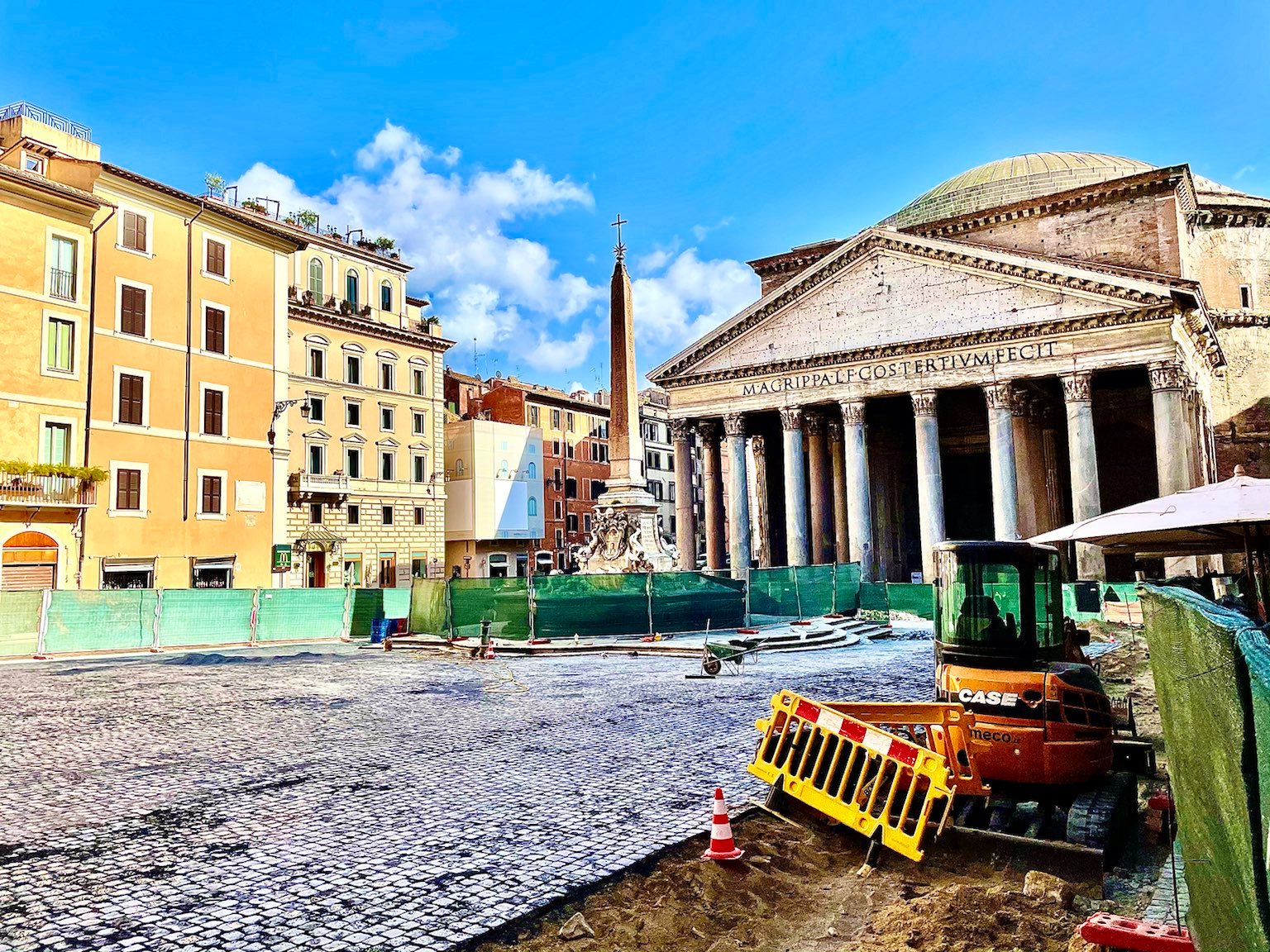
Photo by Bree Dail.

Posted in SESSIUNCULA | Tagged
Comments Off on Daily Rome Shot 08

Is it time to exorcize the Democrat Party?

Each day for a while now, after saying Mass I’ve been saying the Exorcism Against Satan and Apostate Angels, which is chapter 3 of Title XI in the Rituale Romanum.

I’ve been doing this with the authority of the bishop for the diocese and I’ve asked God to extend this exorcism to all places and equipment and people involved in the US election, for the sake of “election integrity”.

Priests and bishops have to do what only they can do, for the sake of the common good.  And the matter of “election integrity” is central to the common good of the nation.  It is wrong for us to act like senators or congressmen or representatives of government (which is an affliction rising from Original Sin).  We sacerdotes have to do sacerdotal things.

If we don’t, no one else can.  And THAT is what the Enemy of the Soul is counting on.

My instinct to do read this exorcism seems to be spot on.

I read this at the news feed of the SSPX:

The Day the Pope Exorcised Adolf Hitler

Pope Pius XII performed exorcisms on Adolf Hitler, the Nazis, and the Communist Party. The work of an Italian Vaticanist published this autumn lifts a corner of the veil on exorcisms practiced by the popes and long clothed in papal secrecy.

“The devil’s greatest malice is to make people believe that he does not exist,” Baudelaire said. For those who still have doubts, the Vaticanist Fabio Marchese Ragona, has just published in September 2020, a book entitled Il mio nome è Satana – My Name is Satan.

One of the work’s interests lies in several accounts of exorcisms carried out in the Vatican itself, by various sovereign pontiffs, in particular by Pope Pius XII, who tried to cast out the demon by whom he estimated that Adolf Hitler was possessed.

It was not until 2006, recalls Fabio Marchese Ragona, that the Holy See decided to make this unprecedented fact public: anxious to take all natural and supernatural means in order to put an end to the mass killings committed, particularly against the Jews, by the Third Reich, Pope Pacelli decided to perform an exorcism ritual “from a distance,” from the private chapel of the pontifical apartment.

Fr. Gabriele Amorth – famous Roman exorcist called to God in 2016 – told Vatican News at the time that Pope Pius XII was convinced that the atrocities committed by Hitler and the Nazis could only have a diabolical origin.

But this is not the only exorcism that John XXIII’s predecessor performed from the Vatican. The author of Il mio nome e Satana confides in having discovered, during the investigation which enabled him to write his book, documents attesting that the Pope had also carried out an exorcism on the Italian Communist Party, on the eve of the elections of 1958.

Pius XII was hoping to prevent the Communist Party, notoriously anti-Catholic, from winning the elections. It should be remembered, ten years earlier, the same Roman pontiff had approved a decree of the Holy Office prohibiting any Catholic, under pain of canonical sanctions, from joining or supporting the Communist Party.

Long after his death, in a 1969 report, Pius XII’s own nephew testified to seeing that his uncle was very anxious and had trouble sleeping in the days leading up to the 1958 election: “in the three days leading up to the vote, the pope also performed exorcisms,” ensures Carlo Pacelli.

He also noted that Pius XII had prayed and offered penance and his own sufferings for this intention: a sign of Providence, the Pope’s prayers were answered, and the Communists lost the election.

As Fabio Marchese Ragona points out at the beginning of his book: “The devil can win battles. Sometimes important ones. But never the war.” Enough to give a little hope when the darkness of circumstances seems to prevail.

It seems to me that the US bishops would do well to perform an exorcism of the Democrat Party, which has become the Party of Death.  Abortion is one of those hideous sins that attracts the attachment of demons.  For the spiritual well-being of anyone in that Party of Death, bishops have to exorcism and invoke canons 915 and 916.

I hope all priests and bishops will say Ch. 3 Title 11, at least privately.

Fathers, ask your bishops or superiors for permission to recite Title XI, Ch. 3.  I have audio recordings to help you with the Latin.  HERE  This is WAR, my brothers, serious spiritual war!   Let us do what only we can do.

Posted in ¡Hagan lío!, Be The Maquis | Tagged ,
27 Comments

Liturgical tweaking: rearranging the deck chairs on the Titanic

A few days ago, Corriere della sera had a piece explaining that on 29 November, the 1st Sunday of Advent, the suffering Italians who still bother with the Church will now have to change the way they have prayed the Gloria and – incredibly – the Our Father.

And the priest is now directed to say “fratelli e sorelle”, which to my ear is speciesist and exclusionary.

In the the place of “non ci indurre in tentazione” (lead us not into temptation) the suffering Italians will now have to say, by Conference Fiat, “non abbandonarci alla tentazione” (do not abandon us to temptation).

This is obligatory from next Easter, 4 April 2021.

Some pencil-necked, pointy-headed expert, kind of Italian clerical “Good Idea Fairy“, noticed that the Greek words of the Lord in Matthew 6 could be translated in another way. “Hey!”, quoth the Fairy, let’s make everyone do it that way!”

In Matthew, eisenénkes, from eisféro has been rendered in Italian with the verb “indurre” because of St. Jerome’s Vulgate, which has the verb inducere.

But in 2017, FRANCIS, known to be quite the expert in ancient languages and liturgy, no doubt under the influence of the Fairy, said, “questa è una traduzione non buona”… “this is a translation not good”.

Behold, wisdom.

“I’m the one who falls. He isn’t the one who tosses me into temptation to see how I fall. A father doesn’t do this, he right away helps us to get up. The one who leads us into temptation is Satan, that’s Satan’s trade. … Our sense of the prayer is: What Satan leads me into temptation, you, please, give me a hand, give me your hand”.

Never mind the Pelagian overtone in “give me a hand”.

Suffering Italians will also have to add another thing to the Lord’s prayer. To be “more faithful” to the Greek text, when they say, “forgive us our trespasses” they will then add “as we also forgive those who trespass against us.” Much better, right?

But wait, there’s more.

In the Anglophone world, it seems that a decree is forthcoming for the Novus Ordo which will change the English translation of conclusions of orations. In Latin, we commonly say, “Per Dominum nostrum Iesum Christum Filium tuum, qui tecum vivit et regnat in unitate Spiritus Sancti Deus, per omnia saecula saeculorum. Amen.”, with slight variations. In English we have been saying for that Deus, “one God”… “who lives and reigns in the unity of the Holy Spirit, one God, for ever and ever”. But now, that “one” is to be dropped. “who lives and reigns in the unity of the Holy Spirit, one God, for ever and ever” Why? Because in the Latin there is no “unus“.

Friends, this liturgical tweaking is tantamount to rearranging the deck chairs on the Titanic.

It is a distraction.

This truly is Liturgy Science Theatre 3000.

Of course if you attend the Traditional Latin Mass, none of this nonsense makes any difference.

Posted in Liturgy Science Theatre 3000, You must be joking! | Tagged ,
8 Comments

ACTION ITEM! Seminarian in need of prayers

It is deeply troubling that the tactics of the 80’s and 90’s are being redeployed now.

From a reader…

In connection with your psyops article from just over two years ago, there is a seminarian in need of serious prayer. Would you please keep him in prayer? He is a good friend of mine, an upstanding young man, but he has run afoul of “the system” and they are making his life a living nightmare right now.

Posted in ACTION ITEM!, Seminarians and Seminaries |
3 Comments

ASK FATHER: What happens to the Eucharist if the priest does not communicate during Mass?

From a reader…

QUAERITUR:

I’ve learned through your blog that if a priest does not receive Holy Communion at the Mass he is celebrating, the Mass is invalid. But what happens to the bread and wine that were consecrated moments before? Were they really changed into the Body and Blood of Our Lord? Do the people who receive Holy Communion at that particular Mass receive Our Lord or just bread?

If a priest has consecrated the Eucharist in the proper way, with the proper intention and then, for whatever reason, does not consume the Eucharist just consecrated, the Eucharistic species continue to be the Body, Blood, Soul, and Divinity of Christ until such time as they are consumed by someone or their species “broken”.   They do NOT revert to being bread and wine.   Catholics do not believe what some Protestants think: that Christ is present only insofar as their “eucharistic bread” etc. is being consumed and then, after it is no longer to be consumed reverts to what it was.

If, for whatever reason, the priest does not receive his own Communion of what he has there and then consecrated, then Mass has not truly been celebrated.   People given Communion would technically be receiving outside of Mass.

There are legitimate reasons for a priest not to receive one or both of the Eucharistic species.  For example: the priest dies or faints, thus prohibiting his reception.

Various scenarios of interruption of the consecration or prevention of receiving Communion by the priest are covered in the “De defectibus” of the traditional Missale Romanum.   I warmly recommend that all seminarians and priests read it and become intimately familiar with it.  It doesn’t provide practical rules merely.  It imparts an inner logic about the connection of the priest and Eucharist.

For example:

33. If before the Consecration the priest becomes seriously ill, or faints, or dies, the Mass is discontinued[That was the situation described.]  If this happens after the consecration of the Body only and before the consecration of the Blood, or after both have been consecrated, the Mass is to be completed by another priest from the place where the first priest stopped, and in case of necessity even by a priest who is not fasting. If the first priest has not died but has become ill and is still able to receive Communion, and there is no other consecrated host at hand, the priest who is completing the Mass should divide the host, give one part to the sick priest and consume the other part himself. [Do you see the intimate unity of priest and Host?] If the priest has died after half-saying the formula for the consecration of the Body, then there is no Consecration and no need for another priest to complete the Mass. If, on the other hand, the priest has died after half- saying the formula for the consecration of the Blood, then another priest is to complete the Mass, repeating the whole formula over the same chalice from the words Simili modo, postquam cenatum est; or he may say the whole formula over another chalice which has been prepared, and consume the first priest’s host and the Blood consecrated by himself, and then the chalice which was left half-consecrated.
34. If anyone fails to consume the whole Sacrament aside from cases of necessity of this kind, he is guilty of very grave sin.

Reading De defectibus especially through the lens of Pope Benedict’s Post-Synodal Exhortation Sacramentum caritatis (which presents us with a reflection on the priest’s ars celebrandi) could be of enormous practical use to seminarians and younger priests today.

Posted in "How To..." - Practical Notes, ASK FATHER Question Box, Liturgy Science Theatre 3000 |
8 Comments

Daily Rome Shot 07

Photo by Bree Dail.

Posted in SESSIUNCULA | Tagged
2 Comments

Rome Shot 06

Photo by Bree Dail.

Posted in SESSIUNCULA | Tagged
1 Comment

#ASonnetADay – 100. “Where art thou, Muse, that thou forget’st so long…” Thanks, @sirpatstew …

Posted in Poetry, Sonnet A Day |
1 Comment