

 From a reader…
QUAERITUR:
Father during confession said in his opinion, the Holy Spirit is a woman. “She gives us birth in baptism, she will help you.” [Jackass!] His other remarks were well taken but I was so appalled I couldn’t wait to get out of there. Not to mention, it was face-to-face and no other option — just two chairs at one side of the sanctuary. He also stopped me saying the act of contrition because I was being rote. [Jackass!]
I think his words of absolution were correct but I still wonder. Do you think I am absolved? Is he actually a heretic?
I’m reminded of one of the Martyrs of Gorkum, who were killed by Calvinist Protestants because they refused to deny transubstantiation. One of them, a priest, was an infamous rake and fornicator. They expected him to cave in easily. But when he was challenged to denounce his Faith he said “I was a fornicator, but I’m not a heretic” and they killed him.
The 19 Martyrs of Gorkum are invoked especially for relief from hernias. It seems to me that that jackass priest in that confessional has a brain hernia, cutting off part of his intellect.
Pray for him to the Martyrs of Gorkum.
Is that jackass a heretic? It depends. Heresy is the persistent denial or doubt of a revealed truth of Catholic doctrine. Putting aside the obvious point that God the Holy Spirit transcends physicality, based on biblical texts the gender of the Holy Spirit as male is a core tenet of Catholic belief. Denying it would heresy.
If he said it in the confession, my guess is that this is part of his schtick. Draw your own conclusion.
While Holy Spirit’s power and influence is often expressed in Scripture with feminine imagery (e.g., the word “ruach … spirit“ in Hebrew is feminine), Scripture consistently refers to the Holy Spirit using masculine pronouns. Jesus himself referred to the Holy Spirit as “He” (Greek ekeînos as in John 14:26, 15:26, 16:13).
Stopping you during the act of contrition… GRRRRR. That old garbage. Apparently we can’t sincerely mean what memorized prayers say. The classical, memorized form has all the necessary points that must be manifested for the priest to give absolution. Stick to your guns.
About the absolution. I can’t say much about that since I don’t know what form he used. Even if he is a heretic, were he to have used the proper form, you would have been validly absolved.
What a jackass. What jackassery.
I keep starting these posts and then forget to publish them. So here’s one sorta kinda done.

A “bis” of caccio e pepe and asparagus with truffle.
Please remember me when shopping online and use my affiliate links. US HERE – WHY? This helps to pay for health insurance (massively hiked for this new year of surprises), utilities, groceries, etc.. At no extra cost, you provide help for which I am grateful.
I, too, recoiled in disgust at the suggestion from a BBC cooking section to add butter to “caccio e pepe”. It is suggested as a cheat and caccio e pepe is tricky to make correctly. But still. The horror of it all. It was bad enough to insinuate that you might sub parmigiano for pecorino. It goes to show how far gone the BBC really is. My experience is that less starch releases into soft water.
The key to caccio e pepe could be the water. I find it easier to do certain things with the water in Rome than in these USA. Also, the type of pasta makes a difference, how quickly or slowly it dried, the way it is finished, etc. “Bronze” cut, which leaves a rougher exterior seems better for many reasons.
 I missed this yesterday. It was the anniversary of the work on the dome of the Cathedral of Florence designed by Brunelleschi. If you have not read it already, I cordially recommend Ross King’s fascinating Brunelleschi’s Dome: How a Renaissance Genius Reinvented Architecture. It is a good book for understanding the roots of Renaissance architecture.
INDIA
A mob of 70 Hindus VIOLENTLY attacked a Catholic PRIEST and NUNS on Wednesday evening in Jaleswar
They brutally beat the priest because he was celebrating an anniversary Mass for a deceased Catholic
The priest and nuns were ARRESTED despite being VICTIMS pic.twitter.com/xXma6lIHOt
— Catholic Arena (@CatholicArena) August 8, 2025
Before launching into the trip itself, homage must be paid to my hosts. Last night we had terrific sauteed peppers and spicy sausage on the grill, which could be consumed with or without the excellent Turano rolls (which I have missed).
Transformations. sauteed pepper and hot sausage


So satisfying.
I picked up my rental car from ORD (the cost… YIKES) for the drive to La Crosse where the cool kids of canon and civil law gathered with Card. Burke and a star studded cast and try to be both civil (a challenge for some of them) and canonical for a couple of days of excellent talks and socializing. One of the presenters is Michael Mazza who has done so much to defend priests and defend their good name, their reputation, which is always a casualty especially at the hands of the dioceses which don’t follow proper procedures. I look forward to meeting good friends, including the official parodohymnodist of this blog, whom I’ve known since the 80’s.
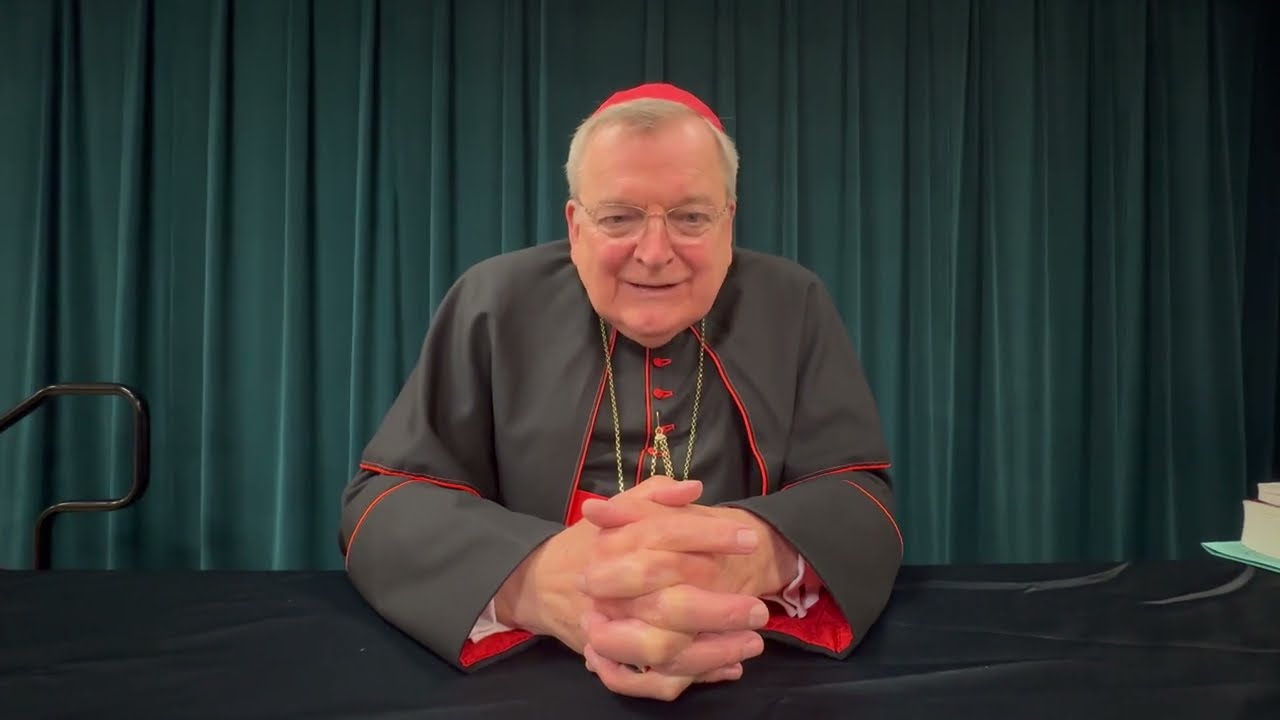
Excellent presentations. Card. Burke honored up with another brief video message which I must edit and post.
Arriving at the Shrine you see the “candle chapel” which one of my more brilliant friends compared to – the inside, mind you – “a zoroastrian fire tower”. The grounds of the Shrine were truly lovely. Volunteers swarmed to tend the flowers.

Card. Burke during the Q&A after supper last night. I was able to ask about can. 249. Heh.

Along the river walking home. How nice to see real trees and grace.

The pilgrims house is being built. It’ll be ready in 2027.


My dear Little Flower.


It was a good opportunity for confession.
Heading down after the talks.

This was fun.

I stopped in my old stomping grounds as a first leg to Milwaukee tomorrow. Into a favorite grocery store I compared the pizza aisle to what is available where I now hang my head… HAT… my HAT.
The entire aisle is pizza. It isn’t even quarter of that elsewhere.

More later.
The Roman calendar has many little treasures which remind us of how our Faith and the Church’s calendar, the rhythm of temporal and spiritual life, are integrated in our seasons.
Today, for example, the Feast of the Transfiguration of the Lord, there is a special blessing of grapes in the traditional Rituale Romanum. The powers that be, some of them at least, want to take this away from people. It is not found in the “BOB” or “Book of Blessings… De Benedictionibus”. In its index, “Grapes” are relegated to “new fruits” on the feast of the Presentation. Don’t let them take away our heritage.
You might consider that title, “THE GRAPES OF… TRANSFIGURATION!” a little dramatic. However, consider that the vast majority of grapes grown went to wine, their individual leap to collective glory.
In the Transfiguration, Our Lord let something of His glory shine forth through His human body. In wine, in advance we detect something of the joy of the heavenly banquet, remembering that, just as grapes are crushed to make wine, our Lord had His Passion. As the Golden Legend say, “the blood of Christ is renewed of new wine if it may be founden of a ripe grape”.
We also have to have our Passion, collectively as a Church, and individually. There is no escaping the Passion. Do not listen to those who posit anything Christian that avoids the Passion.
If truth be told, the blessing of grapes at this time seems to be attached more to the Feast of St. Sixtus II, martyred in 258 with his famous companions. The Feast of the Transfiguration came to be observed centuries later in the Roman calendar.
But who cares? The more the merrier! We are Catholics. That means we are both/and rather than either/or when it comes to these happy events.
Back to Sixtus. At the beginning of August we Romans remember the martyrs Pope Saint Sixtus and his four deacon companions. St. Lawrence would famously follow, burned on an iron grate. For that see St. Ambrose. HERE This is the time of year with the first grapes of the harvest are blessed. Together with the Transfiguration of our Lord, the blessing of grapes – an eschatological symbol – shows that Holy Church is already in the end time, though we wait for its completion. And it sure feels like the end times.
Here is the translation for the blessing of grapes, for those who don’t have Latin:
V. Our help is in the name of the Lord.
R. Who hath made heaven and earth.
V. The Lord be with you.
R. And with thy spirit.
Let us pray.
Bless, we beseech Thee, O Lord, this fresh fruit of the vine,
which Thou hast graciously brought to full ripeness
with the dew of heaven, abundant rain, and calm and fair weather.
Thou hast given them for our use;
grant that we may receive them with thanksgiving
in the name of our Lord Jesus Christ, the True Vine,
who liveth and reigneth with Thee in the unity of the Holy Ghost,
God for ever and ever.
R. Amen.
(And they are sprinkled with holy water.)
I was delighted by the reference to “dew of heaven… rore caeli“. You might recall the controversy over the reference to “dew” when the new, corrected English translation of the Novus Ordo was being prepared.
The cultivation of certain types of grapes requires special conditions. In a contrast to the benefits of dew lauded in the prayer of the blessing, however, dew isn’t always good for grapes. Dew helps fungus to get hold, through in the case of some grapes, certain fungi are welcome, as in the case of the “noble rot” in a very late harvest which produces wines of a spectacular sweetness and depth. Also, it is important to harvest grapes after dissipation of dew. But certainly the evocation of dew in the prayer refers to the necessary moisture grapes need for their proper development. And of course, dew is a Scriptural image for the descent of God with graces.
The coming of and effects of the Holy Spirit, in Scripture and in the Fathers of the Church, are often described not by fire imagery, but rather by water images and, indeed, dew.
First, ros can come from above like rain. Second, ros is dew which forms nearly imperceptibly. In one case, rain flows across a thing and washes it. Dew slowly dampens. In both cases there results a penetrating soaking. Arid ground yields to planting. Seeds germinate and sprout. The ros Spiritus in the (artificially cobbled up and inaccurately called ancient) 2nd Eucharistic Prayer can be both the cleansing and the moistening.
Our Catholic doctrine of sanctification teaches us that at baptism a person is both justified and sanctified by the washing/indwelling of the Holy Spirit. That sanctification can be deepened through the course of one’s life. It comes suddenly. It comes gradually.
In Scripture the psalmist sings about the “King of Justice”. “May he be like rain (Vulgate ros) that falls on the mown grass, like showers that water the earth!” (Ps 72:6 RSV).
In the Song of Songs, we hear, “Open to me, my sister, my love, my dove, my perfect one; for my head is wet with dew (ros), my locks with the drops of the night. By night I have put off my coat, how shall I put it on? I have washed my feet, how shall I defile them” (Cant 5:2-3). St. Augustine (+430) saw in the lover and beloved an image of Christ calling His ministerial Church to service.
From Isaiah we have an image which has come into the Latin Church’s liturgy, namely, “Rorate caeli desuper … Shower (rorate), O heavens, from above, and let the skies rain down righteousness; let the earth open, that salvation may sprout forth, and let it cause righteousness to spring up also; I the LORD have created it” (Is 45:8 Vulgate and RSV – Introit 4th Sunday of Advent).
The Fathers made much of ros through an allegorical technique of interpretation. Origen (+254), via Rufinus’ translation of the Homilies on the Book of Judges (8.5) says: “But we also, if only we might offer our feet, the Lord Jesus is ready to wash the feet of our soul and cleanse them with a heavenly washing (rore caelesti), by the grace of the Holy Spirit, by the word of sacred doctrine.”
Saint Ambrose of Milan (+397), who drew much upon Origen’s writings as a starting point, in his work on the Holy Spirit wrote: “The Holy Scriptures were promising to us this rainfall (pluvia) of the whole world, which watered the orb under the coming of the Lord, in the falling dew of the divine Spirit (Spiritus rore divini)” (De spiritu sancto 1.8).
The imagery of grapes is also Scriptural. The immediate association for Catholics is the Eucharist. But grapes symbolize the end times. They have an eschatological import. In Revelation 14:19-20 we have an image of the end times and judgment when the grapes of wrath are pressed in the winepress. The title of the post might call to mind the book by Steinbeck, but that in turn points to Rev 14.
17 And another angel came out of the temple in heaven, and he too had a sharp sickle. 18 Then another angel came out from the altar, the angel who has power over fire, and he called with a loud voice to him who had the sharp sickle, “Put in your sickle, and gather the clusters of the vine of the earth, for its grapes are ripe.” 19 So the angel swung his sickle on the earth and gathered the vintage of the earth, and threw it into the great wine press of the wrath of God; 20 and the wine press was trodden outside the city, and blood flowed from the wine press, as high as a horse’s bridle, for one thousand six hundred stadia.
Of course the image of grapes is a happy one as well… obviously. From the ancient Roman Church grapes are found in carvings in the catacombs and on sarcophagus reliefs. Bunches of ripe grapes are symbols of completion, that the season has finally brought things to fruition. Grapes remind us that Christ is the Vine, whence all our life and hope flows out to us, His branches and tendrils.
In those ancient depictions we sometimes see the harvest of grapes, which is the happy completion of life. For example there is the relief of the famous 4th c. sarcophagus with the Good Shepherd from the Catacombs of Praetextatus which shows a harvest. In the Catacomb of Priscilla there is a 4th century carving of a dove eating grapes, the dove being a symbol of the Christian soul and grapes the happy attainment of the goal of fullness in due time, heaven. Remember that reference, above, to the dove from the Song of Songs? It all fits together. You can right-click on that image of the Good Shepherd for a larger view.
Grapes remind us that we shall be known from the fruits we both bear and we generate for the benefit of others.
Grapes remind us that we should not be sour grapes for others.
Grapes remind us that, if we do not live our vocations as the Lord’s branches well, then the grapes may be those of wrath, though mercy and forgiveness is what the Lord offers those who fall.
So, get your grapes and get them blessed, today, if you can.
When you eat them consider:
Since I am in Chicago, I post today a link to a story from this date in 2023, 4 August 2022, about the Archdiocese and the Institute of Christ the King.
You might remember that the local Archbishop said to the Institute, whose raison d’être is the use the traditional form of the Roman Rite, that they had to accept the patently and false and manifestly stupid claim that the Novus Ordo “is the only expression of the Roman Rite” or they couldn’t celebrate any Masses in their church. In other words, they offered the Institute an unjust choice: Accept the lie we are forcing on you, or you can’t functioning as priests… and it’s YOUR fault.
This sort of thing is a manifestation of what so often results for priests as moral injury.
Remember: It’s not just the rite, the Vetus Ordo, that they fear and hate, its the people who want those rites. It’s the people.
Adding to the sadness, even though a new pontificate in underway with Leo XIV, even though 99% of local bishop don’t know what his thinking is about the matter is, some bishop are moving against the people who want the traditional Mass (cf. Detroit, Charlotte, Valence, etc.).
Not Roma, but Bologna on the Feast of St. Dominic.

Welcome registrant:
Quodscripsi61
Kinda like … well… I won’t say.
This duck is a legend ?pic.twitter.com/AmUzlLtBcl
— Interesting things (@awkwardgoogle) August 4, 2025
Please remember me when shopping online and use my affiliate links. US HERE – WHY? This helps to pay for health insurance (massively hiked for this new year of surprises), utilities, groceries, etc.. At no extra cost, you provide help for which I am grateful.
You can see where this is going, right?
This is a Bavarian cream bug donut. It is available at the Wisconsin State Fair. My friend spent money to eat this thing. She said it was “very crunchy”. I would TAKE money to eat it. But it would take a lot of money… pic.twitter.com/trqOqKGy5t
— Vicki McKenna (@VickiMcKenna) August 4, 2025
Cristero soldiers kneeling at a clandestine Mass, 1929. pic.twitter.com/s7AGY31GGj
— Peter Kwasniewski (@DrKwasniewski) August 4, 2025

Black to move.

And today marks 13 years of activity for the Mars Rover Curiosity! HERE

They’ve upgraded the software so that it is more energy efficient and can multitask. Also, it’s tread is a good shape and it can keep going for a long time yet. It’s an interesting article.
 At the substack of Catholic Unscripted (three great brits) there is a piece by Rev. Stephen Morgan, whom I have known for years. Brilliant and “good value” (a phrase I learned from him), a convert, who is now heading up a Catholic University in Macao (after working in finance and obtain multiple serious degrees).
He wrote “the book” on John Henry Newman’s key concept, which many cite and few grasp.
John Henry Newman and the Development of Doctrine: Encountering Change, Looking for Continuity
US HERE
At Catholic Unscripted, his piece – NOT behind a paywall because it is that important – is called… I’ll give you a taste…
Hijacked Development
Rescuing Newman from Misuse in the Church’s Moral Crisis
By Stephen Morgan
In February 2023, the Anglican Archbishop of York, Stephen Cottrell, addressed the Church of England Synod with a bold theological claim. Seeking to justify the blessing of same-sex unions, he invoked St. John Henry Newman’s theory of doctrinal development to argue that revealed truth can change into its opposite. What was once considered sin could now, under the banner of “development,” be embraced as sacramentally significant.
The invocation was more than theologically strained—it was ironic. Newman had left Anglicanism precisely because his theory of development, written in the dying days of his life as an Anglican, but in fact worked out over the previous twelve years, demonstrated that the Church of England lacked doctrinal coherence, lacked the authority to validate the changes it had made to the Catholic and Apostolic faith. Yet today, even within the Catholic Church, Newman’s name is misused in precisely the same way: to provide theological cover for innovations that appear, under scrutiny, to contradict apostolic teaching.
Cardinal Víctor Manuel Fernández, Prefect of the Dicastery for the Doctrine of the Faith, has repeatedly cited Newman’s Essay on the Development of Christian Doctrine (1845) to defend controversial interpretations of documents such as Amoris Laetitia and Fiducia Supplicans. In both cases, Newman’s theory has been used to claim that the Church is not reversing her teachings but developing them—suggesting that it was possible to adapt pastoral practice while preserving doctrinal principle, as if the one does not act upon the other in the order of reality.
[…]
I think you can see where this is going.
I urge you to take a few minutes and read Morgan’s piece at Catholic Unscripted.
Some popping quotes from the piece:
“Despite the clarity of Newman’s method, recent years have seen it misappropriated by those seeking to justify changes that clearly fail his tests.”
“The misuse is particularly offensive because it both seeks to endorse grave moral evil and leverages Newman’s authority to undermine the very tradition to which the end point that the logic of the Essay on Development…”.
“A true development builds on what came before without undermining it. This is not what Amoris Laetitia does.
The 2023 declaration Fiducia Supplicans intensified this misuse.”
“The original purpose of Newman’s Essay was to demonstrate Catholicism’s consistency with apostolic faith. Today, that same essay is cited to justify inconsistencies. The difference could not be starker. Newman offered a grammar of development—what is now being practiced is a rhetoric of change.”
“In declaring him a Doctor of the Church, Pope Leo XIV has rightly recognized Newman’s genius. But that genius must be honoured with fidelity, not reinterpreted beyond recognition. If the Church is to remain credible in the eyes of the faithful and the world, it must cease weaponising Newman’s name and begin applying his method.”
See?
This is an important essay. Please give it attention and perhaps drop a note of thanks to Catholic Unscripted for getting it out there!
Pope Leo at Mass for the swarms of young people in Rome for the Jubilee.
Anything missing from the altar?
Jesus, where are you?
The Pope is looking for the crucifix but cannot find it. pic.twitter.com/NmUQOVelVU
— Silere non possum (@silerenonpossum) August 3, 2025
I suspect there will be a conversation with someone about that.
At the Shrine of Our Lady of Guadalupe for a conference. The Feast of their Dedication was celebrated with Card. Eijk, Archbishop of Utrecht, as the homilist. HERE
Card. Eijk was a contributor to the important book on “sense of the faithful” which I describe more at length HERE So was Dr. Echeveria who was brutally fired from Sacred Heart Seminary.
Why is this move brilliant? Explain.


Coat of Arms by D Burkart









A Daily Prayer for Priests


They find you a pro-life agent in your area who commits to giving a portion of the fee to a pro-life group!

PLEASE subscribe via PayPal if it is useful. Zelle and Wise are better, but PayPal is convenient.
A monthly subscription donation means I have steady income I can plan on. I put you my list of benefactors for whom I pray and for whom I often say Holy Mass.
In view of the rapidly changing challenges I now face, I would like to add more $10/month subscribers. Will you please help?
For a one time donation...



Help Monks in Wyoming (coffee – UPDATED LINK) and Norcia (beer) and the wonderful "Soap Sisters" of Summit, NJ!


Please follow me on Twitter!










Visits tracked by Statcounter
since Sat., 25 Nov. 2006:

