Daily Rome Shot 1277

Just off the Via dei Coronari is a little stair leading to the last vestige of the only church in Rome for the Apostle Simon.  Just the door remains.

Please remember me when shopping online and use my affiliate links.  US HERE – UK HERE  WHY?  This helps to pay for health insurance (massively hiked for this new year of surprises), utilities, groceries, etc..  At no extra cost, you provide help for which I am grateful.

People are good…

In high culture…

In chessy news… HERE

White to move and mate in 3. Fun.

Posted in SESSIUNCULA |
2 Comments

24 March – Feast of St. Gabriel, Archangel – images – EXPANDED

Last year I posted some images of the Announcing Archangel St. Gabriel, whose feast day it is in the Vetus Ordo, appropriate in the presence of tomorrow’s Annunciate, the Feast of the Annunciation.   NB: The Feast of the Annunciation, as all Marian feasts, are intended always to redirect our eyes and hearts to the Lord, as hers were.  Nevertheless we delight in reflecting on the role of Our Lady.

I’ll repost, with additions.


Today, the day before the Feast of the Annunciation, is the Feast of the announcing Archangel Gabriel.  He is one of three holy angels whose name we know from Holy Writ.  His name means roughly “God is my strength”.

Gabriel shows up in Daniel and helps to interpret his visions.   Gabriel later announces the birth of John the Baptist to Zacharias (Luke 1:5-7).  Then he announces the birth of the Lord (Luke 1:21-25).  He is named in some apocryphal works as well.  He is sometimes associated with the angel in Revelation who will sound a trumpet for the resurrection of the dead.

There are innumerable depictions of Gabriel before the Annunciate, sometimes more glorious and sometimes more humble.  All interesting.  Do you have a favorite?

Here are a few of mine.

Sandro Botticelli has Gabriel placing himself below the Annunciate.  Note the colors of their robes and the position of their hands, the echo of the tree and lily, the perspective created with the flooring.

I have a soft soft for Barocci and his colors, and his tenderness and depiction of awe. Here the angel seems to be in awe even as he announces. Dove-winged Gabriel is in the very moment of explaining while pointing to the prayer book, Scripture, in her hand.  And there’s a cat, ignoring the whole thing, which would be the usual thing for a cat to do in such a moment, for in paintings cats are often symbols of infidelity and fickleness.  I also dig Mary’s hat, hanging up.

Years later we have this.   From Glyn Warren Philpot, early 20th c.

Mary is not even seen except in the eyes of the angel.

No longer groveling below, he swoops in from above…

This is in the Scuola Grande di San Rocco. I once knew the Maestro Grande and had a private tour to all the nooks there. Fascinating. Tintoretto emphasizes the poverty of the Holy Family and sense of surprise. Heaven suddenly pours into the wreckage of human living.

And Caravaggio with that light and that characteristic hand

Henry Ossawa Tanner, “The Annunciation,” 1898

Gabriel is more like himself, I think. He reminds me of the “pillar of fire by day”. Mary would become in this moment the tabernacle of the presence foreshadowed by the tent of meeting in Exodus.  The angel is like the fire in the bush.

George Hitchcock… here the angel is the most like himself.  He cannot be seen.   This isn’t one of my favorites, but it is thought provoking.

Many will emphasize the dialogue.  Could this be the most famous?

San Marco, Florence.  Beato Angelico.  I like the raptor wings and the lovely hortus. Note the hands of the Announcing and the Annunciate.   I think you can right click and get a larger.  You need it.

Leonardo seems also to emphasize the dialogue.  Again with the hands.  The Annunciate Virgin seems to be marking her place for reading when the interview is done.  If not for her raised hand there seems to be little surprise, only slightly enigmatic attention.  The raptor-winged angel is all business.

One could multiply these nearly beyond count.

Perhaps you have your favorites.


2025

Some of you did have favorites posted in comments last year.

Here’s one by Carlo Crivelli in the National Gallery in London.

There’s so much going on.  Right click for a larger and be amazed.

A couple of guys on that arch are getting some business done.  Perhaps a couple of birds are being purchased.  Carrier pigeons, perhaps, and a dovecot given the topic of “message”.  Next to that the portal to Heaven is open like something from Star Trek and a phaser of grace from the Holy Spirit is zapping down through the window.  In the upper story, a rug is being aired and there is a pigeon, again, and in a cage a Christological Goldfinch.  Oh yes, and a peacock which is a symbol of the resurrection because ancients believed that peacock flesh did not decay.  The shelf in the Virgin’s rooms seems uncharacteristically disordered but the bed is made to military specs.  Note the carpet on which she kneels is sort of scrunched.   Perhaps because she was suddenly surprised?  Gabriel didn’t even go inside and St. Emidius is photobombing with a model of his city Ascoli Piceno like a realtor.   The motto “Libertas Ecclesiastica” is the title of the papal bull that gave the city its rights.  On the feast there was a procession to the monastery of the Observant Friars, whom you see on the left.  Is the guy in red and black the patron of the artist who commissioned this?  Maybe with his child?  More details.  A guy in the street seems to be either trying to figure out what he has to buy at the market or he’s eyeing the strangely garbed loiterers along the way.  Through a tiny gap in an archway, a women is talking with a bucket on her head.  And in the foreground, it wouldn’t be Crivelli without some seemingly random veggies, here an apple (the Fall of Man) and a squash or cucumber (Redemption).  They also given depth to the painting by an optical illusion.

Annunciation by George Hitchcock, Philadelphia.

This seems to be more of an interior locutions. The Medival and Renaissance idea of a hortus inclusus might be going on here. Often when the Virgin is reading, the text is thought to be from the Prophet Isaiah. I can’t make out what the Hebrew says, if anything.

Dante Gabriel Rosetti’s “Ecce Ancilla Domini”. A rather sparse palette for this pre-Raphaelite painter. The embroidery she is working on is feature in another of his paintings about Mary’s childhood.

Note: No wings and his feet are on fire. His hand is raised slightly as if to say “Do not be afraid”. The Holy Spirit is barely noticeable. Her hair is messy and she is staring at the lily (or beyond) as if she has never seen one. She’s all drawn up and pulling back. It is an odd painting, to me. Is Gabriel casting a shadow?

A fine young artist who does fusion stuff, Daniel Mitsui, did a samurai version of Gabriel coming to Joseph for the second time in a dream telling him to get outta Dodge.  Check out his site.  His version of the war in Heaven is worth your time.


Posted in Classic Posts, Just Too Cool, SESSIUNCULA | Tagged
5 Comments

Notes on a curiosity in today’s Gospel reading from Luke 11

On this 3rd Sunday of Lent in the Vetus Ordo we have a Gospel reading from Luke 11:14-28 in which Our Lord refutes an accusation that He cast out demons because He was aligned with the Devil.

It is helpful to look at parallel Gospel passages for additional details.  In this case we have parallels in Matthew and Mark.

One element of the episode popped out at me.  It wasn’t in Mark, but it is in Luke and Mark.  Here is the RSV:

Matthew 12:27 Mark Luke 11:19
27 And if I cast out demons by Be-el?zebul, by whom do your sons (Greek huioi) cast them out? Therefore they shall be your judges. And if I cast out demons by Be-el?zebul, by whom do your sons (Greek huioi) cast them out? Therefore they shall be your judges.

The DRV has “children” in both instances.

One could get fancy with Greek huioi and make it to mean any male Jews, young or adult.  A plain reading of both passages is “children”.   Ancient Jews, as the Greeks and Romans, had classifications of age groups.  While the “seven ages” goes back to Solon, in general there was boyhood, youth and old age.  One moved from being at boy to being a youth at about 13.

It seems that the earthly time of the Lord, 1st century Jews had also children, not just adults, doing exorcisms.

A couple of things are to be drawn from this.

Firstly, the Jews practiced exorcism.   As a matter of fact, in the Gospel reading we hear on the 1st Sunday of Lent, the Devil quotes a psalm that the Jews used in their exorcisms!  That said, the remark about children hints that there was great need for exorcisms then, so much so, that they needed the assistance of the young.  That suggests that manifestations of possession were obvious to them.   It is not a coincidence that in many instances of the Lord casting out demons He was also healing, as in the Gospel today wherein the man was mute.  In Matthew the demoniac is both mute and blind.   One might ask: Are there fewer instances of possession now?  Or are they simply not as obvious?  Why would that be?  Is it because our times are so numbed that we don’t notice it?

Secondly, exorcist is one of the Minor Orders, the second after acolyte.    In ancient times the function of those in minor orders fit the name of the order.   Minor orders could be received at quite a young age. In more recent times that ceased.  Way back, exorcists exorcized.   This exercise of exorcism was needed particularly at this time in the liturgical year because catechumens were being “scrutinzed” and exorcized several times during the second part of Lent (3rd Sunday onward). Pope Cornelius (+253) in a says that in Rome there were 52 exorcists. Scrutinies and exorcisms are all compressed into the modern (traditional) Rite of Baptism.  For example, the ancient practice of exsufflation (out-breathing) remains in the rite.  It is mentioned by St. Augustine for the baptism of infants.  The traditional rite has several exorcisms while the Novus Ordo still retains one though it is not nearly as explicit as those in the Vetus Ordo form.

If memory serves the ancient child St. Cyricus may have performed an exorcism when his mother St. Julitta was undergoing oppression by the Enemy after she was tortured.  However, the tales of these ancient saints vary quite a lot.


Posted in SESSIUNCULA |
5 Comments

Your Sunday Sermon Notes – 3rd Sunday of Lent 2025

Too many people today are without good, strong preaching, to the detriment of all. Share the good stuff.

It is the 3rd Sunday of Lent in the Novus Ordo and in the Vetus Ordo.   Surprisingly, the experts of the Consilium didn’t do away with Lent completely.

The Roman Station is St. Lawrence outside-the-walls.

QUESTION: At the Mass you went to, was the Station mentioned?  Let us know in the combox.

As of this Sunday we are in the SECOND stage of Lent.

Was there a GOOD point made in the sermon you heard at your Sunday Mass of obligation?

Tell about attendance especially for the Traditional Latin Mass.

Any local changes or (hopefully good) news?

I have a few thoughts about the orations in the Vetus Ordo for this Sunday: HERE

A taste:

Welcome to the second part of Lent.  As Pius Parsch puts it in The Church’s Year of Grace, in the first two weeks we put ourselves on guard against attacks by the Prince of this world, the Devil and fallen angels, with the weapon of mortifications.  On this Sunday we move from defense against the Enemy to attack: Christ casts out a demon and refutes any connection with the Enemy.  He then explains how not to allow the demons – and maybe “our demons” in the form of memories of past sins that haunt us – to return to trouble us.   On that note, Paul inveighs against sins that not only will haunt us for the rest of our lives, but are also avenues through which demons can attach themselves to us to oppress us and also attach to the places where those sins occurred.    We have to put our “houses” in order.

Posted in SESSIUNCULA |
5 Comments

Daily Rome Shot 1276

Please remember me when shopping online and use my affiliate links.  US HEREWHY?  This helps to pay for health insurance (massively hiked for this new year of surprises), utilities, groceries, etc..  At no extra cost, you provide help for which I am grateful.

This is a public service announcement… and it is true.

Imagine…

This is strangely alarming even though it conveys more accurate information…

In chessy news…  HERE

White to move and mate in 4.

Posted in SESSIUNCULA |
1 Comment

Daily Rome (video) 1275 – a trip to the tailor

Instead of a static photo today, here’s a video about Gammarelli in Rome (ecclesiatical tailor).

You will recall several vestment projects here on the blog, which caused a great deal of joy and continue to enrich sacred worship.

YouTube thumbnailYouTube icon

And there’s this…

In chessy news…

Chess.com (I have an affiliate tag… sign up now and I’ll get credit… posted a jocular post inviting suggestions for renaming the bishop. (I immediately thought of a few which I can’t write here.) The joke provoked a hurricane of comments. Some got creatively funny. Other’s took it seriously. Some took it seriously and had a spittle-flecked nutty. BTW… the piece is called a bishop in English but that is not it’s equivalent in other languages. In Italian, for example, it’s an alfiere or “standard bearer”, in French it’s a fou “fool” (ehem), in German it’s a laufer “runner” and in some tongues it’s the word for an elephant. At chess.com suggestions for a change included “truck driver” and “Bob”.

Tomorrow will see the end of the American Cup in St. Louis. The winners of the lower brackets is set to take on the winner of the upper.

Here’s a cool thing that I don’t really want and don’t at all need but would be cool to have anyway.

Black to move and mate in 3.

NB: I’ll hold comments with solutions ’till the next day so there won’t be “spoilers” for others.

Meanwhile, …

Posted in SESSIUNCULA |
9 Comments

A quick reminder…

Posted in Just Too Cool, Priests and Priesthood, Save The Liturgy - Save The World | Tagged
1 Comment

Daily Rome Shot 1274 – processions and more

Not Rome, but Norcia. A procession with a relic of St. Benedict… of Norcia, his birthplace.

One day in May, years ago by now, I was hanging around outside the Paul VI audience hall (Vatican) during a plenary of the Italian Bishops Conference waiting for my bishop to emerge, chatting with fellow journalists (I was in the press corps) and the bishops’ drivers and secretaries a couple of bishops who had simply fled the hall in desperate boredom. I had just been to a Eucharistic procession the day before for Corpus Christi held by the Teutonic College that went through the Vatican gardens, Swiss Guards carrying the canopy, … stunning. Deep in his chest one old bishop rumbled “Meno chiacchiere – più processioni. … Less jabbering – more processions.” Exactly. Let’s do REAL “Walking together” instead of all this eternal process B as in B, S as in S.

As you look at this, you will see on the right of the “cover image” of the tweet, a painting by Caravaggio of a boy pealing a piece of fruit.

I know this painting well. It used to hand in the apartment of a good friend, a distinguished art historian and great expert on Caravaggio and Velasquez. He had obtained this painting in a sale and authenticated it. He apartment was filled with great masters, many Velasquez, El Greco, Poussin, Reni, Bernini, a HUGE Artemesia, etc. I learned so much from him. When he died his widow took charge of the collection. She, clearly, has lent this to the exhibition in question. It will be a pleasure to see it. I should look her up when I am in Rome (soon). I haven’t seen her for several years. She had had a battle with cancer and various other adventures.

I have to share this…

Hard puzzle.  White to move.  There’s a mate coming up if you can find it.

NB: I’ll hold comments with solutions ’till the next day so there won’t be “spoilers” for others.

In St. Louis, Hikaru Nakamura defeated Fabiano Caruana in blitz tiebreaks to win the Champions Final of The American Cup 2025.  Alice Lee an endgame Tatev Abrahamyan. She waits for her Grand Final opponent to be determined.   In the Elimination Bracket, Levon Aronian eliminated Sam Sevian, and Irina Krush defeated Nazi Paikidze.  Today we have only the Elimination Finals: Caruana v. Aronian and Krush v. Abrahamyan.

Posted in B as in B. S as in S., SESSIUNCULA |
4 Comments

Sterile faith v. living faith

From the pen of Bl. Ildefonso Schuster, the great liturgist and Cardinal Archbishop of Milan.

The Church, as though she feared that the very splendour of her liturgy might lead simple folk into thinking that Christianity consisted merely in holding functions and receiving the sacraments, insists continually in her Lenten formulas that we should, by our good works, give reality to what is so sublimely expressed in the liturgy. Without this personal and intimate realization, brought about by constant effort, the liturgy would become a kind of magic formula. This fact clearly explains the words of the Gospel that many who during this life hold a high place among the followers of Christ, who even prophesy and work wonders in his name, will after death be rejected and condemned by our Lord himself. Nescio vos — “I know you not — depart from me all ye that work iniquity.” It is not ritual forms nor a sterile faith, but the good deeds inspired by a living faith, that will gain for us everlasting salvation.

This is not to say that our ritual forms, our sacred liturgical worship is inconsequential.  In fact, our sacred worship, which fulfills the requirement of the virtue of Religion, is our sustenance and strength which powers our daily works, both of vocational duty and of mercy.  They each enliven the other.

Posted in Hard-Identity Catholicism |
8 Comments

Ite ad Ioseph… Go to Joseph! – UPDATED

Try to wrap your head around the paradox in the vocation of St. Joseph.

Firstly, he was a relatively poor craftsman, a tekton, which in Greek is “builder” which can include “carpenter”.

However, consider the implications of the genealogy at the beginning of the Gospel of Matthew. Joseph was also the true heir to the Davidic throne, being descended from David’s son Solomon.  Mary was descended from David’s son Nathan.

We don’t have in Scripture a single word spoken by him.  However, we know that it was his role to name Our Lord, so for sure He at the very least spoke the word “Jesus”.

Hidden vocation and hidden thought.

The fine scripture scholar Brandt Pitre has a recording of talks he did on St. Joseph which I highly recommend: HERE.

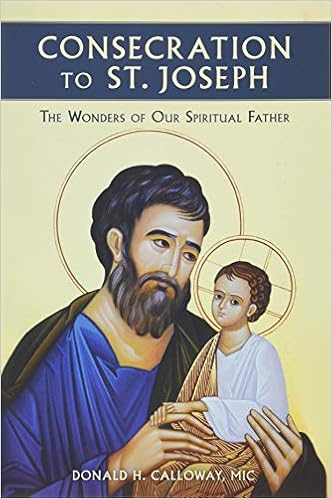
Also, you will love Fr. Calloway’s book on Joseph.

Consecration to St. Joseph: The Wonders of Our Spiritual Father by Fr. Donald Calloway

US HERE – UK HERE


St. Joseph is a mighty intercessor.  I’ve been blessed several times by his help in times of real need and stress.  I have zero doubt that he was the one who intervened, so concretely that it’s amusing.

The Great Roman sent a couple of photos from the celebrations for St. Joseph.

There are Bignè di San Giuseppe “Frittelaro” and fritelle.  As the Romans tell it, to help support the Holy Family St. Joseph supplemented his income by selling fried pastries.

And there is a tradition of trying to climb a greased pole with has goodies at the top.

Posted in SESSIUNCULA | Tagged
6 Comments