?!?

And then there is this.

And now supper…


I noticed on the site of The Catholic Herald a blurb about a news story in The Guardian:
Jesuit-educated Zimbabwean President Robert Mugabe reminded the Archbishop of Canterbury that the Church of England is “a breakaway group from the Roman Catholic Church” during an awkward meeting in Harare yesterday (video).
National Catholic Fishwrap’s website, the editors have run something that was in their print edition, the actual fishwrap. They are reacting to both Bp. Olmsted of Phoenix and Bp. Morlino of Madison and their implementation of new local practices for Communion under both kinds.
They invoke the usual suspects, such as Call to Action, Chicago Theological Union, Boston College so as to crush poor benighted Olmsted and Morlino in the iron jaws of their logic.
They are also waking up to the fact that this issue of Communion under both kinds also has implications for their mobs of usually unnecessary Extraordinary Ministers.
In short, they are panicking.
What I find most interesting is that NCF refers throughout to “Communion wine“. The word “blood” didn’t appear in the article. A small detail, but one I find telling.
“But Father! But Father!”, some of you may protest. “You are just nitpicking. After all, they aren’t used to thinking in terms of traditional images, language, theology… the Church’s teachings. You’re mean!”
Yes. Indeed.
 You have by now read that His Excellency Most Rev. Robert Morlino, intrepid Bishop of Madison, helped the priests of that diocese to understand that the indult distribution of Holy Communion under both kinds upon a wide variety of occasions has expired. As a matter of fact, it expired a few years ago. As a result the rector/pastor of the cathedral parish in Madison explained in his parish’s bulletin that distribution under both kinds would conform to present law. In other words, it would be a lot rarer. A similar series of events occurred in the Diocese of Phoenix under Bp. Olmsted.
What the expiration of the indult for more opportunities for Communion under both kinds means is that the directives for same are now the General Instruction of the Roman Missal and Redemptionis Sacramentum and whatever law the local bishop establishes.
But let’s be clear about something. Communion under both kinds is still permitted, but on on fewer occasions. It is not being forbidden in the Diocese of Madison or the Diocese of Phoenix where similar measures are being followed. It is just that the law is now being followed.
In some corners people are having a nutty over this, even claiming that these troglodyte bishops, who clearly are trying to repress the laity and destroy all the obvious fruits of Vatican II, are denying people their right to Communion under both kinds. Hate-mongers! Reactionaries! Throw-backs!
Piffle.
I find it exceedingly ironic that when priests implement, for example, Summorum Pontificum in their parishes liberals start hollering “The bishop is the moderator of the liturgy in the diocese! The bishop gets to decide! The bishop! [sputter] The BISHOP!” But now when bishops act as moderators of the liturgy in their dioceses in the matter of Communion under both kinds liberals start squawking, “The bishop has no right to do this!”
Bp. Morlino has issued a more extensive explanation of what will now be the practice in the Diocese of Madison in a pdf available on the site of the diocese, here. The bishop lays out in simple terms even those locked into spittle-flecked high dudgeon can understand the whys and wherefores of his particular legislation.
If I read him correctly, I think his main concern is that people are not in fact benefiting from Communion under both kinds in the way Vatican II envisioned. There has been danger of profanation of the Eucharist and a blurring of the roles of clerics and laity. Therefore, measures must be taken. Were those aspects of Catholic life in good shape, then he wouldn’t be doing this. But they are not, so he has to do something about it.
Here is part of Bp. Morlino’s explanation. Keep in mind that this is a communication addressed to the priests of the Diocese of Madison which he has also made public. Therefore, the priests are the principle addressees and all others are being allowed in for a listen. We jump into this in media res and with my emphases and comments:
Now, with the issuance of the Roman Missal, the Church gets more specific in matters such as these (thus the General Instruction which we are presently using as our guide). [Not the old GIRM, but the present GIRM.] The Missal goes further than the Vatican II document, [SC 55 mentions some occasions in which Communion under both kinds could be distributed, namely, to newly professed in the Mass of their religious profession, and to the newly baptized in the Mass which follows their baptism. Those who think Vatican II was the be-all-and-end-all of the Church’s journey might consider that SC 55 isn’t terribly expansive.] instructing that the Chrism Mass and Corpus Christi would be good occasions for distributing Communion under both species, as might be the distribution to wedding couples at their marriage, to children receiving their First Communion, to Confirmation candidates at their Confirmation, to consecrated religious at their conventual Mass, to women and men on retreat, and to deacons and seminarians at any Mass. The document also allows the pastor to choose certain other days, such as the patronal feast of the parish, to distribute under both forms, so long as the reasons are good and so long as all other conditions are met. [If you are going to have Communion under both kinds, these seem to be the moments to have it. But, remember, the possibility of having it, doesn’t mean it is obligatory.] But it does warn pastors:
“In practice, the need to avoid obscuring the role of the Priest and the Deacon as the
ordinary ministers of Holy Communion by an excessive use of extraordinary ministers might in some circumstances constitute a reason either for limiting the distribution of Holy Communion under both species…(Norms, 24)” [Do I hear an “Amen!”? While some might want to argue that Communion under both kinds is a good in itself, there are other factors to consider as well, other goods to be upheld.]
The Third Edition of the Roman Missal reinforces the right of bishops to make additional
allowances for reception of Communion under both species, beyond that which the documents already mention:
“The Diocesan Bishop is also given the faculty to permit Communion under both kinds
whenever it may seem appropriate to the Priest to whom a community has been entrusted
as its own shepherd, provided that the faithful have been well instructed and that there is no danger of profanation of the Sacrament or of the rite’s becoming difficult because of the large number of participants or for some other cause (Roman Missal, 283).”
This permission has been assumed, if not expressed directly in the past. I recognize this, and I understand fully that communion under both forms at every Mass has become common practice at some parishes.
[NB:] However, I have been told of, and have personally experienced, the reality that the provision both that the faithful be well instructed and that there be no danger of profanation of the Sacrament, is not being met. [Therefore, Communion under both kinds should not be offered at all, much less in the much more expansive way it was before the expiration of the wider permissions!] As such, while recognizing the need for patient, prudent and practical steps according to your individual parishes, I’ve asked you to move in this direction. As I’ve said, over and over again, and as you know well, this requires catechesis. So many do not understand the Eucharist as the memorial of Christ’s Sacrifice, his death and resurrection; nor the real presence of Christ, body, blood, soul, and divinity, under both species of bread and wine; nor the role of the ordinary and, if necessary, extraordinary ministers of the Eucharist. [It seems to me implicit in this paragraph that were there to have been adequate catechesis and adequate provision to avoid profanation, then Bp. Morlino would not be changing the diocesan practice. Consequently, if parish priests who have had this more expansive use of Communion under both kinds for a long time don’t like what Bp. Morlino is asking them to do, they would do well to blame themselves for the change, rather than blame Bp. Morlino, or Bp. Olmsted for that matter, or any other bishop who will also go in this direction. Don’t blame bishops for doing their jobs.]
Most of all (and this has been my point from the start) so many of our people do not understand the kinds of reverence due at all times to the sacrament, whether within the Eucharistic Liturgy or outside the celebration.
This gets back to the need for the new translation, and every point I’ve attempted to make. What we say and do at the Mass, and what we do before the Lord present in the tabernacle matters.
Thus, I cannot in good conscience, allow us to go forward without addressing these matters.
That’s specifically what I’ve asked you to do. Please help your people to know and understand the beautiful gift we have in the Eucharist, to know our obligations of preparing for reception of the Sacrament, both in terms of our preparation through the Sacrament of Confession, our observance of the pre-communion fast, our attending to our attire as best we can, and the like. Please help them to know of Christ’s presence, fully and entirely in the Sacred Host. Our people know well, the aspect of the Mass which is the Sacred banquet, but help them to know the Eucharist at the Memorial of Christ’s loving Sacrifice for them. Help them to understand your role in laying down your own life as the minister of Christ’s Body and Blood, present in the Host.
[…]
So, Bp. Morlino expresses his reasons for this move. He sees that there are problems which need to be corrected. Of course liberals will object that there is not any danger of profanation! No danger of blurring of roles! In this case, the diocesan bishop thinks differently. He sees problems. Therefore he is going to act for the good of the souls of the faithful under his charge.
Let’s track back to a point he made about the new, corrected translation.
Since I write a lot about the new translation here is how I read his words.
With the new, corrected translation more people will have an opportunity to hear more clearly the content of the original Latin prayers. Setting aside whatever beef a few people may have with some awkward phrasing in the new text, blah blah blah, the new text is undoubtedly closer to the content of the Latin original. Greater clarity is now possible. Benefits will follow. They must, over time, follow. In a similar way, just as we clarify the content of the words we also have to clarify the content of the gestures. Christ is the true Actor during Holy Mass. Our words and our gestures communicate something of Christ’s own words and gestures. We must be careful in what we say and do. We must be faithful to the Church’s legislation, each person carrying out his or her own proper role in participation in the sacred mysteries. From time to time that means examining our consciences about what we are doing. We have to take stock, human nature being what it is, and make course corrections from time to time.
That is my take on what is going on.
Therefore, WDTPRS kudos to Bp. Morlino together with good wishes for a long and fruitful mandate in the difficult Diocese of Madison.
We have had about 30 people in and out.
His Hermeneuticalness has his summation HERE with a couple nice photos to boot, including the undersigned and the great Fr. Ray Blake.
It was great fun.


CLICK ME and DONATE!
It is time for a LONDON BLOGNIC!
We are going to meet at The Coal Hole on The Strand near the Savoy. There is Holy Mass at Corpus Christi on Maiden Lane at 6:30 pm (Extraordinary Form). We will go straight over to the Coal Hole after Mass. So, 7:30 is approximate. You get the idea. I figure we will be there for a couple hours, at least.
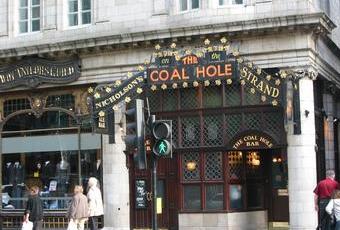
It will be nice to be in (or at least near) the Liberties of the Savoy! The tipstaves won’t be able to haul us off to the sponging house.
London Blognic at The Coal Hole
Total Voters: 29
As long-time readers know, “blognic” is a blend of “blog and picnic”.
A blognic is a social appointment intended get people together to talk and have a drink or some food. Not much more than that! It is meant to be fun and bring together face to face people who participate on this blog. Sometimes when I travel people ask if they can meet me. This is a way to do that.
UPDATE 10 Oct 2037 GMT:
A reader sent the following:
I can’t be there, but a good choice, Father; I’ve had some decent pints in the Coal Hole.
I don’t know what the food’s like (the pubco that owns it, Nicholsons, usually does plain pub grub in a competent manner), but there’s usually an interesting range of ales.
Going by this 1830 map of the Liberty of the Savoy, I’d say the Coal Hole was just within it:
If anyone is trying to follow it, note that the map is oddly oriented, having North towards the bottom left corner. Of course most of the roads have changed due to redevelopment, but if you take a line on Southampton Street, which still exists on the other side of the Strand, it looks like the un-named road on the 1830 map, in between Beaufort Buildings and Cecil Street (neither of which exists under that name today) is the present Carting Lane. The Coal Hole is on the eastern corner of Carting Lane and the Strand, which seems to put it firmly in the Savoy.
I am so glad! We will be safe and snug in the snug… or in the basement. It seems as if we might have a good crowd!
UPDATE 10 Oct 1750 GMT:
The pre-blognic Mass is on at Maiden Lane with Mass XII

And Os iusti for an Abbot.


 From a priest:
Read the black, and do the red seems to work well. [Do I hear an “Amen!”?] I am training a new liturgy coordinator. She will be in charge of the environment in the church. In the past that meant flowers and banners. Are there any Magisterial documents on this topic? How are we to decorate our church. We do have antependiums made with specific liturgical colors, what other criteria are there?
Good question. First, I’ll guess you are in the USA. The US bishops have a document about these matters called “Built of Living Stones“. I am not much impressed with certain aspects of it, such as their (purposely?) inaccurate rendering of GIRM 299 about the position of the altar. But that is not your main concern. BLS may be a little squishy but perhaps it could be a good starting point.
I will open this to the readership. Perhaps priests in parishes can help you out with this one. I’ll be interested to see the advice.
For my part, antependia are good. I would do things the old way and avoid flowers during Advent and Lent. Don’t overdo it at Christmas and Easter. Potted plants should be forbidden through interdicts and latae sententiae excommunications. If I hear that you have arranged pumpkins and dead branches and corn cobs around the place for Thanksgiving, I may have to hunt you down. If I ever hear that you have allowed the “reconciliation room” to be pimped out with a little table, a fat candle, and a little bowl of pebbles, I will hunt you down. At the first appearance of anything with a rainbow on it… well… it gets worse from there.
I think what you see in church should make you think about the Church Militant, Suffering and Triumphant and about the transcendence of God even before the humility of Christ and his Passion and Resurrection, pointing always back to the central position of the Eucharist in the church. Things which don’t do that … well… just get rid of them. And get rid of anyone who suggests pebbles anywhere, anything tie died or finger-painted, and just about anything that looks like it could have been worn in a Clint Eastwood spaghetti western.
Finally, depending on the space, sometimes less is more.
PS: Convert the reconciliation room immediately to a real confessional with a fixed barrier and grate.

 From a reader:
I was away from the Church for nearly 20 years, and when I found my way back, the remote parish I joined often didn’t have a priest and when they did he was only there for Mass and immediately after each Sunday service had to leave. So, it was many months before I was able to make it to confession. When I finally was able to participate in the Sacrament, I came away with a heavy feeling in my heart – more guilt at being away so long, sadness at my deep sinfulness …. This was not my memory of this sacrament, as I remembered it as being uplifting and strengthening and full of light. Now I am quite reticent to return to the sacrament, even though I feel a strong desire. Any suggestions for what I can do to ease my way back into the confessional?
First, congratulations for your return to the practice of your Catholic Faith. I am very glad you had the chance to make a good confession and receive, thanks be to God, absolution.
The principle effects of the Sacrament of Penance, or of Reconciliation, are, first and foremost, to forgive you your mortal sins, and then to reconcile you with God and the Church and fellow members of the Church, and to give you strength to avoid sins in the future. It is a great thing when the sacrament also makes you feel good, but making you feel good isn’t really a main effect of the sacrament. Yes, the sacrament is intended to give you peace. As we hear in the post-Conciliar form of absolution, “may God give you pardon and peace”. I don’t think “peace” and feeling good are quite the same thing.
It may be that, as you have returned to your Faith, and you have made a first confession in a long time, and a hard confession at that, you have a healthy sense of the horror we should have for sin and a sense of pain about your past failures. That may be a good thing, if it will strengthen in you your resolve to resist sinning in the future.
I have a suspicion that this heaviness of heart will subside.
Stay close to the Church. Make good Communions. Use the confessional as often as you need to. I think you will in a short time relax once it really sinks in on the affective or emotional level – not just the intellectual level – that you really really really have been reconciled with God and the whole Church, that you have really really really been grafted back onto the Vine, who is our Lord. Just as a graft needs a little time to bond and heal into its new place, you also might just need a little time for this all to sink in.
But don’t stay away from confession because you still have a heavy heart from your past confession.
Lastly, there is nothing so bad that we little mortals can do that the infinite power of God cannot forgive so long as we ask.
About your next confession… just do it! You’ll be fine.
For your Brick by Brick file.
I have often suggested that you, dear readers, invite people to come to Mass with you. Be inviting. People like to be invited, even if they don’t accept. And you never know what will happen! In another post I mentioned that Fr. Tim Finigan, the mighty p.p. of Our Lady of the Rosary in Blackfen, the Supremo of English priest-bloggers, for the parish’s patronal feast suggested that people invite guests to come to the High Mass. I think it might have worked. Fr. Finigan told me that it was a large congregation that evening and there were faces he didn’t usually see at TLMs. Wonderful.
On that note, this comes from a reader:
From a reader:
I just wanted to let you know that you’re right about inviting people to the TLM, and that it might take more than one invite. Persistence is key!
My parents are visiting for the weekend and my mom decided she was coming with me, but my dad, who only goes to Mass on Christmas, after much persuasion is now coming too! I had to ask about four times (first he “doesn’t do that sort of thing”, then he had stuff he had to get done, and then he tried the nothing to wear excuse) until I got to, “what time does it start?”
So now both my parents are joining me for the TLM tomorrow. Hopefully it will go okay. Please say a prayer for me. Things didn’t get off to the greatest start when they got here last night and learned that I observe the Friday fasting and abstinence here.
Nice!
Remember… this also applies to inviting fallen-away Catholics to any Mass and to go to confession as well… or some event at the parish…or … well… you get it.

I stopped today at Southwark’s (Anglican) Cathedral, a splendid building I hope will be soon… well… you know.
The tomb of John Gower is here, which would make the place worth a visit all by itself.

There is a memorial to Shakespeare, since he is lived and worked nearby (The Globe is just a stone’s throw). Over the memorial, is a whimsical window with characters from the Bard’s plays, and allegorical figures of the Seven Ages of Man.

While waiting for a lunchtime organ recital, I had a bite to eat at the “refectory”, a cafeteria with a quiet plaza and view of the Cathedral’s tower.

Later, the Museum of London.

Coat of Arms by D Burkart









A Daily Prayer for Priests


They find you a pro-life agent in your area who commits to giving a portion of the fee to a pro-life group!

PLEASE subscribe via PayPal if it is useful. Zelle and Wise are better, but PayPal is convenient.
A monthly subscription donation means I have steady income I can plan on. I put you my list of benefactors for whom I pray and for whom I often say Holy Mass.
In view of the rapidly changing challenges I now face, I would like to add more $10/month subscribers. Will you please help?
For a one time donation...



Help Monks in Wyoming (coffee – UPDATED LINK) and Norcia (beer) and the wonderful "Soap Sisters" of Summit, NJ!


Please follow me on Twitter!










Visits tracked by Statcounter
since Sat., 25 Nov. 2006:

 Now, with the issuance of the Roman Missal, the Church gets more specific in matters such as these (thus the General Instruction which we are presently using as our guide).