WDTPRS: 4th Sunday of Easter (Novus Ordo) – Mighty humble Shepherd, humble mighty flock

FORWARD:

If you are a sheep who has strayed, come back now to His fold, Holy Catholic Church.  GO TO CONFESSION!


Coming up this Sunday in the Novus Ordo is the 4th Sunday of Easter, when the Gospel is from John 10 about the “Good Shepherd”.

sacrophagus Good ShepherdIn the Vetus Ordo, “Good Shepherd Sunday” was last week (the 2nd Sunday after Easter).

It’s really too bad that there is a disconnect.  I’m not sure why the experts of the Consilium thought it was so important to break the continuity of hundreds of years like that.  But let’s keep moving.

Last week I wrote some reflections about the Good Shepherd at One Peter Five (where I have a weekly column).  HERE

For this Novus Ordo 4th Sunday of Easter the Collect which goes back to the time of the Gelasian Sacramentary is a little gem.

Omnipotens sempiterne Deus, deduc nos ad societatem caelestium gaudiorum, ut eo perveniat humilitas gregis, quo processit fortitudo pastoris.

Whoever wrote this was a true master of faith, thought and language.

Note the nice eo…quo construction and the rhythmic endings of clauses which makes the prayer so singable.  There is synchesis in the last part, a parallelism of grammatical forms “ut A-B-C-D, A-B-C-D”.

The prayer’s structure resembles the orderly procession which the vocabulary invokes.

Procedo is “to come forth” as well as “to advance, proceed to.”  It comes also to mean, “to result as a benefit for” someone or something.  Think of English “proceeds”, as in money raised for a cause.  “Procession” (apart from the liturgical meaning) is a theological term describing how the Persons of the Trinity relate to each other.

A societas is “a fellowship, association, union, community”, that is, a group united for some common purpose.  I’ll render it as “communion”, which gets to the relationship we will have in heaven and, in anticipation, as members of Holy Church.

There is a nice contrast in humilitas and fortitudo.  They seem to be opposites.  (Hint: they’re not.)

True to the ancient Roman spirit, humilitas has the negative connotation of “lowness”, in the sense of being base or abject: humus means “soil”.  On the other hand, fortitudo means “strength” and even “the manliness shown in enduring or undertaking hardship, bravery, courage.” In the 8th century Gelasian Sacramentary, whence comes today’s prayer, that fortitudo was originally celsitudo (“loftiness of carriage”, also a title like “Highness”). Fortitudo could poetically refer to Christ’s moral strength and endurance in His Passion and death.

Our Lord chooses the weak and makes them strong with His strength, His fortitudo (cf 1 Corinthians 1:26-28).

Weakness and strength are not to be measured by worldly successes.

LITERAL ATTEMPT:

Almighty eternal God, lead us unto the communion of heavenly joys, so that the humility of the flock may attain that place to which the might of the shepherd has advanced.

CURRENT ICEL (2011):

Almighty ever-living God, lead us to a share in the joys of heaven, so that the humble flock may reach where the brave Shepherd has gone before.

Translators occasionally turn an abstract idea that sounds like a possessive (a trope called synecdoche), as in “the humility of the flock” or “the might of the shepherd”, into a characteristic of the possessor, as in “the humble flock” or “the mighty shepherd”.  I think we lose something beautiful in that exchange.  You decide.

In our Collect is the image of Christ as shepherd. In mighty resolve He goes before – precedes us, the humble flock. He leads us back to that from which He first proceeded, communion with the Father and the Spirit.

Going forth.  Turning.  Going back.  IMPORTANT.

In the Greek Neo-Platonic philosophy that informed early Christian thought we often find the paradigm of going forth (proodos, Latin exitus), a turning around (metanoia, Latin conversio), and returning back (epistrophe, reditus).  This common ancient pattern is echoed in today’s ancient prayer.

This Collect also reminds me of mosaics in the apses of Christian basilicas.

Mosaics are assembled from tiny bits of colored stone, tesserae, into beautiful spiritual works with many symbols.

Up close, individual tesserae are unremarkable, often flawed.

Once a great artist gathers and arranges them according to a plan, they proceed to dazzle and amaze.

God is the artist.  We are the stones (cf 1 Peter 2:5))

Holy Church is like a mosaic.

Just as one tessera makes the others more beautiful, we small individual Catholics, with different vocations, in diverse places, and even distant eras in history, play important roles in a larger societas.

Saints make us make sense.  They make us beautiful.  We make them make sense.  They are even more beautiful as we honor and imitate and engage them.  They are not done with us.  We must be doing by and with them.

S M Trastevere sheep mosaicThe mosaics in apses of ancient and Romanesque churches often depict Christ dressed in glorious imperial trappings.  Apostles and saints, His celestial court, stand on either side bracketed in turn by Bethlehem or the earthly and heavenly Jerusalem.

Beneath the feet of Christ, mighty Shepherd King, are lines of courtly sheep, hooves elegantly raised as they process into a green safe place where water flows, symbolizing the river Jordan and our baptism, the refrigerium we evoke in the Roman Canon.

The Second Person of the Trinity, the Son, proceeded from the Father from all eternity. He proceeded into this world in a mighty gesture of self-emptying in order to save us from our sins, turn us away from sin and death, and open for us the way to salvation.

In His first coming, Christ came in humility to take up our fallen societas, our humilitas, His grex, into an indestructible societas with His divinity.

In His second coming, clothed in His own fortitudo He will shepherd us into a new societas in heaven.

If you are a sheep who has strayed, come back now to His fold, Holy Catholic Church.  GO TO CONFESSION!

I include in this category of straying sheep those who dissent from the doctrine of the Church the Good Shepherd founded.

Posted in SESSIUNCULA | Tagged ,
3 Comments

ROME 24/4– Day 30: Let there be LIGHT!

This morning the sun came up at 06:21.
This evening the sun will set at 19:58.

The days are getting longer and more beautiful and I am starting to think about leaving.  *sigh*

Thank you, Lord, for this day.  Thank you for my readers and benefactors who made possible this refreshing, recharging, restoring, renewing, revitalizing, … repairing time.

My view for awhile, as I write – now – with clouds like cotton, a cool breeze past the freesia and a few alstroemeria whose stems had a hard time, and playing on the other side of the room… THIS.

This evening’s ecclesiastical business ought to end with the ringing of the Ave Maria Bell at 20:15. I’m still listening.  The multiverse portal eludes me and the days are passing.

Welcome registrant:

Venerable Bede

A couple more of you switched your donations to Zelle.  Thank you.  HEY!  You can always start a regular donation with Zelle!

Lately, I’ve offered Holy Sacrifice for my benefactors who are now deceased.  I won’t forget you. Today I said Mass for my priest friends.   In the next few days, I might be able to take a couple of intentions.

Please remember me when shopping online and use my affiliate links.  US HERE – UK HERE  WHY?  This helps to pay for health insurance (massively hiked for this new year of surprises), utilities, groceries, etc..  At no extra cost, you provide help for which I am grateful.

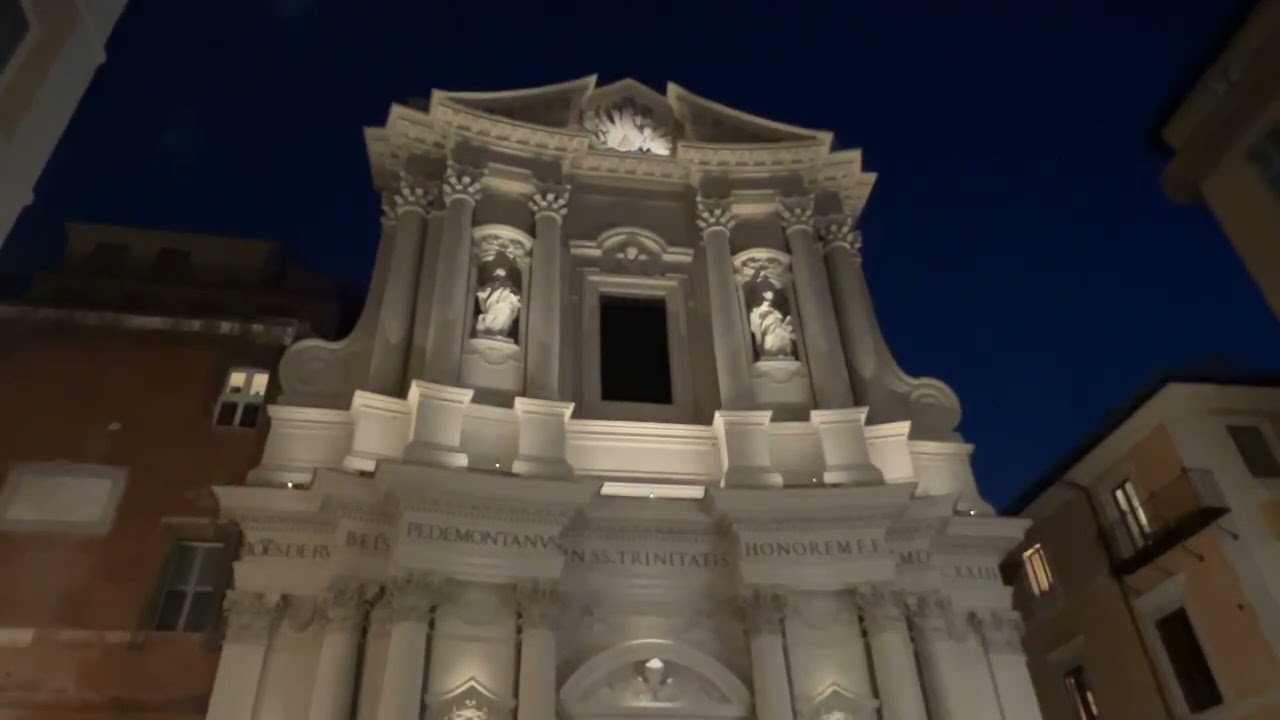
Last night we had the joy of the inauguration of the lighting of the façade of Ss. Trinità dei Pellegrini (aka The Parish™). Here’s my humble little video of the event with period appropriate music…

YouTube thumbnailYouTube icon

The Big Red Button™.

Afterwards, some of us of the Archconfraternity went for a bite to eat. Here’s mine.  Yeah… it was as good as it looks.

Aren’t they beautiful?

But, no, I guess not.  Life in its many forms was just an accidental result of random chemical reactions back in the primordial soup.

Speaking of soup, its Friday.  Perhaps a minestra tonight.

In cheesy news, I am delighted. In the antepenultimate 12th round, Hikaru Nakamura beat Alireza Firouzja and Gukesh D beat Nijat Abasov.  They have joined Ian Nepomniachtchi in the lead. Fabiano Caruana defeated Vidit Gujrathi and is now a half point behind the leaders.  The top spot is up in the air.  Today is a rest day.  Hostilities recommence in the penultimate round 13 tomorrow.   Big games, too. Hikaru v Nepo and Gukesh v Alireza.  The road for Hikaru is uphill against Nepo.  Hikaru has been amazing.  But so too has Nepo.  Gukesh, on the other hand, has two advantages that Hikaru doesn’t.  Gukesh 1) has white against 2) the (justly – heh heh) struggling Firouzja.  Firouzja could play the spoiler.  I hope for a Alirezan floor-wiping by Gukesh.

White to move and mate in 4.  Not too hard today.

NB: I’ll hold comments with solutions ’till the next day so there won’t be “spoilers” for others.

Censeo insuper hoc in scaccos ludentium certamine Alirezam esse delendum.

Posted in SESSIUNCULA | Tagged
4 Comments

ASK FATHER: Kissing the priest’s hand in the Latin Mass v. the liturgical spirit of Judas. Wherein Fr. Z rants.

From a reader…

QUAERITUR:

Finally I got my first Latin Mass and it was wonderful.  I want more more more and I can’t understand why the Pope doesn’t want us to have it.  I know he doesn’t like things he says are fussy, like lace.  I saw during the Latin Mass the servers were kissing things and kissing the priest’s hand when giving things to him.  Maybe that’s the sort of thing that Pope Francis doesn’t like?   I have to ask why the kissing stuff is in the Latin Mass.  I get the idea that things are not done by accident.  It must have a point.

If you noticed that, which can happen rather quickly, you were probably sitting close and paying attention.  Good for you.  I recommend, however, at first, not to get too bogged down in the details.  Take it in.  Get used to it.   That said, I won’t let you hang.

What you saw are the famous oscula, “kisses”, solita oscula, “the usual kisses”.  These may be applied to objects handed to the priest, and the priest’s hand itself. They serve to show respect to the priest who is alter Christus… another Christ. They show respect to the sacred things being used and the One to whom they refer us. They show joy in the occasion and action, and to lend decorum and solemnity to the moment.   Objects include the chain of the incense thurible, the spoon for the incense, his hat, cruets with wine and water, etc.

Also, it is not done everywhere.  However, according to the rubrics, they are to be done.

For those who don’t know about this, in the Vetus Ordo of the Roman Rite, always in Pontifical and Solemn Masses and sometimes at Low Masses, objects are kissed as they are given to the celebrant, as is his hand. The rule is when giving, kiss the object first, then the celebrant’s hand and when getting kiss the hand first, then the object.  However, when receiving a sacramental, such as a blessed palm on Palm Sunday or a blessed candle at Candlemas, you kiss the sacramental first, and then the hand.

Also, because the kiss is a sign of joy, the solita oscula are omitted on Good Friday and during Requiem Masses.  Our Church is very cool.  We had/have it all worked out.

The kissing of objects and hands surely spread to Holy Mass from and in a courtly context.

There’s nothing wrong with that, by the way.   Critics of the traditional Roman Rite throw various accusations at it, like, “That’s just a remanent of an imperial court and it has nothing to do with Christ because Christ was humble.  We need pottery and simplicity.”   To which we respond: “That’s the spirit, Judas!”

There is nothing wrong with respect and decorum.  Think of Luke 7 and the woman with the precious ointment.

She stood behind him at his feet, weeping, and began to bathe his feet with her tears and to dry them with her hair. Then she continued kissing his feet and anointing them with the ointment.

Sounds like a ritual to me.

Liberals accuse traditionalists of clinging to the useless bowing and scraping of ancient court practices.  They won’t kneel! No!  They’ve evolved beyond all that.   They’re all grown up now.  Liberals would rather have us, as they do, kneel and bow and scrape to the world, the flesh and the Devil.

The liturgical spirit of Judas.

The giving of solita oscula ties into the style and quality of vestments and vessels and music used for Holy Mass, as well as the music and the architecture and how congregants comport themselves.  It’s all a whole.

Be clear about something!  All you who attend the Traditional Latin Mass…  attend!

When we dress our priests and bishops in gold and lace, and place gold on them and into their hands, we aren’t honoring the priest or bishop the man, however worthy and admirable he may be.

We kiss their hands because they were anointed to serve us.

You can hear them squeal, “But Father! But Father! I won’t do THAT!  We are beyond that now!  We are modern! We won’t crawl before some potentate or kneel down or receive on the tongue.  This is now and all that frippery of a bygone era isn’t like the pristine early church of an Alleluia people.  But you cling to that patriarchalism and backwardism because YOU HATE VATICAN II!”

It isn’t a humiliation for us to behave with decorum.   We honor them, giving our best, because we honor Christ at work in them. We are grateful for the merits of the Cross and our pathway to heaven.  You kiss when you love.

The priest and bishop are our mediators for the one Mediator. They are, during Holy Mass, both the priest who offers the Sacrifice, and also the Sacrificial Victim. The lambs prepared for the day of sacrifice were taken great care of and fussed over… right up to the time the knife slashed their throats open.

When you see the priest and bishop in fine vestments, remember the love and gratitude and care with which we treat sacred things and persons and places. We look to them and through them as Moses looked, straining, to glimpse the Mystery as God passed by on the other side of the cleft in the rock (cf Exodus 33).

These things and gestures are signs that facilitate the encounter with mystery that is simultaneously frightening and alluring, hard to prepare for and yet vital for our spirits. They help us to prepare, through their beauty and challenge for our own deaths.

It is wrong for a priest or bishop to refuse the kissing of his ring and hand.  Acceptance of a gift honors the giver.  People want to give honor and show love for Jesus, the King and Eternal Priest present before them in their person. They instinctively, and also by instruction, seek to reverence what brings them the ordinary means of salvation.

Also… and this is important… you remind the priest of who he ought to be.  In a sense, to kiss the priest’s hand – as is common in some cultures – is the opposite of being subservient to him.  By kissing his hand, you exert a measure of control because you underscore his reason for living: your salvation.

You kiss the priest’s hand and you are saying: “You will account.”

The kissing of the priest’s hand is an elegant, meaningful, helpful practice.

I am reminded of a poem from yesteryear which, though to our ears today it rings a bit saccharin and sentimental….

There’s nothing wrong with sentimental!   There’s nothing wrong with yesteryear’s flowery language!  Let us not be cynical like the interiorly withered liberals who in their faux sophistication place themselves above such things in sniffy joylessness.

Here’s the poem. It conveys perennially valuable clues about the attitude we should adopt in the present of the Lord’s anointed.

Think about the moments that the poem describes:

The Beautiful Hands of a Priest

We need them in life’s early morning,
We need them again at its close;
We feel their warm clasp of true friendship,
We seek them when tasting life’s woes.
At the altar each day we behold them,
And the hands of a king on his throne
Are not equal to them in their greatness;
Their dignity stands all alone;
And when we are tempted and wander,
To pathways of shame and of sin,
It’s the hand of a priest that will absolve us,
Not once, but again and again.
And when we are taking life’s partner,
Other hands may prepare us a feast,
But the hand that will bless and unite us
Is the beautiful hand of a priest.
God bless them and keep them all holy,
For the Host which their fingers caress;
When can a poor sinner do better
Than to ask Him to guide thee and bless?
When the hour of death comes upon us,
May our courage and strength be increased,
By seeing raised over us in blessing
The beautiful hands of a priest.

Hence… kissing the priest’s hand and objects during Holy Mass.

Posted in "But Father! But Father!", "How To..." - Practical Notes, ASK FATHER Question Box, Our Catholic Identity, Poetry, Priests and Priesthood, Wherein Fr. Z Rants | Tagged
20 Comments

WDTPRS – 3rd Sunday after Easter (Vetus Ordo): Be distinguished by your profession of Christ!

In the midst of chaos, we need to bring our minds to work at hand, our work of sacred liturgy, the renewal of which is our only hope for true revitalization of the Church.

This Sunday’s Collect survived the knives of the liturgical experts and was inserted into the 1970 Missale Romanum on the 15th Sunday of Ordinary Time. The redactors who glued the Novus Ordo together, however, removed the word iustitiae, thus returning it to the form it had in the ancient Gelasian Sacramentary. Other ancient sacramentaries, such as the Liber sacramentorum Gellonensis as well as the Augustodunensis had the iustitiae. In any event, by the time St. Pius V issued the the Missale Romanum of 1570, which I am sure you have on hand, someone had seen fit to make it read, “in viam possint redire iustitiae”, which endured until the 1970MR and subsequent editions.

COLLECT (1962MR):

Deus, qui errantibus, ut in viam possint redire iustitiae, veritatis tuae lumen ostendis, da cunctis qui christiana professione censentur, et illa respuere, quae huic inimica sunt nomini, et ea quae sunt apta sectari.

Stylistically snappy! It has nice alliteration and a powerful rhythm in the last line.

I think there is a trace here of John 14, which I will show you below. Can we also find a connection between this Collect in a phrase from the Roman statesman Cassiodorus (+c. 585 – consul in 514 and then Boethius’ successor as magister officiorum under the Ostrogothic King Theodoric)? Cassiodorus wrote, “Sed potest aliquis et in via peccatorum esse et ad viam iterum redire iustitiae? … But can someone be both in the way of sins and also return again to the way of justice?” (cf. Exp. Ps. 13).

Is this prayer old enough to have been known by Milan’s mighty Bishop St. Ambrose (+397) or even St. Augustine of Hippo (+430), who use similar patterns of words?

Your thorough Lewis & Short Dictionary says censeo has a special construction: censeo, censeri aliqua re, meaning “to be appreciated, distinguished, celebrated for some quality”, “to be known by something.” This explains the passive form in our Collect with the ablative christiana professione. Getting christiana professio into English requires some fancy footwork. We could say “Christian profession”, but this adjectival construction really means “profession of Christ.” This same thing happens in phrases such as oratio dominica, “the Lordly Prayer”, or more smoothly “the Lord’s Prayer”.

Via means, “a way, method, mode, manner, fashion, etc., of doing any thing, course”. There is a moral content to via as well, “the right way, the true method, mode, or manner”.

Let’s see what people used to hear in church on the 15th Sunday of Ordinary Time in the…

OBSOLETE ICEL (1973):

God our Father,
your light of truth
guides us to the way of Christ.
May all who follow him
reject what is contrary to the gospel.

And now, ….

LITERAL RENDERING:

O God, who do show the light of Your truth to the erring so that they might be able to return unto the way of justice, grant to all who are distinguished by their profession of Christ that they may both strongly reject those things which are inimical to this name of Christian and follow eagerly the things which are suited to it.

CURRENT ICEL (2011):

O God, who show the light of your truth
to those who go astray,
so that they may return to the right path,
give all who for the faith they profess
are accounted Christians
the grace to reject whatever is contrary to the name of Christ
and to strive after all that does it honor.

Ancient philosophers (the word comes from Greek for “lover of wisdom”) would walk about in public in their sandals and draped toga-like robes. Thinkers such as Aristotle were called “Peripatetics” from their practice of walking about (Greek peripatein) under covered walkways of the Lyceum in Athens (Greek peripatos) while teaching. Their disciples would swarm around them, hanging on their words, debating with them, learning how to think and reason. They would discuss the deeper questions the human mind and heart inevitably faces. They were effectively theologians.

We must be careful not to impose the modern divorce of philosophy from theology on the ancients. In ancient Christian mosaics Christ is sometimes depicted wearing a philosopher’s robes. But He doesn’t merely love Wisdom, He is Wisdom incarnate, the perfect Teacher!

He is the one from whom we learn about God and about ourselves (cf. Gaudium et spes 22 – which the young Pope John Paul II helped to write during the Council).

The Collect also reminds me of the very first lines of the Divine Comedy by the exiled Florentine poet Dante Alighieri (+1321) who was heavily influenced by Aristotle’s Ethics and the Christianized Platonic philosophy mediated through Boethius (+525) and St. Thomas Aquinas (+1274). The Inferno begins:

Midway in the journey of our life
I came to myself in a dark wood,
for the straight way was lost.
Ah, how hard it is to tell
the nature of that wood, savage, dense, and harsh –
the very thought of it renews my fear!
It is so bitter death is hardly more so.

Dante, the protagonist of his own poem, is describing his fictional self. In his poetic persona, Dante is in the middle of his life (35 years old – half of 70, the number of years mentioned as man’s span in Ps. 90:10). He is mired in sin and irrational behavior, having strayed from the straight path of the life of reason: he is in the “dark wood”.

The life of persistent sin is a life without true reason.

Human reason, when left to itself without the light of grace, is crippled.

Dante likens his confused state to death. He must journey through hell and the purification of purgatory in order to come back to the life of virtue and reason. In the course of the three-part Comedy the Poet finds the proper road back to light, Truth and reason through the intercession of Christ-like figures, such as Beatrice, and then through Christ Himself. In the Comedy, Dante recovers the use of reason. His whole person is reintegrated through the light of Truth.

Don’t we often describe people who are ignorant, confused or obtuse as “wandering around in the dark”?

This applies also to persistent sinners. By their choices and resistance to God’s grace they have lost the light of Truth. God’s grace makes it possible for us to find our way back into the right path, no matter how far from it we have strayed in the past. When we sin, we break our relationship with Christ. If in laziness we should refuse to know Him better (every day), we lose sight of ourselves and our neighbor.

Christ, the incarnate Word, gives us consolation:

“‘Let not your hearts be troubled; believe in God, believe also in me. In my Father’s house are many rooms; if it were not so, would I have told you that I go to prepare a place for you? And when I go and prepare a place for you, I will come again and will take you to myself, that where I am you may be also. And you know the way (via) where I am going.’ Thomas said to him, ‘Lord, we do not know where you are going; how can we know the way (via)?’ Jesus said to him, ‘I am the way (via), and the truth (veritas), and the life (vita); no one comes to the Father, but by me. If you had known me, you would have known my Father also; henceforth you know him and have seen him…. He who has seen me has seen the Father’” (cf. John 14:1-6 RSV).

We Catholics, who dare – DARE – publicly to take Christ’s name to ourselves, need to stand up and be counted (censentur)!

In what we say and do other people ought to be able to see Christ’s light reflected and focused in the details of our individual vocations.

To be good lenses and reflectors of Christ’s light, we must be clean.

When we know ourselves not to be so, we are obliged as soon as possible to seek cleansing so that we can be saved and be of benefit for the salvation of others. We must also practice spiritual works of mercy, bringing the light of truth to the ignorant or those who persist in darkness either through their own fault or no fault of their own.

Every Catholic is called to evangelize, if not in an “official” capacity in the Church’s name, at least through the obligation we have as members of Christ’s Body the Church.

Evangelization and the efforts of ecumenism are an obligation for every Catholic.  There are still people living in darkness. We must “preach” always and, as the phrase wrongly attributed to St. Francis of Assisi says, sometimes use words.  In the early Church it was the comportment of Christians that attracted so many converts.

When people look at us and listen to us, do they see a light-extinguishing black hole where a beautiful image of God should be?

Posted in WDTPRS |
Comments Off on WDTPRS – 3rd Sunday after Easter (Vetus Ordo): Be distinguished by your profession of Christ!

“you must not remember your forefathers…” Wherein Fr. Z rants.

I ran into a notable quote today at one of my daily stops, the estimable Laudator.  The quote is from the work On the False (or Dishonest) Embassy by the ancient Athenian orator Demosthenes (+384 BC).  The context is the negotiation of the “Peace of Philocrates” which dealt with a war between Athens and Macedonia’s Philip (father of Alexander).  Athens sent as negotiators Philocrates, Demosthenes and Aeschines.  The latter, during the negotiations, seems not to have done the best by Athens and so, later, he was tried for treason (for which he was eventually cleared).    He was later prosecuted again by Demosthenes and Aeschines, though acquitted, was ruined.

Hey!  Politics as blood sport?  You ain’t seen anything until you’ve read how the ancient Greeks and the ancient Romans went for each other’s chitlin’s.    What’s going on today in the USA with a certain party and its mongrel agents against a certain candidate gives you a modern taste… but just a taste.

Anyway, … the quote.  The mania today in some circles to disconnect the Church’s theology and liturgy (liturgy is theology!) and entirely remake Catholic identity in a – pace Paul – worldly conformation is, not an existential threat to the Church, because that would be contrary to Christ’s promises and the Church’s indefectibility, a vexing pragmatic threat.  It is vexing because, through the pragmatic diminution of the Church in the world, souls will be lost to the world’s allurements and many who might otherwise be drawn in, will remain at a distance.

Am I wrong?

Of course God finds a way.  One of those ways is His permissive will regarding persecution.  “Blood is the seed of the Church”, as Tertullian put it.  Churches are being burned in France and baptisms were double this year.   Big shots in the Church bend and twist some moral teachings and the Magisterium of previous Popes into unrecognizable tangles of ambiguity, but many are making the choice to get informed about the truth with reliable sources.   The environment we are now in is a product of systematic efforts both secular and ecclesial, to dumb people down to acceptance of falsehood or indifference to truth.  It didn’t happen overnight.  It won’t be solved overnight.    We must persevere.

Perseverance and continuity, steadfast reliance on grace and firmness in tradition are the way forward in the maelstrom.

Meanwhile, the quote from Demosthenes which sparked this little midday rant:

Words Deserving Many Deaths

Demosthenes 19.15-16 (On the Dishonest Embassy; him = Philocrates; tr. Arthur Wallace Pickard-Cambridge):

Aeschines rose and spoke in support of him, using language for which he deserves, God knows, to die many deaths, saying that you must not remember your forefathers…

ἀναστὰς ἐδημηγόρει καὶ συνηγόρει ἐκείνῳ πολλῶν ἀξίους, ὦ Ζεῦ καὶ πάντες θεοί, θανάτων λόγους, ὡς οὔτε τῶν προγόνων ὑμᾶς μεμνῆσθαι δέοι…

Posted in Hard-Identity Catholicism, Pò sì jiù, The Coming Storm, The future and our choices | Tagged , ,
1 Comment

ROME 24/4– Day 29: home stretch

The sun rose upon Rome at 06:23 and it will sink beyond sight at 19:57.

The Ave Maria should ring at 20:15.

Last night I heard some bell ring a couple time again just before 8.  But nothing special chimed at 20:15.   The mystery continues.

Yesterday, walking to the bookbinder… I don’t know what these trees are.  They are blossoming with light purple flowers.

A view from the Via Monserrato over to the Via Giulia past the restaurant Pierluigi on the right.  Waaaaay over priced and pretentious, as far as I am concerned.

For simpler fare at lunch

Hard to beat that.

I ate this while watching the last of yesterday night’s (day in Toronto) death match between Vidit and Nepo.  It seesawed, but I simply had to go to bed.  Also, I had get one of the commentators out of my ears.  One of the frequent commentators during these tournaments is an Indian woman, Tania Sachdev, an International Master (notch below Grand).  Her chess commentary is quite good and she is easy on the eyes.  However, when she goes into commentatrix mode, her voice could etch steel.  It’s all I can do to hit the mute or FF and hope I get out of her range for a respite.  As I said before, when she talks about the positions, potential moves, she’s really good.  However, most of the time when she jumps in, she starts by repeating what the guy before her said.  And when there is a transition to a break, or something unexpected happens, not even shooting range ear protection will save your molars from cracking.   How I dread seeing who will be on the crew tomorrow for the very important Round 12.   In Round 11, Nepo did defeat Vidit after a grueling 5 hour game to become sole leader (third straight win).  This game will probably be studied thoroughly and for a long time.  Hikaru won again.  He played two online tournaments on Tuesday and then beat Pragg with black.  He’s a force of nature.  Unfortunately Firouzja bested the lowest rated player in the tournament, Nijat Abasov.

Please remember me when shopping online and use my affiliate links.  US HERE – UK HERE  WHY?  This helps to pay for health insurance (massively hiked for this new year of surprises), utilities, groceries, etc..  At no extra cost, you provide help for which I am grateful.

Meanwhile, white to move and mate.

NB: I’ll hold comments with solutions ’till the next day so there won’t be “spoilers” for others.

Posted in SESSIUNCULA | Tagged
Comments Off on ROME 24/4– Day 29: home stretch

ROME 24/4– Day 28: bad news and good news

“When,” you ask, “did the sun rise in Rome today?  I respond: “06:24.”

“And when will it set?”

“19:56.

“Did you hear the Ave Maria Bell last night at 20:15?”

“No.  I was distracted by a roasted chicken.”

Welcome registrant:

Baltimore Catholic

Thanks to LG for shifting to Zelle for making regular donations.

I had unhappy news today.  It seems that the TLM pilgrimage to Poland and then Prague was cancelled because not enough people signed up.  Too bad.  I was looking forward to it.  I don’t think it was the TLM.  I don’t think it was Poland.  Perhaps it was me.  Alas.

Drama did not keep me from running an errand to my bookie… er um… bookbinder.

I have some nice chess pieces here for my study purposes, heavy and large.  Too large for the squares on the vinyl board.  I got another board, but while the squares are just right, there was an excessively wide border about the whole thing such that, rolled up, it won’t fit in the tuby zipper tote bag (the TZTB).  Hence, a trip to my bookie… er um… bookbinder, on the bet (see what I did there?) that he would trim in a trice the undesired edges.  (Both alliteration and assonance.)  He did.  I shot an action photo and… drat! Which it is not in my photo roll, as Preserved Killick might put it.

Good news!  On the way home, which I cunningly calculated to take me past a hardware store and a grocer, I saw that the pomerium stone of the Emperor Claudius, which last year a juvenile fiend who still needs a sound thrashing, had spray painted with his wanna-be-dog piddle mark.  HERE   It has been cleaned!

Can you imagine?

When I see this stone, which has an example of a letter that Claudius, a linguist, tried to insert into the Roman alphabet (Ⅎ in the lowest line), I am mindful of the scene in the wonderful TV series I, Claudius.  The elderly Claudius, knowing his days are numbered, won’t do anything to stop Nero from succeeding him.  Why?  Because (as the book and TV go) Claudius thinks that Nero’s corruption will spur people to demand a return to the Republic.   (Historically laughable, of course.  As laughable as the scene in the movie Gladiator wherein Marcus Aurelius wanted the Republic restored.  HA!  Preposterous, but I was entertained.)

One thing that corrupt systems will accomplish, is the revelation of the corruption, along the lines of the Devil always showing us what he is up to.

YouTube thumbnailYouTube icon

If you have not seen I, Claudius, I warmly recommend it.

Meanwhile, black to move and mate in 3.

NB: I’ll hold comments with solutions ’till the next day so there won’t be “spoilers” for others.

In Toronto, the Candidates fire up again.   Today, the two at the bottom of the standings, #7 Alireza Firouzja (2760) is up against #8 and lowest rated Nijat Abasov (2632).  We are pulling for Nijat with black to defeat him.   Also, Pragg v. Hikaru, Vidit v. Nepo, Gukesh v. Fabi.  Should be great games.

Ceterum censeo Alirezam esse delendum.


Posted in SESSIUNCULA |
13 Comments

Wednesday after the 2nd Sunday after Easter – traditional Solemnity of ST. JOSEPH! – Terror of demons, Protector of Holy Church!

On this Wednesday after the 2nd Sunday of Easter, many who use the traditional calendar will opt to celebrate St. Joseph, Patron of the Universal Church.   This was/is a moveable feast.  The Mass formulary is essentially preserved, mutatis mutandis, in the Votive Mass of St. Joseph in the 1962 Missale Romanum.

The feast, called a Solemnity by Bl. Ildefonso Schuster, was established by Pius IX who at the time of the occupation of Rome by the troops of Victor Emmanuel, called on the protection of the Church by St. Joseph.

We might do the same today, in the time of another “Victor Emmanuel”.

If the Lord still exerts His care over the Church, why would not St. Joseph also be zealous to defend Christ’s Body the Church?

St. Joseph has special care of the dying.  He gave up the ghost surely in the care of Jesus and Mary.  What a grace.  Would that we will have that grace as well.  We should habituate to pray for it on a daily, even more often, basis.

Eventually, Pius XII founded on 1 May the feast of St. Joseph the Worker, against the encroachment of Communism.  By doing so, St. Joseph was no longer moveable.  Also, it displaced Sts. Philip of James, Apostles.

Sometimes I have pondered why Joseph disappears from view in the Gospels, surely because of his death.  The most reasonable explanation is that Joseph was the true heir of the Davidic throne.  As such, Joseph was the true King of the Jews, the Son of David.   However, it was fitting that Christ have this title and role as he entered into His public ministry.  He had to be the new David.  Therefore, according to divine providence, Joseph remains in the background, having conveyed his Holy Family to safety at least three times, and having conveyed the Davidic title to Christ.

Holy St. Joseph!  Pray for us!

Posted in SESSIUNCULA | Tagged
1 Comment

ROME 24/4– Day 27: a stroll and a sandwich

Sunrise in Rome was at 06:26.  Sunset in a few minutes is at 19:55.

Tonight the Ave Maria switches to 20:15.  I shall listen accordingly for the phantom Ave Maria Bell… perhaps really an echo breaking through multi-universe barriers sent by my counterpart in More (bearded-Fr. Z Rome) to call for my aid against nefarious Stiusej (a clever multiverse pseudonym to mask their identity) bent on the destruction of all things good, true and beautiful?  Only I, who follow the sound of the phantom bell, can find the Sacred Portal™ guarded by The Great Roman™ of the Arch-Order of the Noble Guards (aka Ganganellians) who defend against the invasion of more Stiusej from a parallel world.

Meanwhile, at The Parish™ appropriate candles were aflame by the lovely painting of St. Benedict Joseph Labre (+1783) who lived by begging and who is, therefore, dear to my heart.

He is patron of the homeless.   Today, 16 April, is his feast.  His Mass texts are in the appendix of the Missale Romanum for “aliquibus locis”, this locus being Rome.

The following has nothing to do with the saint’s feast and more to do with my lunch, which simply involved mortadella with truffle and pizza bianca with hot tea.

Please remember me when shopping online and use my affiliate links.  US HERE – UK HERE  WHY?  This helps to pay for health insurance (massively hiked for this new year of surprises), utilities, groceries, etc..  At no extra cost, you provide help for which I am grateful.

A friend and I had a stroll to the Spanish Steps to see the azaleas, which are out, a custom since about, if memory serves, 1952.  There were hoards of tourists, 90% dressed as if for their own bathrooms at home.

Alas, the flowers haven’t had time really to blossom yet.  I dread a return trip.

Meanwhile, mate in 4.  Black to move.

NB: I’ll hold comments with solutions ’till the next day so there won’t be “spoilers” for others.

Click!

I am now a chess.com affiliate.   So, click and join!   Maybe we can build a fun and active Catholic Chess Club within Chess.com.

In chessy news, in round 10 at the Candidates, Hikaru came back from a horrible position to defeat Nijat Abasov.  An amazing defense.  Fabiano Caruana defeated Alireza Firouzja (YAY!).  Four rounds to go.  Tuesday, today, and Friday (not today) are rest days.  Ian Nepomniachtchi and Gukesh D are tied for 1st.    In a sideline, Alireza’s father caused a bit of a problem which resulted in his being escorted out of the playing hall.  More controversy.

Ceterum censeo Firouzja delendum esse.

Posted in SESSIUNCULA | Tagged
2 Comments

Faith practice declining far and wide…. except…

I saw a piece at the Baltimore Sun which says that the Archdiocese of Baltimore will be the 30th diocese to declare bankruptcy.   They will close parishes.  What will be left?  21 of 61.   Meanwhile, there is an FSSP parish there, in a troubled neighborhood.  Standing room only.

I saw a piece at LifeSite citing studies in Italy about Mass attendance.   Attendance has plummeted to some 10%.   Driving the trend is the widespread abandonment of the Faith by women.  “For the youth and early adulthood ages, the run-up can be said to be essentially successfully completed.”   What that means for the next generation (if there will be one in Italy that is even partially Italian in heritage!), we can all surmise.

The one who did the study offered this insight:

Exploring the possible causes of such a catastrophic abandonment of Catholicism in a land which lies at the heart of the Church, the Roman professor surmised that among the likely causes are the liturgical abuses and upheavals to which the Church in Italy has been subjected. He particularly pointed to the “progressive spectacularization of Vatican liturgies that has occurred over the past three pontificates” in Rome, as well as the liturgical innovations with which Italian clergy have scandalized faithful Catholics 

“Many of the nominally still highly institutionalized and centralized (‘liturgy-centered’) rituals may now have been transformed, in part or entirely, into ‘performance-centered rituals.’” Diotallevi wrote. “For Catholic liturgies, a push in this direction may also have come from the progressive spectacularization of Vatican liturgies that has occurred over the past three pontificates, from the substantial deregulation of increasingly large sectors of ‘Catholic’ liturgical offerings, as well as from many of the solutions adopted by clergy during the lockdowns that have recently taken place to counter the spread of COVID-19 pandemic.” 

The public liturgical abuses that Italy has seen in recent include a Mass sacrilegiously offered on a surf board, in the water, at the beach, with the priest bare-chested, an outrage that prompted local civil authorities to consider charging the priest with the crime of a public offense against religion. Another priest offered Mass at a park in a rainbow “pride” stole and a skin-tight cycling outfit, and joked when hosts were blown by the wind onto the ground after the consecration. 

“Catholic” Italy.

Meanwhile, people who want the Traditional Latin Mass – people who faithfully attend Mass, raise children, hand on the Faith and pay the bills – are being actively persecuted.


Posted in Hard-Identity Catholicism, Pò sì jiù, The Coming Storm, The future and our choices |
22 Comments