
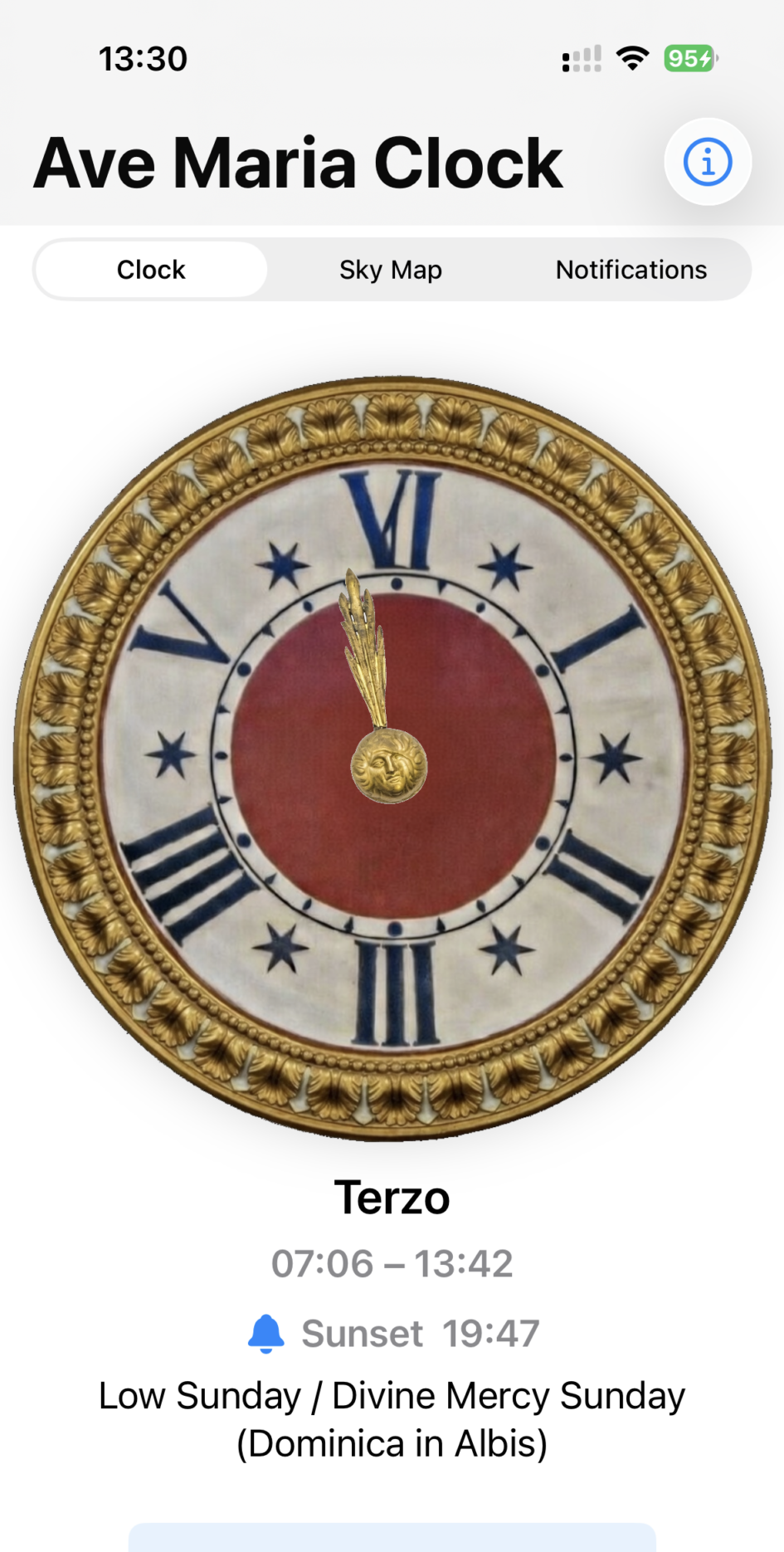
 For the last few days I’ve noted with interest that there is a new iPhone app (Android soon) with a historic SIX hour clock which can ring also the Ave Maria Bell, which technically should be rung 30 minutes after sunset. HERE
In earlier posts in which I have explained the six hour clock and the Ave Maria Bell, I’ve addressed the old ways of computing time, determining the end of a day and the beginning of a new day, which was important for issues like contracts and appointments to positions of authority.
In a nutshell, the Ave Maria Bells signals the end of the “religious” day and the beginning of “religious” night and it is rung in the ball park of 30 minutes after sunset. If the Ave Maria rings at, say, 19:00h (7PM) of 28 February, then 18:00h (6PM) would start the 23rd hour of the day and 19:00 would start the 1st hour of the new day’s, 1 March, “evening and morning”. In Roman churches, Vespers were usually sung about an hour before the Ave Maria Bell. Hence, in the example above, at about 18:00 at the 23rd hour.
Why is the pertinent?
Recently I saw a bit of news that a Vatican court is looking into the – get this! – the validity of the resignation of Benedict XVI! HERE There, there a link to a longish piece from late November 2025 by long-time Vatican journalist Andrea Cionci about the computation of time indicated by Benedict in his declaration of resignation, about text changes the Secretariat of State made to the Declaration and the change of a comma such that the result was NOT that Benedict resigned but that he was saying that the See of Peter was impeded.
There is a lot packed into that article. Here is a precis.
Cionci’s article argues that Benedict XVI’s Declaration was manipulated so that it would appear to be a valid resignation when, in the Cionci’s view, it was actually a juridical signal of an “impeded see.” Its first major claim concerns the word commissum. Cionci says that if Benedict originally wrote or spoke commissum, the phrase could be understood as referring to a “misdeed” committed by cardinals on 19 April 2005. In that reading, Benedict would not be saying that the papal office had simply been entrusted to him, but rather hinting at wrongdoing surrounding the beginning of his pontificate. Changing that to commisso makes the phrase fit the official sense, “entrusted to me,” and thus supports the standard reading of the text as a normal resignation formula.
Here’s the time part.
The second major claim concerns a comma before hora vigesima. The article says that with the comma, the text reads like “from 28 February 2013, at the twentieth hour,” which would indicate 8 p.m. on 28 February. Without the comma, however, it can be read as “at the twentieth hour from 28 February.” Cionci then applies the old Italian method of reckoning hours from sunset rather than from midnight. Since sunset in Rome on 28 February 2013 was about 6 p.m., counting forward twenty hours reaches 1 p.m. on 1 March. That timing matters to the article because it places the decisive moment after the Vatican bulletin convoking the conclave, allowing the author to argue that Benedict had not abdicated validly and was then effectively forced into an impeded see.
That comma issue is not insignificant. You know the old joke: “Let’s eat, Grandma!” or “Let’s eat Grandma!” In Italian there is ” “Grazia, impossibile fucilarlo” or “Grazia impossibile, fucilarlo” (Pardon, impossible to shoot him” and “Pardon is impossible, shoot him.”).
Here is Benedict XVI’s declaration:

The article has different links and some images to help ground and explain the argument. The article also deals with Benedict’s resignation of the ministerium and not the munus. The idea being this, taken together with the issue of time, the comma, and text changes, since can 332 §2, which governs abdication, requires renunciation of the Petrine munus, therefore Benedict XVI’s abdication is null and invalid. He remained pope after the resignation, and Bergoglio was an antipope, as such destined to the nullity of everything he said and did in 12 years. This means that, according to Cionci, the Declaration was not a badly written abdication (and it was not well-written), but a decisio, that is, a decree with which Benedict announced his See to be impeded. Hence, also the announcement of a conclave was made before the time set by Benedict (that vigesima hora business) demonstration the usurpation of the papacy, making Francis an antipope.
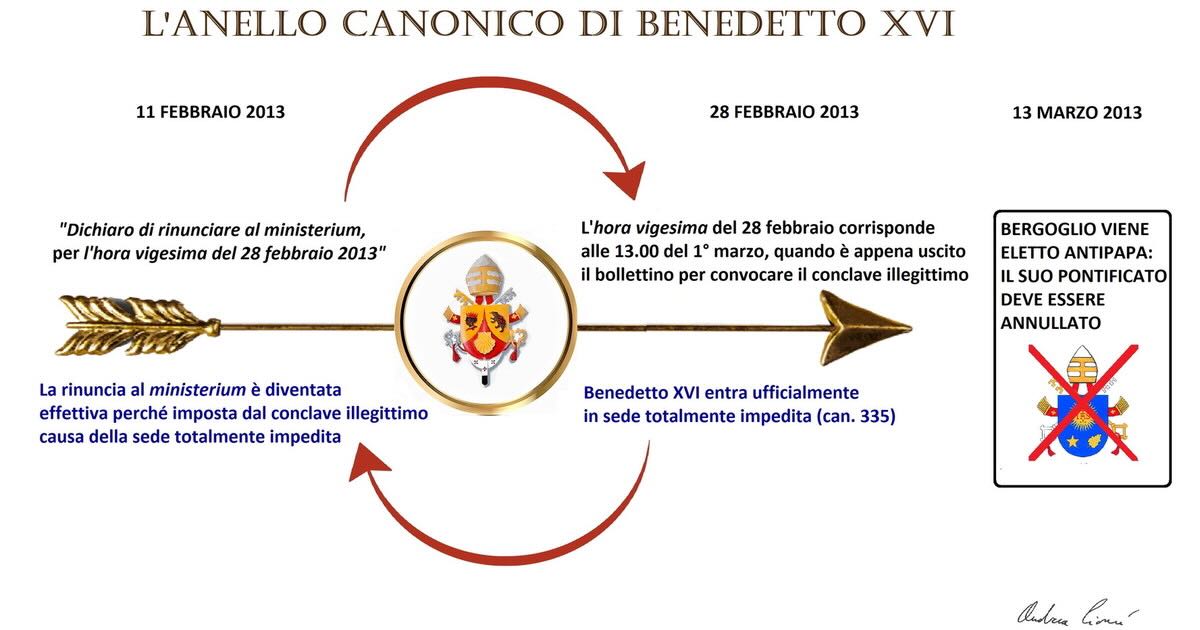
In that graphic, above, you see – according to Cionci – that on 28 Feb at the 20th hour Benedict is in a state of his See being “totally impeded” (cf. can. 335). The key point is that an impeded see is not the same thing as a vacant see. A vacant see means the officeholder is gone, by death, resignation, transfer, or deprivation. An impeded see means the officeholder remains, but cannot function. Benedict still possessed the munus while being prevented from exercising the ministerium.
Take any or all of that and conclude as you wish. What I found interesting is the ongoing relevance of old ways of computing time in the Church. The fact that an Ave Maria Bell is still on the Vatican curial calendar is …. ehem… timely.































Father,
You speak of “the old Italian method of reckoning hours from sunset rather than from midnight” and of “old ways of computing time in the Church”. Would this – and so the Ave Maria Bell – be equally characteristic of other Italian cities, such as Venice, for one more-northerly example, with the appropriate local adjustments – and, indeed, further afield, in cities and dioceses outside Italy?
It’s basically easy.
Pope Benedict abdicated.
He does not not-abdicate on a hidden other sense of his abdication contrary to what it sounded like and was received as meaning, especially not if he was well alive for another eight years and gave due reverence to his successor.
Also, bad as the pontificate of Pope Francis was: the idea that all the time (or the first 9 years anyway) Benedict had been still pope, had deceived the Church about his abdication and had been continuing to do so – how on Earth can someone even think that this solves or alleviates the problem? It’s obvious that the contrary is the case!
It diminishes it not in the slightest; and it adds a mountain of another problem on top of it.
Also, while it is not my job to judge people let alone popes … Pope Benedict does not seem to me to have been evil enough to pull such a string. For it would have been evil, monstrously so, to pull such a string.
He was physically (and perhaps morally, thinking of Vatileaks) exhausted, possibly not ideally treated by his physician, possibly a bit it error on his priorities (he could have sent a Cardinal-Legate to World Youth Day!). There may (or may not) have been a dash of the “fleeing from the wolves” he had himself warned about attached to it. But he was no evil mastermind who deceived the Church about the person of the Pope. He simply was not.
The main point, however, is that it is interesting to see a discussion about the computation of time.
Proud member of Team Oxford Comma
For the consequences of commas, I refer to the trail of Roger Casement, where the problem lay in the absence of punctuation in the Norman-French text of the Treason Act of 1351 (no typo). Casement was subequently hung for treason related to WWI – litterally hung on a comma.
As for the theories surrounding BXVI’s abdication (or otherwise): plenty of rabbitholes are available, but those that ignore the fact that if BXVI would have wanted something else, he could have stepped up, thrown in some choice German expletives, and set the thing right the very next minute (or day, or any time before the next conclave), are missing a few elements, even for a conspiracy theory. As he didn’t correct anything, we either need additional elements added to the rabbithole to explain why he didn’t, or we need to accept he did resign (and presumably made a big mistake in doing so). Occam’s razor applies.
English lawyers eschew commas.
Fascinating post, Father. The question of time definitely makes one think….
Minus/Munis – legal people must argue this for determination, but makes sense to me…
The time thing is new to me – quite interesting… Another legal determination, but seems reasonable…
All past popes who resigned left the Vatican (or were imprisoned) and stopped wearing papal garb and did not sign anything with papal titles (until Benedict ‘invented’ the ex-office).
But there’s more…
The pressure on finances when the ATM’s in the Vatican stopped in FEB…
Don’t forget the Butler thing the fall prior…
A young Ratzinger wrote about a bi-farced See in the late 1970’s
Fear: “Pray for me, that I may not flee for fear of the wolves”!!!!
And Malachi’s Martins book predicting a forced resignation (wrong pope, probably right idea)…
The direct evidence and circumstantial evidence point to invoking Canon 188 probably guilty on two of the three counts:
1) Grave Fear at play
2) Substantial Error at play
3) Simony is not in play (unless someone can show me benedict had a hidden rule and compass)
As some point it becomes overwhelming..
If in play you can start to consider that the two who came after benedict may be each a horn from the beast in revelation 13:11…
It belatedly occurred to me to check the handy and fascinating Medieval Reckonings of Time (1918) by Reginald Poole (in a series called ‘Helps for Students of History’) – a scan of which is available in the Internet Archive. Sadly, not a lot of detail, but including the simple, confident very comprehensive statement, “It should be noted that in ecclesiastical use the day begins with Evensong of the preceding day.”
@Gianni
I, too, am an Oxford Comma Supremacist.
Enter the younger MORTIMER.
Y. Mor. The king must die, or Mortimer goes down;
The commons now begin to pity him:
Yet he that is the cause of Edward’s death,
Is sure to pay for it when his son’s of age;
And therefore will I do it cunningly.
This letter, written by a friend of ours,
Contains his death, yet bids then save his life;
[Reads.
Edwardum occidere nolite timere, bonum est,
Fear not to kill the king, ’tis good he die:
But read it thus, and that’s another sense;
Edwardum occidere nolite, timere bonum est,
Kill not the king, ’tis good to fear the worst.
Unpointed as it is, thus shall it go.
That, being dead, if it chance to be found,
Matrevis and the rest may bear the blame,
And we be quit that caus’d it to be done.
(Edward II by Christopher Marlowe.)
On a completely different note, a question. If Vespers is sung about an hour before sunset, is Compline then sung immediately after Vespers?
I continue to go back to Antonio Socci’s book, “The Secret of Benedict XVI- Is He Still The Pope?”.
Socci writes about WikiLeak docs published in October 2016 which revealed “effort made by the Democratic entourage of Hillary Clinton to create a sort of “revolution” in the Catholic Church at the time when it was still guided by Benedict XVI. Its objective was to shift the Church away from its “non-negotiable principles” and from doctrinal orthodoxy towards “progressive” themes, …to new sexual customs, contraception, and abortion.” He also points to the dialogue between Benedict and the Russian Orthodox Church which “alarmed the American establishment.” Throw in the machinations and funding of George Soros and you have some very suspicious coincidences- I read somewhere where Benedict was refered to as a Katechon- fascinating given that he devoted himself to a life of prayer for the Church after he resigned; he certainly recognized the spiritual warfare that continues to rage against the Church and brought the best and most powerful weapon he could to bear.