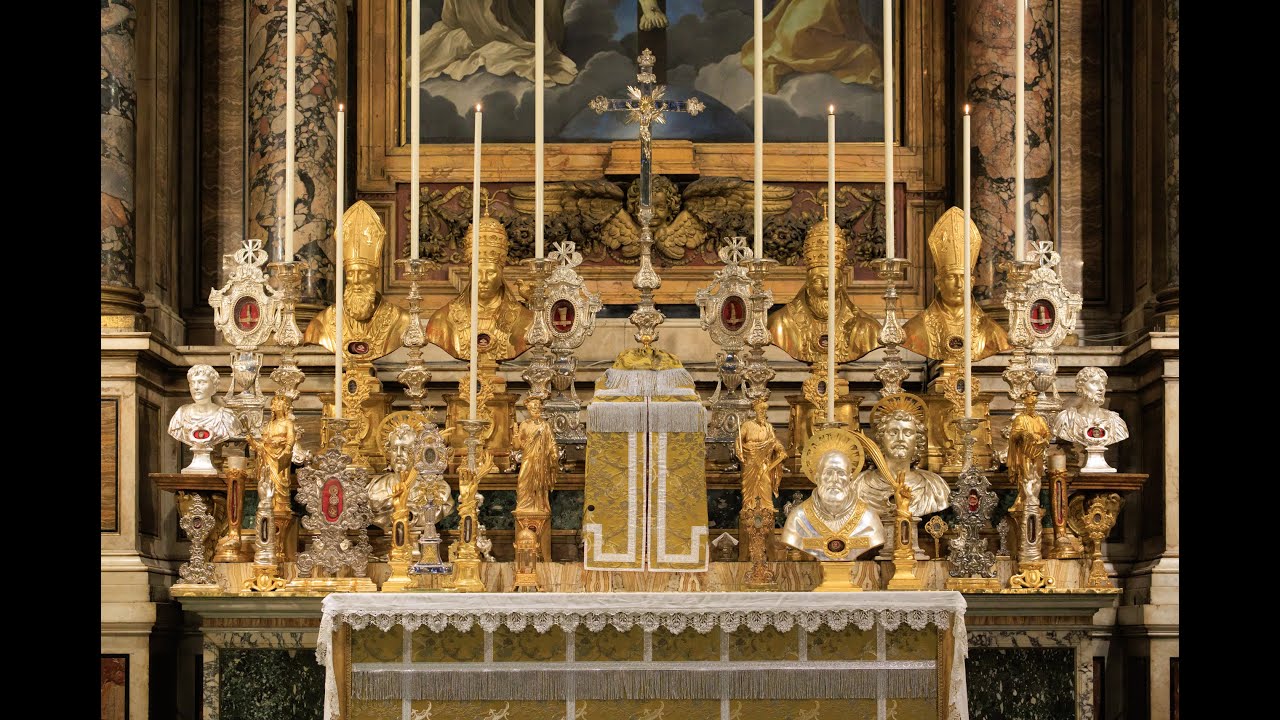
Edward Pentin has – HERE – the text of an Open Letter correcting Card. Cupich who not long ago wrote a bizarre piece for Vatican News using Dilexi te as a springboard to trash the Church’s liturgy which has been (i.e., still is) in use in a relatively stable form for over a thousand years. HERE
If you don’t remember what Dilexi te is, that’s alright. Hardly one does. It came out eons ago… last October! It’s an Apostolic Exhortation from (but in large part not, I think, by) Pope Leo XIV, which focuses on the Church’s mission to love and serve the poor.
Msgr. Bux is the originator of the great “Bux Protocol”. He is a liturgical expert and former consulter to the Dicastery for the Doctrine of the Faith and, if I remember rightly, the Office of Papal Ceremonies.
What did Cupich do? He situates the liturgical reform of the Second Vatican Council (e.g. Sacrosanctum Concilium – SC) within the broader movement of the Church seeking “a new image … simpler and more sober, embracing the entire people of God … more closely resembling her Lord than worldly powers.” According to Cupich, the liturgy therefore is not only about ritual or aesthetics, but must be a tangible expression of the Church’s mission among the poor and marginalized (never mind how those who want traditional liturgy are marginalized). Cupich asserts that the “noble simplicity” mentioned in SC in the liturgical reform aimed to let God’s action shine more clearly in the liturgy, and to free the Church from the trappings of worldly power, so it can speak more authentically to our age. Along the way the windy prelate proclaimed:
The liturgical reform benefited from scholarly research into liturgical resources, identifying those adaptations, introduced over time, which incorporated elements from imperial and royal courts. That research made clear that many of these adaptations had transformed the liturgy’s aesthetics and meaning, making the liturgy more of a spectacle rather than the active participation of all the baptized for them to be formed to join in the saving action of Christ crucified.
Ed Pentin’s reaction to Cupich’s musings – HERE.
Shall we have a look at Msgr. Bux’s piece v. Cupich?
To His Eminence Cardinal Blase Cupich
Your Most Reverend Eminence,
“For I think that God has exhibited us apostles as last of all, like men sentenced to death; because we have become a spectacle to the world, to angels and to men.” (1 Cor 4:9). This statement of the Apostle describes the identity of Christianity, both as the proclamation of the Gospel and as the Church’s public worship. Focusing on the latter, it can rightly be said that the liturgy is the spectacle offered to the world by those who adore Christ, the one Lord of the cosmos and of history, to whom they belong and not to the world. This is recalled by the expression “liturgical service,” which is truly appropriate — unlike the term “animation,” now in vogue — as if worship were not already animated by Jesus Christ and by the Holy Spirit. [That “animation” language is used more in Italian liturgical jargon than in English. For example, the old Willie Nelson imitator playing the bongo at Jesus Happy Lamb And Friend Faith Community in Rogerville is helping to “animate” the liturgy.]
After the persecutions, this became evident, because Christians did not burn incense to the Roman emperor but to Jesus, the Son of God. Catholic liturgy therefore has regal and imperial characteristics — Eastern liturgies teach us this [NB: Cupich doesn’t mention the Eastern “lung” of the Church] — because worship of God stands in opposition to any worship of the worldly rulers of the moment.
It is untrue that the Second Vatican Council desired a poor liturgy, since it asks that “rites should shine with noble simplicity” (Constitution on the Liturgy, 34), because they must speak of the majesty of God, who is noble beauty itself, and not of worldly banalities. The Church understood this from the beginning, both in East and West. Even Saint Francis prescribed that the most precious linens and vessels be used in worship. [More about St. Francis on liturgy HERE]
What then is the “participation” of the faithful, if not to be part of and to take part in the “spectacle” of a faith that affirms God and therefore challenges the world and its profane spectacles — which are indeed spectacular: think of mega-conferences and rock concerts. The liturgy expresses the Sacred, that is, the Presence of God; it is not a theatrical performance. The participation desired by the last Council must be full, conscious, active, and fruitful (ibid. 11 and 14) — that is, a “mystagogy,” an entry into the Mystery that takes place per preces et ritus [through prayers and rites], which, as Saint Thomas reminds us, must elevate us as much as possible to divine truth and beauty (quantum potes tantum aude); or, in the words of then-Father Robert F. Prevost: “Our mission is to introduce people to the nature of the mystery as an antidote to the spectacle. [And the stiletto finds the gap between the 4th and 5th ribs.] Consequently, evangelization in the modern world must find adequate means to reorient the public’s attention, shifting it from spectacle toward mystery” (May 11, 2012). The usus antiquior of the Roman rite performs this function; [NB] otherwise it could not have withstood the secularization of the Sacred that entered into the Roman liturgy, to the point of making people believe that the Council itself wanted it. This is the identity and mission of the Church.
Finally, Your Eminence, I invite you to consider that the liturgy, since ancient times, was solemn in order to convert many to the faith, and for this reason it must also have an apologetic value and not imitate the fashions of the world, as Saint Cyprian reminds us (applause, dances, etc.), up to the “deformations at the limit of the bearable” that entered the novus ordo, as Benedict XVI observed. This is the authenticity of the “sacred liturgy”; this is the ars celebrandi, as demonstrated by the offertory of the Mass, which is performed for the needs of worship and for the poor.
Therefore, Your Eminence, I ask you to engage in a synodal dialogue for the good of ecclesial unity!
In the Lord Jesus,
Fr. Nicola Bux
Thus, Bux has tossed the gauntlet of dialogue across Lake Michigan.


 November 12th 2025