UPDATE:

Or…. which seems not to be accurate.
Update from Peter Kwasniewski about Cardinal Burke’s health pic.twitter.com/AHrrDHuiw1
— Nick Donnelly (@ProtecttheFaith) August 10, 2021

UPDATE:
Or…. which seems not to be accurate.
Update from Peter Kwasniewski about Cardinal Burke’s health pic.twitter.com/AHrrDHuiw1
— Nick Donnelly (@ProtecttheFaith) August 10, 2021

On this Feast of St. Lawrence this seems appropriate.
The Holy Grail might be in Valencia, Spain.
 There is an interesting book by Janice Bennett entitled St. Laurence and the Holy Grail: the story of the Holy Chalice of Valencia (Ignatius, 2004) which argues that the 1st century cup of agate, now mounted on a medieval base of gold and precious stones is the cup that Jesus used at the Last Supper for the consecration of His Most Precious Blood, “poured out for many for the forgiveness of sins.”
For many, not for all… in the sense that not all will accept the gift.
Please understand that this book has big holes, uneven writing and research, and is open to serious skepticism on some aspects. However, it also relates truly fascinating information about this amazing relic held in Valencia and gives the reader a glimpse into the story of St. Lawrence and translations of various manuscripts of interest. Take this with a grain of salt, but it is a great read.
The cup itself is of a kind of agate, like chalcedony or sardonyx. It is like other cups found in Egypt, Syria and Palestine at the time of Christ. In the British Museum there are stone cups of the same style as that in Valencia dating to A.D. 1-50. It is of an odd color, reddish, “like a live coal”, and it is hard to say exactly what the stone is. The ancient naturalist Pliny describes that stone cups were submerged in oil until the stone absorbed some, and then boiled in acid which modified the organic material and changed the colors of the veins in the stone. The cup was very finely and accurately crafted and lacks ornament other than a fine band around the lip. It was broken in the middle on 3 April 1744, Good Friday, when it was dropped. I’ll bet that guy was reassigned! The break was repaired and only a tiny chip is missing. The cup can hold about 10 ounces.
You are asking, “But Father! But Father! How can anyone claim that this cup in Valencia came from the hands of Jesus in Jerusalem?”
The cup has an interesting story, traced by Bennett in her book. Here is the super brief version.
Some scholars argue that Christ used two different cups at the Last Supper, one of metal and the other of agate, the latter used for the first consecration. Some argue that the Upper Room used for the Last Supper belonged to the family of John Mark. There is some confusion about the different “John”s and “Mark”s in the New Testament. Suffice to say that it is possible that Mark the Evangelist was the son of the women who was a prominent member of the first Christians in Jerusalem. Peter went to her house when he was released from prison. That house was a meeting-place for the brethren, “many” of whom were praying for Peter when he was in prison: (Acts 12:12-17). This is possible the same place where the Last Supper took place, which establishes a connection with Mark and with Peter. It is argued that Mark gave Peter the cup Jesus used at the Last Supper for the consecration of his Precious Blood. This would be the second cup Jesus handled that night.
St. Peter consequently took the cup with his to Rome, where the Prince of the Apostles used it for Holy Mass until his martyrdom under the Emperor Nero. Thus, this cup became a precious object within the Christian community in Rome.

Sixtus II ordaining Lawrence to the exclusively all male diaconate
Bennett relates the argument that the presence of and even use of this cup in the ancient Roman Church is proposed as a possible reason why in the Latin Rite our consecration formula speaks of “hunc praeclarum calicem… this precious chalice” whereas the non Latin rites refer to the Greek “to poterion… the cup”. Interestingly, in the New Testament the word used is poterion, “cup”, and in Latin it is calix. However, in Spanish the word caliz (in Italian calice) is used to distinguish this important vessel for Mass from a simple cup, or copa (Italian coppa). “Cup” is simply not worthy of the moment and the purpose. Where do the words involved here come from? A Greek kylix was ceramic and had a wide base, was shallow, and had handles parallel to the table along the wide open lip. This style also came to be made from precious metals. The Romans called this cup a calyx. The word “grail” probably derives from old Spanish gral, grail for a drinking vessel, perhaps coming from Latin gradale or grasale a wide dish. In Provençal, the language of many of the troubadors who spread the grail legends, we have grazal.
During the time of the Emperor Valerian there was a terrible persecution of Christians. In A.D. 258 Pope Sixtus II was commanded to turn over the goods of the Church and, when he refused, was killed. Sixtus, however, had entrusted to his deacon the goods of the Church for their administration. This deacon was the famous St. Lawrence, a Spaniard from Huesca. When the Emperor went after Lawrence and commanded that the goods of the Church be rendered up. Lawrence asked for three days to get everything together. But instead of giving it to the officials he gave everything away and then produced a group of poor people, saying “These are the true treasures of the Church”. For that Lawrence was beaten and tortured horribly, even to being fried alive on an iron grate. For his part, however, Lawrence had already given the precious stone cup to another Spaniard named Precelius, who took it to Spain. The iron grid of Lawrence’s martydom is preserved in a Roman Church just a few minutes from where I am writing, in San Lorenzo in Lucina though he was martyred where there now stands San Lorenzo in Panisperna and buried at San Lorenzo fuori le mura, a Minor Patriarchal Basilica.
Lawrence is obviously the patron saint of cooks as well as several other groups. [cooks!]

Perceval
This is where the history firms up a bit. Various manuscripts indicated that the stone cup was kept in several places. By 533 it was in the Cathedral of Huesca, which was built in that year. Huesca was where St. Lawrence was from and perhaps where the Spaniard Precelius took it. After the 711 invasion by the Moslems it was hidden in the Pyrenees in various caves. After Charlemagne’s journey to the area in 777, the location of the cup, which was hidden, roused up many of the “grail legends” that come down to us in many forms today. In 830 the cup is at the Monastery of San Pedro de Siresa. In 1071 it was taken to the monastery of San Juan de la Peña. In 1190 Cretien de Troyes wrote a 9324 line poem Perceval about the “Holy Grail”. In 1209 Wolfram von Eschenbach wrote Parcival, based on Spanish legends, which centuries later inspired Richard Wagner’s opera. In 1322 a Sultan sells a gold cup from Jerusalem, which he claims is the cup of the Last Supper, to Jaime II, King of Valencia and Aragon. This is perhaps the cup which is converted to become the base for the ancient stone cup. In 1399 the stone cup was given to King Martin the Humane and taken to Barcelona. King Alfonso V of Aragon sends the cup to Valencia. In 1744, the cup is broken, repaired and fixed to its base. In 1936, to save it from the Marxists, a woman named Maria Sabina Suey smuggled the cup out of the Cathedral wrapped in newspaper. She hid it in various places to keep it from desecration and destruction. The cup returns to the Cathedral of Valencia in 1939 with the end of the war where it remains to this day.
Even if this is not the very cup Jesus used at the Last Supper, and it might well be, it is hard to dismiss that this is the cup that inspired all the Holy Grail legends which branch into the stories of the Knights of the Round Table, an Indian Jones movie, and another recent piece of rubbish not worth our time to name.
 The ancient stone cup, on its golden medieval base, is now in a beautiful chapel in Valencia. When Pope John Paul II visited Valencia on 8 November 1982, he kissed the cup (better than kissing a Koran) and then used it to celebrate Holy Mass.
It might have been the first time, 1724 after Pope Sixtus II, that “Peter” had held the cup again.
Pope Benedict used it for Mass in Valencia.
It could really be it, after all.


 It is good sometimes to sit and really drill into the hymns for the liturgical Hours, rather than just read them through – familiar as they become with repetition (the essence of liturgical rites). It helps to know the melodies, too. Since we are our rites, we Catholic priests really ought to know our rite. That means slowing down, drilling in, soaking it in, letting it seep into the marrow, dye the warp and weft of our prayers.
The Vigil of St. Lawrence, (check out Vespers HERE) we have this year the Hymn for Vespers on Mondays, feria secunda in Latin, the second day of the week.
The Vespers hymns follow an order through the week, recounting God’s work of creation day by day. Yesterday, for Sunday Vespers, the 1st day of the week, we sing Lucis creator optime, which is about the creation of Light: Fiat lux! Today, the hymn recounts God’s creative action on the second day of the week in Genesis 1:
6 And God said, “Let there be a firmament in the midst of the waters, and let it separate the waters from the waters.” 7 And God made the firmament and separated the waters which were under the firmament from the waters which were above the firmament. And it was so. 8 And God called the firmament Heaven. And there was evening and there was morning, a second day.
Today’s hymn, Immense caeli Conditor (and it is Cónditor not Condítor!), is in what is sometimes called the Ambrosian Meter, for Ambrose used it. The Ambrosian strophe has four verses of eight syllables in iambic dimeter. Remember that by the time this was written, accentual meters had pretty much replaced the earlier classical meters which considered the length of time it took to pronounce syllables, rather than just word accent … which lead to fascinating tensions in heterodyne feet! Not just a ham radio term, heterodyne! I don’t need to tell you that heterodyning is making a signal frequency by mixing two frequencies in a stable way using a mixer, like a oscillating vacuum-tube or transistor. Thank you, Reginald Fessenden, another guy jacked around unfairly by Thomas Edison. But I digress….
The Vespers hymns of the week in the Roman Breviary were probably written by St. Pope Gregory I, “The Great” (+604) who did a great deal to shape the Roman Rite that we have today… the Traditional Roman Rite, which our inheritance, our patrimony as Roman Catholics. Let us never allow anyone to rob us or withhold from us our heritage.
Let’s drill. Let’s dye.
Imménse caeli Cónditor,
Qui mixta ne confúnderent,
Aquæ fluénta dívidens,
Cælum dedísti límitem.
Mighty creator of the heavens, dividing the streams of water You gave heaven as a limit, lest once mixed they should be confusedly jumbled together. (NB: heterodyne? Nope.)
Firmans locum cæléstibus,
Simúlque terræ rívulis;
Ut unda flammas témperet,
Terræ solum ne díssipent.
Fixing a place for the heavenly streams, at the same time fixing one for those of the earth, so that the wave might temper the flames lest they destroy the ground of the earth. (NB: sŏlum, the o is short.)
Infúnde nunc, piíssime,
Donum perénnis grátiæ:
Fraudis novæ ne cásibus
Nos error átterat vetus.
Now pour forth, O most Merciful, the gift of unending grace, so that the ancient offense not grind us down in the failures of new crimes.
Lucem fides adáugeat:
Sic lúminis iubar ferat:
Hæc vana cuncta próterat:
Hanc falsa nulla cómprimant.
O let the Faith increase the light: O thusly may divine splendor of illumination hasten: O may it trample under foot every vanity: O let no false thing suppress it. (NB: lux – f., iubar – n., lumen -n.)
Præsta, Pater piíssime,
Patríque compar Únice,
Cum Spíritu Paráclito
Regnans per omne s?culum.
Amen.
 At ARRL there was an eye-catching title in a list of old posts on the side bar (much like all the titles of my posts on my side bar).
HMS Bounty Rescue
“Okay…”, quoth I. “I wasn’t aware that HF transceivers were available to the crew of HMS Bounty, an 18th c. Royal Navy full-rigged and ill-fated ship.
It happens that a replica of HMS Bounty was built for the famous film. It was sailed around for a while, but eventually wrecked off the coast of North Carolina thanks to Hurricane Sandy. Some of the crew died, but most were rescued.
They had tried all the means of communication they could to get the Coast Guard, sat phone, Marine Mobile Net on HF. Nothing worked. No one responded. But one of the crew, a ham and DXer had WINLINK stuff, which they were using to post, via HF, to Facebook. They sent an EMAIL to the Coast Guard, the Coast Guard arrived.
This really caught my eye because last night on ZedNet we talked a little bit about Winlink.
I am pretty intrigued by this tech… email when there is no internet.
Email when there is no internet.
Think about it.
Read that post. It is really interesting.
Meanwhile, a screenshot of my entry at QRZ for my contact with the Pitcairn Islands.

 Mount St. Mary Seminary in Emmitsburg, Maryland, is one of the most prestigious seminaries in these USA. It has enjoyed a good reputation for years. In the decades when many (most… virtually all) seminaries were cesspools, “The Mount” was comparatively steady.
St. Mary’s Seminary is part of St. Mary’s University. At the University page about COVID-19 POLICIES we see this:
Note that it is not a question.
UNDERGRADUATE STUDENTS AND SEMINARIANS – MAIN CAMPUS
To achieve our goal of at least 80% immunity within our community, undergraduate students who will be taking classes at the Emmitsburg campus in Fall 2021 and seminarians are required to be vaccinated against COVID-19 before coming to campus in August 2021. The deadline to submit an exemption request for medical or sincerely held religious beliefs has now passed.
Students must submit a record of their vaccination to the Health Center before returning to campus and no later than August 18, 2021. This information will be kept confidential.
Seminarians must be jabbed or they can’t return? No exemptions for medical or religious beliefs?
Don’t want the jab? It’s that or your vocation, sonny.
Is that what this comes down to?
It is not known what part the Seminary faculty/board were allowed by the University to have in this decision.
Moderation queue is ON.
Fr. Vierling made my day today by posting on Twitter this wonderful 17th c. Flemish School painting of the Blessed Virgin receiving Holy Communion from St. John, who is obviously celebrating Mass with the “Tridentine” Missale Romanum.

Note the altar cards, the maniple, the little angel with the chalice and the houseling cloth over his arms.
Let me just say, to tweak the tweakable, that Masses celebrated by St. John (who died c. 100) were just like that, with the 1570 Missale Romanum (or maybe the 1474 Missale Romanum or Ordo Missalis secundum consuetudinem Curiae Romanae). Surely the angels could have arranged that somehow. I mean.. since Mary’s house could be moved around…. If the “Tridentine Mass” was good enough the Blessed Virgin, it’s good enough for me. And Christ spoke Latin. So there.
NB: the chalice of the Mass is still on the altar. In the pre-62 Roman Missal there was a somewhat neglected rubric about Communion for the people. A server with a chalice or vessel of wine and water and a towel would follow the priest so that people could purify their lips and mouths. In the old Caerimoniale Episcoporum people were directed to go to the Epistle side after Communion and purify their lips and mouths. This is something that Easterners do after Communion. In the Latin Church this custom continues in the Traditional Rite of Ordination of Priests. The newly ordained, who concelebrate with the Bishop who reads the Canon aloud so that the new priests can say it at the same time, after their Communion then drink unconsecrated wine from a chalice to purify their mouths.
Here is a modern version of the scene by the talented oddball Giovanni Gasparro. He has both the chalice and the Host. Does the chalice contain the Precious Blood? Could be. I suspect that the painter doesn’t know about that old rubric, though we see the second chalice in old paintings.

What I like about this, is the angelic deacon (NB: tassels) or altar boy, at least I think it is an angel, perhaps Gabriel, looking at the Host which he cannot receive.
Angels are unfathomably above us in the order of things, but, amazing as they are, they cannot receive sacraments, they cannot receive the Eucharist.
Here is a late 16th c. painting in the Hermitage (which I would love to visit before I die). Note the maniple, but no cards. I wonder if this isn’t the Rite of Toledo, Mozarabic. I’m not sure if they used altar cards or not. The acolytes are Sts. Polycarp and Ignatius, surely of Antioch, not Loyola.

He is holding both the chalice and the Host. We don’t see the chalice of the Mass on the altar, so this is the Precious Blood. The Mozarabic Rite does have Communion under both kinds.
If you look closely, on the front of the altar there is a relief or painting of the Martyrdom of St. John in Rome at the Latin Gate, when they tried to kill him by boiling him in oil.
The 17th c. Spaniard Alonso Cano gives us his view of the moment.

No chasuble. He is barefoot. She has a houseling cloth. The bird stands by, eagle-eyed.
He is holding the Host with both hands. It is almost as if he is a monstrance, holding the Host for a long time so that Mary can contemplate Her Eucharistic Son. You might be tempted to think that this is “Exposition” rather than Communion, but she has the cloth over her hands. I think it is both.
Another version by Alonso Cano, in Genova.

Note again, the angel standing by with the purification cup. She has the houseling cloth.
Something from the German school, now in the Alte Pinakothek München from the school of Johann Andreas Wolff, early 18th c.

Note that the angels down on the ground have the houseling cloth and the purification chalice. They are so overwhelmed by this awesome moment, the Mother of God receiving her Eucharistic Son, that they can barely contain themselves. Up above, we seem to have larger, older angels, with incense. Perhaps the painter is reflecting in the angelic order what he sees at Solemn Mass in the sanctuary: the older boys handle the incense and the younger ones have the simple tasks.
I’ll conclude with a really interesting image. What’s going on?

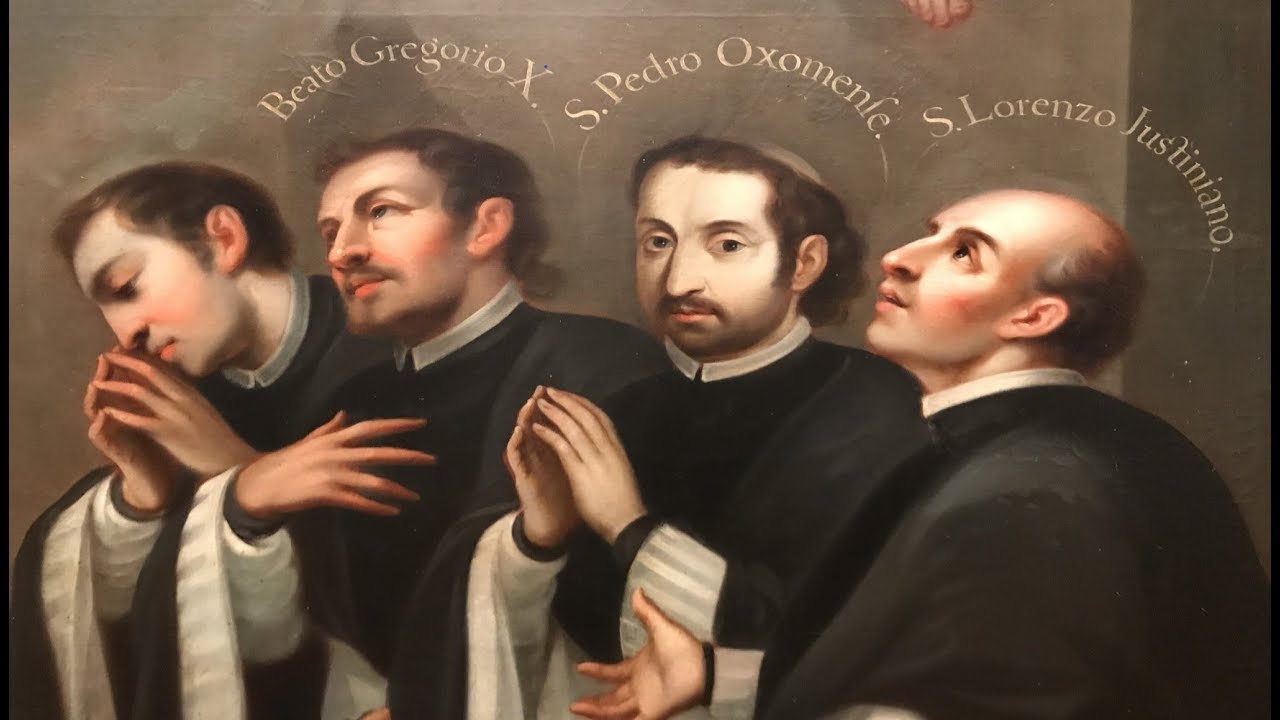
This is El bautizo de la Virgen María by Antonio de Torres (1666-1731). A great example of Mexican Baroque.
Four angels, including the obvious Michael stand by, perhaps he other three are Raphael, Gabriel, and the non-Scripturally named Uriel. One of them, I imagine the Annunciation Archangel Gabriel looks out to us, indicating the scene which we should contemplate. This is not in Scripture, of course. The scenario is inspired – I think – by María de Jesús de Ágreda’s (1602-1665) Mística Ciudad de Dios.
III. 319. The most blessed Lady also asked Him for the Sacrament of Baptism, which He had now instituted, and which He had promised Her before. In order that this might be administered with a dignity becoming as well the Son as the Mother, an innumerable host of angelic spirits descended from heaven in visible forms. Attended by them, Christ himself baptized his purest Mother. Immediately the voice of the eternal Father was heard saying: “This is my beloved Daughter, in whom I take delight.” The incarnate Word said : “This is my Mother, much beloved, whom I have chosen and who will assist Me in all my works.” And the Holy Ghost added : “This is my Spouse, chosen among thousands.”
Here is some Mexican Baroque music from the period of the painting. It is a Mass for 5 voices with violins and oboe by Manuel de Zumaya (+1755), who was a priest. Listen as you contemplate the “Baptism of Mary”.

I guess you can tell that it has been a while since I’ve visited a good museum on a Sunday.
Was there a GOOD point made in the sermon you heard at the Mass for your Sunday (obligation or none), either live or on the internet? Let us know what it was.
Too many people today are without good, strong preaching, to the detriment of all. Share the good stuff.
What was attendance like?
Tell about attendance especially for the Traditional Latin Mass. I’m getting reports that it was waaaay up.
Was the Motu Proprio mentioned? Any local changes or news?

Coat of Arms by D Burkart









A Daily Prayer for Priests


They find you a pro-life agent in your area who commits to giving a portion of the fee to a pro-life group!

PLEASE subscribe via PayPal if it is useful. Zelle and Wise are better, but PayPal is convenient.
A monthly subscription donation means I have steady income I can plan on. I put you my list of benefactors for whom I pray and for whom I often say Holy Mass.
In view of the rapidly changing challenges I now face, I would like to add more $10/month subscribers. Will you please help?
For a one time donation...



Help Monks in Wyoming (coffee – UPDATED LINK) and Norcia (beer) and the wonderful "Soap Sisters" of Summit, NJ!


Please follow me on Twitter!










Visits tracked by Statcounter
since Sat., 25 Nov. 2006:


