ROME 25/10 – Day 13: “Clergy Appreciation Month”. 50% off. Oh… and food.

At 7:15 the sun crept over the Seven Hills like Augustus’s shade inspecting his quondam empire, gilding the domes and pigeons of Rome in imperial light.

By 18:39, Sol will yawn and slip behind Janiculum, leaving the city to its vespers, scooters, and the tombs of saints.

At 19:00 the Ave Maria Bell should ring, summoning us from day work to aperitivi.

The shade of Augustus shall repeat, “Sic transit gloria solis” and Rome will begin her nightly negotiation with eternity.

At My Cuban Store it is “Clergy Appreciation Month”. 50% off on all clerical shirts (including standard and guayabera clerical shirts).

NBRegistrants…. if you register and then nothing happens or works, it is possible that I didn’t approve your registration.  The main reason for my not approving is that, in the bio section which I require, what you put in it didn’t convince me that you were a) not a bot or spammer, or b) a bad actor of some kind.

WELCOME REGISTRANT:

JTT5748

That said…

This is cool…

Yeah… this…


In chessy news…

In a Fischer Random (960) match in St. Louis, Viswanathan Anand is struggling again Garry Kasparov. Both, former world champs. Kasparov leads 8.5-3.5, but the intrigue remains, since 12 points are still up for grabs on the final day.

Some food things…

I met a friend, in town, a lawyer who defends priests, for drinks at my usual spot.

Since he has been here before, he made a bee line for the bar and they created a new cocktail… as one does.

At the restaurant… some beginners…. my friend wanted some pecorino.

Salmon carpaccio in ground red peppercorn and orange.

Freshly made caponata.   Wow… exquisite.  A little blurry here, I know.

This has been a go to place for me over the years.  They’ve had good times and less good.  Right now they are having GREAT times.  This is one of the best meals I’ve at at this place for a long time.  I spoke at length with the owner.  He explain that even in the last month he got back an old chef who had been elsewhere, a guy he started with.   He brought new nuance and brightness to the menu, along with expert timing of the FISH which I will post tomorrow.

This place is BACK!  And it is close.  And we all know each other, which in Rome really helps.

Everyone got thumbs up.  My friend, whose 26th visit to Rome it was, said it was some of the best he’s had.

Hmmm… I had a thought.  We should pressure John Sonnen, who runs pilgrimages, to have a special tour of restaurants and churches in Rome with the TLM.  No massive slogs through a dozen places.  Low impact.  Busy part of the day.  Here are suggestions if you want to go on your own.  Here are a few fixed places.  Tour with Mass for grown ups.


Posted in SESSIUNCULA |
4 Comments

ROME 25/10 – Day 11/12

Hodie Romae sol ortus est hora septima et quartadecima minuta. Occidet autem hora duodevicesima et quadragesima minuta.

Campana “Ave Maria” pulsari debet hora undevicesima.

Hic dies festus est sancti Ioannis Henrici Newman atque sancti Abrahae Patriarchae Veteris Testamenti.

Eodem die colitur sanctus Ioannes Leonardi, cuius corpus in ecclesia Sanctae Mariae “in Campitelli” quiescit, haud procul ab eo loco ubi scribo.

Inside the church I highlighted the other day, with the arms of Benedict XV over the door.  Santa Maria del Suffragio.

They don’t update things very often.  This is on the door.

Last night’s repast with a priest friend from the USA in town briefly.  He got the saffron risotto with ossobuco.  (A little messed up when I took the shot.)

I, saltimbocca. It was a little overdone, IMHO.  Veal that thin can be tricky.

Please remember me when shopping online and use my affiliate links.  US HERE – UK HERE  WHY?  This helps to pay for health insurance (massively hiked for this new year of surprises), utilities, groceries, etc..  At no extra cost, you provide help for which I am grateful.


In chessy news… chess.com… Kasparov Leads Anand As Legends Clash In New Saint Louis Chess Club

That’s Fischer Random!

White to move and mate in 4.

NB: I’ll hold comments with solutions ’till the next day so there won’t be “spoilers” for others.

Priestly chess players, drop me a line. HERE

Posted in SESSIUNCULA |
10 Comments

From “The Private Diary of Bishop F. Atticus McButterpants” – 3-10-25 – Smoke alarm

Dear Diary,

Fr. Tommy’s still in Rome on his sabbatical. He’s probably visiting those ancient churches, and eating gelato. Unjust world. Without him, the place feels hollow. Already did when he went to the parish. The rest of us are here fighting the good fight against diocesan paperwork and Chester. He’d probably be running the place if he had opposable thumbs.

Fr. Gilbert. He’s trying, I’ll give him that, but he’s no Tommy. He got the kind of perky optimism that could make a tax audit seem like a birthday party. He helped me sort through correspondence until he got distracted by the smell of something burning. Turned out it was my toaster oven warming lunch. Smoke alarm shrieking, towels flapping, the works. Chester dodged under the sink. I’d swear the look in his eyes meant he’d found a way to turn up the temp. Anyway, we ordered out from that shop over the way that has the huge subs.

I had a call from Dozer. He wanted to “compare notes on vocations,” which I think was code for bragging that he’s finally got more than one.

Now I’m thinking about gelato. There’s some of that green chocolate mint left in the freezer. Should I go to Rome for little bit?

Posted in Diary of Bp. McButterpants |
4 Comments

9 October – Feast of St. Abraham, Old Testament Patriarch – WDTPRS: Roman Martyrology

Today, 9 October is the feast of St. Abraham, Patriarch of the Old Testament.

Here is the entry in the newest edition of the Martyrologium Romanum with a translation:

3. Commemoratio sancti Abrahae, patriarchae et omnium credentium patris, qui, Domino vocante, ab urbe Ur Chaldaeorum, patria sua, egressus est et per terram erravit eidem et semini eius a Deo promissam.  Item totam fidem suam in Deo manifestavit, cvm, sperans contra spem, unigenitum Isaac ei iam seni a Domino datum ex uxore sterili in sacrificum offerre non renuit.  …

The commemoration of Saint Abraham, patriarch and father of all believers, who, since the Lord was calling him, went froth from the city of Ur of the Chaldeans, his home land, and wandered through the land promised by God to him and to his seed.  He manifested his complete faith in God when, hoping against hope, he did not refrain from offering in sacrifice his only-begotten son Isaac, given by the Lord to him, an old man, from his sterile wife.

Nothing is impossible with God.

The Martyrologium Romanum commemorates this day the living prototype of the believer who trusts when sight fails.

The Fathers of the Church, meditating on the figure of Abraham, found in him the matrix of the entire spiritual life: obedience, detachment, hope, prayer, and the prophetic anticipation of Christ.

St. Irenaeus of Lyons, that earliest heir of apostolic tradition, sees Abraham as the first man who “by faith received the covenant” (Adv. Haer. IV.21.3). For Irenaeus, the patriarch’s life is a pre-gospel. The promise that “in thy seed shall all nations be blessed” already contains the mystery of Christ:

“In the faith of Abraham the Incarnation was prefigured, for his seed is Christ, by whom the blessing comes upon the nations.”

Thus the Old and New Covenants are not opposed but organically one: the faith of the Patriarch flowering in the faith of the Church. The ancient journey from Ur to Canaan prefigures the Church’s pilgrimage from the world to the heavenly Jerusalem.

Ambrose, writing two centuries later, reads that same journey as the itinerary of every Christian soul. In De Abraham (I.5) he comments:

“Voca te Deus ut exeas de terra tua, hoc est de corpore tuo.”

God calls you, he says, to go forth from your own land—that is, from the body and from earthly desires. The geographical exodus becomes an interior migration. For Ambrose, Ur signifies the darkness of ignorance and sensuality, while Canaan, “the land which I will show thee,” is the contemplation of divine things. The Christian must leave behind his “kindred,” that is, worldly attachments, to enter the promised rest of charity. Abraham is thus the archetype of the monk and of every soul who departs from the familiar in search of the invisible.

St. Jerome, his contemporary, adopts the same spiritual reading. Commenting on Genesis 12, he sees in the command egredere an ascetical principle: to “go forth” is to transcend the passions and climb the ladder of virtues. He insists that Abraham obeyed nuda fide—with naked faith—since he did not know where he was going. In that ignorance, Jerome finds a sign of perfect trust:

“He believed, not because he saw, but because he heard.”

The life of faith, for Jerome, begins when one surrenders the map and lets God direct the steps.

Origen, in his Homilies on Genesis, discerns in Abraham’s offering of Isaac a revelation of resurrection faith. The text of Genesis says that Abraham set out “on the third day.” For Origen, this is no accident: the third day announces the Resurrection. “Abraham knew,” he writes,

“that God was able to raise his son from the dead; therefore he offered him, and received him back as a figure.”

The knife raised over Isaac is the shadow of Calvary; the ram caught by its horns in the thicket is the humanity of Christ entangled in the thorns of mortality. Origen’s Abraham is the first believer in Easter. His faith does not end in the renunciation of the beloved but in the hope of restoration beyond death.

Augustine, gathering these strands, makes Abraham the type of both priest and victim. In City of God (XVI.32) he observes that “Isaac, carrying the wood for the sacrifice, was a figure of Christ bearing His Cross.” The two “walked together” (ambulabant pariter), signifying not “synodality” but the unity of will between Father and Son in the mystery of redemption. For Augustine, every detail of the Genesis narrative is prophetic: the mountain signifies the height of divine love, the altar the Cross, the fire the Holy Spirit, the obedient son the incarnate Word. Abraham’s sacrifice thus contains in embryo the whole Triduum. In another place he remarks that Abraham

“offered in figure what God would truly perform,”

since the Father would not spare His own Son but deliver Him up for us all.

St. John Chrysostom, preaching in Antioch, contemplates the same scene with moral fervor. He calls Abraham “the father of faith and the master of obedience.” What moved God, he says, was not the knife but the heart:

“He raised the blade, yet the sacrifice was complete already in his mind.”

Chrysostom insists that such faith is the root of all Christian virtue, since it trusts the divine command even when reason cannot see the purpose. The patriarch becomes, in his words, “the first fruits of the faithful.” Isaac’s silence and consent make him a type of Christ’s meekness; Abraham’s readiness prefigures the priesthood of believers who offer their lives as a living sacrifice.

For the Alexandrian Fathers, the story of Mamre, the hospitality of Abraham to the three mysterious visitors, was no mere moral tale but a theophany. St. Basil the Great, in De Spiritu Sancto (IX.22), writes that Abraham

“adored one and welcomed three,”

discerning dimly the mystery of the Trinity. His table beneath the oak of Mamre foreshadows the Eucharistic table of the Church, where God sits with His friends. In the tent of the patriarch, the invisible God begins to be seen; in his hospitality the image of divine communion is revealed.

Gregory of Nyssa, brother of Basil, deepens this mystical sense. In his Life of Moses (II.29), he compares Abraham’s faith to the soul’s epektasis, the perpetual stretching forth toward what lies beyond.

“He goes out, not knowing whither he goes because the good which he seeks has no limit.”

Faith for Gregory is not static possession but endless movement toward the Infinite. Abraham’s pilgrimage is the emblem of the soul’s unending ascent into God.

The image of the sinus Abrahae, the “bosom of Abraham,” provided another field of reflection. Tertullian, in De Anima (55), imagined it as a place of rest and refreshment for the righteous dead, a kind of vestibule of paradise awaiting the Redeemer. Ambrose later ennobled the image in De obitu Valent. 72:

Sinus Abrahae requies aeternae pacis… the bosom of Abraham is the repose of eternal peace.”

Augustine, commenting on the parable of Lazarus, identified it with the hidden life of the Church, where the faithful departed rest in the promise of resurrection. Thus Abraham remains father not only of the living but of those who sleep in hope.

Throughout patristic literature, Abraham’s greatness is never detached from humility. St. Gregory the Great, reflecting in Moralia in Iob 5.3.6 on his intercession for Sodom, marvels that

“he who was a friend of God called himself dust and ashes”

Faith and humility, for Gregory, are inseparable: to believe is to acknowledge one’s nothingness before the Almighty. The same Abraham who converses familiarly with God bows to the earth in reverence. His confidence is born not of presumption but of trust in divine mercy.

Thus, from Irenaeus to Gregory, Abraham stands as the common ancestor of all theology.

He is the first contemplative, the first missionary, the first intercessor, the first pilgrim of faith. His life forms the grammar of revelation: calling, promise, testing, and blessing. In him the Fathers discern the whole outline of salvation history already traced in miniature. He believed, and it was counted to him as righteousness; he obeyed, and the nations were blessed through him.

The Church, reading Genesis in the light of Christ, sees in Abraham the mirror of her own faith, walking through this world as a stranger, building altars on the way, awaiting the city whose builder and maker is God.

In fact, speaking of altars, the Roman liturgy invokes Abraham as both witness and intercessor.

In the Roman Canon the priest prays:

“Supra quae propitio ac sereno vultu respicere digneris, et accepta habere, sicut accepta habere dignatus es munera pueri tui iusti Abel, et sacrificium patriarchae nostri Abrahae, et quod tibi obtulit summus sacerdos tuus Melchisedech.”

Here Abraham stands between Abel and Melchisedech as the perfect figure of priestly faith: he offers not the fruits of the earth but the beloved son, prefiguring the Eucharistic oblation of Christ Himself.

Posted in Saints: Stories & Symbols | Tagged
3 Comments

9 October – Feast of St. John Henry Newman – WDTPRS: Collect for Newman and “Lead, Kindly Light”

Here is the COLLECT for the Feast of  St. John Henry Newman Memorial, anniversary of the day, 9 October 1845, when he was brought into greater light and received into Holy Catholic Church at Littlemore.
Pope Leo XIV will proclaim St. John Henry to be the 38th Doctor of the Church on 1 November.

LATIN:
Deus, qui beátum Ioánnem Henrícum, presbýterum,
lumen benígnum tuum sequéntem
pacem in Ecclésia tua inveníre contulísti,
concéde propítius,
ut, eius intercessióne et exémplo,
ex umbris et imagínibus
in plenitúdinem veritátis tuae perducámur
.

The use of confero might raise an eyebrow.  Buried in the entry for confero in our Lewis & Short Dictionary we find “With the access. idea of application or communication, to devote or apply something to a certain purpose, to employ, direct, confer, bestow upon, give, lend, grant, to transfer to (a favorite word with Cicero.).”  The problem is that contulisti here has the sense of “grant”, but then we also have to deal with concede down the line, which also normally comes off as “grant”.  So, I will stick with “grant” for confero and then use something else for concede.

An imago is certainly an “image” or “copy”, it is also a “ghost, likeness, echo, semblance, appearance” or “shade”.

WDTPRS LITERAL VERSION:

O God, who granted blessed John Henry,
a priest following Your kindly light,
to find peace in Your Church,
graciously vouchsafe,
by his intercession and example,
that we may be drawn from shadows and shades
into the fullness of Your truth.

You will notice right away the reference to the a poem written by John Henry in 1833 later rendered as a popular hymn, Lead Kindly Light.

You might know the story of its writing.  When the young Newman was traveling in Italy he fell ill. He experienced a time of great emotional and spiritual discouragement. When a nurse asked him what troubled him, he responded, “I have work to do in England.”  Eventually he got passage on a boat home, but they were constrained to heave to, slowed by a thick fog and nearby cliffs.  Trapped in the fog, on June 16 Newman wrote The Pillar of the Cloud:

Lead, Kindly Light, amid the encircling gloom
Lead Thou me on!
The night is dark, and I am far from home—
Lead Thou me on!
Keep Thou my feet; I do not ask to see

The distant scene—one step enough for me.

I was not ever thus, nor pray’d that Thou
Shouldst lead me on.
I loved to choose and see my path, but now
Lead Thou me on!
I loved the garish day, and, spite of fears,

Pride ruled my will: remember not past years.

So long Thy power hath blest me, sure it still
Will lead me on,
O’er moor and fen, o’er crag and torrent, till
The night is gone;
And with the morn those angel faces smile

Which I have loved long since, and lost awhile.

A version of the hymn, just to help you ponder.


OFFICIAL VERSION:
O God, who bestowed on the Priest blessed John Henry Newman
the grace to follow your kindly light
and find peace in your Church;
graciously grant that,
through his intercession and example,
we may be led out of shadows and images
into the fulness of your truth.

In this world we walk by faith, not by sight.

We peer towards mystery through the dark glass,…

…through the crack in the rock,…

…through chink in the garden wall.

The hope of Christians draws us to the One who will draw us forth from this shadowy place into His marvelous light.

Holy Church is our surest path to that which is good and true and beautiful.

Of interest is that  “ex umbris et imaginibus in veritatem” was John Henry Newman’s epitaph.

However we put this, “from shadows and shades into truth”, “from out of shadows and reflections into truth”, “from shadows and phantasms into truth”, “from illusions and approximations into reality”… this has a rather Platonic ring to it.

For Newman this certainly also meant something like “from the Church of England and from Anglo-Catholic to the Roman Catholic Church”.

You might imagine yourself, if you have your Platonic hat on, moving away from the back of the cave, turning around, and heading out of the cave to your source.

At the heart of the Platonic and Augustinian paradigm is conversion – the turning point at which we, who are moving out and away, begin to return.

This is a paradigm found in many of the Latin Church’s more ancient prayers.  It is also found in the experience of the penitent and of the worshiper at Holy Mass.

Posted in Liturgy Science Theatre 3000, Saints: Stories & Symbols, SESSIUNCULA | Tagged
2 Comments

Another report of pain in the Diocese of Charlotte

I warmly recommend this piece at Crisis for your reading and your wide sharing with all whom you know.

You may know the facts. The Bishop of Charlotte suppressed the people who had a Traditional Latin Mass in different locations, and then ghettoized them far away in a tacky little fixer-up chapel which he openly said would not be big enough. He told them than can’t take up a collection, which means improvements will be hard, and they must continue – above all – to pay at their territorial parishes. He said he would accompany them. He wasn’t there on Sunday. But there was a sign on the door that said they shouldn’t take photos.

Such loving care.

Read the piece at Crisis.

A few bits…

[…]

But when Bishop Martin shut down the Traditional Latin Mass in all parishes and forced those communities to disband, I felt compelled to join those who were banished to a remote chapel, miles away from the highway, at the end of a series of two-lane roads surrounded by cornfields. If we are supposed to be with those who grieve, then this was the place to find them. In order to express true compassion—from the Latin cum passio—one must suffer with. It requires presence. Despite Bishop Martin’s claim to his sheep that he would “commit to walk with” them, he was noticeably absent.

The holy water font was a simple, wide basin placed on a small circular wooden table just through the main entrance. For those who traveled from ornate churches like St. Ann’s in Charlotte or Our Lady of Grace in Greensboro, this must have felt like being in exile. The overhead lighting was tacky and more appropriate for a stage than a sanctuary. One could easily envision a band in place of the altar.

[…]

It was claimed that having the Traditional Latin Mass at parishes was divisive. So, paradoxically, faithful Catholics were forcibly divided from their parish communities and sent long distances away, that they may not worship in the same spaces as their neighbors.

[…]

Posted in SESSIUNCULA | Tagged
17 Comments

“OF COURSE!”

Today I have been working on the next offering for over at One Peter Five (a weekly commentary on upcoming Sunday Mass texts with the TLM).   I had a funny image flash through my mind.  It wouldn’t have fit in what I was writing there, but maybe here it has a place.

What was I writing?

Paul says that the Corinthians – and we, their distant heirs – have been “enriched with all speech and knowledge,” so as to lack no spiritual gift while we wait for the Lord’s revealing. This enrichment is not mere eloquence or erudition but the infusion of faith that blossoms into wisdom. … Isn’t St. Paul’s paean of thanksgiving also for us a summons to vigilance? It is we who have been magnificently enriched with faith and knowledge. Consider what we have now, which has been handed down with love through countless generations! We have the treasury of the saints, the witness of martyrs, the splendor of the sacraments. We have ever clarified teaching, the deepening of doctrine, the outward expression of both in our polished and tended and perfected sacred liturgical worship.

To squander these gifts would be a sin against gratitude. To tamper, tinker, and trivialize them would be a crime against God and neighbor.

Paul expected much of his Corinthians who were just in their first steps in this journey called the Church. We, on the other hand, possess centuries of reflection, the accumulated fruit of our forebears’ contemplation, sweat, blood and tears.

Would, therefore, Paul not expect even more from us?

So… I’m writing away and I start thinking about the pseudo-archeologizing liturgical nitwits out there who stand in contempt of the solemn rites of the Roman Church in favor of a pristine clay platter and cup, burlap, and a chunk of crumbly and yet still oddly unchewable bread.

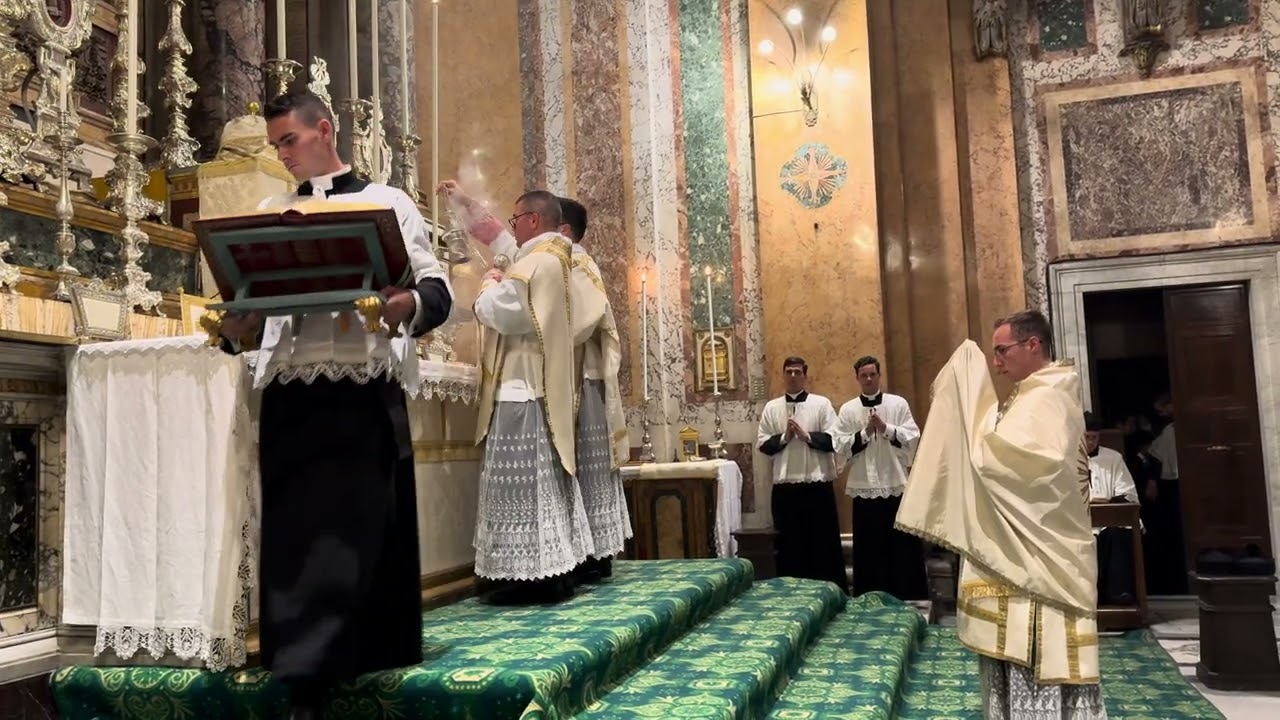
My mind drifts to St. Paul, perhaps coming out of something like that, though I’m sure they would have tried to use their very best things for their worship, suddenly being transported into the middle of our Solemn Mass last night for the Feast of Our Lady of the Rosary.

YouTube thumbnailYouTube icon

There stands Paul, in Santissima Trinità dei Pellegrini.  He sees the symbols of Trinity everywhere, including the magnificent painting by Guido Reni.  “What’s a Rosary?”  An angel illumines his mind.  The vestments, clergy in choir, baroque polyphony – the Gregorian chant sounds kind of familiar – the accoutrement of the altar, dozens of seminarians in choir dress, the architecture itself.  Familiar psalm verses and unfamiliar… Creed? Again the angel illumines his mind.  Incense, he gets that.  The two fold consecration!

Taking it all in he suddenly straightens up, slaps his forehead and cries,

כַּמּוּבָן!

Posted in Lighter fare |
1 Comment

Note from a reader: first confession in 19 years! Wherein Fr. Z rants.

I nag you to…

GO TO CONFESSION!

I received a note today which made my day.

Father Z,

Today, on the Feast of Our Lady of the Rosary, I went to Adoration and Confession. It was my first time going to Confession in nineteen years! When I said as much, Father exclaimed, “Wow! Nineteen years! God must have been chasing you for a while.” That He has. I talked myself out of going for too many years and I am sorry it took so long. Thank you for your persistent reminders to go. There are not enough words to express my gratitude.

May God bless you immensely!

You get …

Everyone, for the love of God…

GO TO CONFESSION!

There is no sin that we little mortals can commit that our all-powerful and loving God will not forgive, provided we ask for forgiveness.

The Sacrament of Penance was established by Jesus Christ.  He intended that this sacrament be the ordinary means through which we return to the state of grace.

No matter what you have done, Christ – in the person of the priests in the confessional – washes that sin from your soul with His own Blood.

Once you have received absolution, those sins will not be held against you in your judgement.  They are gone.   You will remember them, but their guilt is no longer with you.  You have to do penance for them, but the sins are removed, they are not just covered over or sort of kind of forgotten.  They are eradicated from your soul. They are no more.

GO TO CONFESSION!

“I absolve you from your sins…”

When was the last time you heard those words from the priest after confessing all your sins in kind and number?   Hmmm?

While we live we have the chance to get things right with ourselves, our neighbors and our God.

Get things right.

GO TO CONFESSION!

Fathers, if you don’t now offer decent times for confessions in the parish entrusted to you and if you don’t preach about this important sacrament and about sin, you are probably going to go to Hell.  And Bishops…  I fear for you if you are not promoting this important sacrament in your dioceses.  Think about your judgment.

You also had better…

GO TO CONFESSION!

Posted in GO TO CONFESSION, Just Too Cool, Our Catholic Identity, Wherein Fr. Z Rants | Tagged
3 Comments

The Altar of Chair in St. Peter’s Basilica. What a shame.

What a shame that altar was torn out.  The Altar of Chair in St. Peter’s Basilica.

I was there that morning and saw them doing it.  They hadn’t gotten the crime finished before we priests were about to say our morning Masses.  The basilica personnel tried to shoo us away.

Having the altar THERE was a theological statement. Although, having the hideous Paul VI altar disconnected and freestanding is also a theological choice, isn’t it. For a while there was a better Cranmer version. Now the hideous Paul VI is back.


Posted in SESSIUNCULA | Tagged
3 Comments

An act of reparation for the demonic disgracing of St. Peter’s Basilica

Last year, I posted from 4-7 October about making acts of reparation for the sacrilegious antics with the demon “Pachamama” in the Vatican Gardens and even upon the main alter of St. Peter’s Basilica.  This year, the 4-6th slip by me.

But today is the Feast of Our Lady of the Holy Rosary.

Please consider saying a Rosary in reparation for the horrors perpetrated in the Basilica, not only with the demon idol and demonic bowl (on Oct 27) back in 2019.

You might include a this, from an angel who appeared to the visionaries of Fatima. It is sometimes called the Angel Prayer.  Include that for reparation for the unseemly actions by those in favor of sodomy which were perpetrated in the Roman Church bearing the Most Holy Name, the Gesù, and then in the Vatican Basilica under the pretext of observing the Jubilee Year.

Act of Reparation to The Holy Trinity

O Most Holy Trinity, Father, Son and Holy Spirit, I adore Thee profoundly. I offer Thee the most precious Body, Blood, Soul and Divinity of Jesus Christ present in all the tabernacles of the world, in reparation for the outrages, sacrileges and indifferences by which He is offended. By the infinite merits of the Sacred Heart of Jesus and the Immaculate Heart of Mary I beg the conversion of poor sinners.

Posted in Hard-Identity Catholicism | Tagged
1 Comment
























