
UPDATE your BOOKMARK!

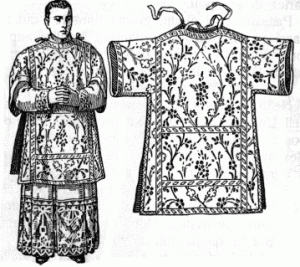 From a deacon….
QUAERITUR:
Is it your opinion that a deacon can use most of the blessings contained in the older form of the Ritual? I took this for granted during formation for diaconal ordination, and totally dismissed the Book of Blessings as a fundamentally impotent book. Just prior to Ordination I stumbled onto a blog that suggested that while deacons & priests can use the Book of Blessings, only priests can use the blessings in the older Ritual. This person stipulated that a Bishop would need to impart faculties for deacons to use the older Ritual for blessings.
During our formation the liturgical formator (who is general pretty solid and orthodox) suggested we bypass the Book of Blessings and use the older Ritual for blessings “if we indeed actually want something blessed”. Today a person asked me to bless their car after Mass, and I used the generic blessing in the Book of Blessings, chagrined! I know there is a blessing for that in the older book and it actually blesses the vehicle!
The new-fangled Book of Blessings (De Benedictionibus) is problematic. If you read the introduction, you find an attempt to change the theology and praxis of blessings, to eliminate the distinction between constitutive and invocative blessings. Effectively, it reduces all the blessings to invocative blessings. If memory serves there is only one blessing (one the options for a Rosary… the traditional prayer…) which actually blesses something. The prayers in the Book of Blessings call God’s blessing down on someone who might look at a sacred image, rather than bless the image itself.
That said, for what it’s worth, there 21 (I think I got that right) things in the Book of Blessings which deacons can bless. They include, medals, small crucifixes statues or pictures that will be displayed elsewhere than in a church or chapel, scapulars, rosaries, or other articles used in religious devotions. Deacons may bless rosaries. With this Novus Ordo book deacons may also bless holy water… well… “happy water”, but only outside the context of Holy Mass (obviously at Mass a priest is present). Deacons may bless private homes.
Deacons may NOT use most of the blessings in the older, traditional Rituale Romanum. The Rituale says that deacons may only bless things they are expressly allowed to bless. However, try to find one in the Rituale. There is no provision for a bishop to give a deacon the ability to bless things with the older Rituale.
So, I regret to say that deacons really cannot bless much, since there is but one constitutive blessing in the Book of Blessings and, I think, none in the Rituale Romanum.
Was there a GOOD point made in the sermon you heard at the Mass for your Sunday (obligation or none), either live or on the internet? Let us know what it was.
Too many people today are without good, strong preaching, to the detriment of all. Share the good stuff.
Also, are your churches opening up? What was attendance like?
In a lot of places the dispensation from Mass attendance was ended. Were your obliged to go.
For my part:

 In the older, traditional calendar of the Roman Rite, today is the 3rd Sunday after Pentecost.
Let’s have a look at the…
COLLECT (1962MR):
Protector in te sperantium, Deus, sine quo nihil est validum, nihil sanctum: multiplica super nos misericordiam tuam; ut, te rectore, te duce, sic transeamus per bona temporalia, ut non amittamus aeterna.
There is a pleasant alliteration in lines 2-3 of the collect. We can find a pair of pairs: nihil validum, nihil sanctum and some great ablative absolutes te rectore, te duce.
Where does this prayer really come from?
The first part, Protector in te sperantium deus, seems to be a fairly common introductory phrase in ancient Roman prayers. But after that, we find the whole prayer as it appears in the 1962MR in the Liber sacramentorum Gellonensis or Gellone Sacramentary, one of the Frankish “newer Gelasian” type sacramentaries, an attempt at a complete service book in the late 8th century, and in the Liber sacramentorum Romanae ecclesiae or Book of the Sacraments of the Church of Rome, which is another “Gelasian” type book. However, the snipping and pasting experts employed by the Council’s Consilium hacked off the end of the “Pian” edition’s ancient prayer and for the “Pauline” version of the Missale Romanum, glued on a chunk of another ancient prayer in the Veronese Sacramentary or Leonine Sacramentary or for good measure Codex sacramentorum vetus Romanae ecclesiae a sancto Leone papa I confectus, for the month of July, perhaps on the 13th of the month, and perhaps as part of a preface formula: Vere dignum: qui mutabilitatem nostram ad incommutabilia ita iustus et benignus erudis, ut nec fragilitatem destituas et coherceas insolentes: quo pariter instituti pia conversatione et caelestibus sacramentis, sic bonis praetereuntibus nunc utimur, ut iam possimus inherere perpetuis. They even tinkered with that.
Tinker tinker tinker!
In the Novus Ordo Missale this prayer – sort of – is used on the 17th Sunday of Ordinary Time.
COLLECT (2002MR):
Protector in te sperantium, Deus, sine quo nihil est validum, nihil sanctum: multiplica super nos misericordiam tuam; ut, te rectore, te duce, sic bonis transeuntibus nunc utamur, ut iam possimus inhaerere mansuris.
Many people don’t realize that very few of the prayers of the 1962 Missale made it into the Novus Ordo without alterations. Sometimes those alterations took the prayers back to an more ancient version. Mostly, they just fiddled around with them.
Let’s have some vocabulary.
Protector is, according to our always valid Lewis & Short Dictionary, from protego, meaning “to cover before, or in front, cover over” and obviously also “to shield from danger” as well as things like “put a protecting roof over”. Amitto is “to lose” in the sense of “let slip”. A Latin dux is a “leader, guide”, and also “commander, general-in-chief”. This is why Benito Mussolini was in Italian called “il Duce”. A rector is pretty much the same as the first sense of dux, but it can also be a “helmsman” or “governor”. Interestingly enough, gubernator means “helmsman” also, while an English “governor” is a moderator.
St. Andrew’s Bible Missal (1962):
O God, guardian of those who trust in you, without whom nothing is strong, nothing holy, increase your mercy towards us. With you as our ruler and guide, may we pass through the good things of this world, so as not to lose those of the world to come.
LITERAL VERSION (1962MR):
O God, protector of those hoping in You, without whom nothing is efficacious, nothing holy, multiply Your mercy upon us, so that, You being our guide and leader, we may pass through temporal goods in such a way that we do not lose the eternal.
We have the image of a people asking God to cover them over abundantly with mercy. We are acknowledging how we need a roof over our heads to protect us, so we want God’s mercy upon us. Also, since a protector is something or someone that covers us in front, God is our shield before us. In His mercy He guards us from the attacks we face as soldiers in the Church Militant.
We must never forget that we are members of the Church Militant, the part of the Church which is in the world, on the march, as a pilgrim people. We must be clear in our minds that the Lord says this world has its prince (cf. John 10:31 and 14:30). Satan and his fallen angels desire our everlasting damnation and agony with them in Hell. Jesus broke their power over us, but for a time we are still in this world which they dominate. We are living in a state of “already, but not yet.”
As soldiers, traveling through enemy territory, we need strong shields. We need a sure leader to set our feet on the right path out of the danger zone. We need a sturdy roof over us when we rest. We need some way to grasp what is holy and what is deception.
God is the one without whom nothing is worthwhile or holy. He must provide for us all that we need on the march.
Because of the wounds to our nature from the Fall, we are susceptible to the passing things of this world and vulnerable to the attacks of hell. We need shielding, protection, so that we are not overly mired or stained, lest we lose track of our pilgrim route to heaven.
LITERAL TRANSLATION (2002MR):
O God, protector of those believing in You, without whom nothing is efficacious, nothing holy, multiply Your mercy upon us, so that, You being our guide and leader, we may so use things that pass away as to be able to cleave to those that endure.
Notice the slightly different emphasis. This version also contrasts the passing things of this world with those that do not pass away. This version also stresses that we must cling to, or not let slip, eternal things, so that we lose heaven. However, whereas the older version seems to take a position of suspicion about the dangerous nature of worldly, temporal things, the newer version indicates that we use them correctly. The structure is ita with a result following in the subjunctive: in such a way that…. Lest anyone get their shift all in a twist about how the Novus Ordo version obviously reflects the dangerous modernism of the Second Vatican Council’s Constitution on the Church in the Modern World, Gaudium et spes, remember that the final two lines are also essentially from an ancient prayer. After all, our ancestors also were concerned actually to use the things of the world, which remain good. They are bona temporalia.
OBSOLETE ICEL (1973):
God our Father and protector, without you nothing is holy, nothing has value. Guide us to everlasting life by helping us to use wisely the blessings you have given to the world.
This is so bad that one might laugh, if it weren’t for the fact that God’s people were so cheated for so many years.
CURRENT ICEL (2011):
O God, protector of those who hope in you, without whom nothing has firm foundation, nothing is holy, bestow in abundance your mercy upon us and grant that, with you as our ruler and guide, we may use the good things that pass in such a way as to hold fast even now to those that ever endure.
Today I received a note about a priest who was, in effect, cancelled. Having been cleared of wrongdoing after a false accusation of molestation of a minor, after being cleared also by Rome, his bishop will not give him an assignment.
There are a quite a few priests right now who have been or are being cancelled. Believe me.
I also received word that a Coalition for Cancelled Priests has been formed.
Would that this had been formed some time ago.
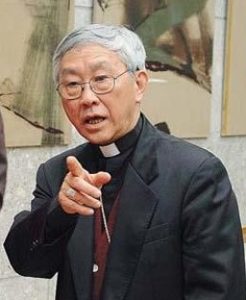 The great Joseph Card. Zen, Emeritus Bishop of Hong Kong and champion of our downtrodden brethren in China, has over the years been generous toward those who desire to participate at Holy Mass in the Vetus Ordo, the Traditional Latin Mass (TLM).
Card. Zen, at his website, made a comment about the rumors concerning a possible restriction of the provisions of Benedict XVI’s “emancipation proclamation” Summorum Pontificum.
Here is his conclusion:
The Tridentine Mass is not divisive; on the contrary, it unites us to our brothers and sisters of all ages, to the saints and martyrs of every time, to those who have fought for their faith and who have found in it inexhaustible spiritual nourishment.
Card. Zen is exactly right. The TLM is a powerful force for unity.
Participation at the TLM unites the faithful across borders, across cultures, across generations.
Zen understands from personal experience how regimes crush souls. He would recognize that which liberates.
It is not unreasonable to suppose that there is some draft of a document floating around in curial offices that pertains to the provisions of Benedict’s Motu Proprio Summorum Pontificum. The Motu Proprio has been hated since it was issued.
The very idea of an emancipation of the Traditional Roman Rite was viciously struggled against even back in the late 80’s and 90’s when something like Summorum was developed. It was crushed.
The opponents of Summorum know that people must not be allowed to be united “to our brothers and sisters of all ages”. They want the people of today isolated in this moment.
Consider, for example, how those who fought against a better translation of the Novus Ordo into English also often proposed that the translations should be under constant revision to reflect the ever changing style of people’s speech. Fathom that a moment, given the devolution of language into illiterate tweets and emojis.
Continuing with the analogy of the “emancipation proclamation”, could there be an analogous “Fugitive Slave Act of 1850” in the works? Of course. There have been and probably always will be attacks and rumors of attacks on Summorum Pontificum and its emancipating provisions.
The opponents of Summorum can’t stomach that people should be free to have the Traditional Mass. They must be forced back into line, into their chains. They fear the Catholic faithful who have been freed from the restrictions of the Novus Ordo. It isn’t just that they hate and fear the TLM. They hate and fear the people who want the TLM.
Will there be a restricting “Slave Act of 2021” against Benedict XVI’s emancipation?
While I don’t doubt that there is some sort of draft document – it would be naïve to think that the enemies of Summorum haven’t proposed something – I don’t think anything is going to happen. Not anything dramatic, at least. We must be careful not to glom on to rumors that are, in sum, unsubstantiated, unsourced, unconfirmed, and then let our imaginative powers sweep us into a maelstrom.
Whether there is a “Slave Act of 2021” in the works or not, the best response that we have is to redouble our efforts to bring the TLM to more and more places and to do so joyfully.
The best way to combat the foes of Catholic unity is to be happy. As a matter of fact, your obvious joy could be infectious.
The only people who are attracted to gloom are those who are happy only when they are unhappy.
Get to work!
 In the Novus Ordo calendar, today – the day after the Feast of the Sacred Heart of Jesus – is the Memorial of the Immaculate Heart of the Blessed Virgin Mary.
Before Mary conceived Our Lord beneath her heart, she conceived Him in her heart.
She began with her “Fiat!” to ponder – contemplate, inwardly gaze at – Him before His birth.
She gazed at and pondered Him after His birth.
She gazes at Him now.
Did you know that the hearts of mothers and their unborn babies tend to beat with synchronization?
Did you know that mothers and their babies hearts will swiftly synchronize when they smile at each other?
Imagine, for a moment, the smiles of Mary and Jesus as they regard each other. Try to picture that.
Their hearts beat as one.
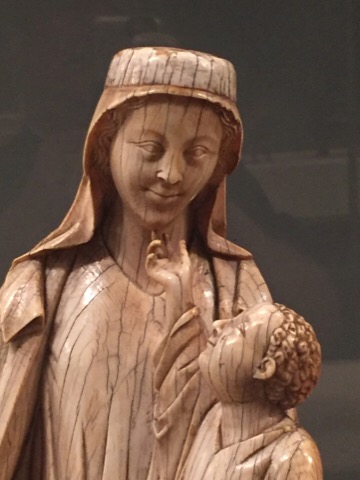
Oak, c. 1250-70, French, probably Parisian, in Met, NYC


Coat of Arms by D Burkart
 fac on A matter of grave concern: People who pray together before or after Mass.: “Wouldn’t praying various prayers together, or even one, after Mass be one of those so-called “organic developments” of the liturgy…”
 on WDTPRS – 21st Sunday after Pentecost: My strengths support yours. My sins weaken us all.: “Thank you for the hard work you do in “unpacking” all this and doing it every week. I wouldn’t have…”
 on A matter of grave concern: People who pray together before or after Mass.: “The fact the headline he chose for his letter is “St. Michael the Archangel, pray for us”…….. rude is a…”
 on A matter of grave concern: People who pray together before or after Mass.: “I again return to my hobby horse of questioning whether obedience to the bishop extends to prayers said outside of…”
 on A matter of grave concern: People who pray together before or after Mass.: “Unfortunately, the Catholic Church doesn’t have a “Prayer to St. Michael Problem”. The Catholic Church has a clerical homosexual problem…”
 on ROME 26/10– Day 16: Baronius… and traitors: “Caesar Baronius. His life story is fascinating. We have the same portrait of him in our basement.” on ASK FATHER: “Are the faithful who go to the SSPX being sacramentally forgiven in confession, or not?”: “@WVC and @Fr. Kelly: I really appreciate you taking the time to try to answer my questions. What I now…”
 on A matter of grave concern: People who pray together before or after Mass.: “Here again, it’s the consistency which is truly frightening. A truly random lot of attitudes and dispositions would not generate…”
A Daily Prayer for Priests








They find you a pro-life agent in your area who commits to giving a portion of the fee to a pro-life group!

PLEASE subscribe via PayPal if it is useful. Zelle and Wise are better, but PayPal is convenient.
A monthly subscription donation means I have steady income I can plan on. I put you my list of benefactors for whom I pray and for whom I often say Holy Mass.
In view of the rapidly changing challenges I now face, I would like to add more $10/month subscribers. Will you please help?
For a one time donation...



Help Monks in Wyoming (coffee – UPDATED LINK) and Norcia (beer) and the wonderful "Soap Sisters" of Summit, NJ!


Please follow me on Twitter!










Visits tracked by Statcounter
since Sat., 25 Nov. 2006: