ASK FATHER: Priest paraphrases the Gospel – GUEST RESPONSE: Pope Francis

I recently had a couple questions from a reader about a priest who regularly paraphrases the readings, especially the Gospel.  He asks how he should handle this problem: should he approach the priest?

It’s hard to know how to counsel him.  Of course the priest already knows that this is not to be done, but he does it anyway.  Hence, he’ll probably blow off a complaint.

I suppose that he could take a video of the priest doing this and share it with the bishop’s office.

That said, perhaps the priest in question is sufficiently impressed by Pope Francis to pay attention his recent 31 Jan 2018 Audience address –  English HERE.  I just listened to it.

The Pope said:

The liturgical proclamation of the same Readings, with the songs deduced from Sacred Scripture, expresses and fosters ecclesial communion, accompanying the path of each and all. One understands, therefore, why subjective choices, such as the omission of Readings or their substitution with non-biblical texts, are prohibited. I’ve heard that some, if there is news, read the newspaper, because it’s the news of the day. No! The Word of God is the Word of God! We can read the newspaper later, but there, the Word of God is read. It’s the Lord who speaks to us. To substitute that Word with other things, impoverishes and compromises the dialogue between God and His people in prayer.

I’d say that Pope Francis would not be pleased with paraphrasing the Gospel.

You might print out the whole of the address, highlight a few points, and give it to him.

Francis included right after that a rather amusing comment on bad readers at Mass.  At about 14:50 in the video.

“Look for good readers – eh? – who know how to read – no? – not those who read ‘myamyamyamya’ and you can’t understand anything.”

YouTube thumbnailYouTube icon

Also, note how many times he says “listen”.

Posted in "How To..." - Practical Notes, ASK FATHER Question Box, Liturgy Science Theatre 3000 | Tagged ,
Comments Off on ASK FATHER: Priest paraphrases the Gospel – GUEST RESPONSE: Pope Francis

ASK FATHER: Initial inquiry resources for priests who don’t know the Traditional Mass

From a reader…

QUAERITUR:

I work at a faithful parish with a wonderful faithful priest. He has told me that while he doesn’t plan to say the TLM he does want to learn more about it so that he can beautify the NO at the parish. Are there good books available that would aide in this for him. I also don’t want to be heavy handed in the matter. Thank you!

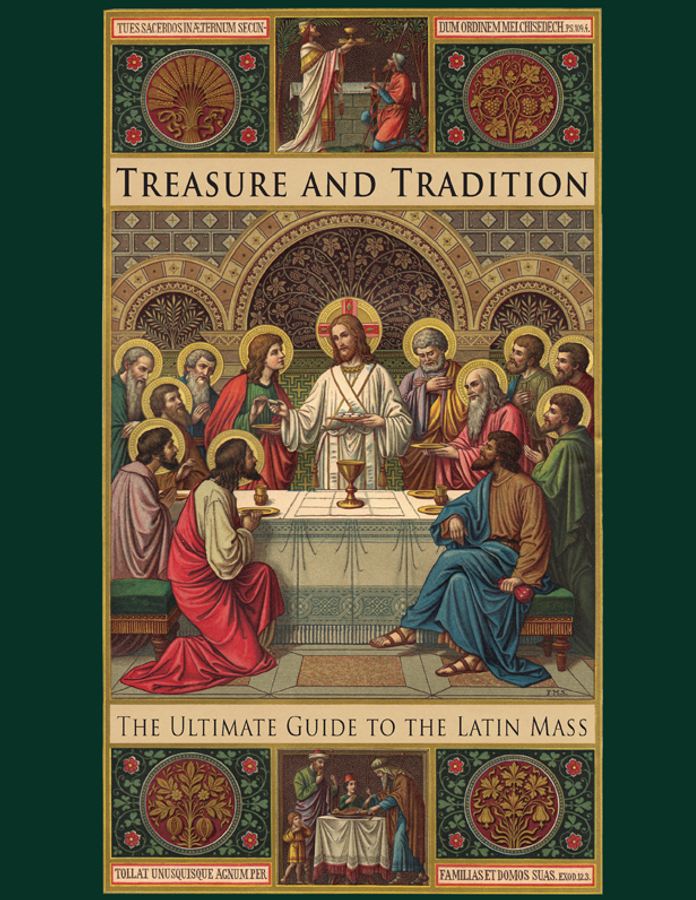
The first thing that occurred to me was the wonderful book by St. Augustine Academy Press.  There is always an ad for it on my right side bar.  It is beautiful and different age groups can benefit from it differently.

Treasure and Tradition: The Ultimate Guide To The Latin Mass

Posted in "How To..." - Practical Notes, ASK FATHER Question Box, Liturgy Science Theatre 3000 | Tagged
7 Comments

ASK FATHER: Why couldn’t priests and religious be godparents?

From a reader…

QUAERITUR:

Would you please comment on why the tradition (at least the 1917 code) was reluctant to permit clerics and religious to be Godparents? Any comment on it being done under the new code?

GUEST PRIEST RESPONSE – Fr. Tim Ferguson:

Prior to the 1983 Code, a priest could only serve as a godfather in a case of necessity and even then, only with the permission of the bishop.

The role of godparent was traditionally seen not only as an official witness to the baptismal act, but also as someone who would assist the parents in raising the children in the faith and, God forfend, step into the parental role if something should happen to the parents.

It’s clear why, until recently, a priest would not ordinarily take on such a role.

Now, canon law has de-emphasized the role of the godparent in providing direct, material assistance to the parents, and does not foresee that the godparents would take on direct parental roles upon the death of the parents.

The role of the baptismal sponsor is to witness the act, and to provide spiritual assistance to the baptized.

While it is now permissible for a priest to serve as a godparent, I think it is a worthwhile question to ask if it’s a good idea.

Does the priestly role mix well with the role of a godfather, or is a priest already serving as a spiritual father to his people? Just as biological parents cannot serve as baptismal sponsors, because their role as parents is already significant, is the role the priest serves one that might make serving as a godfather superfluous?

Now, it’s not forbidden by the Church, and, quod non prohibetur, licet. I’m sure there are a myriad of commentators who will cite situations where a priest has been marvelous as a godparent. There are also countless cases where a man serves as a godfather and then later is ordained. I still think it’s a worthwhile question to ask.

Posted in "How To..." - Practical Notes, ASK FATHER Question Box, Priests and Priesthood | Tagged
4 Comments

ASK FATHER: Can’t Father say things louder at Mass? We can’t hear.

From a reader…

QUAERITUR:

I know that certain parts are not, the secret etc. I am new to TLM. I live in ___ and do not have access to regular TLM, other than thru the computer (livemass.net). My diocesan priest does it once a month if able. My sons and husband do not connect to it because they have no idea where they are at in the mass because we cannot hear anything the priest says during the mass. I asked the priest if he would be able to speak louder or wear a microphone. He said that the rubrics say to speak so only the server can hear him. Is this true? If so, how do people follow along in big churches?

This is a great email.  It raises all sorts of issues. Let’s drill in.

First, just as I repeat until I am blue in the face to clerics: If you don’t know the TLM, you don’t really know the Roman Rite for which you have been ordained.  Lay people don’t have the same obligations as priests in this regard: to know the Roman Rite as they might. However, when we love something, and we should love our sacred liturgical worship, we should want to know more about it.  We are our rites.  They shape us.

This is an example of someone who doesn’t really know the Roman Rite, on the one hand, and who has – through no fault, mind you! – been conditioned to that thing that so typifies the Novus Ordo: the lowering of the Rite.

The older form and newer form are similar in some respects, but quite different in others.  Those differences are important.  However, I guarantee that once you begin to learn the older, traditional form more and more, then more and more you will understand about the newer rite!  Similarly, when priests learn the traditional form, it affects how they say Mass in the newer form.

And yet, people who are not yet familiar with the older form can become disoriented.

“I can’t hear what’s going on.”  “I can’t see.”  “I don’t know where they are.”

These are common remarks.  Sometimes they are complaints.

The Novus Ordo tends to shove everything at you and leave nothing unexposed.  The TLM tends to withhold some things so that you have to seek and wait within the gaps for the mystery that is taking place.  That’s really hard for many people today.  We are accustomed to having everything exposed.

Think about watching a baseball game where now you can see slo-motion of the stitches on the rotating ball.  Nothing is left to the imagination.

Once you are more accustomed to the older, traditional form, you will recognize the various gestures and signals that tell you where you are in the Mass.  However, Mass is not a didactic follow-the-bouncing-ball sing-along, either.  There are times when just being still, resting in the moment, are what we should and can do.  If you don’t know what Father is doing precisely at moment X, that’s okay.  You know what he is doing overall.  You are on Calvary.  You are in the Upper Room.  You are at the Tomb.

People think that they have to hear everything or see everything.  Instead, the genius of all the rites of all Churches are that they deprive the senses, to help you to encounter mystery.

On another line of thought, I sometimes with tongue in cheek say that the older Mass is like grown up food and the newer Mass is like baby food.  There’s nothing wrong with baby  food or with adult food.

Babies need to be feed.  “Open wiiiiiiide!  Here comes the airplaaaaaaane!  mmmnumnn mnuuum!”  You spoon feed stuff that doesn’t have to be chewed to junior.

Eventually, they awkwardly start holding their own spoon, with which they pound cheerios into oblivion.  Little frowns appear as they switch hands or look at how they hold it.

After that, harder food arrives with new teeth, but it has to be cut up.

You get my drift.   Having everything audible all the time, everything visible all the time, is like spoon feeding the blended carrots with choo-choo sounds.  That’s perfect for junior.  But junior grows.  Junior grows because of the baby-appropriate food.  Adults can eat that food too, but they won’t thrive on it.  They eventually need more complicated and satisfying food.  They don’t have to have things cut up for them.  It is a little demeaning to do that, as a matter of fact.

Even people who are deaf or blind can participate at Mass in a profound way.  We have to get beyond the mania of spoon-feeding and get into the heart of the Mass.

In any event, after a while, after more exposure, you will pick up on all the small signals whereby people for centuries have known what’s going on and how to follow.   Yep… they did this for centuries.  They weren’t that much smarter than we are.

Finally, microphones.   Oh dear.  They really are lethal to liturgy, aren’t they.   Artificial implication constantly ramming your ears so that you can’t have a natural experience of the liturgical moment.  No, no.  Thank God that you don’t have to have a microphone blaring everything at you.   Be grateful for the silence.  Be happy that the Church is confident in you.

Microphones are useful maybe for the sermon, but let the rest of Mass be natural.

And, yes, the rubrics do control the level of voice of the priest during the older form of Mass and – to a very curtailed extent – the newer.   Father must obey these rubrics.  Somethings you are not to hear.

But also remember that sometimes Father is not talking to you!

Lastly, “unveiling” things is a profound liturgical sign.  But you can’t unveil something that hasn’t in the first place been veiled.

Let there be veilings and unveilings in their due time.


Posted in "How To..." - Practical Notes, Liturgy Science Theatre 3000 | Tagged ,
27 Comments

NYC Days 4-5 and My View For Awhile: ESCAPE FROM NEW YORK!

One of the things I enjoy in NYC is a good bowl of borscht. It pleases in every way, especially in the color.

One of my errands was to La Lame to check on possible fabrics for the Pontifical sent in black that I am determined to make to replaced the …suboptimal but serviceable set we have now.

What I have been thinking about is a set from Gammarelli with a serious textile that would definitely provide for a “wow” effect.  However, my calculations, once I include several additional meters for a new pall, would push the fabric alone well past $15000.  (NB: I am open to a big donor!  I’ll have your name woven on labels and sown onto all the pieces of the set with a request for prayers for you or your designated intention.)

However, a La Lame we saw some good and possible items.

Nice, but not quite what I am looking for.

Frankly, I am torn between making a classical Roman set, or perhaps going in the direction of the English, Pugin look, with draping vestments, with wider galloons and bright, contrasting colors.

In any event, I had a probably providential meeting with someone who has brought me into contact with someone who can make to my design any fabric I want (jaquard damask) in pure silk or synthetic or a blend.  This could bring my cost for the project down and also provide a unique look and patter.

I was shown a “blanket” of one weave with three colors in their permutations.

This was pretty exciting.  I have been looking for someone to recreate or closely approximate the gold silk from which I made our first Pontifical set.   I haven’t been able to find any since.  These folks can make it!

Here’s the fabric I need to reproduce.

We would be able to make an antependium and gremial, etc., additional vestments to match.

I was told that they could recreate historic fabrics and patterns from photographs, etc.

In any event, my job is now a lot harder.  I have to think through more issues now.  I almost need someone to take over part of the design process.

Holy Mass is worth the effort, time and money.  We are doing our best.  DONATE!  It’s tax-deductible.

Meanwhile, as I considered our new options for vestments, I had some fish.

Speaking of going into the belly, last night I went with friends to – gulp – Jesuit-run Fordham for a “debate” between Ross Douthat of the NYT and ultra-lib Massimo “Beans” Faggioli.   Talk about being out of my element: that’s David Gibson of the hyper-progressivist RNS in the moderator chair and in the foreground, seated with lots of gray hair, is our old pal Phyllis Zagano!

Our escape to our supper reservation was delayed by an… a chat with the latter.

In any event, they said that the event was live streamed and will also be available online, by Salt and Light (just continue in the lib theme… I mean, really?  Jesuit-school, Jesuits in lay clothes in the audience (yes, you are recognizable), Beans, Gibson, RNS, Salt and Light,  Zagano…  but I escaped with my life, though I was a little rattled).

WATCH HERE

Make up your own minds, but I thought Bean’s constant downplaying of categories of “continuity and discontinuity” was incoherent and out of touch with reality.  Douthat diplomatically pointed that out, but didn’t make much of an impact.  Also, Faggioli introduced a few spectacular non sequiturs.  See if you can pick them out.  I was a little disappointed about Douthat’s answer about the possibility of deaconettes in the future.  However, when I went to greet him on our way out, he said as much: “I’ll bet you didn’t like my answer…”, etc.  I responded: “It’s never going to happen so it it’s a non-problem!”

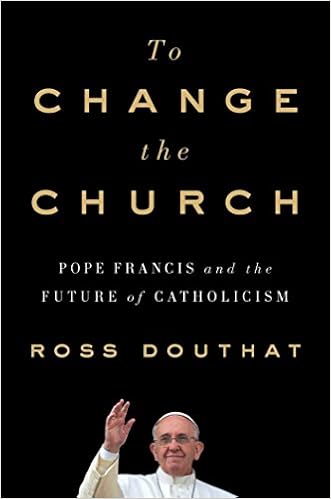
Douthat has a new book coming, which he is sending to me.  I look forward to it.

To Change the Church: Pope Francis and the Future of Catholicism (March 2018)

US HERE – UK HERE
This goes to the heart of the debates and controversies.  Some people are trying to change the Church through changing doctrine.   At the same time they are trying to convince us that nothing is changing.  That’s why they have to avoid discussion of continuity and discontinuity.

Also at the heart of the talk was the meaning of, reception of, effects of, future of the Second Vatican Council.  Faggioli’s notions about that were odd.  It don’t think he makes any sense.   You watch and comment in the combox.

And of course there was discussion of Amoris laetitia and its effects.

But when you pull off the mask, they’ve really got nothing except raw power and intimidation.

Remember: Libs will always… always… require you to deny reality.

All that after having been interviewed yesterday before the event by BuzzFeed.

It has been a good and productive trip.  Among other things, we had a meeting with some of the key players and organizers of a seriously top shelf pilgrimage to Southern Italy in April and May, which aims also to introduce serious people, Catholic and non-Catholic to am outstanding pro-life organization called Heartbeat International. I’ve been involved with them for a while and have found the people and their goals to be worthy of support and praise.  It’s not a flashy organization.  It does a huge amount of good behind the scenes, funding small projects and clinics.  Very smart, dedicated pro-life people.

For the pilgrimage I am taking along my wonderful portable altar from St. Joseph’s Apprentice and my new travel vestments, which are awaiting me at home – they arrived during this trip.  I’ll have them live and in person tonight, along with new pieces for the purple Pontifical set.

More on that later.

UPDATE

Off we go!

Posted in On the road, What Fr. Z is up to | Tagged , , ,
6 Comments

An homage to and book recommendation from a giant

I pick on and poke at Jesuits quite often in these electronic pages because when some weird, division prompting, discontinuous notion is proposed, there’s usually an “SJ” on it.   Along with German bishops in general and a token smattering of other of religious, scratch the surface of a faith eroding trend, and you’ll find Jesuits.

That said, I know some older – dare I add, much – Jesuits and a few younger guys who are simply outstanding.  They have my unreserved admiration for their faith and achievements.   The contrast with some of their bizarre brethren confirms the old adage: corruptio optimi pessima.

So, today I read with interest at CWR an homage of a young Jesuit for his older colleague, Fr. James Schall, SJ.   Fr. Schall probably needs no introduction for many of you.  However, even if you know him well, particularly if you do, you should read this whole thing.  Here, however, is a taste…


Saturdays with Father Schall: A young Jesuit on the older Jesuit’s 90th birthday

Father James V. Schall, SJ has been a source of encouragement to a younger generation of priests and scholars who are seeking to preserve a rich and much-needed intellectual patrimony.

A few years ago I met a Catholic publisher at a conference at the University of Notre Dame. I asked him why his company had invested so much in publishing Father Schall’s books. His answer was that Father Schall is a C.S. Lewis for our time. While I am not sure that Father Schall would consider himself another C.S. Lewis, there is, without a doubt, only one James V. Schall, SJ: a Jesuit priest, political theorist, philosopher, beloved teacher, and prolific writer.

Father Schall (born on January 20, 1928) just celebrated his 90th birthday at the Jesuit retirement center in Los Gatos, California.

[…]

A few years ago, George Weigel praised Father Schall as part of the generation of giants that emerged from the Catholic intellectual renaissance of the mid-20th century. Weigel posits that the most urgent question facing Catholic higher education today is how Catholicism “[got] great priests and teachers like Father Schall,” as the luminaries of that generation pass from the scene. Having spent many Saturdays with Father Schall, I often ponder whether or not my generation will be able to carry that much-needed torch. I once shared my thoughts about this with a newly ordained Jesuit priest and he rather cynically replied that my generation should not have any illusions about being able to fill the shoes of those giants. He believed that we don’t have the conditions which formed the intellectual greats of the past, such as a common intellectual patrimony rooted in the tradition of the West and well-established schools of philosophy and theology. [That’s a good summary of our devastated intellectual landscape.  I think it was purposely devastated in order all the more easily introduce modernism, etc., without resistance.]

Perhaps he is correct to think we will never see the emergence of such a generation again. But I have hope that my generation can carry the torch. One of the books that Father Schall recommended to me was A.D. Sertillanges’ classic book The Intellectual Life. Father Schall wrote:

I would put The Intellectual Life on the desk of every serious students and most of the unserious ones… Its very possession on our desk or shelves is a constant prod, a visible reminder to us that the intellectual life is not something alien, not something that we have no chance, in our way, to learn about.

In a nutshell, Sertillanges believes we can lead a rich intellectual life if we manage to keep one or two hours a day for the serious pursuit of higher things. Sertillanges does not ask us to give up our daily lives and devote ourselves full-time to the intellectual apostolate, like St. Thomas Aquinas did, but he teaches us to organize our lives so we can acquire a good intellectual foundation and spend the rest of our days building on this solid foundation. And so he teaches us about habits, about discipline, productivity, and truth. The bottom line is that Father Schall believes the book will have an abiding, concrete effect on those who read it; if we follow Sertillanges’ simple prescription, it will enable us to build an intellectual life.

[…]


Let me stop there.   One way to show appreciation for Schall and his work is to take his suggestions seriously.

The Intellectual Life: Its Spirit, Conditions, Methods

US HERE – UK HERE

Posted in "How To..." - Practical Notes, Fr. Z KUDOS, Our Catholic Identity | Tagged ,
2 Comments

Candlemas Eve and Candlemas Poetry

16_02_01 Presentation Bellini smToday is Candlemas Eve, and tomorrow is the Feast of the Purification.  We call it Candlemas because, with the references to light in the liturgy, we bless candles.

Here are some poems for Candlemass

First and foremost, making a reference to the removal of Christmas decorations…

Ceremony Upon Candlemas Eve
by Robert Herrick

Down with the rosemary, and so
Down with the bays and misletoe ;
Down with the holly, ivy, all,
Wherewith ye dress’d the Christmas Hall :
That so the superstitious find
No one least branch there left behind :
For look, how many leaves there be
Neglected, there (maids, trust to me)
So many goblins you shall see.

And the longer version of the same…

Down with the rosemary and bays,
Down with the mistletow;
Instead of holly now upraise
The greener box for show.

The holly hitherto did sway,
Let box now domineer,
Until the dancing Easter day,
Or Easter’s Eve appear.

Then youthful box which now hath grace
Your houses to renew,
Grown old, surrender must his place
Unto the crisped yew.

When yew is out, then birth comes in,
And many flowers beside,
Both of a fresh and fragrant kin,
To honour Whitsuntide.

Green rushes then, and sweetest bents,
With cooler oaken boughs,
Come in for comly ornaments,
To readorn the house.

Thus times do shift;
Each thing his turn doth hold;
New things succeed,
As former things grow old.

A Candlemas Dialogue

by Christina Georgina Rossetti (after 1891)

‘Love brought Me down: and cannot love make thee
Carol for joy to Me?
Hear cheerful robin carol from his tree,
Who owes not half to Me
I won for thee.’

‘Yea, Lord, I hear his carol’s wordless voice;
And well may he rejoice
Who hath not heard of death’s discordant noise.
So might I too rejoice
With such a voice.’

‘True, thou hast compassed death: but hast not thou
The tree of life’s own bough?
Am I not Life and Resurrection now?
My Cross, balm-bearing bough
For such as thou.’

‘Ah me, Thy Cross! – but that seems far away;
Thy Cradle-song to-day
I too would raise and worship Thee and pray:
Not empty, Lord, to-day
Send me away.’

‘If thou wilt not go empty, spend thy store;
And I will give thee more,
Yea, make thee ten times richer than before.
Give more and give yet more
Out of thy store.’

‘Because Thou givest me Thyself, I will
Thy blessed word fulfil,
Give with both hands, and hoard by giving still:
Thy pleasure to fulfil,
And work Thy Will.’

Mary’s Purification

Sr. M. Bernetta, O.S.F. Robert, Cyril. Our Lady’s Praise In Poetry.
Poughkeepsie, New York: Marist Press, 1944.

Out went the stupid to wash the snow,
To cleanse the lily of Christ.
Wouldn’t you think that they all should know
The pearl who couldn’t be priced?
Wiser to purify the crystal stone,
To call the tulip unclean,
Than to wash the rose that God’s hand had sown,
Young Mary, the innocent Queen.

Candlemas

Francesca Franciscan Magazine – February 1960

The Mother brings her Candle
To the Temple of Desire,
In wax of flesh and weakness
But soul-wick full of fire!
A light to pierce the darkness,
Redemption for our race,
The gift of expiation
Before our Father’s face!
A flame of contradiction
To tyrant, Gentile, Jew,
But holocaust for ages,
Each dawn will see anew!
O take your Candle, Mary,
Too soon you’ll suffer loss
In Love’s great conflagration
On the altar of the Cross!

Posted in Liturgy Science Theatre 3000, Poetry | Tagged ,
3 Comments

14 ‘c’atholic Senators SUPPORT ABORTION past 20 weeks

Canonist Ed Peters has picked up on something Fr. Longenecker has done.   I’ll add my voice.

From Peters’ excelleny canon law blog In The Light Of The Law.

About those Bloody 14 [allow me slightly to change the format, for effect]

  • Cantwell (WA);
  • Collins (ME);
  • Durbin (IL);
  • Gilibrand (NY);
  • Heitkamp (ND);
  • Kaine (VA);
  • Leahy (VT);
  • Markey (MA);
  • Cortez Masto (NV);
  • McCaskill (MO);
  • Menendez (NJ);
  • Murkowski (AK);
  • Murray (WA); and
  • Reed (RI).

Fr. Dwight Longenecker is right  that the fourteen Catholic senators named above who voted to prevent the government from protecting pre-born babies from the savagery of abortion have, by just this one vote (and not counting the long string of similar steps that most of these fourteen have taken before), committed a grievous moral offense. By any objective measure they have each placed their souls in mortal jeopardy. [Do I hear an “Amen!”?]

Longenecker’s call for the fourteen to be named and held accountable by earthly means (if only to lessen the accounting they will surely owe at Judgment) is an exercise of his canonical right and probably even the duty as a member of the Christian faithful to make known his views on matters that pertain to the good of the Church—and the scandal given by prominent Catholics acting as they did here surely impacts the good of the Church (CCC 2284)—and to communicate his views to others in the Church (Canon 212 § 3).

Except to explicitate what Longenecker the priest takes for granted (but we laity need to be reminded of), that we should pray for each senator by name, we should pursue what steps the legal, political, and ecclesiastical system provides for such sad scenarios.

But, about that ecclesiastical redress, [NB] two qualifications to Longenecker’s call need to be offered.

First, as has been explained many times, the hideous deed committed by the Bloody 14 is not, standing alone, a crime under canon law and, even if combined with other such acts as many of the Bloody 14 have taken, is not a crime for which excommunication is the penalty (Canon 1369). Specifically, voting pro-abortion is not ‘procuring an abortion’ for purposes of Canon 1398 and so no excommunication for procuring abortion applies in response to voting for it. [for “procuring”] Catholics contacting chanceries and demanding excommunications, therefore, will be noted on the “Uninformed Critics” list and comfortably ignored—this time, with some reason.

Second, a single act, again, no matter how objectively gravely sinful it is, does not trigger the duty of Catholic ministers to withhold holy Communion under Canon 915 which canon operates in the face of obstinate perseverance in manifest grave sin. Catholics contacting chanceries and demanding the withholding of holy Communion, therefore, will be noted on the “They Are on to Something but have Jumped the Gun” list and un-comfortably ignored—though again with some reason. [However, if there is a consistent pattern, that’s another matter.]

So, what to do?

Well, do exactly what Longenecker recommends in the legal and political sphere (for that matter, in the social sphere as well), lovingly shame the Bloody 14 into realizating what they have done and, please God, into personal and public repentance of it.

About excommunication, one may of course petition Rome (or local bishops) to designate political acts such as these as canonical crimes punishable by excommunication. I think there are major obstacles to such legislation but I (and other experts, I am sure) would certainly be willing to weigh in on the possibility.

About the withholding of holy Communion, this, I have said many times, urgently needs to implemented, but not in response to a single act (for that theory is canonically doomed to failure), but rather in response to a demonstrable string of such acts taken by most of the Bloody 14 (and several others, Nancy Pelosi leaping to mind). Here, unlike the excommunication idea above, the law is already in place (Canon 915), it just needs to be applied—correctly of course, but that is not a problem in many of these cases.

The Bloody 14 case might just trigger the long-overdue application of the law.

Finally, a personal observation? The repeated, though for now misguided, calls for excommunication in these cases, and the repeated, but worth-considering, calls for withholding holy Communion in these cases share this: they spring almost completely from Catholic laity and are almost completely ignored by ecclesiastical leadership. This almost total, multi-decade disconnect between people and pastors is source of serious tension in the Church. Pray that such tension is relieved before it erupts into even more serious problems.

What could lay people do – within the bounds of charity, always – to get a hearing and action from their pastors?

Posted in Canon Law, Emanations from Penumbras | Tagged , , ,
37 Comments

NYC Days 1-3: Slips and sliders

People either like or hate my food posts. Hence, I enjoy posting them.

But first, as I watch what’s going on in the Church right now, two paintings at the MET jumped to my full attention.

First, my necessary entrance hotdog. The cart in front of the Met has great hotdogs, and the proceedes go to a wounded Marine. Tell them Fr. Z sent you.

Here is a portrait of a German merchant of the Hanseatic League by the amazing Hans Holbein.

Look at everything in the frame.

Did you see the slip of paper in the book?  It sports the words which might have been a moto of the sitter.  It’s a line in Latin from Terence’s Andria.

Veritas odium parit.

Truth breeds hatred.

Today, if people speak about about real problems of ambiguity and confusion being caused in the Church these days, they get terrible blowback.  Certain libs pour out their venom on the those who insist that mercy cannot be extended at the expense of the truth.  Truth and mercy must go hand in hand.

And another portrait by Holbein of another well-to-do merchant.

He, too, has papers.  I’m interested in the one at his elbow.

This one has a line from the Aeneid: Olim meminisse iuvabit.  This is just enough of a famous line that everyone would know.  When Aeneas et al. are shipwrecked, he utters: “Forsan et haec olim meminisse juvabit… perhaps someday remembering these things will give you joy.” 

That is to say:  Things are really bad now, but someday in the future we will look back on these events and will be able to find the good in them and how they were, ultimately, of benefit.

Going on.  Brueghel’s great summer harvest painting has people eating.

Carpeaux’s magnificent marble of imprisoned and starving Ugolino, as he is faced with the horror of eating his own children.

Corned beef and Pastrami from the 2nd Avenue Deli.   It was good…. but… I must admit that I’ve had better.

That was a fun experience, by the way.  I went to the Deli with a cop on the NYPD who is fairly high in the ranks.   He remarked that it was like a joke: “So, … ‘dis cop an’ a priest walk into a Jewish Deli….”  Indeed we were the focus of the attention of many tables.  A couple of very Jewish families with little kids came over to say hello when they were finished and departing.  Delightful.   A good moment of public relations, too.

Last night a priest friend and a couple went to supper and started with sea critters.  The oysters were great.

So, I’ve been ticking off my errands and visiting some new and old dining places and seeing friends.

And today I made an interesting BREAKTHROUGH on the VESTMENT front!  Stay tuned.


Posted in On the road, What Fr. Z is up to |
15 Comments

ASK FATHER: Visiting retired, elderly priests

From a reader..

QUAERITUR:

I have a particular devotion to the Priesthood and priests and would like to start visiting retired priests who are no longer able to live in residence in a rectory and have had to move on into the nursing home for priests this Lent. There’s a bit of a problem, though. I’ve never visited elderly people, let alone elderly retired priests who likely don’t have much longer in this world. I’m also an introvert and not particularly great at making small talk with strangers, and notoriously great at saying the wrong thing at the wrong time, or saying something that sounds great in my head, but comes out completely wrong or gets misinterpreted and somehow offends someone. As a result, I’ve always shied away from this kind of work and stuck to cleaning priests’ bathrooms.

Do you (or your readership who may have done this before) have any practical advice or tips for going about doing this?

This is a good thing.  Thanks for thinking about this.  Many priests are pretty much alone in their lives, even though they are surrounded by people.  That gets worse as they get older.  I suspect that that is what awaits me, as a matter of fact, given my circumstances.

Every individual situation is going to present different issues.   Sometimes just being there is good enough.  Sometimes conversation is what is needed.  Some people are talkers and some listeners.   You’ll have to figure it out as you go.

It may be that some priests will tell stories about decades past, which could be pretty interesting.  They have lore about the diocese that will be lost with their passing.  Seminarians, too, should listen to the stories old priests tell.   Sometimes I think that, with their consent of course, their stories should be recorded.

It may be that Father has a hard time talking, but he can listen.  Perhaps he has a hard time reading. You could read aloud to him.

Visit and assess.  Talk to the people taking care of him or who know him well.  Figure it out.

You have your own inclinations, you write above.  However, remember that true charity involves sacrificing one’s own inclinations for what is truly good for the other.

Posted in "How To..." - Practical Notes, Priests and Priesthood | Tagged
12 Comments