The Exequies for @BishopMorlino in @MadisonDiocese

Last night I attended a Vespers service held to pray for the soul of Bp. Morlino. A former Vicar General of Madison, now Bp. of Sioux Falls, Most Rev. Paul J. Swain presided and preached. There were many people whom I recognized from out of town in a packed chapel.

It was consoling to see that the diocese availed itself of vestments, candles, and so forth, from the Tridentine Mass Society of the Diocese of Madison.  It is a great honor.  You readers who have contributed to the TMSM helped and were part of it.

Today we go to a large parish for the funeral.  Again vestments of the TMSM will be used, and, again, those of you who have contributed to our projects are morally present.

Please say a prayer for the soul of Bp. Morlino and for those who must choose a successor.

Also, the funeral will be broadcast LIVE on EWTN.  Perhaps you readers can post links to watch it online.

This is an important moment for the Church in these USA. 

I strongly recommend a sound examination of conscience and good confession.

We are in turbulent spiritual times marked but clear markers.

Posted in ACTION ITEM!, Four Last Things | Tagged
13 Comments

And now a message from fictional priest Fr. Charles “Chuck” O’Malley

Now that I am at home and banged up, instead of on the road and banged up (that was not fun), I think I have some good evening viewing lined up.

There is a great article at The Catholic Sun about the late actor Bing Crosby and his playing of movie priest Fr. O’Malley in Going My Way (US HERE – UK HERE) and The Bells of St Mary’s (US HERE – UK HERE).

The article was occasioned by a second book by Gary Giddins; Bing Crosby, Swinging on a Star, Vol. 2: The War Years, 1940-1946 (US HERE – UK HERE).

Quotes:

As emblematic of the war years as Atticus Finch was to the civil rights era (and inspiring seminarians much as Atticus did law students), O’Malley represented a righteousness people could feel and believe in.

and

Early in 1946, Crosby, in New York, visited the city’s archbishop, Cardinal Francis J. Spellman, the powerful “antipode of Father O’Malley,” as Giddins calls him. Crosby wanted to discuss a possible split from his wife, Dixie, whose alcoholism had grown worse. At the time, he was considering marrying the actress Joan Caulfield.

“The visit to Spellman,” Giddins writes, “was seen by her family as evidence of his intentions. If he expected an ecclesiastical solution, he was disappointed. In the account he gave of the meeting, as remembered by (Joan’s sister) Betty Caulfield, ‘Cardinal Spellman said, “Bing, you are Father O’Malley and under no circumstances can Father O’Malley get a divorce.’” Betty added, ‘I think that was the beginning of the end for Joan and Bing.’”

On a personal note, my grandmother, long widowed, in her 80’s married an old widower and converted to Catholicism.  She took to it right away, getting involved in the parish, singing in the choir, saying the Rosary each night with her new old husband, Joe.   As it turns out Joe and Bing were childhood friends growing up in Spokane, WA, though education at Gonzaga.  They kept in touch.

This comes in the context of my catching up on news, including the death of Pres. George HW Bush, arguably one of most honorable and admirable civil servants of the last century.

Fr. O’Malley may have been fictional, but he nevertheless represents something which has seemingly been lost.  Something of that same something is woven through the life of Bush 41.

We’re losing it.   Can we regain it?  Perhaps not without great suffering.

Posted in Just Too Cool, The future and our choices | Tagged
26 Comments

My View For Awhile: Au revoir Edition

Bye, Paris.

Thanks to readers for help with the better seat.

Posted in SESSIUNCULA |
9 Comments

ASK FATHER: Why should a Protestant convert and join the Catholic Church?

From a reader…

QUAERITUR:

Why should a Protestant like me convert and join the Catholic church, given the current corruption that appears to reach all the way to the top?

(This is not an idle question. I was ready to call a priest and learn more, just before the recent scandal broke.)

I get it.  I really do.  I am a convert and those times when I came into the Church were also troubling.  They have been for a while.  As a matter of fact, there has been controversy swirling in and around the Church since the moment Our Lord’s feet disappeared into the heavens at his Ascension.

First, remember that the Church was founded for sinners.  Therefore, let’s not be surprised when we find that the Church is filled with sinners, at every level.

Second, remember that the Devil hates the Church.  The Enemy attacks relentlessly.  It is a good strategy to strike high, strike the shepherds so that the sheep will scatter.  It should shock us but not at all surprise us that there are corrupt clergy and lay people in the Church at every level.   The attacks on the Church are, themselves, proofs that she is who she says she is.

Third, the fact that there is corruption or incompetence in the Church, and that the Church  has always prevailed and moved forward in the Lord’s mission is a sign that this, the Catholic Church, truly is the Church that Christ founded.  Left to us, we would destroy it.  The continuance of the Church demonstrates God’s favor and grace and protection, even from us.

There is no better place to be than in the Church that Christ Himself founded.  The faults of individuals disgust and demoralize from time to time, but they  are not “the Church”.  The Church is, truly, the spotless bride of Christ.  God’s love for us is so great that He entrusts His Church to us little sinful mortals as we muddle along.

If you believe in Christ’s promises and in the Church true claims – as they really are, and not at the fools, libs, modernists, liars and confused distort them for their worldly objectives – then there is no where else that we can be.  We must be Catholics in the Catholic Church.  And if we, knowing the claims of the Church and Christ’s promises, knowing that this is Christ’s Church, fail to enter her embrace or determine to leave it, we put our salvation in peril, because, in rejecting the truth, we reject our Lord Himself.

Great spiritual gain (membership in the Church) comes at a cost.   There is always a cost.   For some it is giving up a known community.  For others it is giving up comfort.  For others it is giving up customs or other matters.   There is always a cost.

The benefits, however, are abundant, if not always immediately comfortable.

Crises come and go.  The Catholic Church was founded by Christ.  And, given that truth, there is no place else we can be.

Posted in "How To..." - Practical Notes, ASK FATHER Question Box, Hard-Identity Catholicism, Our Catholic Identity | Tagged ,
16 Comments

Francis: Homosexuals “should not be accepted into the ministry or consecrated life.”

Aciprensa has it.  HERE

The UK’s (and now US’s) best Catholic weekly has it.  HERE

Francis made a book/interview which will be released next week.  A sample has been released.

In the sample we find that Francis says that pastoral care must be given to homosexuals, but that they should not be admitted to formation as religious or as priests.

“But FATHER! But FATHER!”, some of you are howling, “You are NOT reporting accurately.   There have to be… nuances… subtleties… complexities and refinements.  There must be…rainbows and bridges and…”

NO.  That’s what Francis said.  Read:

Francis warned. “It’s [Homosexuality is] not just an expression of an affection. In consecrated and priestly life, there’s no room for that kind of affection. [Even in the Jesuits?] Therefore, the Church recommends that people with that kind of ingrained tendency should not be accepted into the ministry or consecrated life. The ministry or the consecrated life is not his place.”  [Or her.]

We “have to urge homosexual priests, and men and women religious to live celibacy with integrity, and above all, that they be impeccably responsible, trying to never scandalize either their communities or the faithful holy people of God by living a double life. It’s better for them to leave the ministry or the consecrated life rather than to live a double life.[He is talking about active homosexuality.]

The pope was asked in the book if there are limits to what can be tolerated in formation.

“Of course. When there are candidates with neurosis, marked imbalances, difficult to channel not even with therapeutic help, [So, here he seems to put homosexuality in with other disorders.  Rightly so.] they shouldn’t be accepted to either the priesthood or the religious life, They should be helped to take another direction, but they should not be abandoned. They should be guided, but they should not be admitted. [Third time!] Let us always bear in mind that they are persons who are going to live in the service of the Church, of the Christian community, of the people of God. Let’s not forget that perspective. We have to care for them so they are psychologically and affectively healthy,” the pope replied.

That seems to settle that.

Remember: Priesthood and religious life are not rights.  No one has the right to be a priest or religious.

Posted in Sin That Cries To Heaven | Tagged ,
25 Comments

ASK FATHER: Recourse to the Pontifical Commission “Ecclesia Dei”

From a reader…

QUAERITUR:

Recently, our stable group of roughly 50 people took the extraordinary step of asking our bishop for a regular celebration of the EF, having already spoken to the pastor of the parish. He responded in the negative. How do we go about appealing to the PCED? Any recommendations?

You should send all the accumulated correspondence to the Pontifical Commission.  I have tips for writing to bishops and offices and such on the lower menus, waaaay at the bottom of the blog.  HERE

A couple things are not clear here.  Pardon if I get right to the point.

I assume you spoke to the pastor, as a group, and he said “yes”.  Then WHY OH WHY go to the bishop?

Summorum Pontificum leaves this in the hands of the pastor of the parish.

If the pastor said “yes”, he does not need permission from the bishop.

One of these days, this will sink in. It’s only been 11 YEARS.

On the other hand, if the pastor said “no” (I can’t tell from the email) and then the “bishop” said “no”, then, yes, writing to the PCED is the last resort.

However, either way, you should persevere, making the request in ever larger numbers of people who actually participate in the life of the parish.   Let me make that point again: who actually participate in the life of the parish.  Get people on board who are involved, who are known.  Make yourselves available.  Be cheerfully relentless.

Anyway… people…. PLEASE TRY TO GET THIS INTO YOUR HEADS.

Art. 5, § 1. In paroeciis, ubi coetus fidelium traditioni liturgicae antecedenti adhaerentium stabiliter exsistit, parochus eorum petitiones ad celebrandam sanctam Missam iuxta ritum Missalis Romani anno 1962 editi, libenter suscipiat. Ipse videat ut harmonice concordetur bonum horum fidelium cum ordinaria paroeciae pastorali cura, sub Episcopi regimine ad normam canonis 392, discordiam vitando et totius Ecclesiae unitatem fovendo.

Art. 5, § 1.  In parishes, where there is stably present a group of the faithful attached to the previous liturgical tradition, let the pastor willingly receive their petitions that Mass be celebrated according to the Rite of the Missale Romanum issued in 1962.  Let him see to it that the good of these faithful be harmoniously brought into accord with the ordinary pastoral care of the parish, under the governance of the Bishop according to canon 392, by avoiding discord and by fostering the unity of the whole Church.

It’s the pastor.  And the bishop cannot say the pastor cannot decide, because the bishop cannot override the legislation of the Supreme Pontiff.

The bishop can, with a raw exercise of unjust power crucify the priest who obeys this law, but that is another tale for another time.


Posted in "How To..." - Practical Notes, ASK FATHER Question Box, SUMMORUM PONTIFICUM | Tagged
9 Comments

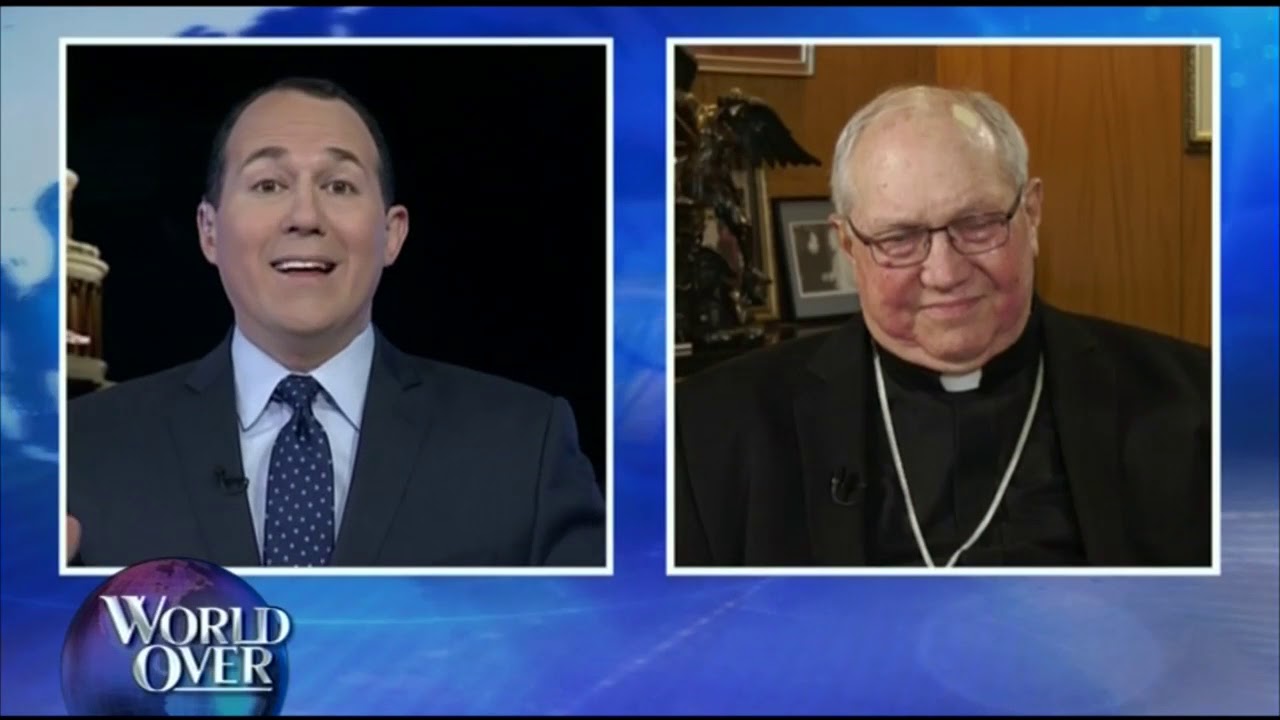
EWTN World Over @worldoverdc tribute to @BishopMorlino

EWTN on Raymond Arroyo’s The World Over has a tribute to Bp Morlino.

YouTube thumbnailYouTube icon

Posted in SESSIUNCULA | Tagged , ,
1 Comment

An important moment for the US Church in the USA, in light of The Present Crisis.

I will keep saying it.

The passing and replacement of Bp. Robert Morlino is an important moment for the Church in the USA, particularly in light of The Present Crisis.

The Diocese of Madison has a page with links to some personal notes about the bishop.  HERE  The list is growing.  So far…

Personal Remembrances

Among these, the contribution of Kevin Phalen has a telling anecdote about the oath bishops must take, which I also treated HERE.

However, today I what Joseph Pearce wrote.   He, as you may know, is the author of Literary Converts (my favorite of his US HERE – UK HERE free UK delivery at the time of this writing) as well as a good book on Shakespeare and his Catholicism (US HERE – UK HERE).   Something of Pearce’s recollection of Bp. M.  What this tale reveals is a) something of the landscape of the diocese which had been entrusted to the bishop and b) how he worked the landscape, and c) his personal style.

Memories of My Friendship With Bishop Morlino
Bishop Robert C. Morlino was a courageous crusader for all that is good, true and beautiful

The Church in the United States has lost one of its most courageous leaders. Bishop Robert C. Morlino, late of the Diocese of Madison, who died suddenly and unexpectedly last week, was someone whom I admired greatly for his sanity and sanctity and someone whom I had the privilege to serve.

Several years ago I was invited by Bishop Morlino to lead a retreat for the priests of his diocese. I was honored to receive the introduction and excited at the prospect of meeting the bishop himself in person. He asked if I might speak on the evangelizing power of beauty and what might be called cultural apologetics. He was keen that the priests of his diocese should understand the importance of beauty in the struggle to win souls for Christ in an age of ugliness and relativism.  [This was a major theme for the bishop over several years.  It was part of his liturgical vision as well.  All of a piece.]

At his behest, I spoke of the good, the true and the beautiful as being a reflection of the Trinity, inseparable, coequal and yet mystically distinct. The good was the way of virtue or love; the true was the way of reason; the beautiful was the way of creation. In an age which had corrupted the meaning of love, removing its rational and self-sacrificial heart and replacing it with narcissistic feeling, and in an age which had corrupted reason to something merely relative and devoid of objectivity, the power of beauty to evangelize was more important than ever. I spoke of the power of a sunrise to raise the heart and the mind to God, echoing the words of the poet Gerard Manley Hopkins that the world is charged with the grandeur of God. I spoke also of the power of human creativity to partake of the creative power of God in the making of great works of art, such as St. Peter’s Basilica or Michelangelo’s pieta, which also raised the heart and mind to God. Such beauty could reach the most hardened of hearts.  [Pretty good, right?]

Bishop Morlino was delighted with my presentation but I was a little disturbed by the reaction of some of his priests. Although all the priests of the diocese were expected to attend, about half of them failed to show. Some of these absentees might have had very good reasons for their non-attendance; others, however, had simply treated the bishop’s invitation and his expectation with indifference or resistance. Equally disturbing was the relative indifference or even sullen resistance of half of those in attendance. In all my years of giving talks to Catholic audiences, at parishes, conferences, colleges, high schools and other venues, I had never met with such negativity. I was not heckled, of course, but the lack of enthusiasm was palpable. About half of those in attendance were clearly there against their will, dragging their cognitive heels, and waiting for the ordeal to be over. These beat a hasty retreat as soon as the formal part of the proceedings were over, failing to attend the reception and convivium that followed. [NB] It was only then that I had the great pleasure of speaking with the happy remnant who were on fire with the faith and shared their bishop’s fervor. I couldn’t help but notice that these were the younger priests of the diocese, signaling that the future was in good hands.  [As the Biological Solution continues is grinding on all sides, this is an important observation.  Bp. Morlino ordained 40 men during his tenure.  This will have a huge impact on the diocese in the future.]

As I returned home, I felt deeply for Bishop Morlino and the thankless task that he and other courageous bishops faced. He and his faithful confreres had spoken out against modernism, against the culture of corruption that had manifested itself so sickeningly in the sex abuse scandal, and against the culture of active homosexuality which spurns the very concept of chastity. In return, they are met with indifference, resentment and even open hostility and rebellion. Bishop Morlino was one of those few, those happy few, those band of brothers, who fought the good fight when so many of his brother bishops were doing nothing or in some cases worse than nothing.  [Hence, his passing and replacement is an important moment in the US Church.]

Before I left, the bishop gave me his personal phone number, telling me to phone him whenever I liked. A friendship was born, albeit one which would never again bring us together in the flesh. It was, however, good to know that the Diocese of Madison was in such good and vigilant hands and that there was a corner of God’s vineyard that was being well-tended. How shocked I was to hear of his sudden death, and how I grieved for his flock. A good and holy shepherd had been lost. A true and courageous soldier of Christ had fallen in the midst of battle. And yet — and here’s the good news that vanquishes all shadows of grief — a good and worthy servant had gone to receive his heavenly reward.

In truth, we have not lost Bishop Morlino. He is not lost to us. He is in a better position than ever to help us and to help the beleaguered Church that he served so faithfully. He is in the company of the saints and in the Presence of God. He can hear us. He can help us. He can intercede for us.

Bishop Morlino, courageous crusader for all that is good, true and beautiful, pray for us that we might be given the courage to fight as you fought in this life that we may be happy with you forever in the glories of the life to come. Amen!

Posted in The Coming Storm, The Drill, The future and our choices | Tagged
7 Comments

ASK FATHER: Communion, kneeling on the tongue

From a reader…

QUAERITUR:

I regularly receive Holy Communion kneeling (on the floor) at my OF-only parish. My pastor has asked me a few times not to do that, though not forcefully – he’s never unkind about it or actually telling me to stop (rather just suggesting I don’t), but I know it bothers him. He’s concerned about me appearing “in opposition” to the bishops and the norms of receiving communion. There is so much confusion around this. Can you point me to something tangible that lays out norms for receiving communion? On the hand is an abuse that’s been normalized, on the tongue is ok, kneeling on the tongue is…? Just want clarity and document-support!

“kneeling on the tongue is…?”

… really uncomfortable.

Yes, kneeling on the tongue for receiving is a rare but effective penitential practice going wayyyy back.  I don’t know how far back, but wayyyy back.  There are secret manuscripts hidden away in secret places with directions on how to get that extreme tongue stretch.

Mastery of kneeling on the tongue for Communion sometimes goes tongue in cheek… ummm… cheek by jowl… with proper liturgical Beretta use.

There are any number of documents that cover how to receive.  In most places, the option to receive on the hand is, alas, a licit option in the Ordinary Form.  However, the document most pertinent to your situation is the CDW document, very much in force and issued in forma specifica, called Redemptionis Sacramentum.  RS secures the rights of Catholics to receive Holy Communion directly on the tongue, while kneeling (par. 90-92).  You must not be prohibited from receiving on the tongue while standing or kneeling.

In the Extraordinary Form, Communion is not to be given on the hand.

It is always a good idea to examine your conscience when it comes to doing something that is outside the norm where you are.  Are you looking for attention?  Are you simply trying to be reverent?   Are you trying to set an example?   What’s your motive? The moment of Communion isn’t about how great we look at doing it.  You don’t have to write back – I’m just putting it out there as a point of examination.

I don’t know your priest, of course.  Perhaps you have engaged him in an amicable conversation.

Lastly, you could go to a parish where you won’t be hassled for receiving like a normal, believing Catholic.

BTW… I think that people should kneel to receive and that they should receive directly on the tongue.   Moreover, we should get rid of Communion in the hand as soon as possible.

Lastly, commas can be important.

Posted in "How To..." - Practical Notes, ASK FATHER Question Box, Lighter fare, Liturgy Science Theatre 3000 | Tagged
20 Comments

4 Dec: @BishopMorlino funeral broadcast on EWTN

The passing of Bp. Morlino – and the naming of his successor – is an important moment for the Church in the USA, particularly in light of The Present Crisis.

There has been quite a bit of even international coverage of his passing.

Now I learn from a Tweet…

It seems that others consider Bp. Morlino’s death and the choice of his successor – especially in the present context of crisis – to be a watershed.

Posted in The Coming Storm, The Drill, The future and our choices | Tagged ,
3 Comments