ROME 25/4– Day 26:

We’ve broken the 06:00 barrier for sunrise by 1 minute. Sunset is at 20:16.

The Ave Maria Bell: 20:30

We are 125 days into the year.

Welcome registrants:

ducinaltum333
fruitcrmble@*******.net
WolfendenP

Please remember me when shopping online and use my affiliate links.  US HERE – UK HERE  WHY?  This helps to pay for health insurance (massively hiked for this new year of surprises), utilities, groceries, etc..  At no extra cost, you provide help for which I am grateful.

Explain this one!   (For those of you not familiar with chess notation, !! means “brilliant”.)

Here’s a lovely French ciborium.

Not too shabby.

On the Via dei Cappellari.   I mentioned this in a short video sent to Roman donors.

Note the “mondezzaro” sign on the left.   Here is the text.

SI PROHIBISCE ESPRESSAMENTE À QVALSIVOGLIA
PERSONA DI GETTARE NE TAMPOCO FAR GETTARE NE FAR
PORTARE IMMONDEZZA DI SORTE ALCVNA VICINO INTORNO
NE SOTTO AL PRESENTE ARCO SOTTO PENA DI SCVDI VENTI=
CINQVE MNTA DA APPLICARSI VN TERZO ALL’ACCVSATORE CHE
SARA TENVTO SEGRETO ET ALTRE PENE ANCHE CORPORALI P[er]
LA QVAL PENA PECVNIARIA IL PADRE SARA TENVTO PER LI
FIGLIOLI ET IL PADRONE P LE SERVE E’ SERVITORI IN CONFORMI=
TA’ DELL’EDITTO DI MONS:ILMO PRESIDENTE DELLE STRADE

PVBLICATO LI 14 AGOSTO 1733

IT IS EXPRESSLY PROHIBITED FOR ANY PERSON TO THROW OR HAVE THROWN OR CARRY OUT ANY RUBBISH OF ANY KIND ANYWHERE NEARBY OR UNDER THIS ARCH UNDER PENALTY OF TWENTY-FIVE SCUDI [coins] A THIRD TO BE APPLIED TO THE ACCUSATOR, WHO WILL BE KEPT SECRET, AND OTHER PENALTIES, EVEN CORPORAL, FOR ANY PECUNIARY PENALTY THE FATHER WILL BE HELD FOR HIS CHILDREN AND THE MASTER FOR SERVANTS IN ACCORDANCE WITH THE EDICT OF THE MONSIGNOR MOST ILLUSTRIOUS PRESIDENT OF THE STREETS.

PUBLISHED 14 AUGUST 1733

Here is a screen shot from the aforementioned video.

Of course people pile garbage there all the time now.

And, on the way home from supper with The Great Roman™.

Posted in SESSIUNCULA |
4 Comments

St. Monica, her incipient alcoholism, the intervention that saved her. WORLD HISTORY CHANGING in an INSTANT!

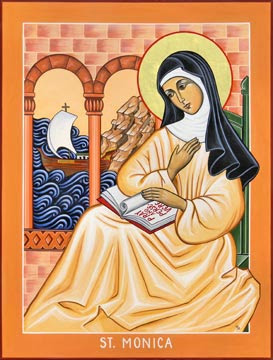
In the older calendar, today is St. Monica’s Feast, also spelled Monnica, a Punic name.

Monica was an inch away from becoming an alcoholic. (The story of her abusive husband has been told here before.)

This is IMPORTANT. At the end, I ask you to consider the implications of the events recounted. WORLD HISTORY CHANGING in an INSTANT.

From Serge Lancel’s Augustine, the best biography I know of the great Bishop of Hippo (p. 8 ff – emphases mine):

Before devoting himself entirely to Mother Church, as he approached the age of forty, Augustine had had a concubine for about fifteen years, of whom he had been very fond and who had given him a son; then, at the same time as a fleeting engagement, a second short-lived liaison.  But only one woman really counted in his life, and that was his natural mother, Monica.

As we may guess from reading a few pages of Book IX.8 of the Confessions, Patricius – Augustine’s father – had taken a wife in Thagaste from a milieu close to his own.  He had married Monica, as his would describe it in a phrase borrowed from Virgil, “in the fullness of her nubility”, which means that he had not married a child, a practice that was in any case more rare then in Africa that in Rome itself.  The couple had three children, in what order we do not know: a girl, who remains anonymous to us, but who, once widowed, would later become the superior of a community of nuns, and two boys, Augustine and Navigius, whom we shall find with his brother in Italy, at Cassiciacum, then at Ostia at their dying mother’s bedside.  …

So Monica had been born into a Christian family and was, as we would say today, a practicing believer.  The religious practices of Christians at that time, in North Africa, sometimes included aspects that would be surprising to us, such as the custom of taking offerings of food to the tombs of martyrs, for agapes that only too often degenerated into orgies; an obvious survival of the pagan festival of the Parentalia.  Of course, Monica did not indulge in those excesses.  If the baskets she brought to the cemetery contained, besides gruel and bread, a pitcher of unadulterated wine, when the time came to share libations with other faithful, she herself would take only a tiny amount, diluted with water, sipped from a goblet in front of every tomb visited.  Was this sobriety a memory of some experience in her early youth?  Augustine tells this story which he says he heard from the lady herself.  Raised in temperance by an old serving-woman who enjoyed the complete trust of Monica’s parents, she had fallen into a bad habit.  Well-behaved girl that she was, she was sent to the cellar to fetch wine from the cask, but before using the goblet she had brought to fill the carafe she would just wet her lips with the wine, not because she liked it, says Augustine, but out of childish mischief.  But gradually she had acquired a taste for it, to the point where she was drinking entire goblets of it with great gusto.  Fortunately she had cured herself of this incipient liking for drink in a burst of pride: the maidservant who accompanied her to the cellar, having fallen out one day with her young mistress insultingly called he a “little wine bibber”.  Stung to the quick, Monica had immediately stopped her habit.

Think now about the spiritual works of mercy: admonish the sinner.

NOW… consider how that servant affected WESTERN CIVILIZATION because of what she did for the future mother of St. Augustine, arguably one of the most influential figures in history.

You never know.

Do the right thing, in sacrificial love.

CLICK

Here’s the Latin from Confessions 9.8.18.

A few interesting words in bold:

8. 18. Et subrepserat tamen, sicut mihi filio famula tua narrabat, subrepserat ei vinulentia. [“an inclination for getting drunk on wine slithered into her”] Nam cum de more tamquam puella sobria iuberetur a parentibus de cupa vinum depromere, submisso poculo, qua desuper patet, priusquam in lagunculam funderet merum, [wine uncut with water – in the ancient world wine was always cut and it drinking merum was a sign of low manners, etc, as Cicero accused Mark Antony] primoribus labris sorbebat exiguum, quia non poterat amplius sensu recusante. Non enim ulla temulenta [archaic word for wine] cupidine faciebat hoc, sed quibusdam superfluentibus aetatis excessibus, qui ludicris motibus ebulliunt et in puerilibus animis maiorum pondere premi solent. Itaque ad illud modicum quotidiana modica addendo; quoniam qui modica spernit, paulatim decidit; in eam consuetudinem lapsa erat, ut prope iam plenos mero caliculos inhianter hauriret. [with a gaping mouth she quaffed whole cups of uncut wine] Ubi tunc sagax anus [wise old woman] et vehemens illa prohibitio? Numquid valebat aliquid adversus latentem morbum, nisi tua medicina, Domine, vigilaret super nos? Absente patre et matre et nutritoribus tu praesens, qui creasti, qui vocas, qui etiam per praepositos homines boni aliquid agis ad animarum salutem. Quid tunc egisti, Deus meus? Unde curasti? Unde sanasti? Nonne protulisti durum et acutum ex altera anima convicium tamquam medicinale ferrum [reproach like a cautering iron] ex occultis provisionibus tuis et uno ictu putredinem illam praecidisti? Ancilla enim, cum qua solebat accedere ad cupam, litigans cum domina minore, ut fit, sola cum sola, obiecit hoc crimen amarissima insultatione vocans meribibulam. [The old servant woman threw this crime (at Monica) with the bitterest reproach calling her a drunk (“wine-swiller”).] Quo illa stimulo percussa respexit foeditatem suam confestimque damnavit atque exuit. Sicut amici adulantes pervertunt, sic inimici litigantes plerumque corrigunt. Nec tu quod per eos agis, sed quod ipsi voluerunt, retribuis eis. Illa enim irata exagitare appetivit minorem dominam, non sanare, et ideo clanculo, aut quia ita eas invenerat locus et tempus litis, aut ne forte et ipsa periclitaretur, quod tam sero prodidisset. At tu, Domine, rector caelitum et terrenorum, ad usus tuos contorquens profunda torrentis, fluxum saeculorum ordinans turbulentum, etiam de alterius animae insania sanasti alteram, ne quisquam, cum hoc advertit, potentiae suae tribuat, si verbo eius alius corrigatur, quem vult corrigi.

In the online Pusey translation… a little dated:

And yet (as Thy handmaid told me her son) there had crept upon her a love of wine. For when (as the manner was) she, as though a sober maiden, was bidden by her parents to draw wine out of the hogshed, holding the vessel under the opening, before she poured the wine into the flagon, she sipped a little with the tip of her lips; for more her instinctive feelings refused. For this she did, not out of any desire of drink, but out of the exuberance of youth, whereby it boils over in mirthful freaks, which in youthful spirits are wont to be kept under by the gravity of their elders. And thus by adding to that little, daily littles (for whoso despiseth little things shall fall by little and little), she had fallen into such a habit as greedily to drink off her little cup brim-full almost of wine. Where was then that discreet old woman, and that her earnest countermanding? Would aught avail against a secret disease, if Thy healing hand, O Lord, watched not over us? Father, mother, and governors absent, Thou present, who createdst, who callest, who also by those set over us, workest something towards the salvation of our souls, what didst Thou then, O my God? how didst Thou cure her? how heal her? didst Thou not out of another soul bring forth a hard and a sharp taunt, like a lancet out of Thy secret store, and with one touch remove all that foul stuff? For a maid-servant with whom she used to go to the cellar, falling to words (as it happens) with her little mistress, when alone with her, taunted her with this fault, with most bitter insult, calling her wine-bibber. With which taunt she, stung to the quick, saw the foulness of her fault, and instantly condemned and forsook it. As flattering friends pervert, so reproachful enemies mostly correct. Yet not what by them Thou doest, but what themselves purposed, dost Thou repay them. For she in her anger sought to vex her young mistress, not to amend her; and did it in private, either for that the time and place of the quarrel so found them; or lest herself also should have anger, for discovering it thus late. But Thou, Lord, Governor of all in heaven and earth, who turnest to Thy purposes the deepest currents, and the ruled turbulence of the tide of times, didst by the very unhealthiness of one soul heal another; lest any, when he observes this, should ascribe it to his own power, even when another, whom he wished to be reformed, is reformed through words of his.
Posted in Classic Posts, Patristiblogging, Saints: Stories & Symbols | Tagged
5 Comments

ROME 25/4– Day 25:

When 06:00 arrived, up came the sun here in Rome. One minute ago as I write, which is 20:15, the sun officially set.

The schedule for the Ave Maria Bell is still 20:30, though technically it should be more closely connected to sunset.

In the older calendar today we celebrate St. Monica, the mother of St. Augustine, who died at Ostia, Rome’s port on their way back to N. Africa. She has a lovely collect:

Deus, mæréntium consolátor et in te sperántium salus, qui beátæ Mónicæ pias lácrimas in conversióne fílii sui Augustíni misericórditer suscepísti: da nobis utriúsque intervéntu; peccáta nostra deploráre, et grátiæ tuæ indulgéntiam inveníre.

More about her in another post.

Please remember me when shopping online and use my affiliate links.  US HERE – UK HERE  WHY?  This helps to pay for health insurance (massively hiked for this new year of surprises), utilities, groceries, etc..  At no extra cost, you provide help for which I am grateful.

Which drink is mine?

Okay, that was an easy one. For bonus points: Can you guess what it is?

There is still only one because I was waiting for friends to arrive and I wanted to be “using” the table rather than just sitting at it when others were circling.

A nice shot from this morning’s Solemn Mass.

A nice shot from Solemn Vespers with Benediction.

And a nice shot of ITALIAN FSSP seminarians who were with us for Good Shepherd Sunday. A great sign of life.


Posted in SESSIUNCULA |
12 Comments

Your Sunday Sermon Notes – 2nd Sunday after Easter 2025 (N.O. 3rd Sunday of Easter)

Too many people today are without good, strong preaching, to the detriment of all. Share the good stuff.

It is the 3rd Sunday of Easter in the Novus Ordo and the 2nd Sunday after Easter in the Vetus Ordo.   It is nicknamed “Good Shepherd Sunday”.

The Roman Station is St. Peter’s in the the Vatican.

Was there a GOOD point made in the sermon you heard at your Sunday Mass of obligation?

Tell about attendance especially for the Traditional Latin Mass.

Any local changes or (hopefully good) news?

I have a few thoughts about the orations in the Vetus Ordo for this Sunday: HERE

A taste:

[…]

Finally, we might consider the practical ramifications for us in the last verses of the Gospel, in which the Lord says there are others who are not of this flock.  There are many who are not of the Church, not near, not following, indeed in mortal peril.  Do we stand by idly in enclosed contentment?   There are those who have fallen away from the Church, which is even more alarming.  I am minded of Lumen gentium 14:

Quare illi homines salvari non possent, qui Ecclesiam Catholicam a Deo per Iesum Christum ut necessariam esse conditam non ignorantes, tamen vel in eam intrare, vel in eadem perseverare noluerint. … For this reason, those who, not being ignorant that the Catholic Church was founded by God through Jesus Christ as necessary, do not wish to enter it or to persevere in it, cannot be saved.

[…]

Posted in Sermons | Tagged
10 Comments

ROME 25/4– Day 24: Conclave insider stuff and MSM machinations

In Rome we got sun at 06:01.  It sets at 20:15.

The Ave Maria Bell is in the 20:30 cycle.

I was at a meeting of journalists, long-time Vatican watchers.   It was informative.  The personal experience of a few of these vets shifted my view of a couple of the cardinals dramatically (e.g., Arborelius and Abongo) toward the positive.  The unhesitating consensus was that Card. Sarah won’t be chosen and the reason was interesting: his seeming hardline about priesthood and celibacy greatly irritated the Eastern Catholics.  I don’t want to totally give up on him but I understood the point.  They were also quite confident that Table (=disaster) would not be elected, which helped to lower my blood pressure.  Strong positives about Card. Pizzaballa in that group.   For my part, apart from his accomplishments – which are significant – there is something compelling about the narrative of the man coming from Jerusalem to Rome.  It’s been done before!

Please remember me when shopping online and use my affiliate links.  US HERE – UK HERE  WHY?  This helps to pay for health insurance (massively hiked for this new year of surprises), utilities, groceries, etc..  At no extra cost, you provide help for which I am grateful.

Conclave stuff.

Other conclave stuff.

Rorate has an open letter to cardinal electors with 62 points of concern about doctrine, liturgy, and discipline. “Only 62?”, you quip. It’s pretty comprehensive and one might read it as a status quaestionis for the Church. If anyone will read it. It is way too long and it includes things that just might make some cardinal’s secretary roll his eyes (like the point about the Church’s teaching on usury) and hit the print button anyway because it’s his job to get information to his boss. Thereafter, I suspect that one or two Electors might glance at pages it is printed on before doing something else.

Meanwhile, currently, New Advent has a sidebar panoptic of the site about all the cardinals that Ed Pentin and Diane Montagna made. It’s handy.

The MSM seems to be in lockstep with the globalist, immanentist Deep Church. MSM is saying that the Parolin illness was fake news spread by Americans and trads to hurt his chances. So the deep Vatican and the worldly powers want him to be pope. La Reppublica HERE, Corriere HERE, ANSA HERE, Il Messaggero HERE.

The situation is very wobbly, I think.

An interesting view of Sant’Andrea della Valle.

All the scaffolding is finally removed from Santa Brigida.

Last night’s supper.  Fantastic.

White to move and mate in 4.

[NB: I’ll hold comments with solutions ’till the next day so there won’t be “spoilers” for others.]

Posted in SESSIUNCULA |
18 Comments

ROME 25/4– Day 23: What’s up?

Up went the sun at 06:03. Down it’ll go at 20:12.

The Ave Maria Bell, you ask?

For the Curia 20:30. However, the real schedule is pegged to sunset.

Today is a 1st Friday.

It is the Feast of St. Athanasius, a saint for our day. Happy Name Day Bp. Schneider.

Welcome registrants:

gothic serpent
RayHenry

It was a lovely day in Rome yesterday and it should be splendid again today.

Here’s an interesting shot.  First, there are visible together three decidedly Roman things: a Rione sign, a “garbage” sign, a “nasone”.  And there is a guy in the background doing something.

He’s putting their new Michelin 2 star sign up.  I have not eaten there.

However, I will be eating these tonight: vongole veraci.  I picked them up after Mass.

This conclave didn’t have much to say about the General Congregations.

A few points I’ve heard.

  • Card. Stella sharply criticized Francis for introducing lay people into Church governance, which requires Holy Orders.
  • Card. Parolin – 70 yrs – had a blood pressure incident which I suspect will, along with Card. Zen’s remarks, knock him out.  Also, people were not happy with a Mass he said for the Novendiales.  He is said to have been campaigning.  True?  Meh!
  • Card. Becciu won’t be voting.  I wonder what he knows and is willing to say, not so much to promote a candidate as to knock him out of the running.
  • Card. Sarah gave a terrific talk during one of the Congregations, as did Card. Eijk.

People are asking me about whom I believe will be chosen.

I will not rule out Card. Sarah.  I believe that even the more deadly libs in the college at least recognize him as a man of deep prayer.  He is 79 (second oldest Elector, I think).

I will not rule out Card. Pizzaballa.  However, he is only 60.   That said, his languages are excellent.  He’s Italian.   He is in Jerusalem and made quite a bold offer of his own person for hostages in Gaza.  There’s something to the almost romantic narrative of the man from Jerusalem coming to Rome to be Pope.  People I’ve talked to have divided reports about his stance on the Traditional Roman Rite.   The preponderance lands in the side of being at least benign.

As far as ruling in… I don’t know.  As the General Congregations go on, more information will be forthcoming even if in drips and drabs.

Please remember me when shopping online and use my affiliate links.  US HERE – UK HERE  WHY?  This helps to pay for health insurance (massively hiked for this new year of surprises), utilities, groceries, etc..  At no extra cost, you provide help for which I am grateful.

Meanwhile, here is what we are doing at The Parish™.

What is going on in your parish?

White to move and mate in 3.  How fast did you get it?

NB: I’ll hold comments with solutions ’till the next day so there won’t be “spoilers” for others.


Posted in SESSIUNCULA |
11 Comments

Prayers for the Election of a Roman Pontiff (Fr. Z’s and Card. Burke’s)

HERE

Posted in SESSIUNCULA |
Comments Off on Prayers for the Election of a Roman Pontiff (Fr. Z’s and Card. Burke’s)

ROME 25/4– Day 22: bare bones

It’s the feast of St. Joseph Opifex… the Worker. On 19 March 1937 (the Feast of Saint Joseph), Pius XI placed “the vast campaign of the Church against world Communism under the standard of Saint Joseph, her mighty protector.” In 1955, Pius XII established the Feast of Saint Joseph the Worker on 1 May. He said that he was instituting the new feast “so that the dignity of human labor might sink more deeply into souls”. This is an explicit anti-Communis, anti-Socialist day for the Church favoring the dignity of the human person who works. As Pius IX wrote, no one can be both a Socialist and a Catholic.

The Roman sun rose at 6:07 on this feast, a civic holiday in Italy – Labor Day – probably because it is a special day for Communists. That’s how things are, I’m afraid.  It was chosen by Marxists to be International Workers’ Day to commemorate the 1886 Haymarket affair in Chicago. The sun will set on Rome at 20:09.

The Ave Maria Bell is supposed to ring at 20:30.

Welcome registrant:

DcnTBone
JoeNagleePark

I’m tired and it is late.


Please remember me when shopping online and use my affiliate links.  US HERE – UK HERE  WHY?  This helps to pay for health insurance (massively hiked for this new year of surprises), utilities, groceries, etc..  At no extra cost, you provide help for which I am grateful.

Posted in SESSIUNCULA |
4 Comments

ROME 25/4– Day 21: Market forces

At 6:05 the sun began to appear in Rome. It’s evening disappearing act commences at 20:10.

The Ave Maria Bell is in it’s 20:30 cycle.

In the NO calendar we celebrate St. Pius V and in the VO, St. Catherine of Siena.

It is the Feast of St. Quirinus, martyr.

This is the 120th day of the year.

This morning was particularly beautiful, with clear deep blue skies and a breeze.   It was a real pleasure to walk about after Mass.

First, some breakfast with The World’s Beat Sacristan.  The table set by him as he indicates his favor for its symmetry.

Which is mine?   This time I’ll say…

I will continue your education in things breakfasty.

This is called a graffa.  They have a single twist, sort of like “cause ribbons”.

The saccotino, which people elsewhere might call pain au chocolat.  (Beneath and out of focus girelle, which is what The Sacristan had.

There will be more to come.

As I usually do, I went through the Campo and said hello to a few people.   Here are some nice vegetables to brighten your day!

Please remember me when shopping online and use my affiliate links.  US HERE – UK HERE  WHY?  This helps to pay for health insurance (massively hiked for this new year of surprises), utilities, groceries, etc..  At no extra cost, you provide help for which I am grateful.

This is a kind of radicchio.  I’m sure what it’s called.

In chessy news… not much is going on that is interesting enough to catch my attention these days.  the Grand Chess Tour Superbet Poland Rapid & Blitz 2025 is on… but I just haven’t tuned in. Instead I watched some weird chess over at the P.za der Fico. I have a course on b3 which I saw several times one afternoon.

White to move and mate in 4.

NB: I’ll hold comments with solutions ’till the next day so there won’t be “spoilers” for others.

Interested in learning?  Try THIS.

I feel strange not having played OTB for a while.  With Easter and the Octave in the rearview mirror and the month of May ahead, maybe I’ll look around for some play, but less wild than at the der Fico.   BTW… I understand that that is a great bar.  Years ago I had a very good gricia there.

Posted in SESSIUNCULA |
1 Comment

Explanation of a how a Conclave works: another Roman dialect sonnet “der Belli”

It’s sede vacante time and all eyes are turned to Rome in anticipation of a conclave.

It is appropriate to have an expert explanation of exactly how a conclave works.  Forget the TV pundits and Know-It-Alls in the Catholic press.  For this we need a truly Roman perspective.

Here’s another sonnet in Romanaccio, the Roman dialect, by Giuseppe Gioacchino Belli.  He is Er Belli… THE Belli, “er” being the Roman for “il”.

He wrote seriously funny sonnets in the Roman dialect about life in Rome in the early 1800’s and aimed deadly satire at Rome’s clerics, religious, prelates and popes.

Belli’s sonnets are wickedly clever, with double-entendres and not a little obscenity. Romanaccio was – still is – very rough stuff and what on the surface is just vulgar to our ears now was sort of normal back when. Another thing to consider is that the Roman nobility spoke Romanaccio too. The count or prince of some major family and the vegetable stand guy in the square talked the same way … when in the square or street.

Speaking of double meanings, in today’s sonnet there is bocce ball imagery. An instance of double meaning is the word “lecco” which means a shot to get your ball next to the pallino (aka boccino) for a point. But “lecco” can also mean “a bribe”… which surely has NOTHING to do with conclaves! The mention of lead in the ball refers to a stud of lead in some bocce balls which, I guess, could be used for trick shots. However, that phrase also means, “one way or another”.

Here we go.

Here’s The Great Roman™ with another gift.

La spiegazzione der Concrave

Er Concrave de Roma, Mastro Checco,
tu lo chiami er Pretorio de Pilato.
Senti mó in che mmaggnèra io l’ho spiegato,
e ccojjoneme poi si nun ciazzecco.

A mmé ttutto st’impiccio ingarbujjato
me pare un gioco-lisscio secco secco:
ché cqua ttutto lo studio è dd’annà ar lecco,
llà ttutto er giro è dd’arrivà ar Papato.

Ccusí ’ggni Minentissimo è una bboccia,
che ss’ingeggna cqua e llà, ccor piommo o ssenza,
de metteje viscino la capoccia.

Fin che cc’è strada de passà ttra ’r mucchio
se prova de fà er tiro e cce se penza:
si nnò ss’azzarda e ss’aricorre ar trucchio.

This wasn’t easy.

The Explanation of a Conclave

The Roman Conclave, Master Frank,
you call the Praetorium of Pilate.
Listen now to how I’ve explained it
and bust my chops if I don’t nail it.

It seems to me this whole tangled mess
is a simple game of bocce on level ground
’cause in the game the point is to get to the pallino
and in the conclave you intrigue around to get to the papacy.

In this way, every Eminence is a bocce ball
that rolls here and there, with lead in it or not,
to get close to the pallino one way or another.

As long as there is a way to get through the mess,
you try a rolling punto shot and plot it out:
otherwise ya’ take a risk and try a tricky raffa bash.

NB: The “Praetorium of Pilate” is where Christ was condemned to die.   So, too a conclave as far as Mastro Checco is concerned.

Checco is short for Francesco and Mastro indicates that he is a skilled tradesman of some kind.

Bocce could be played with colorful red and green balls, green being the original color for bishops, hence the green hat on coats of arms.  You can envision very well fed round cardinals and bishops milling about close to a tiara.  Bocce is a fun image.   In bocce, you can roll more gently for a point (punto) and you can toss high so the ball comes down in a particular spot (volo) and you can strongly bash other balls or the pallino to move them around (raffa).  There are other terms too.

Posted in Poetry | Tagged , ,
1 Comment