
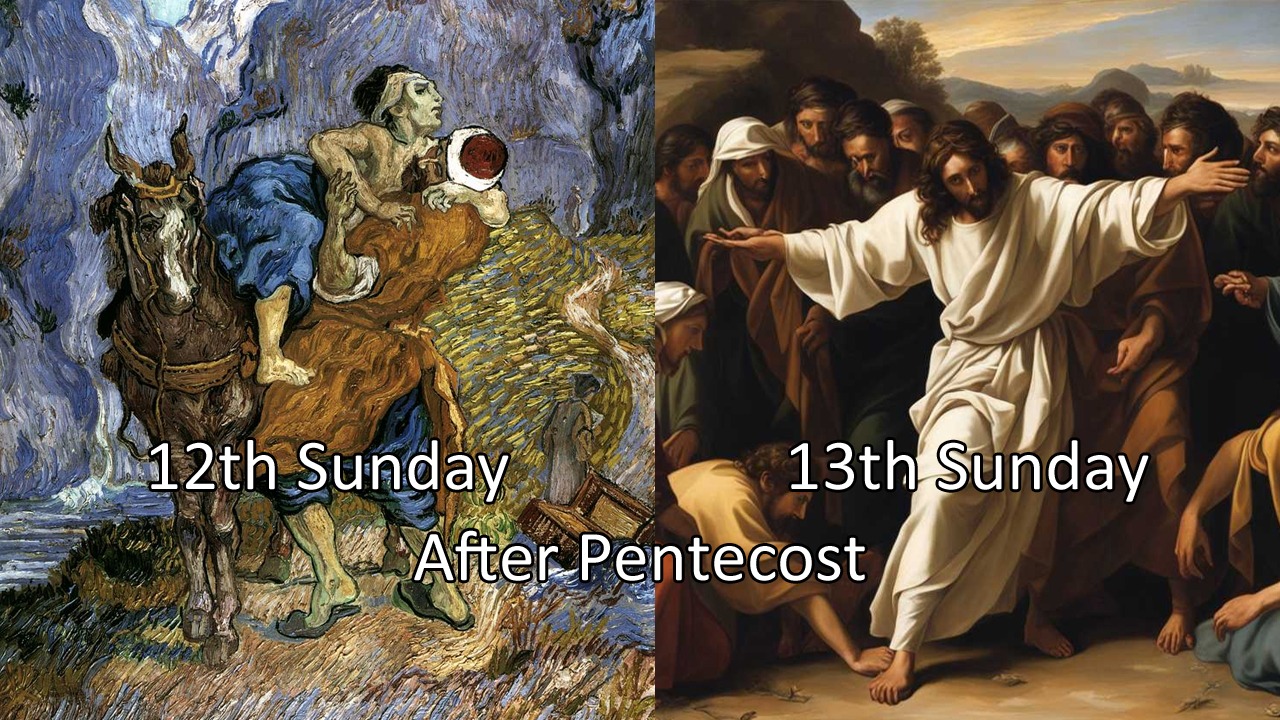
The Gospels for the 12th and 13th Sundays after Pentecost in the Vetus suggests a connection by the fact that they both include Samaritans.
On the 12th Sunday we hear Christ’s parable of the Good Samaritan. The Samaritan is a fictional character within the story. On the 13th Sunday we meet an real Samaritan, one of the ten lepers cleansed by Christ and the only one who returns to give thanks.
Samaritans developed as a community from the population of the 10 tribes of former northern kingdom of Israel, especially around Mount Gerizim, after the Assyrian conquest of 722 BC with whom they intermingled. They set up their own temple and read only the Pentateuch. Jews and Samaritans regarded each other with deep hostility.
St. Augustine makes an interesting observation about the Samaritans in the Gospel of Luke.
In his Quaestiones Evangeliorum 2, 19, Augustine reads the parable of the Good Samaritan allegorically. The man descending from Jerusalem to Jericho represents Adam and, in Adam, the whole human race. Jerusalem is the heavenly city from which Adam fell. Jericho signifies mortality. The robbers are the devil and his angels, who strip man of grace and leave him wounded and half dead. The priest and Levite pass by because the institutions of the Old Law could reveal man’s wounds but could not heal them. Then the Samaritan arrives.
Augustine writes, “Samaritanus custos interpretatur, et ideo ipse Dominus significatur hoc nomine…. Samaritan means ‘guardian,’ and therefore the Lord Himself is signified by this name.”
Christ is the true “Samaritan… Guardian”. He is regarded as a stranger by those who should have recognized Him, yet He alone draws near to fallen humanity. Augustine describes Him as “genere longinquus, misericordia proximus … distant by race, near by mercy.”
Continuing the allegorical explanation, for Augustine, the Samaritan’s beast – upon which the beaten man in placed – signifies Christ’s human flesh, by which He bears our infirmities. The inn is the Church. The innkeeper represents the apostolic ministry. The two denarii signify the two commandments of charity, love of God and love of neighbor. The promised return of the Samaritan points toward Christ’s return in judgment.
On this Sunday, however, the 13th after Pentecost, the Samaritan who appears in the Gospel reading is not a fictional character in a parable, an allegorical figure of Christ. He is a real man healed by Christ. Ten lepers – one is a Samaritan – cry out for mercy. Ten are cleansed. Only one returns. The healed Samaritan returns and falls at the feet of Jesus, glorifies God, and gives thanks.
Augustine interprets this episode in Quaestiones Evangeliorum 2, 40. He sees leprosy as an image of false doctrine. Leprosy produces an unnatural mixture of colors and textures in the body. Similarly, false teaching mixes truth and error within a single discourse.
The result can retain the outward appearance of Christian teaching while being spiritually diseased.
Is this not what we see rampant in certain sectors of the Church today? Even in some quite lofty places?
False teachers within the Catholic Church don’t announce themselves as enemies of the Faith. They retain Catholic vocabulary while quietly emptying it of definite meaning. For example: “synodality”. What does that mean? No one really know. However, the use of vague terms leads to verbiage of, for example, listening but without any discernable effect or change. There results chatter about accompaniment but without conversion, mercy but without repentance, conscience but without formation, development but without continuity, and doctrine but without enduring truth.
A great deal of error arrives dressed in fancy vestments.
Returning to Augustine’s interpretation, all ten lepers were cleansed. They represent people who have come to possess true doctrine within the Church. Nevertheless, nine fail to return and give thanks. Sound doctrine, orthodoxy itself, when embraced by pride and ingratitude, remains incomplete.
Augustine says, “Novem itaque indigent uno, ut quadam unitatis forma coagulentur et decem sint… The nine require the one, so that they may be joined together by the form of unity and become ten.” Ten being a symbol of completeness, perfection.
The nine remain nine because they lack the unity represented by one. The grateful Samaritan, by contrast, signifies the one Church: “Ille qui gratias egit unicae Ecclesiae significatione approbatus atque laudatus est. … He who gave thanks was approved and praised as a figure of the one Church.”
The Samaritan returns to the source of his healing. He attributes the gift to the Giver. He therefore prostrates himself in humility. Thus, Augustine says, he “unitatem regni humili devotione servavit … preserved the unity of the kingdom by humble devotion.”
The fictional Samaritan of the 12th Sunday after Pentecost is Christ healing wounded humanity and carrying it into the Church. The living Samaritan of the 13th Sunday represents the Church returning to Christ in faith and thanksgiving.
Take note that the grateful Samaritan, with the nine who did not return, went on their way in obedience to Christ’s enjoinder to present themselves to the priest in obedience to the Law laid down in Leviticus. Obedience is a key concept in scene with the ten lepers.
There is also a warning here for our troubled times.
We must resist teachers who mingle Catholic truth with fashionable error. We must study the Faith, receive the sacraments worthily, pray, and hold fast to what the Church has consistently taught, handed down.
At the same time, possession of correct doctrine must lead us back to Christ in humility and gratitude. Otherwise, we may be cleansed of doctrinal leprosy while remaining among the ungrateful nine.
Christ the Samaritan found us wounded beside the road. He bound our wounds, carried us in His flesh, and brought us into the inn of His Church. The only proper response is to return, fall at His feet, and give thanks.































A thoughtful reflection, Father. It is much appreciated. Thank you.
This was read all but verbatim as the homily at our church. My dear friend who left the TLM for the NO parish nearby said that we are fastidious about right worship and doctrine but have no outreach and are insular. He is correct in that the parish participates remotely in charitable giving but devotes most donations toward building the church to accommodate the huge number of new members at four packed Sunday Masses. Plus the hierarchy requires our silence to avoid suppression. I’m unsure why my friend didn’t just support the NO outreach as I do while continuing the TLM.
Suggestions?
But my favorite Samaritan is Saint Photina (or, more often in the East, Photini, “illuminated”), the woman at the well in John 4. She is very widely venerated in the East,and is,or was, in the older Roman Martyrology. Here is a link to a Catholic discussion of her: https://www.catholic.org/saints/saint.php?saint_id=5450
Defense of Catholic Truth? The recent appointments by Pope Leo make me very concerned. In a real sense the maxim that “personnel is policy” is true.