Was there a good point or two in the sermon you heard for your Sunday Mass of obligation?
Let us know!
Was there a good point or two in the sermon you heard for your Sunday Mass of obligation?
Let us know!
 From a reader…
QUAERITUR:
My grandfather just passed away after a long and painful sickness. He received last rites and Viaticum last Monday. How can I gain a plenary indulgence for him as fast as I can?
First, my condolences, I am sure that all the readers here will now stop and say a prayer for him:
Eternal rest grant unto him, O Lord. Let perpetual light shine upon him. May the souls of the faithful departed, through the mercy of God, rest in peace. Amen.
Second, I am pleased that you would think to obtain an indulgence for him. All of us should be aware of indulgences and seek to obtain them as often as we can. Think of how that might change our lives and how much benefit that would have for poor souls.
Third, if your grandfather received last rites, including Viaticum, I suspect he is in pretty good shape.
That said, off the top of my head I can think of five ways to obtain a plenary indulgence at any time of the year.
From the Enchiridion Indulgentiarum (Handbook of Indulgences):
We can obtain one plenary indulgence each day.
Indulgences can be applied either to oneself or to the souls of the deceased. They cannot be applied to other living persons.
In addition to the described work, to obtain a plenary indulgence we must fulfill the following conditions:
1) GO TO CONFESSION! A single sacramental confession suffices for gaining several plenary indulgences, and Communion must be received.
2) Prayer for the intention of the Sovereign Pontiff must be recited for the gaining of each plenary indulgence. This is satisfied by reciting one Our Father and one Hail Mary. However, we are free to recite any other prayer according to our piety and devotion.
3) All attachment to sin, even venial sin, must be absent. If you are not free from attachment to sin, even venial, or if the prescribed conditions are not fulfilled, the indulgence will be partial only.
A confessor or the local ordinary can commute the work or conditions if a person is legitimately impeded.
The three conditions may be fulfilled several days before or after the performance of the prescribed work. However, it is fitting that Communion be received and the prayer for the intention of the Pope be recited on the same day the work is performed. How many days is “several days”? Traditionally, it was said 8 days. However, in 2000 for the Jubilee, the Sacred Apostolic Penitentiary said 20 days. Later, it was asked if that applied only to the Jubilee Year. The same SAP said that it applied to the general norms. So, the highest authority in the Church (apart from the Pope) on indulgences says “20 days”, though you are free to stick to getting everything done within 8, as we always did before.
Reverend Fathers, teach about indulgences. Everyone, strive to obtain them!
I had a thought about what Card. Burke said. In his interview with a French TV station, His Eminence said, in answer to a question about the possibility that the Pope might persist (quite an assumption) in driving forward Communion for the divorced and remarried:
“Resisterò. Non posso fare altro…. I shall resist. I can do no other.”
As a happy ex-Lutheran, that had a familiar ring for about a nanosecond. “Hier stehe ich, ich kann nicht anders.”
Anyway… here’s the thought.
Will the National Schismatic Reporter (aka Fishwrap) now take Card. Burke to their bosom? Embrace him as their new hero?
After all, the Fishwrap‘s entire income and raison d’être has come from resisting every Pope since Paul VI.

This is a big week coming up in Rome. This could be a pivotal week in this pontificate.
Consider:
9-11 Feb – Meeting of the Gang of Nine
12-13 Feb – Consistory meetings of all the Cardinals
14-15 Feb – Public events for the Consistory for Cardinals
And that’s just the surface. Imagine what is going on behind the scenes.
It was a year ago that Card. Kasper presented his looooong ramble to the Consistory, which provoked the storm in the Synod of Bishops last October. You will recall that that is Card. Kasper proposed his incredible “tolerated but not accepted” approach to Communion for the divorced and remarried without annulment.
Here we go again!
This time it seems that the Cardinals will be presented with updates on the economic situation of the Holy See as well as proposals about reform of the Curia. Stakes are huge.
As you know, John Paul II’s constitution establishing the structure of the Curia and competence of its offices was called Pastor bonus (cf John 10:12). Since what is going to be proposed is surely going to overturn John Paul’s vision, I have imagined that the new document might be called Mercenarius malus.
And the make up of the College of Cardinals changes as of next week. Again, stakes are huge.
Between now and the Synod in October, tension is going to rise. Last month in Rome I sense a lot of pressure and uncertainty. Anxiety and tension will build until October.
 What do we do when legitimate authority gets something important wrong?
We respectfully resist legitimate authority.
Pope Francis does or doesn’t do, A, B or C. He doesn’t, for example, wear proper pontifical garb, as tradition and decorum require, in the proper moments. I think that is wrong. However, while this is important, I don’t think it is important enough to resist him. His not putting on this or that vestment is not enough to merit resistance.
However, what if Pope Francis were to say that the divorced and civilly remarried without declaration of nullity could be admitted to Holy Communion, without any other clarifications?
I have in mind a well-known text by Jesuit St. Robert Bellarmine (+1612), Doctor of the Church, in his work De Romano Pontifice:
“Just as it is lawful to resist the pope that attacks the body, it is also lawful to resist the one who attacks souls or who disturbs civil order, or, above all, who attempts to destroy the Church. I say that it is lawful to resist him by not doing what he orders and preventing his will from being executed.”
Do I think that Pope Francis would do something so grave as to merit resistance? I don’t think so. I pray not.
His Eminence Raymond Card. Burke has given an interview to a French TV station. He was asked a question along these lines. The site of the SSPX has a translated partial transcript. Excerpt on France TV Info:
Cardinal Burke: I cannot accept that Communion can be given to a person in an irregular union because it is adultery. On the question of people of the same sex, this has nothing to do with marriage. This is an affliction suffered by some people whereby they are attracted against nature sexually to people of the same sex.
Question: If perchance the pope will persist in this direction, what will you do?
Cardinal Burke: I shall resist, I can do nothing else. There is no doubt that it is a difficult time; this is clear, this is clear.Question: Painful?
Cardinal Burke: Yes.Question: Worrisome?
Cardinal Burke: Yes.Question: In your opinion, can we say today that the Catholic Church as an institution is threatened?
Cardinal Burke: The Lord has assured us, as He has assured St. Peter in the Gospel, that the powers of evil will not prevail, “non praevalebunt” as we say in Latin, that the forces of evil will not have victory over the Church.Question of the end: Is the Pope still your friend?
Cardinal Burke (with a smile): I would not want to make the pope an enemy for sure. That is fine for now. [from the context: “That is enough for this interview”].
It seems to me that Card. Burke’s response was correct and appropriate. He didn’t say that that is what is going on now, that he is resisting the Pope now. He was asked a hypothetical question that all Catholics should be able to answer.
This is not a new question and answers to the question are not new. In Acts 5:29 Peter says, “We ought to obey God, rather than men.” In Galatians 2:11 Paul says, “But when Cephas [Peter] was come to Antioch, I withstood him to the face, because he was to be blamed.” Through the centuries great Fathers and Doctors of the Church along with many prominent theologians have pondered the hypothetical situation of a Pope who goes off the rails and what the faithful ought to do in response. They conclude that if even a Pope errs in some matter, they must be resisted for the sake of avoiding scandal, defending the Faith, and the salvation of souls.
So, in Card. Burke’s response, there is nothing terribly new. He is merely stating what all Catholics ought to know and ought to do.
Should it happen, quod Deus avertat, that even the Holy Father try to change clear Catholic teaching founded in the clear words of Christ Himself or the clear teaching of the Magisterium rooted Scripture and Tradition, then the Catholic faithful would have to resist him in that matter. For example, were a Pope to attempt to ordain a woman, he must be resisted. Were a Pope to attempt to marry two men or approve of such a thing, he must be resisted.
However, I don’t believe that we will ever see such a situation.
I am with Benedict XVI on this one. Before Joseph Ratzinger was elevated to the See of Peter he explained something about the working of the Holy Spirit in the election of a Pope. I, like Ratzinger, do not think that the Holy Spirit directly chooses the Pope, just as I do not think that the Holy Spirit dictated word for word the Scriptures which we hold to be divinely inspired. God leaves a lot of room for human insights and will. What the Holy Spirit does do, however, is ensure in His providence, that the Pope who is elected isn’t going to be a total disaster for the Church. Similarly, just as I believe that the Holy Spirit guides and works within the mind and will of Popes in their governance of the Church and in teaching, I don’t think the Holy Spirit tells them directly what to do. Popes remain men, subject to the problems all men have. Popes can err in judgment. They can weaken in will. They can become infirm, ill, and even become demented or otherwise off their rockers. In that situation, I firmly believe that the Holy Spirit, in that role of preserving the Church against the attacks of Hell and in guaranteeing the Rule of Faith and the Magisterium, would intervene. What might the Holy Spirit do to prevent disaster? That’s hard to say. However, I wouldn’t rule out that the souls of hypothetical Pope Nutcase or Pope Loonytoon would suddenly be called forth from this earthly vale of tears to their eternal reward before God’s throne, were they about to gravely damage the Church in a fundamental way. The stakes would have to be pretty high, and only the Holy Spirit would grasp those stakes. Moreover, just as the human body and mind can take a lot of punishment and wounds, so too the Body of Christ the Church. A good father doesn’t stop junior from running simply because he might fall and skin a knee or, even better, just because he has fallen and skinned a knee. So too, God the Holy Spirit.
Enough for now. Here is a video of the interview with Card. Burke.
The moderation queue is ON. I want a whole bunch of responses before I turn it on. That way people won’t be reacting to each other… at first.
I recently obtained a blurb from a mailing of a diocese to priests which had a great summary of how to handle the cases of catechumens who are in apparently invalid marriage situations. I obtained permission to repost it.
This is useful mostly for parish priests, but it could be good for laypeople who are catechumens who are in the process of coming into the Church.
Lent is coming. Many catechumens will be received into the Church at Easter. Make sure you come into the fold properly!
Here is the blurb:
This is a reminder that no catechumen or candidate living in an apparently invalid marriage may be initiated/received into the Catholic Church. [Notice the “apparently”. Remember that Nemo est iudex in causa sua… no one is a judge in his own cause. The status of marriages has to be determined by a tribunal. So, if there is something that appears to be out of order, take it to the proper authority!] This includes anyone who has attempted remarriage while their first spouse is still living or anyone who has attempted marriage to a person bound by a prior marriage. It does not matter if the parties were baptized or unbaptized, what religion they practiced, or if they were married in a civil ceremony. In some cases it may be possible to recognize the current marriage if the first marriage is proven invalid following a judicial process or if the first marriage is dissolved, but in other cases it will be necessary for the parties to separate or at least live chastely together; please refer any questions to the Tribunal. It also includes anyone who attempted marriage to a Catholic outside of canonical form, who would need to validate their marriage in the Church prior to initiation/reception. RCIA catechumens and candidates whose first marriages ended in a divorce but who have not remarried can be initiated/received, but they should be informed beforehand that the Church does not consider them free to remarry given their current status, but they may in the future seek a declaration of nullity through a judicial process, per their discretion.
Clear and helpful.
Marriage is not simply a personal act that affects nobody but the couple. Marriage is public. Marriage affects everyone in the community. Marriage is important for the good ordering of the community.
In a era when lousy education and a culture dedicated to the base appetites has clouded intellect and weakened will, more than ever we need the solid teaching and practice of the Catholic Church regarding marriage.
 Lies and black legends are constantly retold about both the Crusades and the Inquisition. Recently, the First Gay President – in a spectacular display of tactless disregard for both truth and audience – chose to trot them out during the National Prayer Breakfast.
There are a lot of smart readers here.
I think we should compile a reading list about the Crusades and the Inquisition. Good books. Good articles.
It could also be good to point out which books are really bad, so that we recognize them when they are cited.
I’ll turn the moderation queue so that I can clean up some links, etc.
¡Hagan lío!
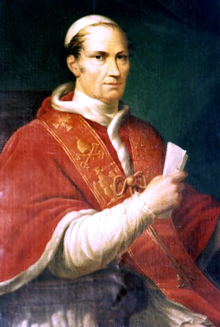 At First Things there is an interesting piece about how enemies of truth, and therefore of God, created a “black legend” around a Pope with disinformation. The target Pope wasn’t, this time, Pius XII, but rather Leo XII (+1829).
AN ANTI-VAXX POPE?
Just as every Easter long-falsified stories about Jesus are warmed up by journalists to increase the print-run of their magazines, so similar nonsense is brought forth whenever issues of science and religion are covered in the media. Whenever one needs to fill an empty page, magazines are quick to run a story about the “persecution” of Galileo and the “fight” of the Church against science. Therefore, I was not surprised that in the current discussions about the ethics of vaccination some claimed that Pope Leo XII (1823–1829) prohibited vaccinations.
The legend appears in a contemporary account by G. D. Godkin, who writes in his biography of King Victor Emmanuel II about the late pontiff with little respect:
He was a ferocious fanatic, whose object was to destroy all the improvements of modern times, and force society back to the government, customs, and ideas of mediaeval days. In his insensate rage against progress he stopped vaccination; consequently, small-pox devastated the Roman provinces during his reign, along with many other curses which his brutal ignorance brought upon the inhabitants of those beautiful and fertile regions.
In the words of moral theologian Fr. Richard M.Cormack, SJ [Booo!] (1922–2000):
In 1829 Leo XII declared, “Whoever allows himself to be vaccinated ceases to be a child of God. Smallpox is a judgment of God, the vaccination is a challenge toward heaven.” [Does that even pass the smell test?]
This alleged statement was often used to ridicule the Holy See and Catholic faith. It “proved” that Catholics did not use reason but blind faith and trusted rather divine providence than their intellect. Just like papacy rejected the unification of Italy and acted “irrationally,” so it had (according to Godkin) denounced all progress.
How could a man like Leo XII, after successful inoculations in Europe, America, Africa, and Asia, really reject a treatment that saved innumerable lives?
He didn’t. The whole “announcement” was made up to discredit Leo XII. A black legend was born. Later, when pressured to present evidence, some historians tried to justify the forgery by suggesting that Leo XII had perhaps said something of the sort as Cardinal, and thus before his election, but could again not produce the actual source of the statement.
In reality, Catholics had endorsed vaccinations since the 1720s. It was, after all, Catholic missionaries, mostly Jesuits, who began inoculating Amazon Indians against smallpox in the 1720s. In Europe, Catholic orders set up modern hospital care, and church officials, such as the archbishop of Bamberg in Germany, introduced public vaccinations in the 1780s. In Rome, Pope Pius VII (1800–1823) voiced support for the treatment, and already in 1805 more than eight-hundred newborn Roman babies were vaccinated. The president of the Jimmy Carter Center, Donald Hopkins, notes in his history of small pox, The World’s Greatest Killer. Smallpox in History, that even in the remote villages of Bohemia in the early 1800s the priests constantly reminded their parishioners of the importance of being vaccinated.
Pius VII, who resisted Napoleon, who had imprisoned him, and whom Catholics therefore venerated as a living martyr, was the immediate predecessor of Leo XII. His support for vaccinations should have made historians, who repeated the above-mentioned black legend, cautious: How often did a papal successor reverse course so completely, from endorsement to prohibition—and without a trace in the official papal pronouncements? For anti-Catholic historians the account simply had to be true, because it fit their own perception of Catholicism as intellectually and morally inferior.
For those, who wish to read a thorough refutation of the vaccination legend I recommend the article by Yves-Marie Bercé and Jean-Claude Otteni, The Practice of Smallpox Vaccination in the Papal States (in French). The story that the Catholic Church rejected vaccination as an interference with divine providence is anti-Catholic slander—nothing more.
BTW… if you want to read more about modern disinformation, try this. It is enlightening, to say the least.
 Disinformation: Former Spy Chief Reveals Secret Strategies for Undermining Freedom, Attacking Religion, and Promoting Terrorism by Ronald Rychlak and Lt. Gen. Ion Mihai Pacepa.
UK link HERE
 At The Wanderer there is part 1 of a new interview with His Eminence Raymond Card. Burke.
See if this isn’t exactly what I have been talking about for… how long now?
“The Sacred Liturgy is absolutely the first act of the New Evangelization. Unless we worship God in spirit and in truth, unless we celebrate the Sacred Liturgy with the greatest possible faith in God and faith in the divine action which takes place in Holy Mass, we are not going to have the inspiration and the grace to carry out the New Evangelization. […]
If the Sacred Liturgy is celebrated in an anthropocentric way, in a horizontal way in which it is no longer evident that it is a divine action, it simply becomes a social activity that can be relativized along with everything else — it doesn’t have any lasting impact on one’s life.
I think the celebration of the Extraordinary Form can have a very significant part to play in the New Evangelization because of its emphasis on the transcendence of the Sacred Liturgy. In other words, it emphasizes the reality of the union of Heaven and earth through the Sacred Liturgy. “
I have been saying for years now that no initiative we undertake in the Church, in any of the Church’s spheres of activity, will bear good and lasting fruit unless we revitalize our sacred liturgical worship of God. Everything starts there. Everything returns there. Revitalization of our liturgical worship is the first act of New Evangelization. It is the best means of communication and evangelization both ad intra and ad extra.
This is why we need the Extraordinary Form far and wide, often and everywhere.
Summorum Pontificum is a mighty tool for the New Evangelization.
 From a reader…
Father, if one is lazy on the job and neglects some their duties over a period of, say a couple months, is that person required to make restitution to the company? does the amount of time that you are lazy and still accept pay make a difference here? im thinking 6 hours a week compared to 4o?
One good thing that the post-Conciliar liturgical reform brought to Holy Mass is the inclusion in the Confiteor of sins of omission. We commit sins “opere et omissione“- by action, and by inaction. Some sins of omission are easy to identify and to confess, “Father, I failed to say night prayers on two occasions.”
I remember a one panel cartoon I saw years ago. Two souls are in Hell, up to their necks in fire. One says to the other, “At least your sins were sins of commission!”
In agreeing to a work contract, one pledges a certain amount of effort and time in return for a certain amount of remuneration. Recognizing that not living up to one’s end of the contract can be sinful is a sign of a well-developed conscience. If I promise you five apples in return for you giving me five dollars, and I only give you four apples, I have no right to demand five dollars from you.
It is a matter of justice to give someone what is his due.
With hourly work, we come into some gray areas.
Some folks can be unnecessarily hard on themselves. If they are not working at 100% for the full eight hours of their workday, they feel as if they slacked off. A reasonable employer, on the other hand, understands that workers need time for occasional breaks, or momentary pauses.
If you really believe that you’ve slacked off at work – and you’re confident that your boss is a reasonable person – you might speak to him or her. “Boss, in looking over my timesheet and my list of responsibilities, I see that, in the last couple weeks, I’ve failed to do everything on my list. I’d like to make it up to the company somehow.” If the boss is a reasonable person, he should be impressed with your honesty, and work with you to figure out the best way to move ahead. You will, of course, have brought future attention and scrutiny to yourself.
If the boss is less than reasonable, it might be best to simply put your nose to the grindstone and resolve to work harder from hereon in, perhaps even slowly but surely making up for “lost time”.
One of the things we need to review in a daily examination of conscience involves how we -today – fulfilled or failed in our daily duties. That includes doing good work for a wage. Taking money for work you didn’t do is a kind of theft. Restitution, if possible, is necessary because of justice.
A good confessor should also be able to help keep you honest and on track.
So… GO TO CONFESSION.
Moderation queue is ON.

Coat of Arms by D Burkart









A Daily Prayer for Priests


They find you a pro-life agent in your area who commits to giving a portion of the fee to a pro-life group!

PLEASE subscribe via PayPal if it is useful. Zelle and Wise are better, but PayPal is convenient.
A monthly subscription donation means I have steady income I can plan on. I put you my list of benefactors for whom I pray and for whom I often say Holy Mass.
In view of the rapidly changing challenges I now face, I would like to add more $10/month subscribers. Will you please help?
For a one time donation...



Help Monks in Wyoming (coffee – UPDATED LINK) and Norcia (beer) and the wonderful "Soap Sisters" of Summit, NJ!


Please follow me on Twitter!










Visits tracked by Statcounter
since Sat., 25 Nov. 2006:

