Rome 24/10 – LAST full Day 42: chores

On this my last full day in Rome the sun rose at 06:53.  It set at 16:55.

They are still screwing up the Ave Maria Bell on the calendar.  Telling.

Thank you, Lord, for this day.  Thank you for tomorrow.

The Feast of St. Martin is heavily laden with remembrance and anticipation, past losses and a new season.

Today is mostly packing and shifting things which remain here to a safe place. It is lovely day, but alas I am inside. Later in the evening, when I had my chores done, I wanted a walk and a bite out.  That didn’t happen.  I’m too tired.

Please remember me when shopping online and use my affiliate links.  US HERE – UK HERE  WHY?  This helps to pay for health insurance (massively hiked for this new year of surprises), utilities, groceries, etc..  At no extra cost, you provide help for which I am grateful.

Get this.  Sorry, I’m terse today.

US HERE

In chessy news…

(It’s white’s move. Mate in 2.)

A glimpse into my Roman morning details.  The little slip has the day’s Mass intention (which I blotted a little to post).


Posted in SESSIUNCULA |
6 Comments

Rome 24/10 – Day 41: Another heartbreak

The sun rose behind clouds at 06:52.  I hope we will have clear skies when it sets at 16:56.

The Ave Maria should ring in its 17:15 cycle and the Vatican calendar has still got it wrong.    I double checked: 4-20 November @17:15, 20 Nov- 28 Dec 17:00.

In the Novus Ordo it is the 32nd Sunday in Ordinary Time and it is the 5th resumed Sunday after Epiphany in the Vetus.  It is the Novus Feast of St. Leo the Great (+461).

There are 52 days left in this calendar year.

The 1st Sunday of Advent is 1 December.  Whew!   Tempus fugit.

Thank you, Lord, for this day.

Welcome registrants:

Goretti9791
Michael06

Lunch with The Great Roman. One of the most honorable men I’ve ever known. I say that on the birthday of the Marine Corps.

In churchy news….

Once again we see what “pastoral concern” means to some. Bp. Joe Vasquez, the Administrator of the Diocese of Tyler, TX, which was where Bp. Strickland was before he was so ungraciously sacked, has cancelled the celebration of the Traditional Latin Mass at the diocesan cathedral and other churches, segregating those people into a single place where the FSSP serves.  I learned of this first via a blistering Tweet/X from Fr. Mawdsley HERE. Now that I check around, others have this too such as Diane Montagna and Raymond Arroyo and Michael Matt, etc.  In fact, it is all over the place and there is not a lot of joy.

Rorate reminds us that this happen ONE YEAR after Rome sacked Bp. Strickland. (Actually one year less one day, Strickland was sacked on the Feast of St. Martin, 11 Nov.)

Still, the proximity is telling.

Meanwhile,…

Differing view points.

An allegory (what you don’t see in this depiction, are the rats chewing the ropes and eating the stores).

The bellls… May they be heard in Tyler.

strong>Hey Fathers!  How about a clerical Guayabera shirt?

In chessy news… HERE

(White to move and mate in 2)

Sign up for Chess.com and I will get the credit.

Posted in SESSIUNCULA |
12 Comments

Catholic Unscripted on FIRE

This is amazing… it’s not just about that tragedy who is Welby. Even if you have to put it on a high speed, watch and/or listen.

I’m an old vet of the Catholic internet and these three are newcomers. They deserve recognition and support. I became a member.

Posted in SESSIUNCULA | Tagged
2 Comments

Thoughts about the Feast of the Dedication of a Church: “It is not the same thing to pray in private, or to pray in the sacred sanctuary and to take part in the rites of Catholic Liturgy.”

Today at Mass for this Feast of the Dedication of the Lateran Basilica I was struck by the beauty of the orations and imagery.  First, there was the collect, which I mention elsewhere.  The first reading is from the Book of Revelation that has the line which, transposed in Gibson’s movie of the Passion at the moment in the Via Crucis the Lord meets His mother never fails to close my throat.  The The Gospel reading initially seems odd, but winds up being apt with a profound celebrant’s “of course!”

Turning for insights to Schuster, the late, great Blessed Ildefonso, liturgist, Benedictine and Cardinal Archbishop of Milan, I found rich veins of sacred ore.  I’ll share some.

Schuster (1890-1954) had a deep liturgical sensibility.  As a result he lamented the modernist trend in worship, architecture, matters liturgical.  The essence of modernism after all is the reduce the supernatural to the natural.   What Schuster would have said about the Novus Ordo… I can imagine.

Getting back to the Feast of the Dedication of the Lateran, here is something of what Schuster had to say.  Edited.

My emphases and comments.  First, consider how some will say that is is enough to pray privately.  Hence…

It is not the same thing to pray in private, or to pray in the sacred sanctuary and to take part in the rites of Catholic Liturgy. By reason of its consecration the Church is the throne of God’s mercy, the place chosen by him, and where he chiefly condescends to work our salvation. [Similarly, isn’t it enough just to tell God you are sorry?  It’s a good start.  However, He gave us a sacrament precisely for this, which means that use of that sacrament is God’s own will, His desire for us, that we use it for forgiveness of sins.] Here we know he listens to our prayers ; here Jesus is pleased to receive from the assembly of believers that solemn, public, and united adoration which is due to him[This has to do with the virtue of Religion.  In Justice we give to human beings what is due.  But God, though a Person, is a qualitatively different Person.  Hence, there is a different virtue, like Justice, for God.]

[…]

As a lightning-conductor by attracting the lightning protects the inhabitants of a building, so the Church, through the efficacy of the consecration of a sanctuary, raises up in every place an altar of propitiation where the anger of God is placated, where his heart is ever present, and the power of his adorable name is felt. [Did you get that?  And altar of propitiation.   It isn’t mainly a table for the “meal” and of “welcoming” and that stuff.  It is for propitiatory sacrifice. The concept of propitiation was contentiously edited out of the orations of the Novus Ordo.] For this reason, our ancestors never failed to consecrate an altar, and to dedicate solemnly every church or oratory, no matter how small. We know that St Charles Borromeo consecrated fifteen churches within less than three weeks, and Pope Benedict XIII, who consecrated many hundreds of altars both in Rome and elsewhere, exhorted the bishops to consecrate at least all the parish churches in their dioceses.

At the present time, through an exaggerated desire to simplify everything, old altar stones are inserted into new altars, and modern buildings dedicated to the worship of God are often opened after having been merely blessed by a priest. [Let’s not even get into what they look like.] This seems to denote want of faith and of religious enthusiasm, and many do not realize that it is not altogether desirable that the same edifice should serve as a place of worship and a parish hall. All this is not in keeping with the spirit of the Church. It not only deprives the people of the special graces and efficacy attached to consecrated buildings and altars, but causes them to lose the sense of devotion due to the house of God.

The office for the consecration of a church is not only magnificent, but very instructive. [Remember how I rant that “liturgy is doctrine!”?  Look at this…] If, in our day, the populace ignores the sacredness of the holy place, it is that it no longer hears the voice of the Liturgy which in former years expounded the catechism. Legem credendi lex statuat supplicandi. We have travelled a long way since the days of faith when veneration for sacred things was so great that the cloths which covered the altar were used as relics.

[..]

The name given to the church or house of prayer, domus orationis, should help us to understand the theological importance of the Liturgy, the public prayer of the Church. Besides the private prayer which each of us in cubiculo, clauso ostio, makes to his heavenly Father, there exists another prayer, public and collective, which Christian society as a public body raises to God. This public prayer so often recommended by Christ and his apostles, is of so much importance and is so sacred that it pervades with its sanctity the place where it is celebrated, and therefore the house of God is called domus orationis, the house of prayer.  [We are our rites.  Our rites shape our beliefs and actions.  The design arrangement and decoration of a church, reflects and then shapes those who enter.]

Post-Communion : ” We beseech thee, almighty God, to lend the ears of thy lovingkindness to all who pray to thee in this place which we, all unworthy, have dedicated to thy name.”

It is well to consider attentively the classic conception of the dedicatio.

We moderns, absorbed by the idea of practical utility, erect places of worship chiefly because the needs of the population require it. They are inaugurated with a religious rite, suggested by the ritual, but this is often regarded as a secondary matter, and though it is not omitted is certainly not the primary consideration. [This is great…] The Church—we are apt to think—exists for the people. In the eyes of the ancients the position was quite different. The Church existed for God. [!] Without any thought of public utility, the altar and the temple were votive gifts offered to the divinity through a sacred and official rite which dedicated them to him—Dedicatio[Hence, buildings were the best they could offer!]

In many classical temples the people did not enter into the sanctuary inhabited by the divinity, and the altar of sacrifice stood outside at the top of a flight of steps. In the early Middle Ages at Rome, Ravenna, Milan and Bologna, several basilicas were grouped together or at a short distance one from another, as was especially the case in Benedictine Abbeys. The number of these holy places did not arise from any need on the part of the population, they merely had a votive character. The Lombards multiplied churches and oratories all over the country, and to this day there are to be found in the ancient cities of Italy a quantity of religious buildings which were certainly not erected for the convenience of the population, for the limited proportions of some of these chapels did not admit of the presence of many worshippers.

The founders of these oratories could only have had one object in view. This was the ancient intention of making an offering, a dedicatio. All those sacred buildings, altars and chapels represent munera, monuments or votive gifts presented to the majesty of God in thanksgiving for his benefits, or in memory of some saint. [munera… so richly laden a word!]

[…]

Soooo much going on in there.

Have you ever heard some modernist-trained liturgist or other say that “liturgy” comes from the Greek for “the work of the people”?  Therefore, El Pueblo has to be brought into doing physically active things in “the liturgy” (never call it “Mass”, because that’s sacrificial sounding).

Posted in Hard-Identity Catholicism, Just Too Cool, Liturgy Science Theatre 3000, Save The Liturgy - Save The World, SESSIUNCULA | Tagged , ,
4 Comments

WDTPRS: Feast of the Dedication of St. John Lateran, Rome’s Cathedral

Since I am in Rome, it is appropriate to post about the Feast of the Dedication of the Papal Archbasilica of the Most Holy Savior and St John the Baptist and St John the Evangelist, which we call St John Lateran.

Rome’s Cathedral was solemnly consecrated on 9 November 324.

The Lateran Basilica is “omnium urbis et orbis ecclesiarum mater et caput… the Mother and Head of all the Churches of the City and the World”.

The original basilica was constructed by the Emperor Constantine.  The Bishop of Rome’s cathedra, or throne, is there, the symbol of his teaching authority. The nearby baptistery is the ancient place of Christian initiation for the Church of Rome.

We are not sure why 9 November was chosen for the dedication.  Perhaps the date was chosen to bring its dedication within 10 days to other Roman basilicas, Sts. Peter and Paul (Nov 18).    The Romans had a “thing” about their dead and a nine-day period called a “novendialis”.  In fact, this observance is still an important part of the death of a Pope and the preparations for a Conclave.

Also, a death day is known in Latin as “dies natalis… birthday (into Heaven).

On the dedication of a church, the day itself or annivesary, we celebrate solemnly the day a church is “born”.

Every person has a “name day” and a “birthday”. So too a church. Our churches are dedicated or consecrated in honor of saints or mysteries of the Faith.  The celebration of the dedication recalls the sanctity of the place which, as a consecrated building, has been removed from the temporal order and given entirely to God.

Church buildings should be rich in sacred symbols. This includes a sanctuary with its altar, the sacred space within the sacred space mirroring the Holy of Holies in the Temple of Jerusalem.  The prayers for the solemn consecration of a church, especially in the older, traditional Roman Rite, connect the earthly church building to the heavenly Jerusalem of the life to come, described in Scriptures especially in the Book of Revelation.

There are parallels in the rites of the consecration of a church and the rites of Baptism.  There are exorcisms.  The is washing with water, anointing with Chrism and naming.  Alphabets are given in the church as the “opening rites” are given in baptism.  And so forth.  More on this below.

The rite of consecration and the annual feast of its dedication reflect that the church building is a house of prayer and the place of sacrifice.   It is a foreshadowing of the heavenly Jerusalem.  It is the microcosm of the Church Universal, the nuptial chamber of the Spouse and the Bride, the way to Calvary and the Garden of the Tomb.

In the beautiful Mass formulary for the dedication, the Gospel reading starts out curiously with the reading in Luke 19 about the rich short guy Zacchaeus climbing a tree to see the Lord.  Christ spots him and says that he is going to go to his house: “Today salvation has come to this house,” says the Lord.   That’s why this reading was chosen, for sure.

A church must reflect its awesome purpose.  It is a place where a soul peers through the cleft in the rock at God’s back as He passes by (Exodus 33), where he searches for the beloved in the palace (Song of Songs), where he gazes through the dark mirror (1 Cor 13).  This is where the soul simultaneously expands in worship and shrinks down in awe at mystery’s encounter.

When Pope Sylvester dedicated the Lateran Basilica he called it the “Domus Dei … House of God”.  A church building reflects that we are to be like the “living stones” who build up a holy spiritual Church (1 Peter 2:5). Over the doors of many old churches you find the phrase “House of God and Gate of Heaven”. In Genesis 28, Jacob awakes from his vision of the angels ascending and descending the ladder betwixt heaven and earth.  Trembling, Jacob says: “How terrible is this place! This is no other but the house of God, and the gate of heaven.”  “Terribilis est locus iste!” is the opening chant for the Mass of the Dedication of a Church.

The rite of consecration and texts of the dedication feast recall that, not just the building, but the Christian’s soul belongs to God and is to be holy. 

The consecration of the church building is much like a baptism.  In the traditional Roman rite there is an exorcism with “Gregorian Water”, a mixture of ash, salt, water, wine used exclusively for special purifications of churches and altars.  The altar is “clothed” as with baptismal robes.  Its walls are anointed with chrism, as we were in baptism and confirmation. There is the lighting of candles and their solemn placement at the points where the walls were anointed.  At the beginning of the traditional rite of baptism, the one to be baptized is interrogated, “What do you seek?” He responds, “Faith” (not “Baptism” as in the post-Conciliar ritual).  Then, “What will Faith give you?” “Eternal life”, he says.  A church must reflect in every way not only the splendor of God’s gift of Faith, enabling us to embrace what is mysterious, but also the goal of Faith: eternal life.  A church should reflect the splendors of our Catholic Faith and give us a foretaste of heaven.

Let’s see the first of the two Collects in the Novus:

Deus, qui de vivis et electis lapidibus aeternum habitaculum tuae praeparas maiestati, multiplica in Ecclesia tua spiritum gratiae, quem dedisti, ut fidelis tibi populus in caelestis aedificationem Ierusalem semper accrescat.

O God, who from living and chosen stones prepare an eternal dwelling for your majesty, increase in your Church the spirit of grace you have bestowed, so that by new growth your faithful people may build up the heavenly Jerusalem.

We are conscious of this world, but our prayer directs us to heaven, not to an earthly utopia.

In the Vetus:

Deus, qui nobis per síngulos annos huius sancti templi tui consecratiónis réparas diem, et sacris semper mystériis repæséntas incólumes: exáudi preces pópuli tui, et præsta; ut, quisquis hoc templum benefícia petitúrus ingréditur, cuncta se impetrásse lætétur.

O God, who for us bring each year the day of consecration of this Your holy temple, and always bring us back safely into the sacred rites, hear the prayers of Your people and grant that whoever enters this temple to pray for blessings, may rejoice in in all he had sought.

Posted in SESSIUNCULA, WDTPRS |
1 Comment

Rome 24/10 – Day 39-40: Open! Says me.

Over Rome the sun brought new light at 06:51.   That light will greatly diminish at 16:57.

The Ave Maria is really in the 17:15 cycle but the Vatican calendar still gets it wrong at 17:30.

Today is the Feast of the Dedication of the Lateran Basilica, the Mother Church of the City and of the World.  It is the Cathedral of the Diocese of Rome.

For this days, Lord, I give you praise and thanks.

Breakfast with The World’s Best Sacristan™ and The Parish Priest™.

This is something new at The Parish™.

The General Postulator of the Carmelites as confirmed that this manikin came from the Carmelite Monastery in Lisieux and that it was used by St. Thérèse the Little Flower.

It was a nice surprise to see this connection to St. Thérèse in the sacristy of The Parish™.

Please remember me when shopping online and use my affiliate links.  US HERE – UK HERE  WHY?  This helps to pay for health insurance (massively hiked for this new year of surprises), utilities, groceries, etc..  At no extra cost, you provide help for which I am grateful.

Welcome registrant:

friendindeed

Clams last night.   This is after several hours of purging in sea salt water.


Sant’ Andrea after visiting the fishmonger.

I stopped and thanked St. Joseph for something.  Thank you, St. Joseph.

In churchy news…

Nice people! Great service!

At the National Catholic Register, Ed Pentin has a piece about why the Walking Together about Walking Togetherity was silent about the Traditional Latin Mass. Even though there is a demographic sinkhole opening up under the Church in developed countries precisely because of the choices of her pastors for the last 50+ years, and even though (still) small communities of more traditional Catholic are burgeoning, … no! no! … don’t talk about it! [FINGERS IN EARS AND HUMMING] “Not listening!”

Honestly, you would think they’d rather have a smoking crater than a happy parish with the TLM and young families active in the Church.

In chessy news… HERE

(White mates in 2)

Play
Posted in SESSIUNCULA |
3 Comments

Rome 24/10 – Day 38: fast

For the sunrise it was 06:48, ever later. For the sunset, 16:59, ever earlier.

The curial calendar is still stuck on 17:30, but it ought to be 17:15.  These people.

Thank you, Lord, for this day.

Quite a lot happened, but I am hard pressed.   I will defer.

Just after I got here, I posted a “Creeper Report”.   Here is an update.

There is a building covered with this stuff which I pass by (at least twice) a day.   It’s “ivy”, but it is really – I am told – Virginia Creeper.

Scaffolding is coming down from Palazzo Farnese.  It is going to be splendid.

The fountains in the piazza are nearing the end of their cleaning.

Our Blessed Mother saw the consistory list.


In chessy news… HERE

(White to move and mate in three)

Support the Summit Dominicans! Please visit their shop. Start thinking about those ADVENT CANDLES!

Posted in SESSIUNCULA |
5 Comments

A matter of fact, brutally clear, “handbook” on exorcism, demons, demonic influence and what can be done about it.

I write to alert you to a book to be released on 19 November – now available for pre-order at 25% off – by my friend Fr. Carlos Martins, whose apostolate with relics Treasures of the Church is well-known to you.   Right now he is taking the arm of the Apostle St. Jude around the country.

Here is the new book, forward by Card. Burke.   It’s comprehensive and instructive about angels, demons, all manner and level of demonic attacks, exorcism, etc.

The Exorcist Files: True Stories About the Reality of Evil and How to Defeat It

US HERE – UK (not quite yet)

If you trust me, just stop here and order it.

It is intended as an aid in the spiritual life.

I want to look at this list from the book.  Look at it carefully.

Did you read that? Really?  Perhaps integrate it soon as an element of an examination of conscience for confession (which you should be doing on a DAILY basis).

Let’s go on.

I wrote a longer review of the book, but I won’t trouble you.  GET IT.

Get a copy for your priests.

It is worthwhile even from the account of Alessandro Serenelli, St Maria Goretti’s murderer. Believe me.

A personal note.

Over the years I have had problems with my left leg. Always my left. Multiple fractures, etc., chronic pain. Also, for a couple years, I could not keep my left shoe or boot tied. Double-knots, tucked in military style.  Several times a day I had to retie.   I mentioned this to a long-time reader and daily Mass stream viewer visiting Rome from Ireland and she said she would pray for my boot problem. It went away.

Fast forward to present day. Some time ago, Fr. Martins sent the PDF of his book.  Of course he wanted me to help promote it, which I am delighted to do because it is a great. The next day my left leg, knee especially, was killing me and I had to tie my darn shoe. Coincidence? Remember my problem during Mass with the demon next to The Parish™ on those two recent Sundays? (Recounted elsewhere… you really should be paying attention.)

Also, you will perhaps have seen the video interview with Fr. Martins about the demonic vexation that Tucker Carlson experienced and related elsewhere. HERE

Real stuff, friends.

Posted in REVIEWS, The Campus Telephone Pole | Tagged , ,
16 Comments

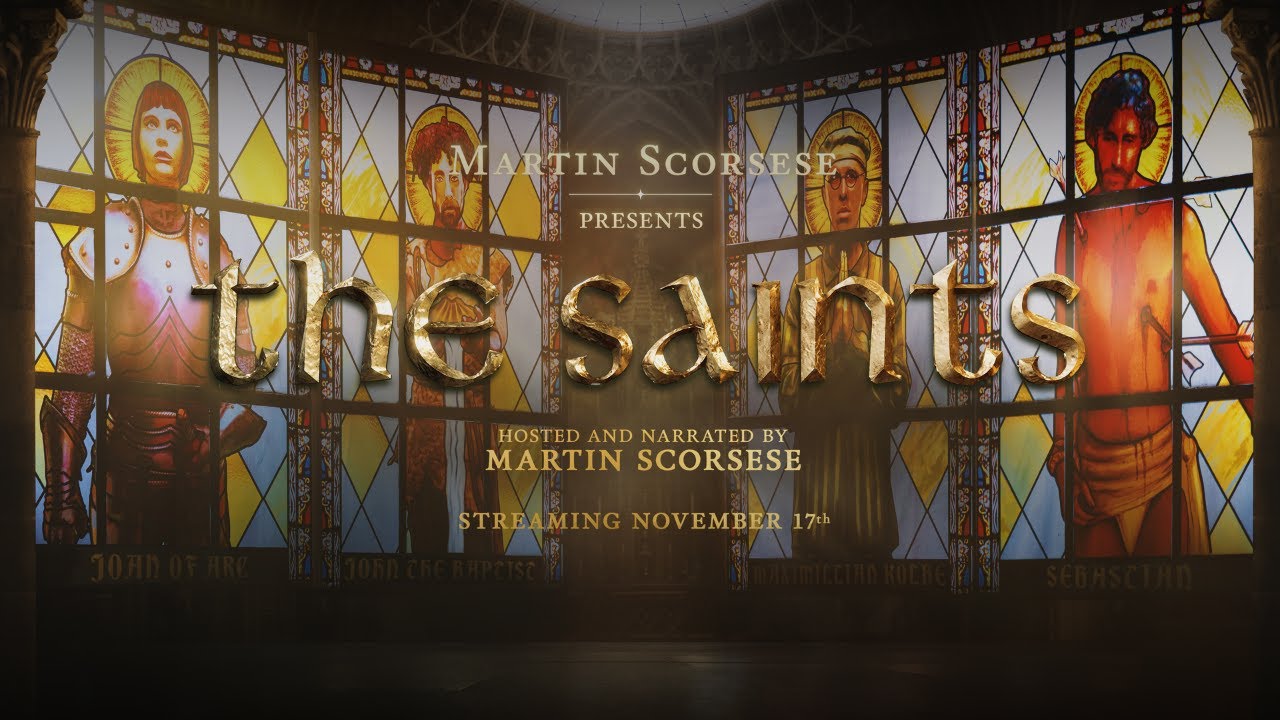
Martin Scorsese – new streaming series on four saints – 17 November

It is often the case that, no matter how far people may stray, faith is the last thing to flicker out.

Martin Scorsese has coming out a streaming series on four saints: John the Baptist, St. Sebastian, St. Joan of Arc, St. Maximilian Kolbe.

The trailer is intriguing, but I am apprehensive.


YouTube thumbnailYouTube icon

I refused to see his movie version of the ghastly novel by Shusaku Endo’s book Silence. I wrote about that HERE.

There is a hollywood tendency.  If something or someone is holy, they have to do knock it down.  It’s as if they can’t stand that something simply be good.  They have to besmirch in some way, as Peter Jackson did in his LotR with Aragorn and Faramir.   So, I am apprehensive about what Scorsese has down to these saints.

John the Baptist
Sebastian
Joan of Arc
Maximilian Kolbe

All four are martyrs.  Is there another common thread?


Posted in Saints: Stories & Symbols | Tagged
8 Comments

Rome 24/10 – Day 37: Wherein Fr. Z rants

Morning sun movement became visible at 06:47. It will disappear from view at 17:00.

Thank you for this day, Lord.

The Ave Maria rings at – according to the errant curial calendar – 17:30. But that’s wrong.  It should now be in the 17:15 cycle.

On this dies non I said a Daily Requiem for Poor Souls. As a matter of fact, I just got that intention yesterday, so I brought it to the head of the line.

The Requiem Mass is so beautiful with the Dies Irae.

Quaerens me, sedisti lassus:
Redemisti Crucem passus:
Tantus labor non sit cassus.

Welcome registrants:

TomasDelRio
marcolajolla62

The tail end of some “premium content” sent out to Roman Donors. I am so grateful to them.

In churchy news…

In Florida the abortion amendment was defeated! HERE I know that a great many churches – and there are a lot (of different kinds, splinters) – had NO! signs out.

The late, former Exorcist of Rome, Fr. Gabriel Amorth, said that demons try to possess politicians. HERE Well… duh! Shall we talk about leaders in the CHURCH?

At National Catholic Register, there is a piece about the mainly American (I think) phenomenon of moving priests so often, allowing a man to be pastor for maybe 12 years and then shoving him out. HERE In the Latin Church’s Code of Canon Law, can. 522 says,

Can. 522 – Parochus stabilitate gaudeat oportet ideoque ad tempus indefinitum nominetur; ad certum tempus tantum ab Episcopo dioecesano nominari potest, si id ab Episcoporum conferentia per decretum admissum fuerit.

So…“A pastor must enjoy/have stability and therefore is fitting that he be appointed for an indefinite period of time”. However, in the next part: “He can be appointed by the diocesan bishop only for a specific period if the conference of bishops will have permitted through a decree.”

The clear intent of the law is that pastors, “the parish priest”, in normal circumstances have a long time in his parish.

Most of the priests I talk to think this appointment for 6 years, with another 6 possible years is terrible. They are just getting into the place and they get moved. When they get to baptize the children of the children they baptized… then they’ve gotten settled. Will some have other opinions? Sure. Are parishes different from each other? Sure. Are there bad fits that have to be adjusted? Sure. But you get the idea.

Most priests I know think that this term limiting of pastors is also a dodge that bishops use so they don’t have to work things through with pastors who are perhaps “troublesome” for them. They just wait them out and move them.

Most priests I know think that moving priests so often over time gives people the idea that the priest isn’t really in charge. They come and go. The lay staff is the stable element.

Therefore, there is no “father” in the parish. This is also part of a war on men and boys, which manifests also in the sanctuary.

Take a look at that piece.

At a substack called WM Review, there is a provocative piece about whether or not, because of the change to the rites of ordination after the Council, we will have validly consecrated bishops in the future.

This question comes up once in a while because it is an important issue and there were significant changes to the rites of ordination of priests and of bishops under Paul VI.  The changes to the ordination for priests were concerning enough that John Paul II in 1990 put things back into the rite that Paul VI took out.  Rites should make explicit exactly what they are supposed to do.   For example, the post-Conciliar Book of Blessings has “blessings” that don’t explicitly bless things with a constitutive blessing (as opposed to an invocative blessing).  The forward to the Book of Blessings states that it is trying to eliminate the distinction.   Change the rite, you just might change the effect.   And WE ARE OUR RITES.  How we pray impacts what we believe and, hence, how we live, and vice versa in a complete intertwined loop of influence.

The rites of ordination were significantly changed after Vatican II, so it is entirely normal that one might wonder about them.

HOWEVER… in view of the ordination of priests the late great Michael Davies wrote a book called Order of Melchisedech: A Defence of the Catholic Priesthood – US HERE  Davies tackles the changes to the rites after the Council, pointing out the problems.  However, he argues that the rites DO ordain validly despite the changes.   That said, he also brings up the issue of the intent of the ordaining bishop.   Folks… I am working from my memory about Davies’ book, which I read a long time ago.   If I put my foot wrong there, please correct me.  Davies argues (I think) that so long as the bishop has the correct theology of priesthood, ordination, etc., then the rite is just within the bounds of valid.  However, if over time the theology of priesthood and ordination is eroded through modernist machinations – and believe you me that is EXACTLY what they tried to do to us in seminary in the 1980’s! – then all bets are off.   In any event, the WM Review pieces comes down on the side of invalidity.  I don’t agree.

However, this is a question that will not go away easily.   Why?  I mentioned my seminary in the USA.  I did two years of hard time at the hell-hole that was the Saint Paul Seminary in the late 80’s.  I finished in Rome.  However, we were not to use the word “priest” (which we called “the P word”), because we are all “ministers”, some ordained and some non-ordained.  In our class which was supposed to be on Priesthood and Eucharist, but which was called something like Ministry and Symbol, we were told, that – I am not making this up –

“when the ordained minister says the words of institution [not consecration] over bread and wine no real change takes place – they become a symbol of the unity of the community gathered there in that moment.”

Yup.  Really.

How many things are wrong with that?

I objected.  I asked how that jived with transubstantiation.  The heretic priest – who left the priesthood to shack up with a female seminary faculty member after celebrating the invalid marriage ceremony of disgraced musician David Haas – replied that the Church no longer teaches transubstantiation.   I asked when that happened.  Vatican II.   I asked why Paul VI, after Vatican II, wrote in his 1965 encyclical Mysterium fidei said the opposite and that we have to use “transubstantiation”.  He became furious.  He said I was locked up in irrelevant Aristotelean categories, blah blah blah.  I responded: “I grew up Lutheran.  Even Lutherans believe more than you.”   Soon after, the rector had a heart attack.  This heretic became rector.  He threw me out the next day.  It was after that, on the advice of a priest friend, that I pray to the Little Flower St. Thérèse for help.  The next day I received signs of roses all day long.  That night, the Auxiliary Bishop (now a retired Archbishop) called me with the news that I was not being thrown out.  (This is why I have a wreath of roses on my chalice.)

But did you get what that heretic said?  For him, the Eucharist symbolized, but not in a real way, the unity of the community (not the Body Blood Soul Divinity of Christ), gathered there (just localized) in that moment (not in an enduring way such that you would reserve it in a tabernacle).   That’s worse than Rahner’s bizarre ideas about sacraments celebrating pre-existing realities!

But that’s not all!   What danger could these heretic jerks have had for the knowledge and faithful of future priests and future bishops?

Channeling his inner Schillebeeckx, there are no priests in the sense of sacramentally ordained.  The community calls forth presiders for their “eucharist” (see above for what he believed about eucharist!) who embody who the community is.  As the community changes, or the one called forth changes, that person returns to the assembly and another is called forth to preside.

THAT’s what we got in seminary in the 1980’s.

So … is there any reason ever to wonder about the intention of some men who were formed for priesthood in those years?

Yes.  However, those notions I wrote above are so weird, so far out, that very few men indeed would buy them and remain a priest for any length of time after ordination.  Very few.  And it would be unlikely that men believing that complete crap would be made a bishop.

It certainly has happened that there were some – maybe now are – some bishops with such  screwy ideas.  I have in mind one in the Amazon…. and I don’t mean my wish list.  But are there bishops who have zero connection to authentic Catholic theology of priesthood and ordination. It would have to be demonstrated to me with solid proofs and not just claims because the bishop is … sub-optimal in some ways.

Jesus founded our Church.  Jesus will take care of our Church.  That doesn’t mean that the Church will survive “woke” in the USA or in the Amazon or in Rome!   It means that Jesus will maintain the Church in some form with valid sacraments – valid Holy Orders – no matter what is inflicted on her from without or from within. Christus vincit!  Christus regnat! Christus imperat!

In chessy news… HERE

From Paul VI’s  Mysterium fideiMy emphases:

REASONS FOR PASTORAL CONCERN AND ANXIETY

9. There are, however, Venerable Brothers, a number of reasons for serious pastoral concern and anxiety in this very matter that we are now discussing, and because of Our consciousness of Our Apostolic office, We cannot remain silent about them.

False and Disturbing Opinions

10. For We can see that some of those who are dealing with this Most Holy Mystery in speech and writing are disseminating opinions on Masses celebrated in private or on the dogma of transubstantiation that are disturbing the minds of the faithful and causing them no small measure of confusion about matters of faith, just as if it were all right for someone to take doctrine that has already been defined by the Church and consign it to oblivion or else interpret it in such a way as to weaken the genuine meaning of the words or the recognized force of the concepts involved.

11. To give an example of what We are talking about, it is not permissible to extol the so-called “community” Mass in such a way as to detract from Masses that are celebrated privately; or to concentrate on the notion of sacramental sign as if the symbolism—which no one will deny is certainly present in the Most Blessed Eucharist—fully expressed and exhausted the manner of Christ’s presence in this Sacrament; or to discuss the mystery of transubstantiation without mentioning what the Council of Trent had to say about the marvelous conversion of the whole substance of the bread into the Body and the whole substance of the wine into the Blood of Christ, as if they involve nothing more than “transignification,” or “transfinalization” as they call it; or, finally, to propose and act upon the opinion that Christ Our Lord is no longer present in the consecrated Hosts that remain after the celebration of the sacrifice of the Mass has been completed.

12. Everyone can see that the spread of these and similar opinions does great harm to belief in and devotion to the Eucharist.

Play
Posted in SESSIUNCULA, Wherein Fr. Z Rants |
10 Comments