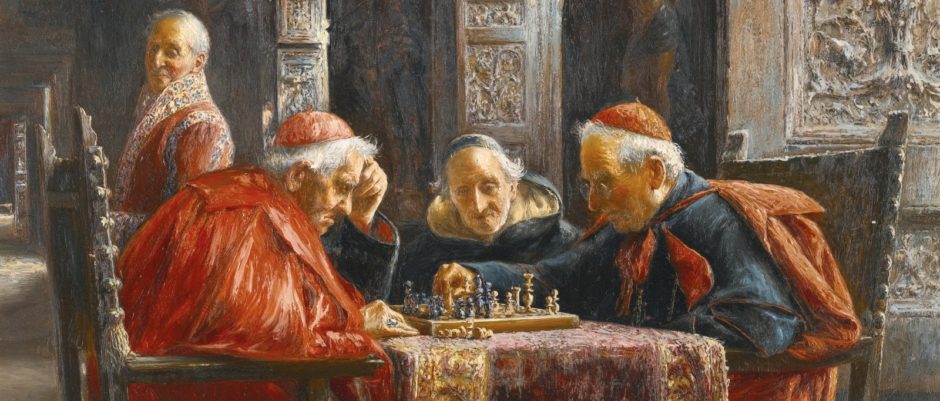
The protesters were very young, very angry, and very well-dressed.

No, this is not about the Occupy Wall Street idiots, with their roasted beat with goat-cheese and spinach salads.

A friend sent me a note about this fun story from Breitbart.

You know that something has gone dreadfully wrong when young people are defending the image of Our Lord from desecration and their bishops seem to prefer to stand back and defend free speech.

French far-right Christians besiege Jesus excrement play [Well… there it is!]

Paris police have arrested around 20 Christian fundamentalists [Oh, really?  Hugonots?  Nah… read on.] who burst into a theatre and threw stink bombs to protest against a play featuring the face of Christ drizzled with fake excrement.

Police made the arrests at the Theatre de la Ville, on the banks of the Seine near Notre Dame cathedral, during a performance of “On the Concept of the Face, Regarding the Son of God”, directed by Italian [figures] Romeo Castellucci. [Coward.  He didn’t write a play about the desecration of an image of Mohammed, did he.  Feeble attempt to shock the middle class, as I take it.  But the protesters, were perhaps not so middle class.  Read on.]

The play, which runs until October 30, is the story of an incontinent man being looked after by his son.

A copy of a huge portrait of Christ by Renaissance artist Antonello da Messina [Wonder which.] hangs at the back of the stage and appears to be covered in excrement towards the end of the performance.

After days of trying to get in, the protesters on Wednesday “entered the theatre and threw stink bombs into the auditorium, shouting: ‘Enough Christianophobia!‘” a police source told AFP.  [Wonder what that was in French.]

France’s ministry of culture blamed the demonstration on members of the Institut Civitas, which in April protested US artist Andres Serrano’s renowned “Immersion Piss Christ” photograph in the southern papal city of Avignon. [Good for them.]

Civitas head Alain Escada said: “Our mission is to spread the word about this performance and to organise a response.”

[Here’s the money quote….  and it just gets better every time you read it!] A spectator described the protesters as “very young people who are very angry but very well dressed.” Faced with a police cordon, they throw eggs and oil at the theatre and those going in, chanting in Latin or praying on their knees.  [They were, therefore, not French bishops.]

The association of French Roman Catholic bishops on Tuesday condemned “the violence perpetrated during recent performances… France’s Roman Catholic Church is neither fundamentalist nor obscurantist (opposed to enlightenment).”  [Who else but French bishops would use the word “obscurantists” to distance themselves from defending images of the Lord even as they are being desecrated.]

Dramatic luminaries including Juliette Binoche and Michel Piccoli have joined a committee to support the theatre, while Civitas has called for a mass demonstration “in Christ’s honour”.  [I will never like Juliette Binoche movies again!]

It’s insulting at the end of a scatological play to sully the portrait of Christ by making people believe that it’s faecal matter that has dirtied it, wounding so many believers,” the Insitut Civitas said on its website.

You decide.

Let’s first look at it this way:

I am in favor of the...

View Results

Now let’s see it this way:

Concerning desecration of the image of Christ in public for the sake of art.

View Results

Chose your best answer and give your reasons in the combox, below.

DO NOT engage each other in the combox.  Let everyone have their say.
Do not respond to them or engage them.


Posted in Our Catholic Identity, The Drill, The future and our choices, The Last Acceptable Prejudice | Tagged , , , , , ,
84 Comments

QUAERITUR: Praying “ad orientem” as a family in the home

From a reader:

Since I have found your blog, I have read it with much interest. You
recently had a post regarding “ad orientem” at Mass. What would be
“proper”/traditional way to have a catholic family pray. We often pray in a circle but should a family all be facing the East when praying?

When I write about prayer “ad orientem” I am thinking mainly about our official liturgical worship.

However, when you are praying together in the home, if you have a crucifix or an image of Our Lord on the wall in a prominent spot, why not “orient” your prayer toward it? Seems like a good idea? No? Everyone facing the same way, all towards a nice crucifix, or an image our Our Lady when saying the Rosary (though she always redirects our gaze back to her Son) could also help relieve any sense of self-consciousness someone might have.

That said, how happy I am to have this question be about prayer in the home!

Holy Church has referred to the family home as “the domestic Church”. As an image of the sacred and consecrated place we know as a “church”, the family home should also be filled with prayer. A church or family home without prayer is like a ruin or tomb.

The important thing is to pray, no matter which way you face.

Posted in "How To..." - Practical Notes, ASK FATHER Question Box, Our Catholic Identity | Tagged , ,
22 Comments

QUAERITUR: Attachment to Sin, Indulgences, and You.

purgatoryAs I write it is All Hallows Eve, the Vigil of the Feast of All Saints.  As November begins will are called upon by Holy Church to pray in a special way all month long for the Poor Souls, whom we may help by obtaining indulgences.

I have written elsewhere about some of the indulgences, plenary and partial, we can obtain.

A reminder in brief: An indulgence is the remission of some or all of the temporal punishment due, in God’s justice, to sin that has been forgiven.  The remission is granted by the Church, through her use of “the power of the keys” given by Christ to bind and to loose, through the application of the super-abundant merits of Christ and of the saints. Indulgences are not pardons for sins, past or future.  It is no sort of “grant of immunity”, as it were, which is so stupid a notion as to be dismissed out of hand as beneath our consideration.  Indulgences concern the penance we owe in justice for sins which have been forgiven.  Indulgences are applied to the poor souls who are, in justice, being purified in purgatory and in that state dealing with the penance due for the forgiven sins they committed in life.  We can help them in their time of penance and purification by performing works which the Church has prescribed.  Indulgences are full (plenary) remission of all temporal punishment or partial.

Several people have written with a measure of dismay to ask how it is possible for us to obtain plenary indulgences.  They assert that it is pretty much impossible because one of the conditions is that we must have no attachment to any sin, even venial sins.  How, they wonder, can be be without any attachment to sins?

First, consider that Holy Church, in laying down this condition, nevertheless believes that you can, in fact, gain the indulgences!  Holy Church, the greatest expert on humanity there has ever been, is confident that you can perform these works and also make an act of will against all sins, even venial sins.  Holy Church would not offer something that it impossible to obtain.

We are members of a fallen race, susceptible to the problems that arise from the world, the flesh and the devil.  We are always in a state of striving while in this world.  We often fail, but we must always keep striving.

We can, in fact, habituate ourselves to making an act of will against all sins.  We can do this!

Just as you habituate yourself to be grateful to God for all His gifts by praying before meals and after, just we we habituate ourselves with acts of the will to love God above all creaturely things by making acts of faith, hope and love during the day, just as we habituate ourselves to check our actions and words carefully by making a daily examination of conscience, we can also habituate ourselves truly to hate sins and desire not to commit them.  We can have the intention, the desire, not to sin even when realistically we know that we are still poor sinners in need of graces and mercy.

Before performing an indulgenced work make an act of will against all sins and ask God to take away all attachment for any sins you might habitually or even infrequently commit, moral or venial.

People habituate themselves and organize their time around all sorts of worldly pursuits.  They will move heaven and earth to be able to park themselves in front of a television for a sports event on a certain date.  They will make plans to go to the opening of a new movie.  If we do these things, which are passing and ephemeral, can we not be even more dedicated to watching for opportunities for gaining indulgences?  Think of the benefit.  We have pleasure from watching a ballgame and we prepare around the event.  But by plenary and partial indulgences we help souls in purgatory who, in turn, will be grateful for our help and will pray for us before God’s throne when they enter into the happiness of heaven, perhaps in part because of YOUR prayer!

As Catholics, it should be part of our identity and regular practice to avail ourselves of the great treasure Holy Church offers from the merits of the Sacrfice of the Lord and of the saints.  We should, as a normal part of our lives, develop the habit of seeking indulgences.  Therefore, we should keep close track of the liturgical calendar.  Priests should announce opportunities for indulgences during announcements at Mass and in the bulletin.  We should help each other gain them, for example by going together with people to a church on its patronal feast or to a cemetery during November, etc.

This is what Catholics do.

It is all about developing habits.  This can take some time, but the rewards are far more than the effort we spend on them.

You can indeed make an act of will to detest sins and desire not to commit them.  You can do this.  It takes some practice, so that it becomes easier, but … you should be doing that anyway, indulgences in view or not.

Posted in "How To..." - Practical Notes, ASK FATHER Question Box, Brick by Brick, Our Catholic Identity, The Drill | Tagged , , ,
28 Comments

England: Confraternity of Catholic Clergy formed and now active!

Some time ago I mentioned in these electronic pages that in England some good, loyal, faithful, holy priests were forming a Confraternity of Catholic Clergy.

Here is an update received from one of their organizers.

British Confraternity of Priests Meets to Pledge Fidelity to Pope
Benedict

The First Colloquium of the British Confraternity of Catholic Clergy
was held on Thursday/Friday at the Reading Oratory School.

More than sixty of a rapidly growing number of the Confraternity
priest members were present along with Bishop Mark Davies of
Shrewsbury and Bishop Geoffrey Jarrett of Lismore, Australia. Two
former Anglican bishops, Mgrs Andrew Burnham and Edwin Barns, along
with several new priests of the Ordinariate of Our Lady of Walsingham,
also attended.

At a time when priests in some countries are gathering in opposition
to Church discipline and traditional doctrine, a broad cross section
of priests from Britain are rallying around a call of fidelity to the
Pope and the Magisterium.

Bishop Davies spoke about authentic priestly identity using the
example of the Cure d’Ars. He reminded priests of their awesome
vocation of making Jesus Christ present in their lives and ministry.
He encouraged priests to live lives of deep prayer and penance, and a
patient zeal in bringing about true reform and renewal in the Church.
He received rapturous applause from the priests. Bishop Jarrett
brought the good wishes of the Australian Confraternity of Catholic
Clergy and spoke encouragingly of how that Confraternity, over
twenty-five years, had played a very significant role in supporting
clergy and even providing new bishops. Mgr Andrew Wadsworth, director
of ICEL and prominent member of the Confraternity, spoke of the need
to seize the moment of new translation of the Roman Missal as an
opportunity for liturgical renewal.

The time together was fuelled by prayerful and dignified liturgy, with
daily Mass, the Divine Office, Adoration of the Blessed Sacrament, and
the opportunity for confessions.

The Confraternity, set up in Britain very recently, has already
attracted very large numbers of priest members, and these continue to
grow. A spokesman for the Confraternity said, ‘The mood here is
different to that found in other new priestly associations. Priests
here want to be in the orthodox mainstream, faithful to Scripture,
Tradition and the Magisterium. Other things have been tried and
failed. The only thing these priests are rebelling against is
infidelity’.

The Confraternity meets several times each year in local chapters
around the country. It exits to promote formation, fraternity and
fidelity amongst the clergy. It is hoped that the Colloquium will be
an annual event and that an annual retreat will also be offered.
Members in Britain are united with well over a thousand priests in
Australia and the US. There is a general gathering of the
Confraternities in Rome every five years.

More information on the Confraternity and future events can be found
on the web-site: www.confraternityccb.org.uk

Posted in "How To..." - Practical Notes, Brick by Brick, Our Catholic Identity, The future and our choices | Tagged ,
6 Comments

BISHOPS/PRIESTS PAY ATTENTION

From ANH:

Occupy Vancouver movement almost takes over Catholic church

Vancouver Archbishop Michael Miler [Miller] anticipated the march of protesters and requested extra police protection outside the cathedral to prevent the disruption of the mass.

Organizers of the Occupy Vancouver movement almost took over the Holy Rosary Cathedral in downtown Vancouver on Sunday morning.

Vancouver Police stopped the protesters from disrupting mass at the Catholic church. A spokesman for the group, which renamed itself Occupy Vatican, said the purpose of the aborted church takeover was to bring to the Catholic Church’s attention the thousands of residential school survivors who suffered under the clergy. [In most civilized places it is illegal to interrupt a religious service in a church.]

However, some members of the Occupy Vancouver movement said that the Occupy Vatican movement did not secure consensus at their Saturday night general assembly and was not supported by the majority of protestors.

Vancouver Archbishop Michael Miler anticipated the march of protesters and requested extra police protection outside the cathedral to prevent the disruption of the mass.

[…]

Posted in The future and our choices, Throwing a Nutty | Tagged ,
16 Comments

Platitude Cookie Alert

Ugh. Isn’t there a Latin proverb that covers this?

20111031-122406.jpg


Posted in What Fr. Z is up to | Tagged ,
7 Comments

And what would you like with that stake?

Posted in Lighter fare | Tagged ,
2 Comments

KC Star refuses to report other side regarding Bp. Finn and Diocese. Refuses even to take paid ad.

How deep can anti-Catholic bigotry run in the mainstream press?  Read on.

At Serviam I noticed this, in reference to the situation of the Diocese of Kansas City-St. Joseph and the embattled Bishop Robert Finn.

I’ve said previously that the [newspaper – Kansas City] Star had failed in its responsibility to accurately and fairly cover news concerning the Diocese of Kansas City-St. Joseph and in particular, Bishop Finn.  I’ve worked in the media.  I’ve worked at the Star.  I know bias exists and that it is allowed to skew coverage.  But I never suspected it to be THIS bad. Now it seems that the Star has taken it to the next level.  It seems to be so committed to its liberal, anti-Catholic agenda that it won’t even allow a paid ad on its pages presenting the facts that the Star has failed to report.  The Catholic League offered $25,000 to the cash-strapped paper to run an ad.  In spite of the fact that The Star routinely sells full page ads locally for less than $5000, they refused the Catholic League’s $25,000 ad.  You can read the ad here.

Now the Star has failed two constituencies – the community and its shareholders who are bleeding money.  The community can do little other than find other news sources.  I imagine the McClatchy shareholders will be a little more vocal.

Go to The Catholic League here.  Read and get a little angry.

It might be time for priests in KC to walk around the block where the Star is housed chanting the maledictory psalms and sprinkling holy water.  Were they to use blessed salt, they might be hauled in.

Psalms 58 [I am not making this up.  It’s really in the Psalter.]

To the choirmaster:
A Miktam of David, when Saul sent men to watch his house in order to kill him.

1 Do you indeed decree what is right, you gods? Do you judge the sons of men uprightly?
2 Nay, in your hearts you devise wrongs; your hands deal out violence on earth.
3 The wicked go astray from the womb, they err from their birth, speaking lies.
4 They have venom like the venom of a serpent, like the deaf adder that stops its ear,
5 so that it does not hear the voice of charmers or of the cunning enchanter.
6 O God, break the teeth in their mouths; tear out the fangs of the young lions, O LORD!
7 Let them vanish like water that runs away; like grass let them be trodden down and wither.
8 Let them be like the snail which dissolves into slime, like the untimely birth that never sees the sun.
9 Sooner than your pots can feel the heat of thorns, whether green or ablaze, may he sweep them away!
10 The righteous will rejoice when he sees the vengeance; he will bathe his feet in the blood of the wicked.
11 Men will say, “Surely there is a reward for the righteous; surely there is a God who judges on earth.”

Posted in Biased Media Coverage, Clerical Sexual Abuse, The Drill, The future and our choices, The Last Acceptable Prejudice | Tagged , , , ,
35 Comments

John Rist on the “white paper” from the Pontifical Council for Justice and Peace

Someone pointed out that Rod Dreher conveyed some remarks of a thinker to whom I do pay a great deal of attention. Apparently, John Rist, an eminent scholar of St. Augustine and a moral philosopher and ethicist, spoke about Caritas in veritate at Mount St. Mary’s in Emmitsburg.   Since many people think there are parallels between Caritas in veritate and the “white paper”, Dr. Rist’s comments can be applied to the new “white paper”.

I had several courses from Dr. Rist at the Augustinianum. This guy’s got game. I recommend What is Truth?: From the Academy to the Vatican. Try also his Real Ethics: Reconsidering the Foundations of Morality (hard) and also Augustine: Ancient Thought Baptized. (Obligatory for anyone who reads Augustine or any of the Fathers or who studies late antiquity.)

Here are Rist’s remarks.  As a preface, I think it is too precipitous to attribute the notions in the PCJP “white paper” to Pope Benedict without filters.  I suspect they come rather more from the Secretariate of State, which may or may not have in mind what Pope Benedict thinks.  Remember that the “white paper” (as I call it) is called by the PCJP a “Note”.  It doesn’t have a signature and there is no indication that Benedict approved it or ordered its publication.

Perhaps the area where the encyclical comes closest to looking wildly over-optimistic is its discussion of the reform of the UN: certainly a matter of raw politics and not merely of economics. Benedict wants to say both that we need an overarching political authority, and that the present one will not do, but he seems to underestimate the difficulty, at the purely political and ideological level, of possible reform, and to mention but then underestimate certain features of the present international order which are seriously threatening to the promotion of his own world view. The United Nations Organization, in its purely political role, was set up at the end of the Second World War with the primary purpose of avoiding serious conflicts between nations which might lead to a nuclear World-War Three. Its core was the Security Council and its permanent members, but these were selected not on moral grounds but in virtue of the fact that they were the major powers of the day: those powers which, in alliance, had overthrown Nazi Germany and Imperial Japan. The General Assembly was to consist of the whole gamut of states in the world, but neither the Council nor the Assembly had any intrinsic moral authority, except that which the Council and a few others had acquired in virtue of being recent victors. And the aims of members of the Security Council, then as now, were to control abuses of power or what was treated as such, by others, not by themselves. Thus a Security Council member could condemn genocide by others but disallow any interference in its own internal affairs – if not in theory at least in terms of Realpolitik. That meant that the effectiveness of the UN depended on the wishes of its individual members, pursuing their private interest however defined or justified, and that any injustice, if sanctioned by a veto-wielding Security Council member, could be achieved with impunity. And of course even if a state (or would-be state) was to be condemned for its policies, as for example, was North Korea, it could only be brought to book if one of the more powerful countries, normally the United States, wished that this should happen.

That must be one of the reasons for Benedict’s view that the UN should be given more teeth, but the suggestion is not only politically impossible, but potentially dangerous (cf. 71). At the moment the UN is politically successful in controlling the behaviour of its member states only when the United States wishes that to happen (and not always then): hence some success in Korea and Kosovo and Bosnia and Iraq, but none whatsoever in Rwanda or Zimbabwe or Tibet. So it is a matter of power-politics, as it was with its predecessor, the League of Nations, which collapsed when a reasonably powerful state, namely Fascist Italy, decided to ignore its decrees, and no-one was willing to act to enforce them. If that situation had confronted the present UN, the Italians would probably have been restrained if the United States had been willing to enforce UN decrees, and had not been thwarted by other Security Council members; otherwise not. So to give the UN more military power would amount to little more than providing a fig-leaf (whether needed or not) for the military power of some of its members regardless of their moral reputation.

That looks bad enough, but the long-term moral problems for Benedict’s agenda are still greater. The UN is now taking upon itself the role of maker of international law, thereby extending its remit (formally at least, though it probably had some sort of tacit remit to proceed in the Charter itself) to include intervention not only between but within individual states: precisely what the Soviet Union, at the outset, wished to resist, and which many powerful states, including Russia, still want to resist when it suits them. But now I am less concerned with the practical than with the theoretical results of all this. The acceptance of the UN as a body fitted to make universal laws about human rights, genocide, etc means that it is in effect taking on the role of God, whose very nature is the nature of natural law, in most versions of the natural law tradition. But now God becomes the decrees of the Security Council, a body to which I for one, and doubtless many others, am not committed as a believer, and the results of that odd circumstance can be recognized in at least two respects: first that the decrees of a human organization are taken to be of overriding importance, though again – remember the case of Goering – formulated by processes and by the agency of those who believe only in positive law: which can be made and re-made. Thus again, as with intra-national legislation, positive law comes to pose as natural law, though it is proposed without reference to the principles by which alone natural law can be expressed. Nor in the future is there any reasonable likelihood that this situation will change, and in Augustine’s view – Him again, yes indeed – it will never change, human nature and its capacity for constructing what recent popes have called structures of sin being likely to remain as they are.

And a second point: the result of all this is absurdities in practice as well as in theory: thus Libya was the state recently in charge of the UN policy on human rights. There is little reason why – to put it crudely – any of us should regard the whims of a collection of dictators as a useful guide to the nature of natural law – nor for that matter the aims of well-financed lobby groups like Planned Parenthood and similar non-governmental agencies with excessive influence over politicians. Of course, in theory the Vatican knows all this perfectly well, not least in its constant but ineffectual efforts to restrain the UN’s pro-abortion policies world-wide. What needs further reflection is whether an international body, given even more authority, is going to be any more amenable. Again, Augustine, in the City of God and speaking of at least nominal and sometimes more than nominal Christian rulers, would advise extreme caution. The diversity of languages, according to his reading of the story of the Tower of Babel, was God’s way of preventing too much centralized and tyrannical control. For once power to act as God is given to a human body, and especially a single human body, the very principles of Benedict’s documents will be overthrown. As the old Roman poet put it, “Quis custodiet ipsos custodies?” (Who will guard the guards?”). Benedict is clearly aware of the risk (as in 71) but seems to underestimate it. Indeed principles of subsidiarity and of a world authority seem to be necessarily and intrinsically in radical conflict – unless we are going to be very clever indeed and helped in a manner not to be assumed by the grace of God (who, for his part, did not like being put to the test at Meribah).

The clergy have always been better at formulating what we ought to do than at telling us how to do it. The Crusades – though not without some merit were not an unmitigated success either politically or morally, neither was the advice given about burning people by her bishops to Mary Tudor – which even her husband, the king of Spain, thought unwise – nor was the behaviour of Cardinal Pacelli as nuncio in handling the ever-growing National Socialist movement, as the leaders of Catholic political parties in Germany discovered to their cost. Recent popes – including this one – have told us that the church does not want to be a political animal, only to point out eternal moral truths; it seems that more thought needs to be given as to how this admirable distinction is to be worked out in practice, and that that thought should take more heed of the old maxim “If you sup with the Devil, you need a very long spoon”. So that if Benedict’s non –Augustinian optimism about the human social prospect is to be vindicated, we do indeed need more thought not about only principles – Benedict has laid many of these out admirably in the present encyclical – but about means, about the relationship, that is, between the City of God and the earthly city.

Posted in The Drill, The future and our choices | Tagged , ,
12 Comments

Writing to priests, bishops, nuncio, Vatican offices with praise, rather than complaints

My friend Fr. Ray Blake posted to his blog about an outstanding idea (slightly edited).

[A] number of Scottish dioceses are going to become vacant soon, the same is true in England. What should one do? Write!

Write to the Congregation of Bishops

His Eminence Marc Card. Ouellet,
Prefect of the Congregation for Bishops
Palazzo della Congregazioni
Piazza Pio XII
00120 Vatican City

Write to the Nuncio

His Grace
Archbishop Antonio Mennini
Apostolic Nuncio to the Court of St. James
54 Parkside,
Wimbledon London SW19 5NE

Write in praise of good and faithful priests. The Holy See is always pleased to hear of men who would make good bishops. The one complaint I hear from priests in Roman dicasteries is that they hear too little from Britain.

Before and after and whilst you write pray, pray for holy priest and even holier bishops.

For the sake of those on the other side of the Atlantic:

His Excellency
Most Reverend Carlo Maria Viganò
Apostolic Nuncio to the United States of America
Apostolic Nunciature
3339 Massachusetts Avenue NW
Washington DC 20008

You might want to review my tips about how to write to a bishop or an office of the Holy See. Those notes have to do more with lodging complaints or perhaps petitioning for the use of the provisions of Summorum Pontificum, but they can be applied also to writing to thank someone or praise another. Of course in your letters of praise it okay to write about how you feel about the topic, but don’t go over the top into hagiography.

My experience is that many of the people who rouse themselves to write do so from ire or frustration.  As a result their missives are generally negative in content and in tone.  However, positive letters are very welcome and obtain real attention especially in that they are the so much rarer.

Consider writing positive letters to your priests and bishops when you see something going well.

Posted in "How To..." - Practical Notes, Brick by Brick, Our Catholic Identity |
4 Comments























