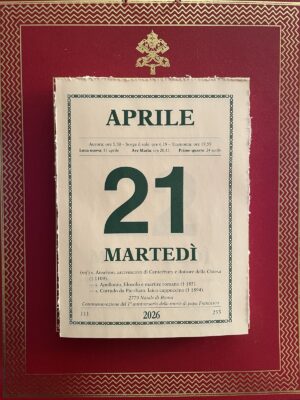
 Today it was 06:19 when Pyrois, Eous, Aethon, and Phlegon bore the chariot of Helios into the view of Rome.
At 19:59 the same “Fiery One”, “He of the Dawn”, “Blazing” and “Burning” will take dimming cart into West.
The Ave Maria Bells is slated to chime at 20:15.
In the Novus reckoning this is the Feast of St. Anselm of Canterbury, Doctor of the Church (+1109). What would he think about Canterbury now?
Welcome Registrants:
LatinMassServer
Rod
Francis died one year ago, today.
Happy birthday Rome. Rome was founded on 21 April 753BC pic.twitter.com/1NldfOxX3c
— Roman History (@romanhistory1) April 21, 2026
Yes, today is the 2779th Birthday of Rome!
Alme Sol, curru nitido diem qui
promis et celas aliusque et idem
nasceris, possis nihil urbe Roma
visere maius.
Q. Horatius Flaccus
Carmen Saeculare
A reason to post the sunrise and sunset while in Rome.
In the great church of St. Augustine here in Rome you will find near the door to the sacristy the the funerary monument of the scholar Onofrio Panvinio (1529 Verona – 1568 Palermo). He figured out the dating of the founding of Rome, the dates we often see with the abbreviation A.U.C. (Ab Urbe Condita). As you know that condita comes from condo, condere, cónditum and not condio, condíre, condítum. If not, we would be saying “From the (year) the City was pickled” rather than “From the (year) the City was founded”. We get “condiments” from the later. In Latin it is good to get the accents right, as in the Vespers hymn Cónditor alme siderum, just to throw another “alme” in today for spice.
Admire his stony countenance captured in cold marble, and say a prayer for the repose of his soul.
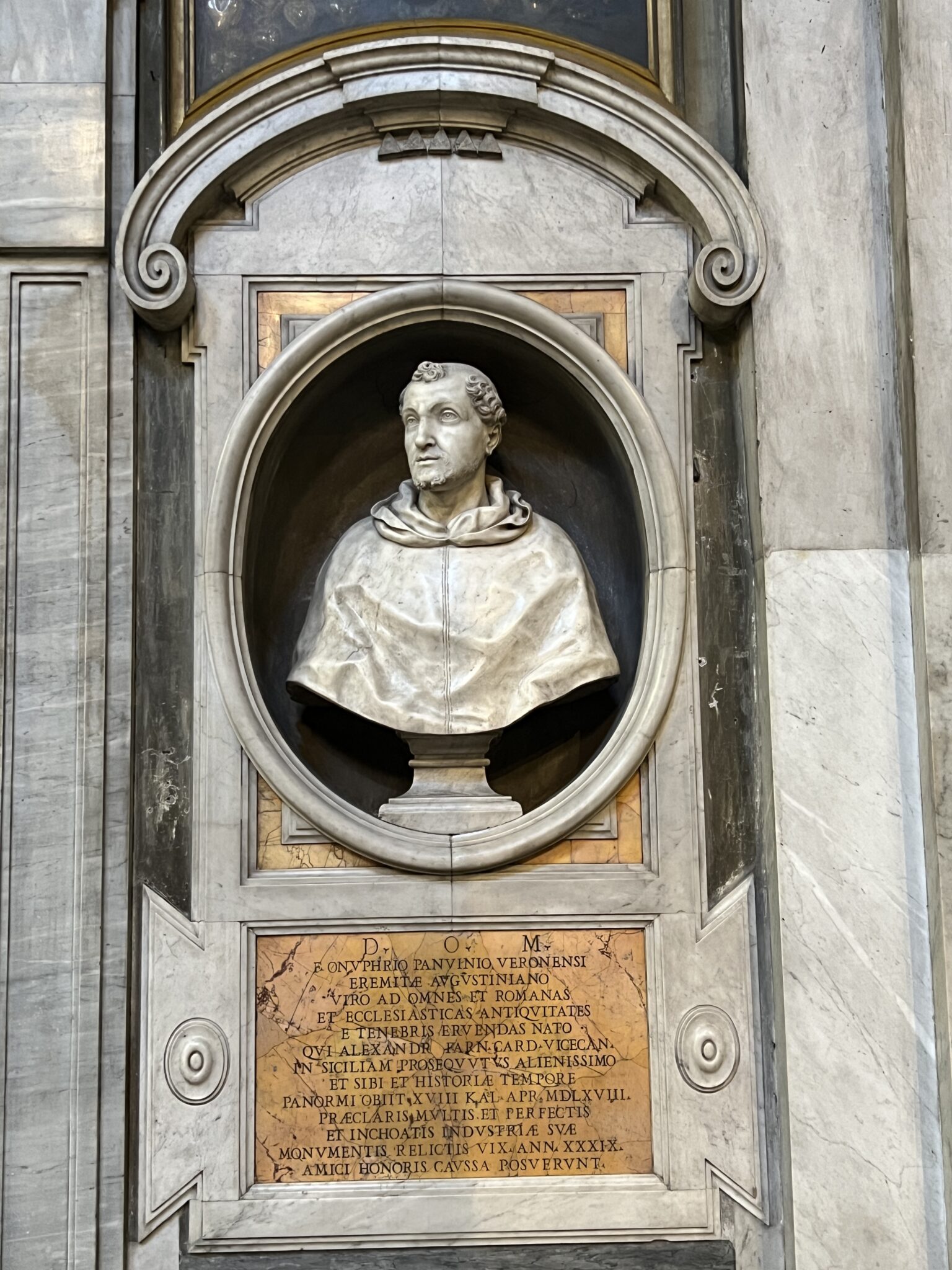
Onofrio was an Augustinian and great scholar. He is the author of such page turners as the 1557 work Fasti et triumphi Rom. a Romulo rege vsque ad Carolum V. Caes. Aug.:Sive epitome regum, consulum, dictatorum, magistror. equitum, tribunorum militum consulari potestate, censorum, impp. & aliorum magistratuum Roman. cum orientalium tum occidentalium, ex antiquitatum monumentis maxima cum fide ac diligentia desumpta. A ripping yarn!
Here is his monument inscription. Go ahead and take a crack at it!
D.O.M.
F. ONVPHRIO PANVINIO VERONENSI
EREMITÆ AVGVSTINIANO
VIRO AD OMNES ET ROMANAS
ET ECCLESIASTICAS ANTIQVITATES
E TENEBRIS ERVENDAS NATO
QVI ALEXANDR FARN. CARD. VICECAN.
IN SICILIAM PROSEQVVTUS ALIENISSIMO
ET SIBI ET HISTORIÆ TEMPORE
PANORMI OBIIT XVIII KAL. APR. MDLXVIII
PRÆCLARIS MVLTIS ET PERFECTIS
ET INCHOATIS INDVSTRIÆ SVÆ
MONVMENTIS RELICTIS VIX. ANN. XXXIX.
AMICI HONORIS CAVSSA POSVERUNT.
And take a crack at this.
White to move and mate in 4.

NB: I’ll hold comments with solutions ’till the next day so there won’t be “spoilers” for others.
BONUS:































White mates in 4:
1. Qxg5+ Kf7 (any other move leads to immediate mate)
2. Qf6+ Ke8 (can’t take the Queen; Black’s Knight is pinned)
3. Ng7+ Kd7
4. Qe6++.
As an Englisman and a Catholic, I stand by my assertion that the See of Augustine is sede vacante, and the last occupant was Reginald Cardinal Pole. This may put me in a minority or at odds with the sensibilities of those in the current Sees of the Catholic Church, but would be grateful for other people’s opinions on the topic.
*Saint Pope Francis. Pope Leo has mentioned that Saint Pope Francis is in heaven three times now.
Arthur Jackman in the 1914 Catholic Encyclopedia article “Reorganization of the English Hierarchy” (as transcribed for New Advent by Herman F. Holbrook) writes “On 29 September, 1850, by the Bull ‘Universalis Ecclesiae’, Pius IX restored the Catholic hierarchy in England which had become extinct with the death of the last Marian bishop in the reign of Elizabeth. Westminster became the metropolitan see and its occupant the lawful successor of the Catholic archbishops of Canterbury.” And “By letters Apostolic, ‘Si qua est’, of 28 October, 1911, Pius X erected the new provinces of Birmingham and Liverpool. With Westminster remained the suffragan Sees of Northampton, Nottingham, Portsmouth, and Southwark”. Providing a lot more detail, his comments include ” before new sees could be formed it was felt necessary to erect more ecclesiastical provinces out of the already abnormal extensive province of Westminster. That this was the object in view seems clear from the concluding words of the Bull: “We have reserved to ourselves the taking of further measures in this matter of the reconstitution of the English dioceses, as shall seem opportune, and as experience may suggest and the good of souls require.” If all that is accurate, it would seem that in 1914, Westminster was no longer ‘the’ metropolitan see, but its archbishops remained the successors of the Catholic archbishops of Canterbury, but I am not sure what has happened since then, or how best to find out expediently! For what it is worth, the Wikipedia article “Catholic Church in England and Wales” includes “In recent times, the former Conservative Cabinet Minister John Gummer, a prominent convert to Catholicism and columnist for the Catholic Herald in 2007, objected to the fact that no Catholic diocese could have the same name as an Anglican diocese (such as London, Canterbury, Durham, etc.) ‘even though those dioceses had, shall we say, been borrowed’.”
Venerator Sti Lot –
I heard a poem once that had the line “What was once London, is now Westminster, what was Manchester, Salford, and what was York, Hudderfield”…
Although both Anglican and Catholic churches have a diocese of Liverpool.
I’m fine with the name changes, but wish our bishops in England and Wales would show a bit more backbone, especially in today’s society where the Catholic church in England is more muscular than previous, and the Anglican sensibilities of the country are pretty much extinct.
Looking – so far unsuccessfully – for English translations of any early Life or Lives of Pope St. Leo IX, I encountered the detail that King St. Edward the Confessor had vowed to go on pilgrimage to Rome, but found himself unable to do so – whereupon, Pope St. Leo accepted his plan to refound Wesminster Abbey instead.