Daily Rome Shot 1018

I received some mail from the TMSM PO BOX.  Included was a book by a longtime reader who is its author.  It is full of clever things to exercise your mind… and patience.

101 Enigmatic Puzzles: Fractal Mazes, Quantum Chess, Anagram Sudoku, and More

US HERE – UK HERE

There are hard puzzles in this book.

A few of the puzzles are chess related.  Here is one of them.

This is a different kind of puzzle.  I am puzzled by the punch line (the intersection of the diagram, obviously) although the observation about Baptists is funny.  Who can help me with this?  Frankly, I couldn’t care less about Taylor Swift and wouldn’t know a song of hers if it bit me on the leg.  But the notion that there is any connection between her and Aristotle… other than both being carbon-based lifeforms… I dunno.

Please remember me when shopping online and use my affiliate links.  US HERE – UK HERE  WHY?  This helps to pay for health insurance (massively hiked for this new year of surprises), utilities, groceries, etc..  At no extra cost, you provide help for which I am grateful.

A somewhat more conventional puzzle… white to move and mate in 2.

Nice people! Great service!

NB: I’ll hold comments with solutions ’till the next day so there won’t be “spoilers” for others.

In chessy news, I am sad to report that my guy Wesley So got bumped down into Division 2 of the chess.com Classic where he also had a rough day. I’m a bit surprised, given his opponents. Also strange was world #4 Nepo losing to world #282 Denis Lazavik and world #2 Fabi losing to Velimir Ivic #204, who also beat world #20 MVL.  These are not over-the-board (OTB) games, but rather online.  The players are supposed to have additional video cams behind them or viewing them to prevent outside help.   The games are also broadcast on a delay.

50% off on premium memberships at chess.com right now.  HERE

And speaking of broadcasts, I’m hoping against hope that one of the commentators tomorrow will not be Tania.  When she isn’t just repeating what others say, she can offer some excellent comments.  However, there are times when her voice quite simply etches multiple glass surfaces.  I have to either keep the volume low or, when I am not multitasking keep my finger over the mute button when things get tense.  That’s when the volume and pitch go way up.  Every other word is pumped up.  To be fair, along the lines of those last qualities, Danny and Danya get every bit as screechy as teenage girls when there are time rush blunders.  Chess is hard.

Meanwhile, in Warsaw, OTB Rapid concluded with Round 9.  The players go on to 18 rounds of Blitz.   China’s Wei Yi (#10) is in the lead with 5 straight wins and undefeated Magnus is second, one point behind.

I miss Rome.  In any event, thank you, O Lord, for this new day.

UPDATE:

I found an open source equalizer to add to my computer to scale down the upper-range.  It doesn’t solve the problem but it helps.

I was a little surprised not to find an equalizer built into Windows.  Strange.


Posted in SESSIUNCULA | Tagged
3 Comments

10 May: St. Job

Many of the figures in the Old Testament are commemorated by Holy Church as saints.

Here is the entry in the 2005 Martyrologium Romanum:

1. Commemoratio sancti Iob, admirandae patientiae viri in terra Hus.

We could talk about Job all day and into next week or next year.


Posted in SESSIUNCULA |
3 Comments

Daily Rome Shot 1017: revived

In the street projecting from The Parish™ in Rome, there is a tiny chapel, associated with the aforementioned Parish but somehow through time acquired and controlled by the office of the Italian government now housed in the old Monte di Pietà (a sort of loan institution which countered the loan operations in the nearby Jewish quarter back in the day).

This chapel was dedicated to Maria Succurre Miseris… Mary, Help of the Wretched.  At some point the beautiful painting of Mary was relocated to the Parish, where it is now, and a rather stingy image of the Pietà was unceremoniously put in its place.

Recently, an agreement was reached whereby the Parish would take care of the chapel.  Hence, cleaning and sprucing and the placing of flowers.   The flowers will surely attract the eyes of the many… many… people who pass on that busy walking route.

Photos from The World’s Best Sacristan.

Here is the painting that was in the chapel.  It receives a great deal of attention from people.  Many people light candles on a daily basis.

A prayer.

Please remember me when shopping online and use my affiliate links.  US HERE – UK HERE  WHY?  This helps to pay for health insurance (massively hiked for this new year of surprises), utilities, groceries, etc..  At no extra cost, you provide help for which I am grateful.


Yesterday was day 2 in the chess.com Classic.  This determines in what divisions players will compete.  In a rather surprising turn, Maxime Vachier-Lagrave, Fabiano Caruana and my guy Wesley So were knocked down to Division 2 by lower rated players. Head-scratching results, frankly.

This puzzled left me puzzled until I puzzled it out. The solution involves a tactic.  Black to move.

NB: I’ll hold comments with solutions ’till the next day so there won’t be “spoilers” for others.

Posted in SESSIUNCULA | Tagged
1 Comment

9 May: Feast of St. Isaiah, Old Testament Prophet

Today is the feast of St. Isaiah.  Yes, that is Isaiah the Prophet.  Many of you might not know that great figures of the Old Testament are considered saints by the Church, though they are not remembered at the altar for Mass.

Here is the entry about Isaiah from 9 May in the Martyrologium Romanum.  Maybe one or more of you you can take a crack at it?  It isn’t too difficult.

1. Commemoratio sancti Isaiae, prophetae, qui, in diebus Oziae, Iotham, Achaz et Ezechiae, regum Iudae, missus est ut populo infideli et peccatori Dominum fidelem et salvatorem revelaret, ad implementum promissionis David a Deo iuratae.  Apud Iudaeos sub Manasse rege martyr occubuisse traditur.

There are quite a few interesting depictions of Isaiah and one of the most dramatic moments for the great prophet, the purification of his lips by a seraph with a burning hot coal.

Here is Marc Chagall’s rendering. Note the Cross in the background to the left.

Isaiah 6 we have the calling of the prophet.  In 740 BC Isaiah had a vision of Heaven while he was in the Temple.   He is terrified and says (v. 5):

“Woe is me! For I am lost; for I am a man of unclean lips, and I dwell in the midst of a people of unclean lips; for my eyes have seen the King, the Lord of hosts!”

A seraph comes to him with a burning coal from the Temple altar and touches it to Isaiah’s mouth saying: “Behold, this has touched your lips; your guilt is taken away, and your sin is forgiven” (v. 7). God then asks whom he can send as a prophet to his people and Isaiah responds: “Here I am! Send me”.

First, purification.  Then, then commissioning.

During Holy Mass (Vetus Ordo) the priest reads the Gospel at the altar, because the reading is also a sacrifice.   Before he reads, or the deacon sings, they says two prayers, one about purification and the other about the mission of reading:

Cleanse my heart and my lips, O almighty God, who didst cleanse the lips of the prophet Isaias with a burning coal, and vouchsafe, through Thy gracious mercy, so to purify me, that I may worthily announce Thy holy Gospel. Through Christ our Lord. Amen.

Give me Thy blessing, O Lord. The Lord be in my heart and on my lips, that I may worthily and in a becoming manner, proclaim His holy Gospel. Amen.

I still have that painting by Chagall in my mind’s eye, with a view of the Cross, therefore the Eucharistic Sacrifice, in the background, rather, in the future.

The altar of Sacrifice is the prime locus of the raising heavenward of the Word to the Father.  Ancient Greek Fathers saw a connection between the coal of Isaiah and the Eucharist and the theme of “deification”, whereby by God’s work in us we become more like God in whose image and likeness we are made.  This is what the Eucharist does when received in the state of grace.  We convert normal food into what we are.  The food of the Eucharist converts us more into what HE is.  Appropriately, we celebrated today also the Feast of the Ascension, which reminds us that our human is seated at the right hand of the Father in an indestructible bond with the Son’s divinity.  St. John Damascene wrote in An Exposition of the Orthodox Faith 4.13.  Earlier, St. John discourses on wood and fire and charcoal.  Here he is expounded on reception of the Eucharist.  Note that this includes a description of Communion on the hand.  HOWEVER, it also describes touching it to the eyes, etc., which indicates not so much a literal description of how Communion was received but rather a spiritualized description:

Wherefore with all fear and a pure conscience and certain faith let us draw near and it will assuredly be to us as we believe, doubting nothing. Let us pay homage to it in all purity both of soul and body: for it is twofold. Let us draw near to it with an ardent desire, and with our hands held in the form of the cross let us receive the body of the Crucified One: and let us apply our eyes and lips and brows and partake of the divine coal, in order that the fire of the longing, that is in us, with the additional heat derived from the coal may utterly consume our sins and illumine our hearts, and that we may be inflamed and deified by the participation in the divine fire. Isaiah saw the coal.  But coal is not plain wood but wood united with fire: in like manner also the bread of the communion is not plain bread but bread united with divinity. But a body which is united with divinity is not one nature, but has one nature belonging to the body and another belonging to the divinity that is united to it, so that the compound is not one nature but two.

This might be a good time to remind you, before Sunday, to …

GO TO CONFESSION!

Posted in GO TO CONFESSION, Patristiblogging, Saints: Stories & Symbols | Tagged
3 Comments

Daily Rome Shot 1017

The photo does not do it justice.

Please remember me when shopping online and use my affiliate links.  US HERE – UK HERE  WHY?  This helps to pay for health insurance (massively hiked for this new year of surprises), utilities, groceries, etc..  At no extra cost, you provide help for which I am grateful.

At the Rapid and Blitz in Warsaw, the lowest rated seed, Kirill Shevchenko (a Ukrainian playing under the Romanian flag) went 3 for three to lead the pack after day 1 with a score of 6/6. Magnus and Nodirbek follow with 4/6. It is, of course, still early days.  At 33 years old, Magnus is the oldest player!

Meanwhile, it’s blacks move. Mate in 3.

NB: I’ll hold comments with solutions ’till the next day so there won’t be “spoilers” for others.

Priestly chess players, drop me a line. HERE

I am sorting mail these days, which piled up during my Roman Sojourn.  One thing I am doing is looking for things to read for a new edition of News of the Church.  I immediately noticed interesting news of from the wonderful Benedictine nuns of Gower Abbey in Missouri, the Benedictines of Mary, Queen of Apostles.  So, stay tuned.

Meanwhile, they have two new music CDs (and downloads).  One of them focuses on martyrs.  Here are three tiny tastes.  I like that they put the famous Ut queant laxis into the collection.  I did a podcast about it back in 2007!

US HERE – UK HERE

Let’s see if we can sell out all the discs and break the downloads.

You get their music.  They get more income.  They open more daughter houses.  More room available for vocations and happy traditional nuns.

See how that works?

Also, lest I forget, the chess.com Classic is revving up.  Several of the players are also playing in Warsaw.  There were real fireworks yesterday, with some spectacular blunders (which I find consoling) and missed mates (which I do often when playing fast).  The highly unlikeable Hans Niemann with what was probably a mouse-slip blundered his queen. He’s out.  Play continues today.  Several players have already made it to Division 1 because of past performances, including Magnus.

Because this is a chess.com event, chess.com is offering discounts on premium memberships (there are free memberships, too).

Go Wesley!

Posted in SESSIUNCULA |
2 Comments

Christ’s Ascension and His Lordly Feet

There are many images of the Lord’s Ascension to heaven through history, and rightly so.  With the Annunciation, the Ascension is perhaps the greatest of all the Feasts of the Lord and for our own humanity.  Imagine!  Our humanity, taken into an indestructible bond with the Lord’s divinity at the Annunciation, with the Ascension is seated – RIGHT NOW  – at the right hand of the Father.

Now HE.  Later WE.

The Ascension is an article of the Creed and it behooves us to reflect on it.

The depictions of the Ascension I like the most are the medieval illustrations which show the Apostles, often with Mary, looking upward as a pair of lordly Feet at all that remains to be seen.

The Ascension of Christ, historiated initial ‘C’, Italy, 15C (State Library of Victoria, RARES 096 IL I)

Who better to turn to for some insight into this than Ratzinger?

From the site Ignatius Insight, providing an excerpt from “The Ascension: The Beginning of a New Nearness,” from Joseph Ratzinger’s Images of Hope: Meditations on Major Feasts (Ignatius Press, 2006 – UK HERE).  My emphases and comments:

You are surely familiar with all those precious, naïve images in which only the feet of Jesus are visible, sticking out of the cloud, at the heads of the apostles. The cloud, for its part, is a dark circle on the perimeter; on the inside, however, blazing light. It occurs to me that precisely in the apparent naïveté of this representation something very deep comes into view. All we see of Christ in the time of history are his feet and the cloud. His feet—what are they?

We are reminded, first of all, of a peculiar sentence from the Resurrection account in Matthew’s Gospel, where it is said that the women held onto the feet of the Risen Lord and worshipped him. As the Risen One, he towers over earthly proportions. We can still only touch his feet; and we touch them in adoration. Here we could reflect that we come as worshippers, following his trail, close to his footsteps. Praying, we go to him; praying, we touch him, even if in this world, so to speak, always only from below, only from afar, always only on the trail of his earthly steps. At the same time it becomes clear that we do not find the footprints of Christ when we look only below, when we measure only footprints and want to subsume faith in the obvious. The Lord is movement toward above, and only in moving ourselves, in looking up and ascending, do we recognize him.

When we read the Church Fathers something important is added. The correct ascent of man occurs precisely where he learns, in humbly turning toward his neighbor, to bow very deeply, down to his feet, down to the gesture of the washing of feet. It is precisely humility, which can bow low, that carries man upward. This is the dynamic of ascent that the feast of the Ascension wants to teach us.

In the readings for the Sunday after Ascension, what does Peter teach us?  Charity covers a multitude of sins!

Let’s have a few more images of the Ascension of different styles, animi caussa!

From the Parisian Missal

With footprints on his blasting off pad.

And there is the more, “It’s a bird!  It’s plane!” style.

Note the reactions…

Getting a helping hand.  Christ is carrying a scroll.  What could be written on it?  It must mean something.

Here’s 15th c. Flemish version where we see Christ getting to the right hand of the Father.  Nice!

Posted in SESSIUNCULA |
5 Comments

The Lord’s Ascension and Roman Beans

We have lovely customs in our wonderful Roman Catholic Church, including special blessings on certain feast days, often tied to the changing of the seasons… in Rome, that is.  It’s the Roman Church, after all.

Tomorrow, the Feast of the Ascension of the Lord – on THURSDAY – was and is decorated with the opportunity to bless beans.

In Rome at this time of year the “broad beans” are usually at their peak. Broad beans are best enjoyed simply with pecorino cheese and cold white wine.  The combination of which is a material proof of God’s love.

The connection of this time of year in the Roman calendar with beans is ancient indeed.  Remember: I am not talking here about a certain attention seeking, bomb-throwing, hopped-up would-be-theologian sociologist.  I mean the vegetable.  Although… the two  often produce similar “after effects”.

During May in ancient Rome the master of the house would walk around the dwelling on the nights of the Lemuria (9,11, 13) waving beans to ward of evil spirits.  On the Kalends of June (1 June) there was a pagan feast of the Sacrum Carnae Deae when beans and bacon were offered in sacrifice and consumed.  In fact, the June Kalends were called Kalendae Fabariae.  Latin faba is, of course, “bean”, and the Italian is still the same, “fave”.

The essentials don’t change much.  For this feast the ancient Romans ate a mess of beans and bacon.  Any excuse, right?

In his Fasti the poet Ovid writes of beany blessings:

Pinguia cur illis gustentur larda Kalendis
Mixtaque cur calido sit faba farre, rogas?
Prisca dea est, aliturque cibis quibus ante solebat,
Nec petit adscitas luxuriosa dapes.

I enjoy Ovid… it just rolls and rolls out so effortlessly.

In any event, beans and bacon were as big back then as they are now.  It’s amazing how consistent we are.  You get much of the same effect with your fave and pecorino cheese (salty fat).

And don’t forget the awe inspiring fave in tegame.

The the ancient Roman cookbook complied in the 4th c. and attributed to Apicius (US HERE – UK HERE), there are various bean and pea recipes. A good one.  HERE and HERE

Pisam Vitellianam sive fabam (Peas or Beans à la Vitellius)

Pisam coques lias. teres piper, ligusticum, gingiber, et super condimenta mittis vitella ovorum, quae dura coxeris, mellis uncias III, liquamen, vinum et acetum. haec omnia mittis in caccabum et condimenta quae trivisti. adiecto oleo ponis ut ferveat. condies pisam, lias, si aspera fuerit. melle mittis et inferes.

Peas or beans with yolks are made thus: cook the peas, smoothen them; crush pepper, lovage, ginger, and on the condiments put hard boiled yolks, ounces of honey, also liquamen, wine and vinegar; mix and place all in a sauce pan; the finely chopped condiments with oil added, put on the stove to be cooked; with this flavor the peas which must be smooth; and if they be too harsh in taste add honey and serve.

If you don’t have a lot of liquamen, use garum (or substitute colatura or even Vietnamese fish sauce, which is similar).

A Bean Blessing is not, alas, in the Rituale Romanum, but another blessing, for any sort of food, can be used.

Bring lots of beans, perhaps along with bacon, to Father and ask him to bless them.

Remember that the Rituale in force in 1962 says that blessings are to be done in Latin.  Sorry…I’m not making that up.

I’ll give the Latin below.  The intro is familiar.  In the bean blessing I made plurals and used an adjective rather than genitive.

P: Our help is in the name of the Lord.
All: Who made heaven and earth.
P: The Lord be with you.
All: May He also be with you.

Let us pray.

Bene+dic, Domine creaturas istas fabales, ut sint remedium salutare generi humano: et praesta per invocationem tui sancti nominis; ut, quicumque ex eis sumpserint, corporis sanitatem et animae tutelam percipiant.  Per Christum Dominum nostrum.

Lord, bless + this creature, [beans – “beany creatures”)], and let it be a healthful food for mankind. Grant that everyone who eats it with thanksgiving to your holy name may find it a help in body and in soul; through Christ our Lord.

All: Amen.

It is sprinkled with holy water.

There is a separate blessing for bacon (“lard”… ascension of the lard?):

P: Our help is in the name of the Lord.
All: Who made heaven and earth.
P: The Lord be with you.
All: May He also be with you.

Let us pray.

Bene+dic, Domine, creaturam istam laridi, ut sit remedium salutare generi humano: et praesta per invocationem tui sancti nominis; ut, quicumque ex eo sumpserint, corporis sanitatem et animae tutelam percipiant.  Per Christum Dominum nostrum.

Lord, bless + this creature, lard, and let it be a healthful food for mankind. Grant that everyone who eats it with thanksgiving to your holy name may find it a help in body and in soul; through Christ our Lord.

All: Amen.

It is sprinkled with holy water.

I hope you will all be “full of beans” for this Feast of the Ascension of the Lord!

The recently deceased Fr. Hunwicke – may he rest in peace – once had a fun post about Ascension Beans. HERE

He includes the blessing for grapes… “Benedic +, Domine, hos fructos novos vineae…”.

The Ritual has blessings for all sorts of food items, such as bread and pizza or cake, beer, cheese and butter, birds, eggs, lamb, oils, whatever other food (ad quodcumque comestibile).


Posted in "How To..." - Practical Notes, Hard-Identity Catholicism |
Comments Off on The Lord’s Ascension and Roman Beans

An innovative reform in the Novus Ordo: Vigil of Ascension (2002MR)

In some places the Feast of the Ascension (which since the 4th century has fallen on a Thursday because before that it always would have been on a Thursday) has been transferred to next Sunday, thus making it “Ascension Thursday Sunday”.  That’s just wrong.

The 3rd edition of the Missale Romanum of 2002 provided a Mass for the Vigil of Ascension, which wasn’t in previous editions of the Novus Ordo.

The prayers for the new Vigil of Ascension are not the same as those found in the pre-Conciliar Missale for the Vigil.

In case you don’t have the Latin texts, here are the antiphons for the Vigil. Ant. ad introitum: Regna terrae cantata Deo, psallite Domino, qui ascendit super caelum caeli; magnificentia et virtus eius in nubibus, alleluia. (Ps 67:33,35)  Ant. ad communionem: Christus, unam pro peccatis offerens hostiam, in sempiterum sedet in dextera Dei, alleluia. (Cf. Heb 10:12)

COLLECT (2002MR):
Deus, cuius Filus hodie in caelos,
Apostolis astantibus, ascendit,
concede nobis, quaesumus,
ut secundum eius promissionem
et ille nobiscum semper in terris
et nos cum eo in caelo vivere mereamur.

This was modified from a prayer in ancient sacramentaries such as the Liber Sacramentorum when it was used on Ascension Thursday having its Station Mass at St. Peter’s Basilica.

The eucological formulas (the collection of prayers), for the Ascension could be the oldest prayers we have in the Roman liturgy!  They are found in what was once often called the Leonine Sacramentary, which survived in one 7th c. manuscript in Verona, thus making it what modern scholars call it: the Veronese Sacramentary.

You might not immediately recognize astantibus as being from asto or adsto, which that ascendant lexicon of Latin lemmata, the Lewis & Short Dictionary, says means, “to stand at or near a person or thing, to stand by”  The L&S will also inform you that asto has the synonym adsisto.

If you have ever heard the phrase “to assist (adsisto) at Holy Mass” this is the concept: you are present and actively participating.

Also, during the Roman Canon, the priest describes the people as circumstantes, “standing around”.  This doesn’t mean they there around the altar with their hands in the their pockets (though that happens in the Novus Ordo). Rather, they are there morally and spiritually “around” the altar, participating each according to their vocation and capacity.  So, circumstantes is used to identify the baptized who are present.

The Apostles, who were adstantes, actively participating in the Lord’s Ascension before, during and after the actual moment of the Ascension, both listened to the Lord and watched the Lord.  Similarly, at Holy Mass we actively participate before, during and after the consecration, both by listening to the Lord speak through the texts and watching what the Lord does in the liturgical action.

LITERAL VERSION:
O God, whose Son today ascended
into the heavens as the Apostles were standing close by,
grant us, we beseech You,
that, according to His promise,
we may be worthy both that He lives with us on earth,
and that we live with Him in heaven.

NEW CORRECTED ICEL (2011):
O God, whose Son today ascended to the heavens
as the Apostles looked on,
grant, we pray, that, in accordance with his promise,
we may be worthy for him to live with us always on earth,
and we with him in heaven
.

When the Second Person took up our human nature into an indestructible bond with His divinity we were thereby destined to sit at God’s right hand, first in Christ and then on our own.

Christ makes us worthy, no one else.  Christ alone.  It’s all His.

Because it’s His, it’s ours.

Our Lord’s Ascension brought our humanity to the right hand of the Father in glory, a first-fruit and token of what awaits us.

The Collect for the Vetus Ordo is from the 5th Sunday after Easter.

Deus, a quo bona cuncta procédunt, largíre supplícibus tuis: ut cogitémus, te inspiránte, quæ recta sunt; et, te gubernánte, eadem faciámus.

O God, from Whom all good things come, grant to Your supplicants, we beseech You, as You inspire we may think what is right, as You guide, accomplish the same.

God loves us so much that He makes us cooperators in His action. He gives us good things to do. He then makes our hands strong enough to handle them, such as His works are also our works. As Augustine says, he crowns His own merits in us.

Posted in SESSIUNCULA |
2 Comments

Daily Rome Shot 1016: nap time

Photo from The World’s Best Sacristan™

Nice people! Great service!

White to play.  Mate in 4.

NB: I’ll hold comments with solutions ’till the next day so there won’t be “spoilers” for others.

In chessy news… the Superbet Rapid & Blitz starts in Poland today, 8-12 May. 9 rounds of rapid, followed by 18 rounds of blitz. Magnus and Gukesh are playing.

Please remember me when shopping online and use my affiliate links.  US HERE – UK HERE  WHY?  This helps to pay for health insurance (massively hiked for this new year of surprises), utilities, groceries, etc..  At no extra cost, you provide help for which I am grateful.

Welcome registrant:

Chirchlady

Also, MT… you sent a donation via Zelle. Zelle doesn’t provide an email. Would you please drop me a line so I can send a thank you note?

UPDATE:

BTW… there is a chess.com tournament going on: Champions Chess Tour Chess.com Classic 2024. Big players are involved including my guy Wesley So. (YAY!) It’s Day 1 and it is the “play in” phase, for favorable placement in the next phase. They have coordinated their schedule with the Rapid and Blitz in Warsaw so that those players can also participate from afar (e.g., Jan-Krzysztof Duda, Nodirbek Abusattarov, Anish Giri). As I am watching, Wesley and Fabi drew – they share the lead.


Posted in SESSIUNCULA | Tagged
1 Comment

Daily Rome Shot 1015: Quaeritur and “blind mind”

From a reader:

Now that you are not in Rome and you are not going to cappuccino and a cornetto, what’s for breakfast?

I could have a cappuccino. I have a great machine. However, usually I have very strong black coffee.  I’m back to mostly protein. Today, kielbasa and spicy kimchi.  I’ve missed the kimchi.

HEY!  vb*****@cox.net!  My thank you note to you got kicked back.  New email?

A a Rome Shot.  It is still like a dream to see this.

Please remember me when shopping online and use my affiliate links.  US HERE – UK HERE  WHY?  This helps to pay for health insurance (massively hiked for this new year of surprises), utilities, groceries, etc..  At no extra cost, you provide help for which I am grateful.

Nice people! Great service!

Meanwhile, white will soon find mate I hope.  It’s there and the pattern has a name with.  Go for it!  White to move.


1. Qxg7+ Bxg7 2. Rxg7+ Rxg7 3. Nxf6+ Kh8 4. Rxf8+ Rg8 5. Rxg8#
NB: I’ll hold comments with solutions ’till the next day so there won’t be “spoilers” for others.

I wonder if there is a place to get good kimchi in Rome.  You would think that there would be, right?

In chessy news, lest you be in the dark, I read that Hikaru Nakamura has by now won in one year over $10K in the chess.com “Bullet Brawl”.   In this format each play has only ONE MINUTE.  Whew.  I dunno.

Also, related to chess (of course) but also no, at Chess Base today there is an interesting piece about aphantasiaHERE Aphantasia is the inability to picture things in their “mind’s eye”.   This would related to chess because, at the higher levels, it requires a strong visual memory.  Some players can visualize positions, even many boards.    Think about this… if you have aphantasia, how do you calculate?  Analyze a position?  How can you play chess at all?  How about all the other aspects of life… like… driving?

Anyway, I struggle to visualize past a certain number of moves.  This is going to hold me back a little when I start getting serious.

It is worth your time.

This is also worth your time. I am presently visualizing you clicking the link and buying some beer, even if you don’t like beer, because a) you can give it to a worthy priest and b) you want to help these great Benedictines at Norcia.

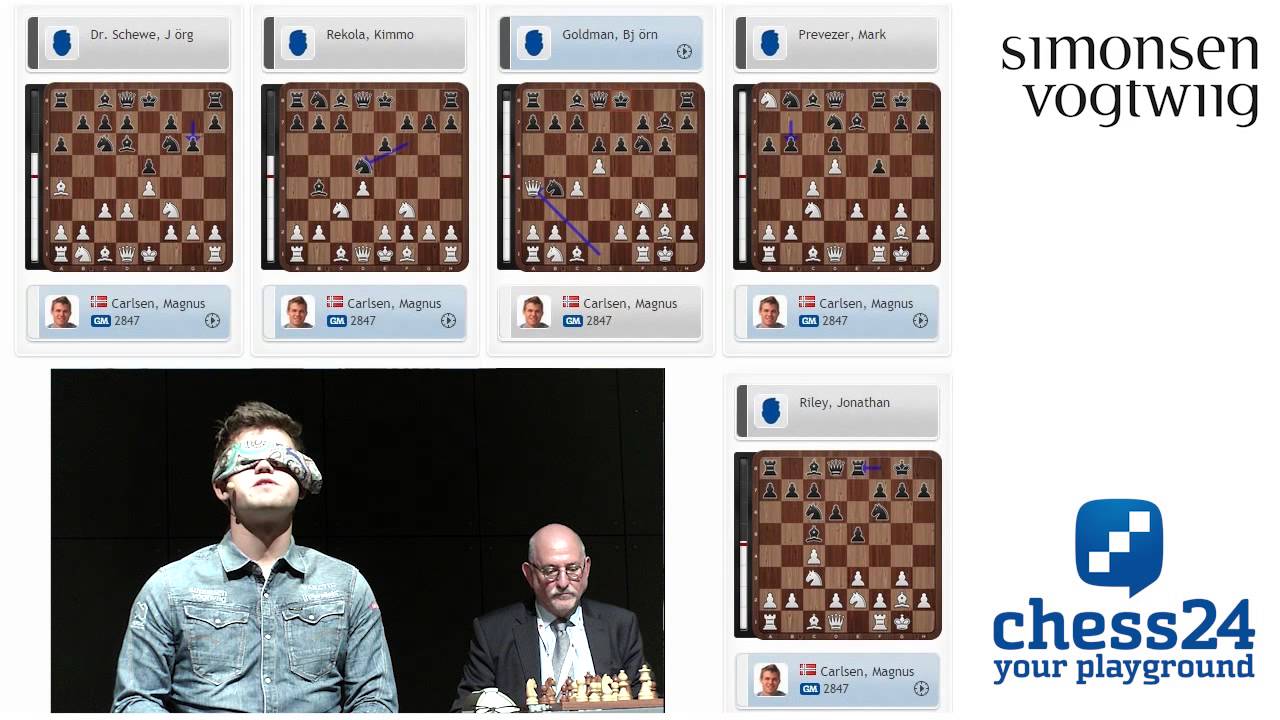
Here’s Magnus playing 5 boards simultaneously while BLINDFOLDED and facing away from the boards.  Note that he plays a different opening on each board.

YouTube thumbnailYouTube icon

It’s just not fair.

Oh yes… it’s a Rogation Day.

Posted in SESSIUNCULA | Tagged
3 Comments