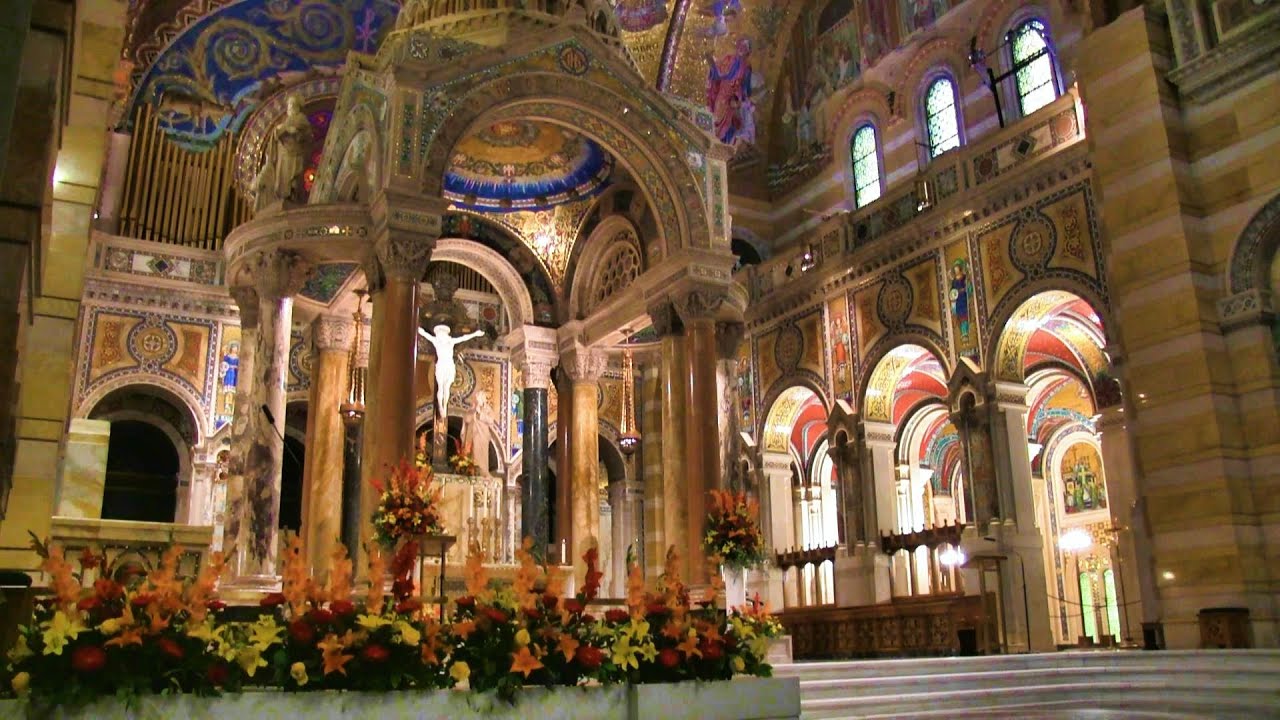
VIDEO: A close look at the pipe organ and the Cathedral Basilica of St. Louis

The Second Vatican Council said that the pipe organ had pride of place among all the instruments used in church for sacred music.  The pipe organ is the “king of instruments”.

Here is a super-geeky close examination of the massive pipe organs in the Cathedral Basilica of St. Louis, certainly one of the grandest churches in these USA.

Firstly, the close look at the pipes and mechanisms of these organs is pretty amazing. You can learn a lot about how they work from this video.

However, a super benefit of the video is the view of the church. You see the interior of the magnificent basilica from angles that you couldn’t possibly arrive at on your own. Even if you know the church well, this video will still delight.

Check it out.

YouTube thumbnailYouTube icon

Posted in Just Too Cool | Tagged ,
7 Comments

ASK FATHER: Do priests who celebrate only in the vernacular really know what they are saying?

From a reader….

QUAERITUR:

I recently discovered the SCDF declaration Instauratio liturgica (Jan. 25, 1974), which says that the meaning of a translated sacramental formula is that of the original Latin, understood according to the mind of the Church.

Especially in the case of not-so-literal translations, this means that, ironically, priests who celebrate sacraments in the vernacular might not actually know what they’re saying. Of course, they understand the vernacular words, but unless they understand them in the same sense as the Latin, which they may have never seen, they don’t fully understand what they’re saying.

To take a concrete example that comes to mind, Bishops’ Conferences have fought to keep from translating “pro multis” literally—successfully in the case of the new Italian Missal. But the Italian priest who says, “per tutti,” is actually saying, “pro multis,” and probably doesn’t know it. I find this terribly ironic given the criticism of priests who say Mass in Latin without understanding well what they’re saying.

The irony flows like a waterfall in spring.

While there is not a manifest question here, there are several implicit questions.

Firstly, can Latin Rite priests really know what the prayer really says if they don’t know Latin?  “What does the prayer really say?”, is an important aspect of prayer, you would think.  It is important for sacred liturgical worship.

Over the many years that I wrote my weekly columns on liturgical translation of the collects, etc., in both the Novus Ordo and the Vetus Ordo, I discovered layers of meaning in the vocabulary and structure that simply can’t be brought into a smooth English version.

If sacramental forms are to be understood according to how the Church understands the LATIN, then that is also the case for the other prayers, such as collects, the Prefaces, the Canon, etc. etc.

I ask often, what does it mean for a community when their priest doesn’t know the language of his own Rite?

Imagine for a moment that a university’s French Department would hire a professor who couldn’t read French.  Imagine for a moment that a medical school would pass through someone who couldn’t pass gross anatomy.    Although I did hear something as deeply stupid as it was troubling the other day.  The Classics Department of a major university has dropped the requirement to learn Greek and Latin.   That means that the dupes who go through the program, at great expense, will get a half-assed degree and, worse, be at the mercy of other people’s translations.

Which sounds exactly like the present state of affairs in Catholic seminaries.

A priest of the Latin Church who doesn’t know enough Latin to celebrate his own Rite is… what?

Another implicit question is, why is this the case? Why is there no Latin when can. 249 explicitly says that seminarians are to be “very well formed” in Latin?

I’m not making that up.

Can. 249 — Institutionis sacerdotalis Ratione provideatur ut alumni non tantum accurate linguam patriam edoceantur, sed etiam linguam latinam bene calleant necnon congruam habeant cognitionem alienarum linguarum, quarum scientia ad eorum formationem aut ad ministerium pastorale exercendum necessaria vel utilis videatur.

How is this translated on the Vatican website?

Can. 249 The program of priestly formation is to provide that students not only are carefully taught their native language but also understand Latin well [FAIL!] and have a suitable understanding of those foreign languages which seem necessary or useful for their formation or for the exercise of pastoral ministry.

Calleo is “to be practiced, to be wise by experience, to be skillful, versed in” or “to know by experience or practice, to know, have the knowledge of, understand”.  Sure, “understand” can translate calleant, but in this context that is the weakest of our choices.  We get the word “callused” from calleo.  We develop calluses when we do something repeatedly.

So, calleo is already “well versed/skilled”. Then bene calleant is “let them be very well versed/skilled”.

Review also Sacrosanctum Concilium 36 and Optatam totius 13, just to point to documents of Vatican II. … unless you “HATE VATICAN II!”, as the libs throw about.

Oh… and by the way… when rectors or others stand up during ordinations to attest before God that the men to be ordained for the Latin Church have been properly trained…. is that true if they have no Latin?

So what are they stating before God and the Church?  Are they telling the truth?  Not objectively, they aren’t.

Latin is necessary.  Its benefits are so numerous that they shouldn’t have to be enumerated.

And yet we are faced today with a clergy of the LATIN Church who are nearly totally ignorant of Latin!

Pope John XXIII in 1962 famously issued an Apostolic Constitution – not some mere encyclical – an Apostolic Constitution called Veterum sapientia in which he mandated the preservation of and teaching and use of Latin.   I am not sure there was another document as blatantly ignored as Veterum sapientia, unless perhaps Ex corde Ecclesiae.

This disastrous situation didn’t happen by mistake.  It was engineered.

The Modernists who had taken the reins with the Council and beyond knew full well that to change the Church’s trajectory into becoming a sort of NGO for globalist unity, they had to unhitch the Church from her moorings. They had to destroy the culture, the ethos of the priesthood.  They had to slam shut the treasury of sacred music, the beauty of which connects people to the Truth.  They had to dumb-down everything so that people would be more susceptible to the “wisdom of this world” that Paul warns against.

The key was the suppression of Latin.

Latin militates against the Modernist project precisely for the reasons John XXIII laid down, as Pius XI had before him.

Thus the “knowledge and use of this language,” so intimately bound up with the Church’s life, “is important not so much on cultural or literary grounds, as for religious reasons.” These are the words of Our Predecessor Pius XI, who conducted a scientific inquiry into this whole subject, and indicated three qualities of the Latin language which harmonize to a remarkable degree with the Church’s nature. “For the Church, precisely because it embraces all nations and is destined to endure to the end of time … of its very nature requires a language which is universal, immutable, and non-vernacular.”

Note that reference to the Church’s nature.

They had to get rid of Latin.

We have to reclaim our Catholic identity.  This is why Latin liturgical worship is important in the face of the cataclysmic demographic sinkhole that is opening up under the Church.

And for those who mewl about Latin being “toooo haaard” or that there are “more impoooortant things to doooo”….

Scorn.

No.

Multitask.  Do the important things remembering that Latin is one of them.

If you can’t learn Latin, then… what are you doing?  Who are you?

Posted in Canon Law, Hard-Identity Catholicism, Latin, Mail from priests, Priests and Priesthood, Save The Liturgy - Save The World, Seminarians and Seminaries, The Drill, The future and our choices, WDTPRS | Tagged , , ,
14 Comments

Daily Rome Shot 214

Posted in SESSIUNCULA |
2 Comments

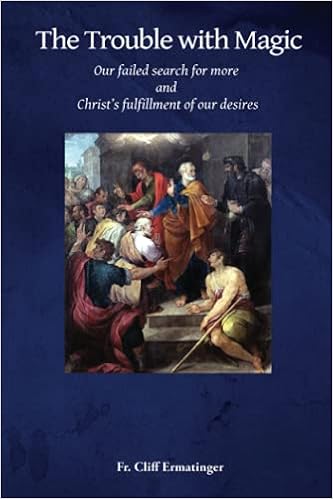
BOOK: The Trouble with Magic: Our Failed Search for More and Christ’s fulfillment of our Desires

A priest friend of mine has published an interesting book about magicwitchcraft.

The Trouble with Magic: Our Failed Search for More and Christ’s fulfillment of our Desires
by Fr. Cliff Ermatinger

US HERE – UK HERE (newly added)

I haven’t read this yet, but I look forward to it.  I’ve been talking to the writer by phone while he has been working on it.  It’s intriguing.   Here’s the description:

The original temptation of Adam and Eve is often depicted as a trivial thing, with our first parents gaining more than they had lost – the ability to choose for themselves good and evil. In this book Father Cliff Ermatinger shows us how what was lost, was far more precious than realized, what was acquired far more reaching in its damage than suspected, and the lengths that God would undergo to restore His lost creation more majestic than imaginable.

The reader is enjoined to come along on an examination of everything that brought humanity to this point in time: from a tree in the garden long ago, mankind’s tendencies towards superstition and turning to gods that cannot save, to the modern shaman in the corner shop that goes by other names: Tarot reader, Yoga guru, , Healer, Social Engineering Overlord. In the end, it is all the trouble with magic.

But this is not the end, for, as Father Ermatinger lays out, God’s ways are not our ways, and He will make straight that which we have broken while bringing the broken human person beyond the lost Eden into perfect communion with Himself.

His other titles are also worth your time! For example:

Rescued from Satan: 14 People Recount their Journey from Demonic Possession to Liberation

The Devil’s Role in the Spiritual Life: St. John of the Cross’ Teaching on Satan’s Involvement in Every Stage of Spiritual Growth

Posted in Mail from priests, REVIEWS, The Campus Telephone Pole | Tagged ,
22 Comments

WDTPRS – 7th Sunday after Pentecost: God can neither deceive nor be deceived

Nadal 7th post PentecostIn the traditional Roman calendar this Sunday is the 7th Sunday after Pentecost.

Today’s Collect survived the cutting and pasting experts of the Consilium to live on as the Collect for the 9th Sunday of Ordinary Time.

COLLECT (1962MR):

Deus, cuius providentia in sui dispositione non fallitur te supplices exoramus, ut noxia cuncta submoveas, et omnia nobis profutura concedas.

Blaise/Chirat (a dictionary of Latin in French) indicates that dispositio is “disposition providentialle”. It has to do God’s plan for salvation. Fallo is an interesting word. It means basically, “to deceive, trick, dupe, cheat, disappoint” and it has as synonyms “decipio, impono, frustror, circumvenio, emungo, fraudo”. Fallo is used to indicate things like simply being mistaken or being deceived. It can apply to making a mistake because something eluded your notice or it was simply unknown. In our Latin conversation it is not uncommon to say nisi fallor, “unless I am mistaken…”. If you look for submoveo you may have to check under summoveo. Find profutura under prosum. Don’t confuse noxia with noxa.

SUPER LITERAL WDTPRS VERSION:

God, whose providence is not circumvented in its plan, humbly we implore You, that You clear away every fault and grant us all benefits.

There is no getting around or circumventing God’s plan.

Why, given who God is and who we are, would we want to try?

But we do, don’t we.

We have to make a choice about which way to go with noxia.  Does it mean “harmful things” that are outside us or that are within us, that is, our own sins, our faults?  Both?

OBSOLETE ICEL (1973 9th Sunday Ordinary Time):

Father, your love never fails. Hear our call. Keep us from danger and provide for all our needs.

ROFL! Quite simply dreadful.  This may be one of the worst I have ever seen.  But we NEVER have to HEAR IT AGAIN.

CURRENT ICEL (2011  9th Sunday Ordinary Time):

O God, whose providence never fails in its design, keep from us, we humbly beseech you, all that might harm us and grant all that works for our good.

We have to make a choice about which way to go with noxia.  Does it mean “harmful things” that are outside us or that are within us, that is, our own sins, our faults?  Both?
God knows who we are and what we need far better than we can ever know ourselves.

Foreseeing all our sins and many faults, all that we say and do is embraced in His eternal plan.

He has disposed all things so as to make glorious things result from the evils for which we alone are responsible.

Sometimes, moreover, it is hard to understand that God actually cares are us.  Given how immeasurably vast God is and how small we are, it is easy for some, mired in earthly distractions, to lapse into sort of deism and imagine a God who created everything and then, like a clock maker, just set the pendulum to swing and stepped away.

There is an old adage that, if you want to know if God is interested in you, just make a plan.

It is good for us each day never to forget to make an Act of Faith, which is a good Trinitarian prayer.

O my God, I firmly believe that Thou art one God in Three Divine Persons, Father, Son and Holy Ghost. I believe that Thy Divine Son became Man, and died for our sins, and that He will come to judge the living and the dead. I believe these and all the truths which the Holy Catholic Church teaches, because Thou hast revealed them, Who canst neither deceive nor be deceived.


Posted in WDTPRS | Tagged
2 Comments

Daily Rome Shot 213

Posted in SESSIUNCULA | Tagged
Comments Off on Daily Rome Shot 213

ASK FATHER: Should I ask for my home to be blessed, but with the Roman Ritual and not the Book of Blessings?

From a reader…

QUAERITUR:

Thank you very much for your continued ministry to all of us who depend on you for clarity in these uncertain times.

I have read many of your posts regarding blessings and I am still somewhat confused. I wish to have my home blessed, I am a convert and have never done so before. However, I have no interest in the sort of good feelings blessing found in the Book of Blessings. Would it be appropriate to ask my parish priest to use a blessing found in the Roman Ritual? Would the blessing need to be done in Latin? Would it be appropriate to remind him to bring blessed salt?

Thank you very much for your time and attention. Please be assured of my prayers.

That’s a good question!   People should have their houses or dwellings blessed.  As a matter of fact in Italy there is still a custom of the local priest going around through neighborhoods to bless dwellings.   Some days in advance, posters are put up in the streets that Father is going to be in the area to bless homes.  When I did this, people were very eager for the annual blessing.  You would go usually with a couple of altar boys to hold things and to carry a basket or two for things that people would give you, such as a bottle of olive oil from their trees, an envelope with money, some eggs from their chickens.  I got a live chicken once.

It is reasonable to ask for the use of the Roman Ritual.  Remember, however, that the blessing in the Ritual is to be done in LATIN.  Some priests don’t have a great facility with Latin.  That could be a problem.   However, a good natured priest will rise to the challenge of doing the blessing in Latin, which isn’t very long.

Even if Father has a hard time with the Latin, it would be better for him to use the Roman Ritual than the dreadful Book of Blessings.  Frankly, I am not sure that there is a specific “blessing” (read: invocation of happy thoughts) for homes in the BoB, at least in the Latin edition.  New houses, maybe.

You should have a big box of salt handy for Father to exorcise and bless, if he hasn’t brought Holy Water.  That salt can be used in blessing Holy Water, can be scattered around your property, and be can be used in food.  That’s a longer prayer, of course.  I made a PRAYERCAzT about the Latin for blessing Holy Water: HERE.

I could be persuaded, were a priest to ask, to record the Latin of the blessings.   I’m not set up yet for really high quality recording yet, but I’d figure something out.

There are prayers for the blessing of homes or places for Holy Saturday and the rest of the Easter Season and then also three prayers for outside of Paschal Time, all three truly lovely in their imagery and content.

BTW… here is a tip, because you don’t know what went on in places and you want the very best environment.

If you move to a new place or do some renovations, such as painting, before you do anything get the priest to come and read the Chapter III exorcism and then go around to every nook and cranny and sprinkle Holy Water.  Every nook, seriously.  Open even every cupboard and drawer. The day I took possession of my new abode, I read Chapter III simultaneously with a priest friend and them we went through the whole place with Holy Water.  I also recently painted my new digs.  Before priming, I anointed every wall with crosses with Oil of the Catechumens, used in the Rite of Baptism for exorcism.  With the plates off the outlets I put in Benedict medals and oil.  I pulled up carpet in a couple of rooms and anointed the floors and, where there were cracks, put in a little more oil.   Those crosses are there now, under the paint and flooring.  They aren’t going anywhere, can’t be removed.

Take that, Scratch!


Posted in "How To..." - Practical Notes, ASK FATHER Question Box, PRAYERCAzT: What Does The (Latin) Prayer Really Sound L | Tagged , ,
4 Comments

ASK FATHER: “Do you know a time with blessed bishops?”

From a reader…

QUAERITUR:

YOU: “reasonable or not, charitable or not, moral or not.” [I wrote that HERE]

Write more about that during history.  I doubt this was different in the past…  pre CV2…  Generally, bishops were ever crooks.  Machiavelians before Machiavel was even born!  Why?  Explain this mystery of evil.  It’s hard to my soul notice that this was ever like that during History.  Do you know a time with blessed bishops?…  Good bishops, when existed?

Explain “this mystery of evil”?  It is the mystery of evil.

Our first parents were unfaithful to God and, through them, terrible wounds were inflicted in our souls.  The “prince of this word”, as Christ called the Devil, the Enemy of our soul, now has a certain dominance over material creation.  The Enemy is very good at being an enemy and we poor fallen mortals have wounds that make it hard to resist temptations.

Was there a time with “blessed bishops”?

Yes and No.

Yes, in every time since the Lord consecrated His Twelve Apostles at

the Last Supper there have been “blessed bishops”.

No, in every time since the Lord consecrated His Twelve Apostles at the Last Supper there have NOT been “blessed bishops”.

Consider that the very first collegial act of the entire Body of Bishops was to abandon the Lord.  There were only Twelve, but they all abandoned Him.  Even John, “the disciple whom Jesus loved”, ran from the Garden of Gethsemane, though He did return to the Cross.   Peter, the Head of the Body of Bishops, who loved Jesus more than the others, denied even knowing the Lord, though he repented and was reconciled and, years later, was martyred in Rome.  One 12th of all the Bishops in the world (at the time) sold the Lord for 30 pieces of silver.

That’s not a great foundation and history has shown time and again that bishops can be and often are rotten to the core.  It has ever been so, it is now, and shall be until the Lord returns.

And before someone jumps into the combox with the old chestnut that St John

Chrysostom said that the floor of Hell is paved with the skulls of bishops … NO!  St. John Chrysostom did not say that.  That doesn’t mean that it isn’t true.  It just means that he did not say that.

The fact is that bishops are men.  The Enemy hates them as men, and hates them even more as bishops.  The Enemy is relentless and smart.  He knows that if a bishop can be turned to a life of vice, or even perhaps possessed, great harm can result to the Church and to the faith of many simple people.  If bad men can be maneuvered into those big chairs, more souls can be twisted away from God.  So the Enemy strikes high. Actually, I don’t believe that many bishops are actively wicked.  Most of the bad one are simply cowards who crumble under pressure of the three perennial forces that we all face: the world, the flesh and the Devil.  That includes, of course, “human respect”.

At the same time, all these Apostle bishops and all their successors are “blessed”.  They are blessed in that the Lord has chosen them.  Mind you always: God does not choose men who are worthy; He chooses those whom it pleases Him to chose.   Consider:

God chose what is foolish in the world to shame the wise; God chose what is weak in the world to shame the strong; God chose what is low and despised in the world, things that are not, to reduce to nothing things that are,  so that no one might boast in the presence of God.  (1 Corinthians 1:27-29)

Bishops are a blessing, even when they are bad at being bishops.   They, like wicked priests, remind us that God is in charge, that God is the true author of holiness of the sacraments and their true administrator.   They, like wicked priests, are a mirror held up to our own responsibilities and failures in the Church.  , in his work The Priest: His Dignity and Obligations, wrote about bad priests, which is doubly, triply applicable about bishops…

The most evident mark of God’s anger and the most terrible castigation He can inflict upon the world are manifested when He permits His people to fall into the hands of clerics who are priests more in name than in deed, priests who practice the cruelty of ravening wolves rather than the charity and affection of devoted shepherds. Instead of nourishing those committed to their care, they rend and devour them brutally. Instead of leading their people to God, they drag Christian souls into hell in their train. Instead of being the salt of the earth and the light of the world, they are its innocuous poison and its murky darkness. St. Gregory the Great says that priests and pastors will stand condemned before God as the murderers of any souls lost through neglect or silence….

When God permits such things, it is a very positive proof that He is thoroughly angry with His people, and is visiting His most dreadful anger upon them. That is why He cries unceasingly to Christians, “Return, 0 ye revolting children . . . and I will give you pastors according to my own heart” (Jer. 3, 14-15). Thus, irregularities in the lives of priests constitute a scourge visited upon the people in consequence of sin.

Turn the sock inside out.   If we see bad bishops and priests at work, venal or cowards or heterodox, then we have to examine our own consciences.   If we get the bishops we deserve, then but looking carefully at those bishops and their deficiencies, we begin to see where we need to apply the remedies.  Gnothi seauton as the ancients said, know thyself.  Bishops and priests are our mirror.

What does that mean when priests – who preach the truth – are being cancelled by bishops far and wide?

Fulton Sheen wrote prophetically in 1948:

“He [Satan] will set up a counter-Church which will be the ape of the Church because, he the devil, is the ape of God. It will have all the notes and characteristics of the Church, but in reverse and emptied of its divine content. It will be a mystical body of the anti-Christ that will in all externals resemble the mystical body of Christ. In desperate need for God, whom he nevertheless refuses to adore, modern man in his loneliness and frustration will hunger more and more for membership in a community that will give him enlargement of purpose, but at the cost of losing himself in some vague collectivity.

“Who’s going to save our Church? It’s not our bishops, it’s not our priests and it is not the religious. It is up to you, the people. You have the minds, the eyes and the ears to save the Church. Your mission is to see that the priests act like priests, your bishops act like bishops, and the religious act like religious.”

That phrase, “hunger more and more for membership in a community” reminds me of the research that has revealed the terrible downturn in belief in what the Church teaches (officially at least) about the Eucharist.   These days, for many Communion is that moment when someone puts the white thing in your hand and then you sing a song (usually about yourself).  “Don’t tell me I can’t have it!  I belong!”

It is a “church” that looks like the Church in a lot of respects.

So, yes, bishops are blessed and, no, bishops aren’t blessed.  They are not blessings for us in one sense, but in another they are.

We have to pray earnestly for our bishops.   The Devil really hates them.  They are men susceptible to the frailties of men, and yet they carry also this great responsibility.  I think it must be very difficult for a bishop to get to heaven.  Great graces are needed, and some of that comes through Holy Orders.   But the prayers of the faithful are needed.  There is a reason why the name of the local bishop is mentioned in the Roman Canon and he is prayed for, by name, at every Mass.

My advice is, if there is some particular bishop who really annoys you or who has hurt you or someone you love or respect, then pray for that bishop.  Fast for him and pray.   Practically speaking, for your own good, it is hard to hate or remain angry at someone for whom you are praying and fasting.  We must strive against the worst elements of ourselves and not fall into hatred of others, much less those chosen by God for consecrated service to the Church such as bishops, priests and religious.  That verges towards sacrilege, the opposite of the virtue of Religion which we should all cultivate.

We must not tolerate bad bishops.  We still have to respect them, even as Christ admonished His disciples about wicked or weak faith leaders:

Jesus to the crowds and to his disciples, “The scribes and the Pharisees sit on Moses’ seat; so practice and observe whatever they tell you, but not what they do; for they preach, but do not practice.”

Another practical thing.    If perhaps we bitch about bad bishops, and even let them know about it, it is concomitantly right and just to praise them when they do something good.

One might object: “We shouldn’t have to praise someone just for doing their job and no bishop should ever expect praise!”

Both of those propositions are true.  However, we are dealing with frail human beings in tough times.  Think in terms of the long run.  Bolster bishops when they are on track.  Send a note of thanks.  It’ll take a moment to write, but it could make a big difference to a beleaguered bishop who might be on the verge of turning into a trembling little gerbil because he is being pressured by those whom he would rather not side with.

 

Posted in "How To..." - Practical Notes, ACTION ITEM!, ASK FATHER Question Box | Tagged
7 Comments

Daily Rome Shot 212

Posted in SESSIUNCULA | Tagged
1 Comment

9 July: Sts. Thomas More and John Fisher

St. Thomas More, once Chancellor of England, was martyred on 6 July 1535.  St. John Fisher, Bishop of Rochester, was martyred on 22 June 1535.   In the Novus Ordo calendar, they are celebrated on 22 June.  In the traditional calendar they are celebrated today, 9 July.  John Paul II named St. Thomas the patron of statemen.


It is quite hard to find their proper for celebration in the Vetus Ordo, the Traditional Latin Mass.  HERE My good friend Fr. Finigan sent it to me.  In your kindness pray for his swift and full recovery from a stroke.

Let us ask St. Thomas to intercede with God to obtain special graces of sorrow and of tears for Joe Biden and Nancy Pelosi and all other Catholic politicians who have for years contributed by their efforts in government and by giving scandalous example, to the extermination of countless pre-born children.

Let us ask St. John to intercede with God to obtain special graces, a deepening of the gifts of fortitude and of fear of the Lord, so that they will at last, as a body, fulfill their duty before God and His people in the instruction of errant Catholic politicians and in the proper administration of the Eucharist in Holy Communion to those who manifestly and persistently cause grave scandal.

I posted this on 22 June, but it bears repetition. From the 2005 Martyrologium Romanum.

Sanctorum Ioannis Fisher, episcopi, et Thomae More, martyrum, qui, cum Henrico regi Octavo in controversia de eius matrimonio repudiando et de Romani Pontificis primatu restitissent, in Turrem Londinii in Anglia trusi sunt.  Ioannes Fisher, episcopus Roffensis, vir eruditione et dignitate vitae clarissimus, hac die iussu ipsius regis ante carcerem decollatus est; Thomas More vero paterfamilias vita integerrimus et praeses coetus moderatorum nationis, propter fidelitatem erga Ecclesiam catholicam servatam sexta die iulii cum venerabili antistite martyrio coniunctus est.

Sts. Thomas and John, pray for us.

Posted in Emanations from Penumbras, Saints: Stories & Symbols |
3 Comments