ASK FATHER: Appurtenant pasta for a Pentecost repast – REPOSTED

From a reader…

QUAERITUR:

Since Pentecost is known for tongues as of flame descending upon the faithful, is there an traditional linguini dish often served on this feast day?

Good for you for asking in advance.  As of this writing, Pentecost is some three weeks away.

Firstly, let’s clarify that the plural is linguine, which in Italian means “little tongues”.   You don’t usually see the singular of spaghetti (uno spaghetto) or of linguine (una linguina – “una lingua”).  This is all feminine, so let go of that “liguini”.

Pentecost brings to mind imagery of tongues of fire.   Hence, linguine and some sort of treatment which is spicy hot.

One classic way to use this shaped pasta is linguine all’astice, that is linguine with lobster and/or other mud critters.  Get the live critters if you can.

You have some choices to make.  In Italian astice and aragosta are different animals.  Astice are the “red lobster” and aragosta are “rock lobster”.   You might also try big prawns, gamberi, though you won’t get the color.

You will need a large pan.  They turn a lovely red when cooked.  I’d use lots of pomodorini, little tomatoes.  Lots of garlic and (red) hot pepper, peperoncino.  You could add some thin slices of red bell pepper.  Abundant chopped Italian parsley.   Also, think basics: really good olive oil, white wine for the preparation, pepper, lemons.

Presentation: split all the parts, including the claws, before you plate it.  It might be good to make one great platter to serve family style.

Wine: Falanghina… Greco di Tuffo… Vernaccia…. Gavi dei Gavi La Scolca… (black label)

Variant: use saffron


Posted in Fr. Z's Kitchen | Tagged
6 Comments

Daily Rome Shot 165

Posted in SESSIUNCULA |
Comments Off on Daily Rome Shot 165

ASK FATHER: Can a Pope change the voting age of Cardinals?

From a reader…

QUAERITUR:

Can the Pope “change” or “raise” the required age of Cardinals
entering a Conclave, say to 85 years old, or even 90? He seems to be changing other laws all by himself, why not this? Does he have the power or authority to do this?

Yes, a Pope can change the “cut off” age for Cardinals to be able to enter and to vote in a Conclave.   In 1970 Paul VI established that only those Cardinals who had not yet reached their 80th birthday at the time of the end of a pontificate could vote.

For example, say that Pope Clement XV dies on 1 April.  That begins the interregnum period of at least 15 days that resolves into the Conclave to elect a new Pope.  Benedict XVI established that if all the Cardinal electors were in Rome sooner, they could start sooner.  But while they have to wait at least 15 days, by 20 days they have to start the Conclave even if some electors are not there yet.  So, after Clement XV dies on 1 April, on 2 April Uriah Card. Heep turns 80.  Card. Heep can enter the Conclave and vote, even though he is 80 when the Conclave begins because he turned 80 after the death of the Pope.  Had Heep turned 80 on 31 March, no dice.

Historically, there have been really long interregnum periods, “sede vacante”.  Back in the 13th century there was one break, between Clement IV and Gregory X that lasted almost 3 years.

Back to the question.  Yes, a Pope can change the age of voting Cardinals, electors.

Posted in SESSIUNCULA | Tagged ,
6 Comments

WDTPRS – Pentecost Sunday: Holy Church’s warp and weft remain strong

The Fiftieth Day Feast, Hebrew Shavuot or Greek Pentekosté, for the Jews commemorated the descent of God’s Law to Moses on Mount Sinai, wreathed in fire, fifty days after the Exodus.  But Jewish feasts also looked forward even as they looked back to an historic event.  At Shavuot they looked forward to the return of the fiery glory cloud of God’s presence in the Temple.

Fifty days after Our Lord’s Resurrection, the tenth (perfection) from His Ascension, the Holy Spirit descended on the Apostles and first disciples to breathe grace-filled life into Christ’s Body, the Church.

The Spirit descended as “tongues of fire”, on the day they memorialized the descent of God like fire on Mount Sinai.

The Jews at that time would also have thought of the vision of the temple in the Book of Enoch, made of tongues of fire.

Hence, this Pentecost event would have really got the the attention of the multitudes, perhaps a million people, thronging Jerusalem for the feast.

This magnificent Sunday (which in the Roman Rite’s Extraordinary Form retains its Octave along with the special Communicantes and Hanc igitur) has in the Ordinary Form a Collect rooted in the ancient Gelasian Sacramentary.

Deus, qui sacramento festivitatis hodiernae universam Ecclesiam tuam in omni gente et natione sanctificas, in totam mundi latitudinem Spiritus Sancti dona defunde, et, quod inter ipsa evangelicae praedicationis exordia operata est divina dignatio, nunc quoque per credentium corda perfunde.

I like that defunde and perfunde.  Spiffy.

Cor is “heart” and corda “hearts”.  Sacramentum translates Greek mysterion.  Sacramentum and Latin mysterium are often interchangeable in liturgical texts.  Defundo means “to pour down, pour out”. Perfundo, is “to pour over, moisten, bedew”, and “to imbue, inspire” as well as “to dye”.

Exordium means “the beginning, the warp of a web”. Exordium invokes cloth weaving and selvage, the cloth’s edge, tightly woven so that the web will not fray, fall apart.

Exordium, also a technical term in ancient rhetoric, is the beginning of a prepared speech whereby the orator lays out what he is going to do and induces the listeners to attend.

From Pentecost onward Christ the Incarnate Word, although remote by His Ascension, is the present and perfect Orator delivering His saving message to the world through Holy Church. “He that heareth you, heareth me”, Christ told His Apostles with the Seventy (Luke 10:16).

Much hangs on exordia.

LITERAL VERSION:

O God, who by the sacramental mystery of today’s feast do sanctify Your universal Church in every people and nation, pour down upon the whole breadth of the earth the gifts of the Holy Spirit, and make that which divine favor wrought amidst the very beginnings of the preaching of the Good News to flow now also through believers’ hearts.

OBSOLETE ICEL (1973):

God our Father, let the Spirit you sent on your Church to begin the teaching of the gospel continue to work in the world through the hearts of all who believe.

Really?   REALLY?

Moving on…

CURRENT ICEL (2011):

O God, who by the mystery of today’s great feast sanctify your whole Church in every people and nation, pour out, we pray, the gifts of the Holy Spirit across the face of the earth and, with the divine grace that was at work when the Gospel was first proclaimed, fill now once more the hearts of believers.

Unity and continuity are keys to this Collect.

The Holy Spirit pours spiritual life into the Body of Christ.

The Holy Spirit wove the early Church together through the preaching of the Apostles and their successors and, in the Church today, extends their preaching to our own time.

The Holy Spirit guarantees our unity and continuity across every border and century.

The Holy Spirit imbues and infuses, tints and dyes the fabric of the Church as He flows through it.

When the Holy Spirit’ fire poured over the Apostles, they poured out preaching in public speeches to people from every nation.  I think they were not in the “upper room” but in the Temple, as the Law required Jewish men.  In Greek, oikos can mean “temple” or “house of God”, not just “house”.

That makes greater sense of the immediate reaction they received.

The Holy Spirit, in the preaching of the Apostles, began on Pentecost’s exordium to weave together the Church’s selvage, that strong stable edge of the fabric, through the centuries and down to our own day.

Also, for Shavuot, Pentecost, the Jews at harvest were commanded by God to leave the edges of the fields unharvested for the sake of the poor.

The bonds of man and God symbolically unraveled in the Tower of Babel event, when languages were divided (Gen 11:5-8).

Ever since the Pentecost exordium’s “reweaving”, though here and there and now and then there may be rips and tatters, Holy Church’s warp and weft hold true.

Let our hearts and prayers be raised for unity. Sursum corda!

In our Collect we pray that our corda may be imbued with the Gifts of the Holy Spirit.  Sacrum septenarium!

Let them be closely woven into, knit into Holy Church and even over-sewn with her patterns, not ours.

Let our hearts be bounded about by her saving selvage, dyed in the Spirit’s boundless love.

Let us also pray for the unwitting agents of the Enemy of the soul, hanging onto Holy Church’s edge but in such a way that they tear at and fray the Church’s fabric.

Pardon my homographs, but though they be on the fringe, they endanger necessary threads, precious souls of our brothers and sisters who through their work of unraveling can be lost in the fray.

When we mesh with the Successor of Peter and remain true in the Faith and charity, our holy selvage and our salvation will not be undone.
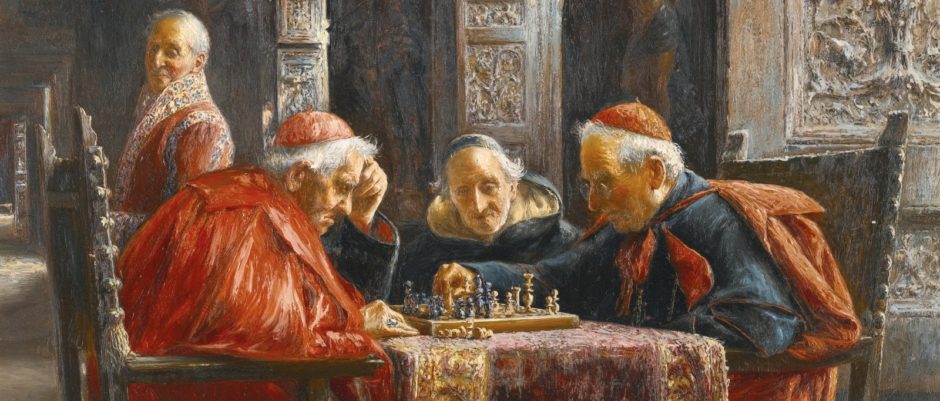
Posted in Liturgy Science Theatre 3000, WDTPRS |
6 Comments

Daily Rome Shot 164

Posted in SESSIUNCULA |
1 Comment

ASK FATHER: Biretta without a pom

From a seminarian…

QUAERITUR:

I am a new seminarian in search of a biretta without a pom. I don’t mind buying my own, but I have yet to find a site that sells a biretta without a pom. Could you or any of your followers point me in the direction of some online options?

Thank you for all that you do. I have followed your blog for about 8 years and learned to love the traditional liturgy in large part because of your work and influence. If you could please keep my name anonymous, I’m early on in seminary and don’t want funny looks for getting a biretta already. But I’m in a friendly-to-tradition diocese, and hopefully will sit in choir as a seminarian at a newly ordained’s first Solemn High Mass later this summer.

Thank you once again. Prayers for you in your time of transition.

Firstly, if there is any chance at all that those in charge at the seminary will look cross-eyed at you because you have a biretta, then don’t have it at the seminary, or keep it out of sight.  It’s not worth it.

Biretta without a pom or tuft.

Sure.  Some easy steps.

  1. Get a biretta with a pom.
  2. Find some fine scissors.
  3. Remove the pom from the biretta.

Otherwise, the “Oratory” or “Filipo Neri” style biretta (being Roman) doesn’t have a pom.  Neither do those of Cardinals (being Roman).  Also, certain canons such as Norbertines have pom-less birettas.

And for you others reading out there, don’t forget…

ACTION ITEM! The “Birettas for Seminarians Project” needs URGENT ATTENTION!


Posted in "How To..." - Practical Notes, ASK FATHER Question Box | Tagged
7 Comments

20 May – St. “Golden Girl” of Ostia and a fascinating Latin inscription

Today is the feast of St. Aurea of Ostia, a martyr from the 2nd century about whom we know nothing for sure, except that she worked miracles, refused to sacrifice to the gods and was murdered in the 3rd c.

St. Aurea of Ostia figures in the ongoing story of St. Augustine of Hippo and his mother St. Monnica.

To find out why St. Aurea or “Golden Girl” figures in the history of this saintly N. African family, read this excerpt from an article I wrote for Inside the Vatican when St. Augustine’s relics were brought to Rome and, for a brief few days, reunited with his mother.

Most visitors to the Eternal City find it puzzling and wondrous that Monnica’s remains would be in Rome and even more so that Augustine’s should be in northern Italy, or that we have them at all.

How did this come to pass?

Monnica died at age 56 of a malarial fever at Ostia, Rome’s port city, not far from where modern Rome’s port, DaVinci airport, is situated.  After Augustine’s baptism in 386 by Milan’s bishop St. Ambrose (+ AD 397), Monnica and Augustine together with his brother Navigius, Adeodatus the future bishop’s son by his concubine of many years whom Monnica had forced Augustine to put aside, and friends Nebridius, Alypius and the former Imperial secret service agent (agens in rebus) Evodius were all waiting at Ostia to return home to Africa by ship.  They were stuck there for some time because the port was blockaded during a period of civil strife.

As she lay dying near Rome, Monnica told Augustine (conf. 9): “Lay this body anywhere, let not the care for it trouble you at all. This only I ask, that you will remember me at the Lord’s altar, wherever you be.”  She was buried there in Ostia.

In the 6th century she was moved to a little church named for St. Aurea, an early martyr of the city, and there she remained until 1430 when her remains were translated by Pope Martin V to the Roman Basilica of St. Augustine built in 1420 by the famous Guillaume Card. D’Estouteville of Rouen, then Camerlengo under Pope Sixtus IV.

As fate or God’s directing have would have it, in December 1945, some children were digging a hole in the courtyard of the little church of St. Aurea next to the ruins of ancient Ostia.  They wanted to put up a basketball hoop, probably having been taught the exciting new game – so different from soccer – by American GIs.  While digging they discovered the broken marble epitaph which had marked Monnica’s ancient grave.

Scholars were able to authenticate the inscription, the text of which had been preserved in a medieval manuscript.

The epitaph had been composed during Augustine’s lifetime by no less then a former Consul of AD 408 and resident at Ostia, Anicius Auchenius Bassus, perhaps Augustine’s host during their sojourn.  It is possible that Anicius Bassus placed the epitaph there after 410 which saw the ravages of Alaric the Visigoth and the sacking of Rome and its environs.

One can almost feel behind these traces of ancient evidence Augustine’s plea to his old friend sent by letter from the port of Hippo Regius over the waves to Ostia.  Hearing of the devastation to the area, far more shocking to the ancients than the events of 11 September were for us, did Augustine, now a renowned bishop, ask his old friend to tend the grave of the mother whom he had so loved and who in her time had wept for her son’s sins and rejoiced in his conversion?

The inscription reads:

HIC POSVIT CINERES GENETRIX CASTISSIMA PROLIS
AVGVSTINE TVI(s) ALTERA LUX MERITI(s)
QVI SERVANS PACIS CAELESTIA IVRA SACERDOS
COMMISSOS POPVLOS MORIBVS INSTITVIS
GLORIA VOS MAIOR GESTORVM LAVDE CORONAT
VIRTVTVM MATER FELICIOR SVBOLE

I’m sure you can provide your own perfect and yet smooth version.

ADDENDUM:

I recently read an article which argued that the inscription was created quite a bit later, as an attempt to spruce up possible pilgrimages to Ostia to see things associated with saints. I dunno.


Posted in Saints: Stories & Symbols | Tagged
1 Comment

ASK FATHER: Could the excommunication of Archbp. Lefebvre be lifted posthumously?

From a reader…

QUAERITUR:

Was the excommunication of Archbishop LeFebvre lifted? Is it possible to do so posthumously?

The excommunication imposed on Archbp. Lefebvre by the law itself (latae sententiae) and also declared by the Congregation for Bishops was not lifted before he died.

There are those who claim that Lefebvre was not ever really excommunicated because there were attenuating circumstances as described in can. 1323, §4, that is, if a person commits an act that incurs the censure was acting out of fear or out of necessity. Lefebvre clearly feared that his work and vision would end with his death because there were no other bishops to carry on and he clearly thought it was necessary to consecrate bishops. Others would argue that those weren’t adequate. But it seems that it’s what Lefebvre was thinking that matters and canon law has to be interpreted in a way that favors the person in question.

In any event, the Congregation for Bishops issued a decree stating that all the bishops involved in the 1988 consecration had incurred the excommunication that results from consecrating bishops without the mandate of the Holy See.

Is it possible to lift the excommunication posthumously?

Yes.

As a matter of fact, a modern example of this occurred in 1965.  At the time of the Great Schism back in 1054, in super complicated circumstances, there were mutual excommunications between Westerners and Easterners, Latins and Byzantines.   At the time of Vatican II, the Orthodox Patriarch Athenagoras I of Constantinople and Paul VI mutually lifted the excommunications.

If Paul VI could lift the excommunications from the time of the 11th century, then a Pope could lift Lefebvre’s excommunication posthumously.    It could be a good, healing gesture as a matter of fact.

Posted in "How To..." - Practical Notes, 1983 CIC can. 915, ASK FATHER Question Box | Tagged ,
10 Comments

Daily Rome Shot 163

Posted in SESSIUNCULA |
1 Comment

You – we – this blog – received an honorable mention

A friend of mine sent me a link to an interview with Card. Burke published in French by the excellent folks at Paix Liturgique.  When His Eminence was asked about the high awareness of Americans about the Traditional Latin Mass – you – we – this blog – received an honorable mention along with a couple others.  It is not yet on the English version of their site.


Here’s my English version of that question and answer.  If you read French, do go over there and see the rest of the interview.

[…]

Paix Liturgique – The survey we commissioned tells us that the number of practicing American Catholics who know about the Motu Proprio [Summorum Pontificum] is over 72%, which is very important.

Cardinal Raymond Leo Burke – I would say that in the USA the awareness that there now exist two forms of the rite of Mass is quite high. This is explained by the fact that at the time that the Motu Proprio Summorum Pontificum was published in 2007 the document was widely presented and commented on in the press. What is more, there are many Catholic blogs with very large audiences in the United States. I am thinking of Rorate Cœli, Father Z, or OnePeterFive.  These quite effective blogs are very favorable toward traditional liturgy, which played a great role in the popularization of the old liturgy even outside the “traditionalist” circles. So, I am not surprised that 72% of practicing [Catholics] know about the existence of the Motu Proprio Summorum Pontificum.

[…]

Paix Liturgique  – Le sondage que nous avons commandité nous indique que le nombre de catholiques américains pratiquants qui connaissent le motu proprio est supérieur à 72 % ce qui est très important

Cardinal Raymond Leo Burke – Je dirais qu’aux USA la conscience qu’il existe désormais deux formes du rite de la messe est assez élevée. Cela s’explique par le fait que lors de la publication du motu proprio Summorum Pontificum en 2007 ce document a été très largement présenté et commenté dans la presse. De plus, il existe aux États-Unis de nombreux blogs catholiques à l’audience très importante. Je pense à Rorate Cœli, au Father Z, ou à OnePeterFive. Ces blogs très actifs sont très favorables à la liturgie traditionnelle ce qui a eu une grande importance dans la popularisation de la liturgie ancienne même en dehors des cercles « traditionnalistes ». Dès lors je ne suis pas surpris que 72% des pratiquants connaissent l’existence du motu proprio Summorum Pontificum.

[…]

It is nice to be mentioned.  Thank you, Your Eminence.

However, the true importance of the mention is, because many different sites worked on a common cause, to make our Traditional Roman Rite both known and loved, there is consequently a high awareness that it is – that it can be – available.

Many factors have, over time, helped the growth of the TLM in these USA.  One of them is the demographic sink hole opening up under the Church into which the “beige” are plunging rapidly.  The committed want something more than “beige” and, therefore, market forces, as it were, are driving the proliferation of the TLM.  Couple that with the fact that many younger priests are now being made pastors of parishes.  They don’t have the baggage of the previous generation, as it were.  Moreover, COVID time allowed a lot of these younger priests both to learn and to celebrate with some frequency the TLM, which led to more and more people experiencing it and, as a result, wanting it available regularly.  In one US diocese, in one year, 5 new locations for the Traditional Latin Mass were quietly added.

The blogs mentioned by Card. Burke will continue to play a role in the expansion of the Traditional Roman Rite.

However, we should also begin working to help the integration of the various groups of committed, practicing Catholics who will be left after the demographic sink hole swallows large numbers.  These different groups will inevitable, out of necessity, find each other and will have to coexist and be together.  There will be some frictions.  It’s all going to work out over time, and I am confident that the Traditional Roman Rite will play an increasingly important role in the wider life of the Church, precisely because the congregations are swelling with young and growing families.   These are solid, committed and happy Catholics, many of whom did not get all beaten up in the horrible desert years before Summorum and before Ecclesia Dei adflicta.   Their solid Catholic living and their joy at being able to participate in Masses that are just Catholic, will be infectious.

We all need to work together to present an increasingly positive and hope-filled horizon.

Times will in many ways be pretty tough, but these are the times into which God called us all according to His plan.  We are His team, right now.  If we work hard, and stick close to the sacraments, and remain faithful, and perform works of mercy with zeal and joy, many will be attracted to that which we have.   People recognize what works.  What we have works.  And we can improve it, too.  We can improve newcomers’ experience.

I’ll stop now.  You get it.

Posted in "How To..." - Practical Notes, Just Too Cool, Our Catholic Identity, The Coming Storm, The future and our choices, Wherein Fr. Z Rants | Tagged , , ,
9 Comments






















