At APOD today we find a pic of the Mercury-Redstone 3 lift-off from Cape Canaveral of Alan Shepard in Freedom 7. 5 May 1961… 60 years ago.
60 years.

Alan Shepard would later command Apollo 14 and walk on your planet’s Moon.

At APOD today we find a pic of the Mercury-Redstone 3 lift-off from Cape Canaveral of Alan Shepard in Freedom 7. 5 May 1961… 60 years ago.
60 years.
Alan Shepard would later command Apollo 14 and walk on your planet’s Moon.
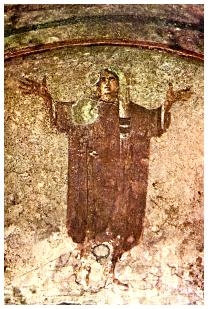
3rd c. allegorical depiction in the Catacombs of Priscilla of the praying Church, hands in the “orans” position. This is NOT, as confused feminists claim, ancient evidence of female priests.
From a reader…
QUAERITUR:
Please comment on lay persons extending their hands while praying the Our Father as the priest does during the Novus Ordo Mass. I feel like you have addressed this topic before but I am unable to find your discussion and would like to send it to a friend. Thank you.
The extension of hands which you describe is the “orans” position, the “praying” position. It is an ancient posture of prayer, particularly for priests praying for and in the name of the people.
During the Our Father the faithful are not to use the orans position, which is the proper hand position of an ordained priest in prayer. The orans position is reserved for a certain liturgical role (read: priest – not even deacons). That position of extended hands is not appropriate for the lay faithful in the pews. Even worse is when they hold that position after the Our Father through the (Protestant) addition that follows.
We must not mix or confuse liturgical roles. Lay people have their own dignity without trying to jazz them up by – and how condescending is this? how clericalist in the worst sense? – by allowing them to do what the priest does. That’s the worst sort of clericalism. When lay and clerical roles are confused for the sake of “active participation” or “getting the laity involved”, the underlying subtext is “You aren’t good enough on your own, so I’ll let you do something that I can do.” Grrrrr. Mind you, I don’t think that all priests who try to get lay people to do things are purposely trying to be condescending clericalists. They are probably well-intentioned. But they haven’t thought through the subtle message in their choice.
On a related now, I am unaware of an official prohibition of holding hands during Mass, so long as it is spontaneous and not invited by anyone or virtually imposed by some Good Idea Fairy with a microphone. It should not be imposed by your neighbor in the pew, either.
There are people at Mass who really would like to be left alone. That’s okay. Leave them alone.
Every once in a while I get a question about Fr. John Corapi, once a highly sought and popular speaker who influenced a lot of people. He eventually had a sort of train-wreck in his life and dropped out of sight. Corapi comes to my mind occasionally because we were, coincidentally, ordained together. I didn’t know him at the time. He was just another one of the guys being ordained that day.
This upcoming 26 May will be our 30th anniversary.
When queried about Fr. Corapi, I haven’t been able to give any news, until now. I was sent a link to a piece by Matt Abbott at RenewAmerican.com about him. HERE
It seems that Fr. Corapi has reconciled with his religious society (SOLT) and has living as a monk, praying and doing penance.
If this is indeed the case, then good for him. We should all be happy when a person turns around.
It amazes me that some people who profess to be Christian are so fast to thrown a repentant and converted person’s past life in their teeth. Don’t we want, and hope for and pray for the conversion of sinners? When they do, shouldn’t we rejoice? We don’t have to make them our best friends all of a sudden. We might not rouse ourselves up to be able to like them very much. But we should at least be as gracious toward them as we would hope they would be to us were the situation reversed, had we done the harm.
For example, I would be over the moon were someone like Joe Biden publicly to denounce his evil positions about abortion. I certainly wouldn’t continue to drub him with his past positions if he genuinely changed and made it public. I would be ecstatic were certain Jesuits to reverse their ways.
We need to be merciful not just toward the repentant and converted, but also toward the unrepentant and even malicious who continue in their evil work. Mind you, I do NOT mean Fr. Corapi in any way as the latter. He has, to my knowledge, never directed any harm in my direction. But there are those who have.
I regularly pray for my enemies, people who even now are harassing and slandering me, people who have done unjust harm. I say Masses for them. I genuinely want them not to die in their sins and go to Hell. I sincerely hope they will attain the bliss of heaven. I ask God to give them what they truly need, what is truly good for them for repentance. Were they to apologize for the harm they’ve done I would warmly forgive them, even as I strive to forgive them now, in advance. I take as a model, St. Thomas More who in his final letter to Henry VIII hoped: “I should once meet with your Grace again in heaven, and there be merry with you”.
“[I]f you forgive men their trespasses, your heavenly Father also will forgive you; but if you do not forgive men their trespasses, neither will your Father forgive your trespasses.” Matthew 6:14-15
A stance of unforgiving rigidity is lethal to one’s own soul.
Today is the Feast of the Forty Martyrs of England and Wales. There are, however, I believe really 284 beatified and canonized martyrs from the time of the Reformation in England.
The monstrous Henry VIII began to execute those who would not sign on to the Act of Supremacy, passed by Parliament in 1534 and which claimed that the King and his issue were “the only supreme head on Earth of the Church of England”, thus usurping the place of the Vicar of Christ, the Pope. Clement VII had refused to grant an annulment to Henry who wanted to put aside his duly married wife Catherine of Aragon. After the Act of Supremacy, Parliament passed the Treason Act. Anyone refusing to sign on to the Act of Supremacy was therefore deemed to have committed treason, a capital crime. Sts. Thomas More and John Fisher were the most famous of those slain by refusing to go along. There was another Act of Supremacy passed in 1558 under Elizabeth because the Catholic Queen Mary had had the previous Act repealed in 1554. This would lead eventually to the virtual conflation of Church and State which has remained as a powerful corrosive force in the Anglican “Church” of England to this day. Effectively, as societal mores change, because of politics the doctrine of its “Church” must change.
At the time of Elizabeth, Pope St. Pius V in 1570 excommunicated the Queen and released all her subjects from obedience to her. In turn she enacted harsher laws, making it high treason for any priest to be in England and for any person to aid them. The usual punishment was to hang, draw and quarter then, many at Tyburn which is now at a traffic crossing in London near Marble Arch at the intersection of Edgeware and Oxford Street.
In 1896 Leo XIII declared in his Bull Apostolicae curae that Anglican orders were “absolutely null and void”. In 2000 the CDF clarified in Dominus Iesus that bodies without apostolic succession are not, technically, true churches, and refers to them as “ecclesial communities”.
Once upon a time, the Feast of the Forty Martyrs was celebrated on 25, which is the Feast of Sts. Crispin and Crispinian, whose relics are in San Lorenzo in Panisperna in Rome.
Speaking of Rome, the residence of English seminarians the priests studying in the Eternal City, the English College not far from the Palazzo Farnese on the Via di Monserrato. The chapel of the College has murals of the English Martyrs, some of whom had studied in Rome in that very place.


In May of 2018, I went to the English College for a spectacular exposition of items from the time of the English martyrs. For example:


Alumni of the English College have reason to be proud of their fellows. My good friend Fr. Timothy Finigan has posted a video about the English Martyrs and I refer you to his fine blog. HERE
Let us not forget that there are modern martyrs. The number of martyrs in the 20th century is truly staggering. There are our suffering brethren in China, now in an ever worsening position because of the “deal” made with the Holy See. There are signs of rising persecution within and without.
Ask the holy martyrs of every age to help us in our times.
 At the Italian blog Messa in Latino we receive news about the Canons of St. Peter’s Basilica that was in Il Messaggero.
What, who are canons?
There are all sorts of canons. “Canon” is applied to the list of books of Scripture, the individual laws in a collection called the Code, and to certain persons.
In the Roman, Latin Church among the things that canon can mean is a members of a group called a chapter (capitulum) or college. Historically they would live together. Today, not so much. Cathedrals and great churches had chapters which saw to the financial and material issues of the buildings, holdings, etc. They had also a liturgical role to sing the office and to be present at liturgical functions. Canons had particular dress and their living from the chapter.
In Europe there are still chapters, but these structures have disappeared in these USA.
The major basilicas of Rome have chapters of canons, including St. Peter’s. The 24 main canons (there are other “honorary canons”, clerics who need some income) have been an important component of the whole life of this important basilica. They have for centuries been present for papal functions. They have participated in the administration of the goods, holdings and buildings associated with the basilica. They have their own chapel in St. Peter’s and a sacristy.
For centuries, indeed a millennium, since at least the 10th century, canons have been central to the life of St. Peter’s, old and new.
Messa in Latino reports something from Il Messaggero:
The Pope forbids Canons to enter St. Peter’s
1 May 2021 by Franca Giansoldati
Vatican City – “Forbidden to enter St. Peter’s. Today the canons of the Basilica cannot enter. Orders from Superiors.” This is the phrase uttered by an embarrassed worker at the Basilica, delivered to the disconcerted Canons of St. Peter’s who today had desired to participate in the Rosary with Pope Francis.
[…]
For some time now, however, the canons – there are about thirty of them – seem to be in Pope Francis’ crosshairs. It is probably one of those sectors in which he would like to bring some order. A few years ago the Pope, seeing two canons during a solemn function serving behind the Cardinals in their usual fuchsia-colored garb, it is said that the dumbfounded Pope asked who were “those two priests dressed in technicolor”.
[…]
After the Suppression of individual Masses in St. Peter’s, and now this, one wonders what we might read in the near future.
“St. Peter’s converted to museum. Residual liturgies moved to Paul VI Audience Hall.”

Coat of Arms by D Burkart









A Daily Prayer for Priests


They find you a pro-life agent in your area who commits to giving a portion of the fee to a pro-life group!

PLEASE subscribe via PayPal if it is useful. Zelle and Wise are better, but PayPal is convenient.
A monthly subscription donation means I have steady income I can plan on. I put you my list of benefactors for whom I pray and for whom I often say Holy Mass.
In view of the rapidly changing challenges I now face, I would like to add more $10/month subscribers. Will you please help?
For a one time donation...



Help Monks in Wyoming (coffee – UPDATED LINK) and Norcia (beer) and the wonderful "Soap Sisters" of Summit, NJ!


Please follow me on Twitter!










Visits tracked by Statcounter
since Sat., 25 Nov. 2006:


