Notes about Holy Communion

I saw a very good post at Ann Barnhardt’s blog. HERE

It is in no way polemical or political. It is, however, both timely and perennial. It is something that needs refreshing in the minds and hearts of many and introduction to even more who may never have heard things expressed with this urgency about…

… Holy Communion.

In a prayer I wrote against the Wuhan Devil (linked on the top menu and HERE) while begging for relief from the disease I ask God to forgive the countless sacrilegious Communions people have made over the last decades.  Remember also the study that shows a huge decline in belief in the Church’s teaching of the Eucharist.  Put all that together with the COVID acceleration of the demographic sinkhole that was already opening up under the Church and, well, we’ve got trouble, my friends, trouble, I say trouble right here in 2020.

Have a look at Anne’s post.   In a nutshell, she reminds everyone, quite properly, that we should treat every Holy Communion like it was our first, our last, and our only Communion.  In fact, every Communion could be our last, because we are going to die and we do NOT know when.

We don’t know when.

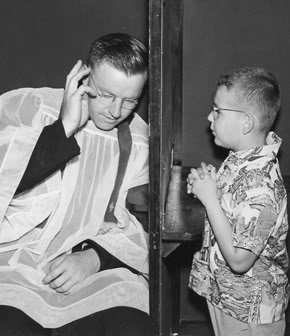
Also, take some time to look at the image she posted.  It has excellent details that, once upon a time, would have been understood by all but, now, we are recovering.


Posted in "How To..." - Practical Notes, Four Last Things, Hard-Identity Catholicism, Liturgy Science Theatre 3000, Save The Liturgy - Save The World | Tagged ,
15 Comments

ASK FATHER: A priest complains about another priest’s form of absolution in his confession

From a priest reader…

QUAERITUR:

At the risk of testing your patience . . . is it valid if the Priest (after improvising the first half of the absolution formula) says: “I absolve you from all the sins of your life . . .”?

I am a Priest, and I cannot find ANYONE I know that doesn’t mess around with the absolution formula! I say it (and all sacramental formulae) EXACTLY as they appear in the rituals. It drives me crazy!

I have mentioned it to the offending priests , only to get a snotty reply; I mentioned to the Priest who was pastor at the time. He was kind and seemed concerned–but nothing happened.

Given the state of the Church, I have lost confidence in our Bishop and even the SCDF–it’s cardinal against cardinal and bishop against bishop! I am so disgusted and disheartened at this point.

Father, I hear you.

First, what the well-meaning and likely soft-headed improve amateur said was probably valid.   That doesn’t in any way excuse this sort of thing.

As far as I know, the only approved English translation – at least in the USA – for the new-fangled post-Conciliar form of absolution is (with my emphasis):

“God, the Father of mercies, through the death and resurrection of his Son has reconciled the world to himself and sent the Holy Spirit among us for the forgiveness of sins; through the ministry of the Church may God give you pardon and peace, and I absolve you from your sins in the name of the Father, and of the Son, and of the Holy Spirit. Amen.”

It is amazing how many questions I get about the antics of jackass priests in the matter of the words of absolution or some other fundamental aspect of the sacrament.

Priests have to get the word out about the legitimate form of absolution.   Furthermore, they should not in any way allow another priest to say something weird and questionable during their own confessions.  No.  This has to be firmly resisted, put to an end.

By the way, I have an old PODCAzT about the Latin Forms of Absolution

PODCAzT 155: Latin Forms of Absolution, Vetus and Novus Ordo

Finally, in the document Redemptionis Sacramentum we read at the end:

Complaints Regarding Abuses in Liturgical Matters

[183.] In an altogether particular manner, let everyone do all that is in their power to ensure that the Most Holy Sacrament of the Eucharist [all sacraments, actually] will be protected from any and every irreverence or distortion and that all abuses be thoroughly corrected. This is a most serious duty incumbent upon each and every one, and all are bound to carry it out without any favouritism.

[184.] Any Catholic, whether Priest or Deacon or lay member of Christ’s faithful, has the right to lodge a complaint regarding a liturgical abuse to the diocesan Bishop or the competent Ordinary equivalent to him in law, or to the Apostolic See on account of the primacy of the Roman Pontiff. It is fitting, however, insofar as possible, that the report or complaint be submitted first to the diocesan Bishop. This is naturally to be done in truth and charity.

I would add to this that, in a parish, start with the pastor – if feasible – and work your way up.

And always always always say a prayer for any priest who might be doing something a little dodgy.


Posted in "How To..." - Practical Notes, ASK FATHER Question Box, Liturgy Science Theatre 3000, Mail from priests | Tagged ,
7 Comments

#ASonnetADay – GUEST POEM from the Requiem Mass – “Dies irae, dies illa, Solvet saeclum in favilla…”

Posted in Poetry, Sonnet A Day | Tagged
3 Comments

All Souls Masses – changes to rubrics when saying three Masses continuously

I am getting ready to say my three Masses today.

On two days of the year, the priest has the privilege of saying three Masses: Christmas and All Souls.  On Christmas, he can keep three stipends for the Masses.  On All Souls he can keep one stipend and if he celebrates the other Masses they must be for the Poor Souls in Purgatory and, traditionally, for the Intentions designated by the Roman Pontiff.  More on that Intentions thing, which also impacts on the gaining of indulgences, such as those for the dead during THIS November HERE.

When the priest says his Masses back to back, the rubrics change a little in the Traditional Mass – which every priest really ought to know.  If he doesn’t know how to say the Traditional Latin Mass, then, if he is a Latin Rite priest, he doesn’t know his own rite.  He is, in that sense, incomplete.

Here are some rubrical changes for saying three Requiem Masses back to back.  Click for larger.

After Communion of the 1st and 2nd Masses, the priest does NOT purify the chalice as usual, but rather places it on the corporal and covers it with the pall.  He says the Quod ore sumpsimus and then purifies his fingers, saying the Corpus tuum while drying them.  He removes the pall from the chalice, replaces the purificator and paten with a new host to be consecrated, covers with the pall and veil and places as for Mass.  He must not remove the chalice from the corporal.   If he slips and purifies the chalice as habitual, he can still celebrate the other Masses.

At the second and third Masses, if celebrated right away, after removing the veil he sets the chalice still on the corporal toward the Epistle side.  It helps to have a larger corporal today (as I do).  He does not wipe the inside of the chalice with the purificator before putting in wine and water and he does not use the purificator on the inside of the cup.

If his Masses are not in a row, he purifies as usual, but should use only water in purifying the chalice (so he doesn’t break his Eucharistic fast).  But if he slips and uses both wine and water, he can still celebrate Mass even within the three hours (that was prescribed at the time of the 1962 Missal).

Everything is set up.  I withdrew from storage a black vestment I have rarely used, quite striking with the olive branches and chi-rho vexillum.  It would be good on Good Friday, too.

However, I have two other black vestments for the other two Masses.


Posted in Four Last Things, Liturgy Science Theatre 3000 | Tagged ,
9 Comments

#ASonnetADay – 79. “Whilst I alone did call upon thy aid…”

Posted in Poetry, SESSIUNCULA, Sonnet A Day |
Comments Off on #ASonnetADay – 79. “Whilst I alone did call upon thy aid…”

Your Sunday Sermon Notes – All Saints 2020 – POLL: Did the Election come up during homily?

Was there a GOOD point made in the sermon you heard at the Mass for your Sunday, either live or on the internet? Let us know what it was. Also, are your churches opening up? What was attendance like?

For my part…

Let’s have a POLL.

Choose your best answer. Anyone can vote. Only registered users can comment.

In the ALL SAINTS 2020 - Sunday obligation Mass I attended or viewed, the ELECTION was mentioned.

View Results

Posted in POLLS, The future and our choices | Tagged
29 Comments

ASK FATHER: Priest gives absolution while I am saying Act of Contrition

From a reader…

QUAERITUR:

In all the time I have gone to confession, I say the Act of Contrition, and then the priest absolves me.

However, the priest at my new parish does Absolution at the same time I am saying the Act of Contrition, and says it very softly. I asked him once if he had done it (absolution) and after he said yes, I asked my wife and she confirmed that he said it simultaneously to the Act of Contrition with her as well.

This seems strange. Am I right to be concerned?

No, this is not a problem.  This is a standard and old fashioned thing to do.

The basic principle is this.  When a priest is morally certain that you properly disposed and are sufficiently sorry for your sins, he shouldn’t delay absolution.   So, when you start the Act of Contrition, which traditionally first expresses attrition before it expresses contrition, he will start the form of absolution while you are still pronouncing the Act of Contrition.

The classic Act of Contrition first expresses the less perfect, but sufficient, sorrow for sins, attrition, which is fear of punishment.  Contrition is more perfect, sorrow for love of God.

So, don’t be surprised if a priest starts the form of absolution while you are saying the Act of Contrition.   Not all do this, but quite a few traditional priests do.


Posted in "How To..." - Practical Notes, ASK FATHER Question Box, GO TO CONFESSION, Liturgy Science Theatre 3000 | Tagged , , ,
15 Comments

ASK FATHER: Form of absolution was just “I absolve you OF your sins” instead of “FROM your sins”.

From a reader…

QUAERITUR:

if the priest says” of your Sins, instead of “from your Sins” in absolution would the Absolution still be valid and if it is valid could you explain where of and from differ or were they are the same

That was valid.

The formula of absolution is, in its short form, “Ego te absolvo a peccatis tuis, in nomine Patris +, et Filii, et Spiritus Sancti… I absolve you from your sins in the name of the Father +, and of the Son and of the Holy Spirit.”

This is the last part of a longer formula, updated – post-Conciliar – which in translation is, “God, the Father of Mercies, through the death and resurrection of his Son has reconciled the world to himself and sent the Holy Spirit among us for the forgiveness of sins; through the ministry of the Church may God give you pardon and peace, and I absolve you from your sins in the name of the Father, and of the Son, and of the Holy Spirit. Amen.”  The short version suffices by itself in a pinch.  More and more priests these days are using the older, traditional form of absolution as well.

Remember that the true form of absolution is in LATIN.  All other approved forms in other languages are translations.   I absolve you from and of your sins mean essentially the same thing.   So, “of” does not invalidate the form.

However, the very fact that you were worried about it, it argument enough for priests to stick to the exact words as approved.

That said, we can drill into this a little.

St. Thomas Aquinas argues (though his opinions are not the equivalent of the Church’s Magisterium – never forget that!) that “Ego te absolvo”  is the form of the sacrament (ST III, Q. 84, Art. 3).  If he is right, then that may suffice.

The Catechism of the Council of Trent, reliable and surely an expression of the Church’s Magisterium, and surely working from Aquinas has this:

Pastors should not neglect to explain the form of the Sacrament of Penance. A knowledge of it will excite the faithful to receive the grace of this Sacrament with the greatest possible devotion. Now the form is: I absolve thee, as may be inferred not only from the words, whatsoever you shall bind upon earth shall be bound also in heaven, but also from the teaching of Christ our Lord, handed down to us by the Apostles.

These days it seems that the minimum form in the Latin Church (the Eastern Churches have their own somewhat different practices) is “Ego te absolvo a peccatis tuis… I absolve you from your sins.”  As far as I can tell, this is what most authors stand by.

Because I am an Unreconstructed Ossified Manualist, I consulted several manuals (e.g., Tanquerey, Prümmer, Sabetti Barrett).  They all come to the same basic conclusion.  “Absolvo te a peccatis tuis” is certainly valid, and “Absolvo te” is probably valid, but if possible the longer form should be repeated to be sure.

Part of the problem here  – aside from the arrogance of priests who screw around with the form of absolution – is the notion of using regularly the bare minimum.  That suggests that perhaps the rest is not so important.

If you confess to a priest who regularly does something dodgy with the form of absolution, I would politely bring it up, as you did.

People are within their rights to have the form of absolution spoken as it is in the book. Ask the priest to give you absolution with the proper form. Do not be nasty or aggressive about this.

If that doesn’t help, talk to the pastor of the parish and/or the local bishop.

Remember that the priest himself cannot talk about the confession because he is bound by the Seal.  Therefore, you can politely inform the the bishop about your experience of the form of absolution.  You would have to include that you have been to this priest several times and that he has always done the same thing.  Do not run him down.  Do not add lots of observations.  Do not try to teach the bishop his job or theology.

Ideally, the bishop (or pastor) would then have a chat with the priest during which the priest would be informed that word had come that he isn’t using the proper form of absolution and, if true, that should be corrected – lest in the future he receive in spades the wrath of the whatever from high atop the thing.

If that doesn’t produce results, send a copy of your correspondence to the Congregation for the Doctrine of the Faith (not Divine Worship) and seek a clarification.

Fathers!   Don’t fool around with the words of absolution or of any other sacrament  Remember what happened when men screwed around with the form of baptism!   At the minimum about are being anxiogenic!   It may be that you have slipped into some variant and, over the years, don’t even realize you are doing it.  REVIEW.   This is the nuts and bolts of our work!    And it isn’t even that hard!

As for the rest of you…

GO TO CONFESSION!
Posted in "How To..." - Practical Notes, ASK FATHER Question Box, GO TO CONFESSION | Tagged , ,
2 Comments

#ASonnetADay – 78. “So oft have I invoked thee for my Muse…” HALF WAY POINT!

Posted in Poetry, Sonnet A Day |
Comments Off on #ASonnetADay – 78. “So oft have I invoked thee for my Muse…” HALF WAY POINT!

Food for thought: American Venerables and the election

I am trying to imagine Ven. Fulton Sheen supporting a pro-abortion catholic presidential candidate who is clearly cognitively strained.  I can’t do it.   He might not share POTUS’ style, but Sheen was a patriot and he had the right order of things in his head when it came to faith and morals.  He, I don’t think, could support someone who would through his family be so in league with Communist China.

I am trying to imagine Ven. Augustus Tolton supporting a pro-abortion catholic presidential candidate and someone whose legislation lead to massive incarceration of young black men.   I can’t do it.   I think that Ven. Augustus would see which of the two is really trying to do something concrete.  Think support of historically black colleges, economic opportunity, etc.

Posted in SESSIUNCULA | Tagged
Comments Off on Food for thought: American Venerables and the election