What’s next? Beg pardon of the serpent for having brought Adam and Eve to knowledge?

The other day I put a link on the sidebar and on the top menu to a page I made with the longer, original prayer to St. Michael the Archangel.  I’ve started to use this prayer daily.  The times call for such measures.

Marco Tosatti has something today which echoes many items that arrive in my email right now.  The St. Michael Prayer figures in it.

He posted a letter which he says was written by a serious person whom he nicknames “Pezzo Grosso” (“Big Shot, “Big Cheese”).

The letter laments current and ongoing negative developments, for example, the wave of admiration of Luther by such as Bruno Forte, the statement that “transubstantiation is not dogma” by Andrea Grillo, the public humiliation of Card. Sarah, and an upcoming congress about reconciliation with Masonry.

He goes on to say…

But now I’m frightened, above all about the tight sequence of events; it’s as if we were close to a due date (that of the visions of Leo XIII? The prophecies of La Salette? Of St. Bridget? Of the Madonna of Akita? Of St. Vincent Ferrer?…). What must we brace for as the next move? Should we imagine that the next “reconciliation” will be with the serpent tempter of Genesis of whom we have to beg pardon, “justifying” his “good intentions” in bringing knowledge to Adam and Eve? Must we consequently rebuke St. Michael the Archangel for having booted him out? Or maybe we have to ask Mary Most Holy to say she’s sorry for having crushed his head? Or even ask Jesus Himself to do it, for not having let himself be tempted in the desert, and in doing so opening himself up to a multicultural and pluralistic dialogue between them?

Dear Tosatti, you won’t believe it, but I’m really starting to be afraid. I reread the exorcism prayer to St. Michael the Archangel, written by Leo XIII (recited after Mass until 1964, when it was inexplicably “cancelled”). I’m asking myself whether I have the strength to respond without the assistance of my Holy Roman Catholic Apostolic Church, nay rather, feeling her to be more and more against the Gospel and the Truth that she taught me. Cardinals and Bishops who still believe in the Truth of Christ must do something now! I fear we are in the end times, dear Tosatti. Big Shot, but Scared To Death (Pezzo grosso ma terrorizzato)

Remember… HERE

Posted in The Coming Storm, The future and our choices | Tagged
9 Comments

A priest’s prayers for before and after making his own confession

From an old prayerbook for priests which I’ve had since before my ordination.  They are dense with old wisdom.

Here are two prayers, in Latin and English, for priests, for before and after they make confession their own confession.

I’ve added accent marks.  In the translations I used an archaic style.  The content might seem a little flowery in our age of tweets and dumbed-down prose, but… there’s nothing wrong with that!  There are a couple tricky bits in the Latin, but I believe I’ve found the right solutions.

In this these troubling times, I suspect many priests, discerning the particular need and/or in good discipline, will seek to make their own confessions soon.  I hope these prayers could be of use.

ORATIO ANTE CONFESSIONEM SACRAMENTALEM

Súscipe Confessiónem meam, piísime ac clementíssime Dómine Iesu Christe, única spes salútis ánimae méae, et da mihi, óbsecro, contritiónem cordis, et lácrimas óculis meis, ut dé?eam diébus ac nóctibus omnes neglegéntias meas cum humilitáte et puritáte cordis.  Dómine, Deus meus, súscipe preces meas.  Salvátor mundi, Iesu bone, qui te crucis morti dedísti, ut peccatóres salvos fáceres, réspice me míserum peccatórem invocántem nomen tuum, et noli sic atténdere malum meum, ut obliviscáris bonum tuum; et si commísi unde me damnáre potes, tu non amisísti, unde salváre soles.  Parce ergo mihi, qui es Salvátor meus, et miserére peccatríci ánimae meae.  Solve víncula eius, sana vúlnera.  Emítte ígitur, piíssime Dómine, méritis puríssimae et immaculátae semper Víriginis Genitrícis tuae Maríae, et Sánctorum tuórum, lucem tuam, veritátem tuam in ánimam meam, quae omnes deféctus meos in veritáte mihi osténdat, quos confitéri me opórtet, atque iuvet et dóceat ipsos plene et contríto corde explicáre. Qui vivis et regnas Deus per ómnia saécula saeculórum.  Amen.

Accept my confession, O most merciful and most gentle Lord Jesus Christ, sole hope of the salvation of my soul, and grant to me, Thy priest, I beg, contrition of heart and tears for my eyes, that day and night I might beweep all my failures with humility and purity of heart.  O Lord, my God, accept my prayers.  Savior of the world, good Jesus, who gave Thyself to the death of the Cross so that Thou mightst make sinners to be saved, look upon me, a miserable sinner invoking Thy Name, and heed not my evil in such a way that Thou shouldst forget Thy goodness. And if I have committed that by which Thou canst condemn me, Thou hast not lost that by which Thou art accustomed to save me.  Spare me, therefore, Thou who art my Savior, and be merciful to my sinful soul.  Free its bonds, heal its wounds.  Hence, most merciful Lord, by the merits of Thy Mother, the most pure and immaculate ever-Virgin Mary, whom Thou didst entrust as a Mother especially to priests, and by the merits of Thy Saints, into my soul send forth Thy light, Thy truth which all my defects require, and assist and teach me to unfold them fully and with a contrite heart. Who livest and reignest, God, forever and ever. Amen.

ORATIO POST CONFESSIONEM

Sit tibi, Dómine, óbsecro, méritis beatae semper Vírginis Genetrícis tuae Maríae et ómnium Sanctórum, grata et accépta ista conféssio mea, et quidquid mihi défuit nunc, et de suf?ciéntia contritiónis, de puritáte et integritáte confessiónis, súppleat píetas et misericórdia tua et secúndum illam dignéris me habére plénius et perféctius absolútum in caelo. Qui vivis et regnas cum Deo Patre in unitáte Spíritus Sancti, Deus, per ómnia saécula saeculórum. Amen.

O Lord, I beseech Thee, by the merits of Thy Mother, the ever-Virgin Mary, and of all the saints, let this my confession to have been pleasing and acceptable to Thee, and whatsoever was now lacking in me and in the sufficiency of my contrition, and in the purity and completeness of my confession, may Thy mercy and compassion make whole and, thereafter, deign to hold me fully and perfectly absolved in Heaven.  Who livest and reignest with God the Father in the unity of the Holy Spirit, forever and ever.  Amen.

This post is intended for bishops and priests and perhaps seminarians, for now to ponder.

Posted in "How To..." - Practical Notes, GO TO CONFESSION, Liturgy Science Theatre 3000, Priests and Priesthood | Tagged , , ,
1 Comment

Sunday of Christ the King – Act of Consecration of the Human Race to the Sacred Heart of Jesus

In the Church’s traditional calendar, this final Sunday in October is celebrated as the Feast of Christ the King.  This feast was implemented by Pope Piux XI  in 1925 with Quas primas, in the face of secularism, the spread of materialistic atheistic Communism, and its cousins Fascism and Nazism.

Since Christ the King was implemented, the Church prays on this Sunday the

Act of Consecration of the Human Race to the Sacred Heart of Jesus

There’s nothing wrong with saying this prayer on other days!  You might try it.

However, the Handbook of Indulgences says:

#27. A plenary indulgence is granted to the faithful, who piously recite the above Act of Dedication of the Human Race to Jesus Christ the King, if it is recited publicly on the feast of our Lord Jesus Christ the King, and piously carry out the precepts in Norm #23 listed above.  [The grant probably refers to the Novus Ordo calendar and the Last Sunday of the Year.  However, favoribilia amplianda.]

Requirements for Obtaining a Plenary Indulgence on Christ the King

  • Public recitation of the prayer “Most Sweet Jesus, Redeemer – Act of Dedication of the Human Race to Jesus Christ King” (listed below)
  • Say one “Our Father” and one “Hail Mary” for the intentions of the Pope
  • Make a Sacramental Confession within a week of (before or after) the Feast of Christ the King
  • Worthily receive Holy Communion (ideally on the Feast of Christ the King)
  • that one be free from all attachment to sin, even venial sin.

Here is the prayer.  Perhaps print it and ask your priests to say it:

Act of Consecration of the Human Race to the Sacred Heart of Jesus

Most Sweet Jesus, Redeemer of the human race, look down upon us humbly prostrate before Thine altar. We are Thine, and Thine we wish to be; but to be more surely united to Thee, behold each one of us freely consecrates ourselves today to Thy Most Sacred Heart.

Many indeed have never known Thee; Many too, despising Thy precepts, have rejected Thee. Have mercy on them all, most merciful Jesus, and draw them to Thy Sacred Heart. Be Thou King, O Lord, not only of the faithful children, who have never forsaken Thee, but also of the prodigal children, who have abandoned Thee; Grant that they may quickly return to their Father’s house lest they die of wretchedness and hunger.

Be Thou King of those who are deceived by erroneous opinions, or whom discord keeps aloof, and call them back to the harbor of truth and unity of faith, so that there may be but one flock and one Shepherd.

Be Thou King of all those who are still involved in the darkness of idolatry or of Islamism, and refuse not to draw them into the light and kingdom of God. Turn Thine eyes of mercy towards the children of the race, once Thy chosen people: of old they called down upon themselves the Blood of the Savior; may it now descend upon them a laver of redemption and of life.

Grant, O Lord, to Thy Church assurance of freedom and immunity from harm; give peace and order to all nations, and make the earth resound  from pole to pole with one cry; praise to the Divine Heart that wrought our salvation; To it be glory and honor forever.


Posted in Hard-Identity Catholicism, Liturgy Science Theatre 3000 | Tagged , , , ,
4 Comments

Wile E. to Fr. Z.

At Fishwrap today (aka National Schismatic Reporter – a prayer for it HERE), the Wile E. Coyote of the catholic Left, has a round up of stories which interested him. He usually adds some commentary.  He picked up on my new catholic Red Guards analogy.  He takes it as a compliment to be included in the list I mentioned and thanks me.

I’m happy to oblige, ??!

Posted in Liberals, New catholic Red Guards | Tagged , , ,
2 Comments

Benedict and Sarah hater Andrea Grillo says: “Transubstantiation is not a dogma”

The New catholic Red Guards do not rest.  They are marching and sloganeering up and down Twitter, pumping the air with their Little Red Books.  The cadres are giving their morning orders to the useful idiot lib masses about whom to attack today and in weeks to come.

The other day I posted the names of some of the New catholic Red Guards.  HERE.  A lot is going on, so it has already scrolled off the front page.

In any event, one of those names is an inveterate hater (especially of Pope Benedict and Card. Sarah), Andrea Grillo.  This fellow is a true hater useful for study so that you can understand better how haters really hate.  If it’s Catholic and it’s older than, say, 40 year or so, this guy probably hates it.

This morning my phone whimpers to life with an SMS from Roman friends with a quote from Brachytrupes via Marco Tosatti.

“Transubstantiatio non è un dogma e come speigazione ha i suoi limiti. Ad esempio contraddice la metafisica.”

“Transubstantiation is not a dogma and, as an explanation, it has its limits. For example, it contradicts metaphysics.”

I think we will all agree that any attempt to explain in human language what Christ did at the Last Super and what God does through every priest at every Mass “has its limits”. Transubstantiation is a mystery.

However, “Transubstantiation is not a dogma….”

?!?

It is unthinkable that Brachytrupes has never read what the Council of Trent taught, against the Protestant Revolt.

And he teaches at a Pontifical Athenaeum in Rome, Sant’Anselmo… the liturgy school.

BISHOPS… SEMINARIANS… if you are in Rome for studies, or thinking about what to… this is the sort of thing you will get at Sant’Anselmo.

Meanwhile….

Ch. 4 of Session 13 of the Council of Trent taught infallibly:

And because that Christ, our Redeemer, declared that which He offered under the species of bread to be truly His own body, therefore has it ever been a firm belief in the Church of God, and this holy Synod doth now declare it anew, that, by the consecration of the bread and of the wine, a conversion is made of the whole substance of the bread into the substance of the body of Christ our Lord, and of the whole substance of the wine into the substance of His blood; which conversion is, by the holy Catholic Church, suitably and properly called Transubstantiation.

And in the canons that followed the teaching:

CANON II.-If any one saith, that, in the sacred and holy sacrament of the Eucharist, the substance of the bread and wine remains conjointly with the body and blood of our Lord Jesus Christ, and denieth that wonderful and singular conversion of the whole substance of the bread into the Body, and of the whole substance of the wine into the Blood-the species Only of the bread and wine remaining-which conversion indeed the Catholic Church most aptly calls Transubstantiation; let him be anathema.

How ironic that Grillo writes that “”Transubstantiation is not a dogma” precisely when he and others are celebrating LutherFest.  What Grillo wrote is precisely what the heretic Luther thought.

The Catechism of the Catholic Church repeats this:

1376 The Council of Trent summarizes the Catholic faith by declaring: “Because Christ our Redeemer said that it was truly his body that he was offering under the species of bread, it has always been the conviction of the Church of God, and this holy Council now declares again, that by the consecration of the bread and wine there takes place a change of the whole substance of the bread into the substance of the body of Christ our Lord and of the whole substance of the wine into the substance of his blood. This change the holy Catholic Church has fittingly and properly called transubstantiation.”

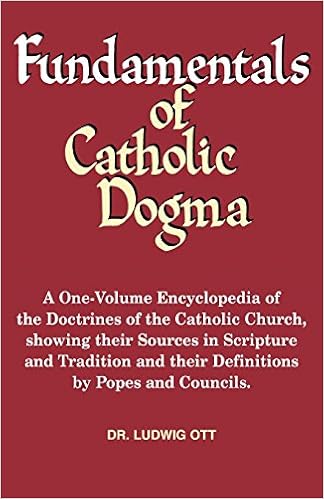
Moreover, the fact that the Church teaches transubstantiation as a dogma of the faith, which Catholics are obliged to believe, is in every book of fundamental theology.  For example, a screenshot of Ludwig Ott’s indispensible volume [US HERE – UK HERE]:

It is, frankly, heresy to deny the dogma of transubstantiation.

I can’t believe that I have to do this!

In his 1965 Encyclical Mysterium fidei, on the Eucharist, Paul VI wrote:

10. For We can see that some of those who are dealing with this Most Holy Mystery in speech and writing are disseminating opinions on Masses celebrated in private or on the dogma of transubstantiation that are disturbing the minds of the faithful and causing them no small measure of confusion about matters of faith, just as if it were all right for someone to take doctrine that has already been defined by the Church and consign it to oblivion or else interpret it in such a way as to weaken the genuine meaning of the words or the recognized force of the concepts involved.

Andrea Grillo, giving the Church the finger from his blog.

Posted in Liberals, New catholic Red Guards, The Drill, You must be joking! | Tagged , ,
8 Comments

Of “Trick or Treat” and portents

The other day I wrote (HERE) of a sense of looming portents.  As haruspex I gazed into the liver of beast, and wondered aloud whether some change might be coming to the Temple of Jerusalem (overly dramatic and apocalyptic) or, perhaps in another temple, “personnel in, say, the Office of Pontifical Liturgical Celebrations.”

Granted that the close collaborators of the Holy Father meet with him regularly, and granted that we are coming to the close of a liturgical year and the beginning of another, at today’s Bolletino I saw:

Aut dulcia aut ludos, Sancte Pater!

Posted in Si vis pacem para bellum! | Tagged
1 Comment

Card. Müller about Luther – Must read!

Let me start with a great quote from what will follow…

Amid today’s confusion, [… many people…] believe the Pope is infallible when he speaks privately, but then when the Popes throughout history have set forth the Catholic faith, they say it is fallible.

And now, a public service announcement. As the stomach turning and ineptly named “Reformation Sunday” approaches, I remind the readership of a book full of great essays.

Luther and His Progeny: 500 Years of Protestantism and Its Consequences for Church, State, and Society, edited by John Rao.

US HERE – UK HERE

IMG_1917

And now…

I spotted at LifeSite a piece, originally at La Nuova Bussola and translated into English, by Ludwig Gerhard Card. Müller about Luther.

Cardinal Müller: Luther’s reform was ‘against the Holy Spirit’

by Gerhard L. Müller

There is great confusion today when we talk about Luther, and it needs to be said clearly that from the point of view of dogmatic theology, from the point of view of the doctrine of the Church, it wasn’t a reform at all but rather a revolution, that is, a total change of the foundations of the Catholic Faith.

It is not realistic to argue that [Luther’s] intention was only to fight against abuses of indulgences or the sins of the Renaissance Church. Abuses and evil actions have always existed in the Church, not only during the Renaissance, and they still exist today. We are the holy Church because of the God’s grace and the Sacraments, but all the men of the Church are sinners, they all need forgiveness, contrition, and repentance.

This distinction is very important. And in the book written by Luther in 1520, “De captivitate Babylonica ecclesiae,” it is absolutely clear that Luther has left behind all of the principles of the Catholic Faith, Sacred Scripture, the Apostolic Tradition, the magisterium of the Pope and the Councils, and of the episcopate. In this sense, he upended the concept of the homogeneous development of Christian doctrine as explained in the Middle Ages, even denying that a sacrament is an efficacious sign of the grace contained therein. He replaced this objective efficacy of the sacraments with a subjective faith. Here, Luther abolished five sacraments, and he also denied the Eucharist: the sacrificial character of the sacrament of the Eucharist, and the real conversion of the substance of bread and wine into the substance of the Body and Blood of Jesus Christ. Furthermore, he called the sacrament of episcopal ordination, the sacrament of Orders, an invention of the Pope — whom he called the Antichrist — and not part of the Church of Jesus Christ. Instead, we say that the sacramental hierarchy, in communion with the successor of Peter, is an essential element of the Catholic Church, and not only a principle of a human organization.

That is why we cannot accept Luther’s reform being called a reform of the Church in a Catholic sense. Catholic reform is a renewal of faith lived in grace, in the renewal of customs, of ethics, a spiritual and moral renewal of Christians; not a new foundation, not a new Church.

It is therefore unacceptable to assert that Luther’s reform “was an event of the Holy Spirit.” On the contrary, it was against the Holy Spirit. Because the Holy Spirit helps the Church to maintain her continuity through the Church’s magisterium, above all in the service of the Petrine ministry: on Peter has Jesus founded His Church (Mt 16:18), which is “the Church of the living God, the pillar and bulwark of the truth” (1 Tim 3:15). The Holy Spirit does not contradict Himself.

We hear so many voices speaking too enthusiastically about Luther, [Do I hear an “Amen!”?] not knowing exactly his theology, his polemics and the disastrous effect of this movement which destroyed the unity of millions of Christians with the Catholic Church. We cannot evaluate positively his good will, the lucid explanation of the shared mysteries of faith but not his statements against the Catholic Faith, especially with regard to the sacraments and hierarchical-apostolic structure of the Church.

Nor is it correct to assert that Luther initially had good intentions, meaning by this that it was the rigid attitude of the Church that pushed him down the wrong road. This is not true: Luther was intent on fighting against the selling of indulgences, but the goal was not indulgences as such, but as an element of the Sacrament of Penance.

Nor is it true that the Church refused to dialogue: Luther first had a dispute with John Eck; then the Pope sent Cardinal Gaetano as a liaison to talk to him. We can discuss the methods, but when it comes to the substance of the doctrine, it must be stated that the authority of the Church did not make mistakes. Otherwise, one must argue that, for a thousand years, the Church has taught errors regarding the faith, when we know — and this is an essential element of doctrine — that the Church can not err in the transmission of salvation in the sacraments.

One should not confuse personal mistakes and the sins of people in the Church with errors in doctrine and the sacraments. Those who do this believe that the Church is only an organization comprised of men and deny the principle that Jesus himself founded His Church and protects her in the transmission of the faith and grace in the sacraments through the Holy Spirit. His Church is not a merely human organization: it is the body of Christ, where the infallibility of the Council and the Pope exists in precisely described ways. All of the councils speak of the infallibility of the Magisterium, in setting forth the Catholic faith. [WATCH THIS!]Amid today’s confusion, in many people this reality has been overturned: they believe the Pope is infallible when he speaks privately, but then when the Popes throughout history have set forth the Catholic faith, they say it is fallible[Sound about right?]

Of course, 500 years have passed. It’s no longer the time for polemics but for seeking reconciliation: but not at the expense of truth. [Do I hear an “Amen!”?] One should not create confusion. While on the one hand, we must be able to grasp the effectiveness of the Holy Spirit in these other non-Catholic Christians who have good will, and who have not personally committed this sin of separation from the Church, on the other we cannot change history, and what happened 500 years ago. It’s one thing to want to have good relations with non-Catholic Christians today, in order to bring us closer to a full communion with the Catholic hierarchy and with the acceptance of the Apostolic Tradition according to Catholic doctrine. It’s quite another thing to misunderstand or falsify what happened 500 years ago and the disastrous effect it had. An effect contrary to the will of God: “… that they may all be one; even as thou, Father, art in me, and I in thee, that they also may be in us, so that the world may believe that thou has sent me” (Jn 17:21).

I, for one, cannot celebrate anything having to do with the Protestant Revolt.

Posted in The Drill | Tagged , ,
10 Comments

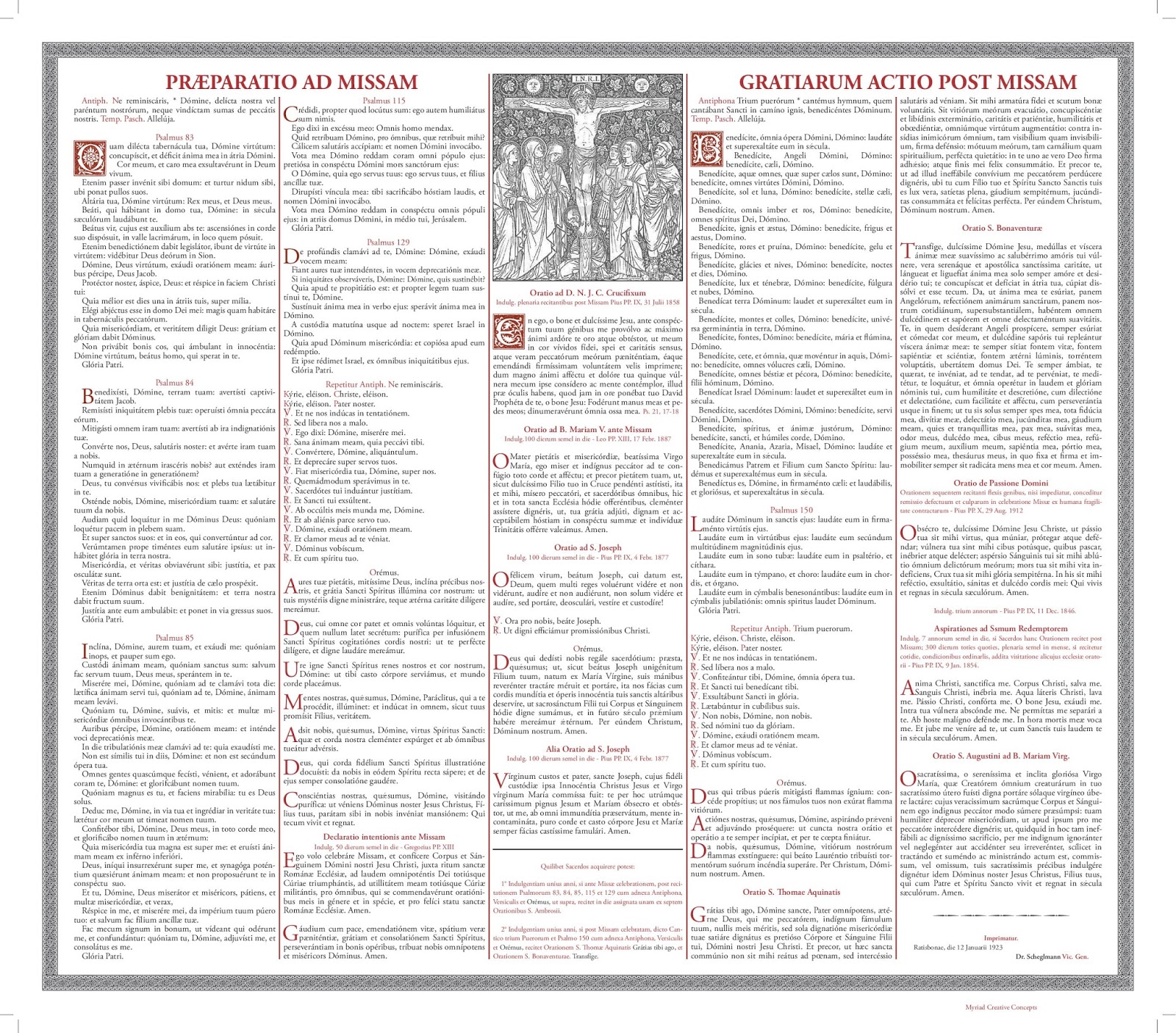
JUST TOO COOL: Prayer Cards for the priest’s preparation before, thanksgiving after Holy Mass

Just too cool.

When I was in Rome for the Summorum Pontificum 10th Anniversary Pilgrimage, a great time, I said Mass at the Priest-Friendliest Church in Rome™, Ss. Trinità dei Pellegrini. In the sacristy there are preserved their niches with kneelers, the movable placards with the prayers priests were/are to recite pro opportunitate in preparation before and thanksgiving after saying Holy Mass.

More on that HERE.

Today I saw at NLM a great post from my friend Gregory DiPippo about these cards or placards with these very prayers.

He provides links to free, downloadable images, PDFs, of the prayers of preparation and of thanksgiving.   HERE

They look great!   As a matter of fact, I would like to have two printed and then framed, one for my chapel and one for the parish sacristy.

As Gregory observes:

Some of these prayers are included in the Missal of the Novus Ordo, but the antiphons Ne reminiscaris and Trium puerorum, and the psalms, versicles, and collects that go with them are omitted, only heaven knows why.

What are the collects which follow the Praeparatio sections recitation of the Reminiscaris and psalms and versicles?

Orémus. [Not my translations but my emphases]

Aures tuæ pietátis, mitíssime Deus, inclína précibus nostris,
et grátia Sancti Spíritus illúmina cor nostrum: ut
tuis mystériis digne ministráre, teque ætérna caritáte dilígere
mereámur. [NB: 1st person plural!  It isn’t the “royal we” that the priest prays.]

Most gracious God, incline Thy merciful ears unto our prayers and by the grace of the Holy Spirit illumine our hearts, that we may be worthy to serve at Thy holy Mysteries and to love Thee with an everlasting love.

Deus, cui omne cor patet et omnis volúntas lóquitur, et
quem nullum latet secrétum: purífica per infusiónem
Sancti Spíritus cogitatiónes cordis nostri: ut te perfécte
dilígere, et digne laudáre mereámur.

O God, to whom every heart is open, every wish is spoken, and from whom no secret is hidden, purify our inmost thoughts by the infusion of Thy Holy Spirit; that we may love Thee perfectly and praise Thee worthily.

Ure igne Sancti Spíritus renes nostros et cor nostrum,
Dómine: ut tibi casto córpore serviámus, et mundo
corde placeámus.

Enkindle, O Lord, our hearts and minds with the fire of the Holy Spirit: that we may serve Thee with a chaste body and please Thee with a clean heart. [renes is interesting. Latin, renes are the kidneys, or loins. However, in ecclesiastical Latin renes are the seat of the affective life, cf. Vulgate Rev. 2,23.]

Mentes nostras, qu?sumus, Dómine, Paráclitus, qui a te
procédit, illúminet: et indúcat in omnem, sicut tuus
promísit Fílius, veritátem.

Illumine, we beseech Thee, O Lord, our minds with the Paraclete who proceedeth from Thee, and lead us to all truth, just as Thy Son hath promised.

Adsit nobis, qu?sumus, Dómine, virtus Spíritus Sancti:
quæ et corda nostra cleménter expúrget et ab ómnibus
tueátur advérsis.

May the power of the Holy Spirit be with us, We beseech Thee, O Lord, and may He mercifully cleanse our hearts and defend us from all harm.

Deus, qui corda fidélium Sancti Spíritus illustratióne
docuísti: da nobis in eódem Spíritu recta sápere; et de
ejus semper consolatióne gaudére.

O God, who taught the hearts of the faithful by the light of the Holy Spirit, grant that, in the same Spirit, we may relish what is right and always rejoice in His consolation.

Consciéntias nostras, qu?sumus, Dómine, visitándo
purífica: ut véniens Dóminus noster Jesus Christus, Fílius
tuus, parátam sibi in nobis invéniat mansiónem: Qui
tecum vivit et regnat.

O Lord, we beseech Thee, visit our minds and cleanse our thoughts; that at the coming of Our Lord Jesus Christ, Thy Son, He may find in us a place prepared for Him. Who with Thee lives and reigns in the unity of the Holy Spirit, God for ever.
R. Amen.

Yeah… we all know why they were omitted.

I wonder what knock on effect on the whole Church there might result were more priests to say these prayers before and after Holy Mass, and recite the vesting prayers… even with the Novus Ordo.

There is no reason why priests can’t say them… if they know about them and want to.

The prayers present quite a different picture of Mass – and of the priest – than we are used to thinking about these days, as does nearly every word of the prayers and rubrics of the older, traditional form of Mass.

That’s why they were omitted.

That’s why they are so hated by the libs.

Anyway…

Donations for the Cards (or even just for the heck of it)!

Posted in "How To..." - Practical Notes, Hard-Identity Catholicism, Just Too Cool, Liturgy Science Theatre 3000, Priests and Priesthood | Tagged ,
2 Comments

More example of coordination from the new catholic Red Guards

More example of coordination from the new catholic Red Guards.

First, a tweet from Massimo “Beans” Faggioli reveals teamwork.

Biggest Beans retweeted Robert Mickens, who was peddling his piece today at liberal La Croix International.   What hilarious about it is that he thinks that Benedict XVI should try to get people not to resist Pope Francis.   Why is that hilarious?  Mickens once was fired from the ultra-liberal Bitter Pill (aka The Tablet) because he calls him “The Rat” and publicly wished that Benedict would dieHERE Hypocritical, much?

Remember, these are cadres of the new catholic Red Guards.   They are pointing out Enemies of the People for harassment and targeting, ultimately with the view of destroying their careers.

Some of Mickens, with whom Beans associates himself:

[…]
Pope Francis is a facing a raucous and, at times, vicious opposition from certain groups of Catholics. The increasing hostility they are showing towards the Bishop of Rome is probably without parallel in the modern history of the Roman Church.  [Riiight. Because libs didn’t resist Paul VI’s Humanae vitae or just about everything JP2 and B16 did.  Nope.  They were a quiet as little mice.]
Now there is actually good news, as well as bad news to all of this.
The good news is that, as best one can tell, those who are rowing against the current helmsman of the Barque of Peter are part of a very tiny, if noisy, minority.
The bad news is that they are mostly found among the Church’s ordained workforce – men who serve as priests and bishops.

[…]

It is impossible to state the exact numbers. However, we can identify certain discernible traits and trends[Remember what the new catholic Red Guards are doing.  They are targeting undesirables for attack.] For example, opposition to Francis is emanating most energetically from the English-speaking world, certain parts of Europe and in areas of Africa where the pope’s critics tend to be younger (under the age of 50), doctrinally rigid and liturgically “retrodox” members of the clergy.
[Watch the vocabulary.] People in the anti-Francis camp also show tendencies toward a very narrow understanding of the application of Canon Law, a slavish devotion to liturgical rubricism and an outdated Euro-centric view of the world that is rooted in classical Greco-Roman philosophical systems[Hmmm…. so, Mickens would substitute categories of matter and form, substance and accident with…. what?]
It would be troubling enough if the opponents of the pope were only members of the clergy. However, that is not the case.
There are also small groups of the baptized faithful that are also highly critical and even disparaging of him. They demonstrate similar characteristics of the rebellious clergy. They, too, tend to be younger, fundamentalists when it comes to church teaching and promoters of a pre-Vatican II liturgy and ecclesiology[If you are Catholic you understand that there is one ecclesiology.  But that’s not Mickens.]

[…]

Massimo Faggioli [The Italian word for tuning in to a radio station is “sintonizzare”, you are attuned, on the same wavelength.] recently described those who are angrily opposing the pope and his moves to renew the Church as the “Catholic cyber militia”.

[…]

[Remember… these Red Guards are pointing out the targets to attack.] Most of the opposition to Pope Francis is coming from Catholics who are devoted to celebrating the Tridentine Mass. And many of them are from fringe groups that Benedict, first as a cardinal and then as pope, moved persistently to bring into the mainstream of the Church. [Not so fringe anymore, especially in places like France.  And in these USA, the SSPX has grown so much they have built an enormous new seminary.]
His most monumental act was to issue a papal “motu proprio” in 2007 to normalize the pre-Vatican II liturgy. [“Normalize”.  And yet here he is, on the attack.] He said part of the reason he did so was to bring about “an interior reconciliation at the heart of the Church”. Francis has shown no attachment to the Old Mass, but he has done nothing to restrict it.
Members of these reconciled groups of Tridentine Mass enthusiasts, however, have betrayed Benedict’s intention to “regain reconciliation and unity” in a divided Church. And, instead, by their attacks on the current pope, they have intensified the divisions. [Let me just ask.  Have liberals with power done anything at all to take to heart and implement Summorum Pontificum?  Could that play any part in the division?  Mickens is simply being purposely obtuse, to deceive.]

[…]

What can be done to put an end to this?
Just a few days after Benedict announced his resignation from the papacy in mid-February 2013, he told the clergy of Rome that he would “withdraw” to be “hidden from the world” and “secluded in prayer”.
But during these more than four years since he slipped into retirement, he has not been completely hidden or secluded. [Watch this!] Benedict routinely sees visitors at his residence in the Vatican Gardens. And many of them are priests, bishops, and laity – including journalists and writers – who have been prominent critics of Pope Francis[So… Benedict is being… watched?  The names of his visitors recorded?]
The former pope has also sent about a dozen or so written messages (that we know of) [Ooooo!] to various religious gatherings and individuals. He’s given a book-length interview, provided a eulogy for the funeral of one of the cardinals that opposed Francis’ document on marriage (Amoris Laetitia) and has even written an introduction and an afterword for at least two books.
He has every right to do so since no one has imposed silence upon him or prohibited from receiving visitors.

[…]

He goes on about how Benedict should speak up against the people Mickens doesn’t like.

Mickens was pitted 1000% against Benedict when Benedict was Pope. Now?

Another example of coordination from the new catholic Red Guards.

A key to understanding this rubbish is that Mickens has true animus for people who don’t see things his way.   He slyly, like Beans did before, tries to pit Benedict XVI against the critics of Francis.

I only wonder: How soon after Benedict speaks up, does Mickens want him to die?  This time.

On the same day that the La Croix hit piece comes out, so too something is excreted by The Guardian.

The war against Pope Francis
His modesty and humility have made him a popular figure around the world. But inside the church, his reforms have infuriated conservatives and sparked a revolt. By Andrew Brown

Pope Francis is one of the most hated men in the world today. Those who hate him most are not atheists, or protestants, or Muslims, but some of his own followers. Outside the church he is hugely popular as a figure of almost ostentatious modesty and humility. [This is about right.] From the moment that Cardinal Jorge Bergoglio became pope in 2013, his gestures caught the world’s imagination: the new pope drove a Fiat, carried his own bags and settled his own bills in hotels; he asked, of gay people, “Who am I to judge?” [Not entirely accurate.  However, there are lots of nearly accurate things in this piece.] and washed the feet of Muslim women refugees.

But within the church, Francis has provoked a ferocious backlash from conservatives who fear that this spirit will divide the church, and could even shatter it. [It seems to me that fear of dividing the Church is not a bad thing.  But, no matter. This is just bad writing.] This summer, one prominent English priest said to me: “We can’t wait for him to die. [Could it have been Mickens? Oh, no.  It was a priest, it seems.] It’s unprintable what we say in private. Whenever two priests meet, they talk about how awful Bergoglio is … he’s like Caligula: if he had a horse, he’d make him cardinal.” Of course, after 10 minutes of fluent complaint, he added: “You mustn’t print any of this, or I’ll be sacked.” [THAT’S EXACTLY RIGHT.  And that’s why, ladies and gents, the new catholic Red Guards are now sloganeering up and down the internet, pumping their Little Red Books in the air and pointing at the Enemies of the Pueblo.]

This mixture of hatred and fear is common among the pope’s adversaries. Francis, the first non-European pope in modern times, and the first ever Jesuit pope, was elected as an outsider to the Vatican establishment, and expected to make enemies. [Hmmm.  This suggests that those who oppose the Pope, oppose him because he doesn’t belong to the “establishment”.  Is that what you get?  Again, it is hard to tell, because he’s all over the place.] But no one foresaw just how many he would make. From his swift renunciation of the pomp of the Vatican, which served notice to the church’s 3,000-strong civil service that he meant to be its master, to his support for migrants, his attacks on global capitalism and, most of all, his moves to re-examine the church’s teachings about sex, he has scandalised reactionaries and conservatives. To judge by the voting figures at the last worldwide meeting of bishops, almost a quarter of the college of Cardinals – the most senior clergy in the church – believe that the pope is flirting with heresy[If true, and I’m not sure about how he get’s that figure, that would be a cause for concern.  No?]

[…]

In 2013, shortly after his election, while he was still surfing a wave of almost universal acclaim for the boldness and simplicity of his gestures – he had moved into a couple of sparsely furnished rooms in the Vatican grounds, rather than the sumptuous state apartments used by his predecessors [Here’s another myth.  The pope’s apartments in the Apostolic Palace were not “sumptuous”.] – Francis purged a small religious order devoted to the practice of the Latin Mass.  [There’s that word again.]

The Franciscan Friars of the Immaculate, a group with about 600 members (men and women), had been placed under investigation by a commission in June 2012, under Pope Benedict. They were accused of combining increasingly extreme rightwing politics with a devotion to the Latin Mass. [Remember this.  “Extreme rightwing politics” and “devotion to the Latin Mass”.  THAT is going to be a method of attack we will see more and more of in the future.  It’s the Latin that they hate the most… no, sorry… it’s the people who want Latin that they hate the most, but they will tar them with the brush of  secular politics.  And because they are all Leftists, they will use the political tactics of the Left to destroy coreligionists.] (This mixture, often seen alongside declarations of hatred of “liberalism”, had also been spreading through online outlets in the US and the UK, such as the Daily Telegraph’s Holy Smoke blog, edited by Damian Thompson.)  [See?  Bit by bit they are making their game and the players more apparent.]

[…]

They even have a photo of Card. Burke with the caption:

Cardinal Raymond Burke (centre), one of Pope Francis’s most prominent enemies. Photograph: Franco Origlia/Getty Images

Read the rest there.  It’s really long.  And the writer goes to extraordinary lengths.

Mark my words, friends.  They are on the march against the Four Olds!

¡Hagan lío!

Pò sì jiù!

Posted in ¡Hagan lío!, New catholic Red Guards, Pò sì jiù, Semper Paratus, The Coming Storm, The future and our choices | Tagged , , , , ,
14 Comments

King Alfred, the great White Horses, and today’s creeping heathen weeds

In the Anglican tradition – I’m not sure if the Ordinariates pick this up – today King Alfred the Great is commemorated, on the anniversary of his death.  He was a pivotal figure in the history of England, and a scholar who, among other things, translated the Consolation of Philosophy by Boethius.


Some years ago, during a trip to Blighty, I zoomed down a road to a meeting of clergy, which I fondly remember, inter alia, for the fellowship.  As we zoomed, I exclaimed, “What’s that?”

I was looking at the enormous figure of a white horse on a hillside.   It was one of the great chalk figures, which dot the countryside, the turf cut down to the chalk to expose the shape.  It was striking.  I understand that there are quite a few in southern England and I’d like to see all of them someday.

In any event, do you know G.K. Chesterton’s poem, The Ballad of the White Horse?  King Alfred is the subject of the work.

This is an epic poem, and, as such, it runs contrary to the spirit of our time, in that it is, well, an epic, and not a tweet.  However, as an epic, it is also an antedote to our day.

As Chesterton wrote of it in a prefatory note:

Alfred has come down to us in the best way (that is, by national legends) solely for the same reason as Arthur and Roland and the other giants of that darkness, because he fought for the Christian civilization against the heathen nihilism.

Isn’t that the struggle we are engaged in now?

We are in a situation where we even see, within the Church, the agents of heathen nihilism at work, much as the Red Guards did in China’s Cultural Revolution.  There are new catholic Red Guards now.  HERE

King Alfred fought an important battle on a field which, today, is overlooked by one of the great chalk horses.   It must be an enormous task to keep these horses clear of overgrowth by weeds.  Chesterton uses the image of tending the horses in his poem.

Here is a taste from Book VIII: “The Scouring of the Horse”.  As you read, think of Fishwrap… Martin… Spadaro… Faggioli… Mickens… La Civiltâ CattolicaAmerika… (my emphases):

“I know that weeds shall grow in it
Faster than men can burn;
And though they scatter now and go,
In some far century, sad and slow,
I have a vision, and I know
The heathen shall return.

“They shall not come with warships,
They shall not waste with brands,
But books be all their eating,
And ink be on their hands.

“Not with the humour of hunters
Or savage skill in war,
But ordering all things with dead words,
Strings shall they make of beasts and birds,
And wheels of wind and star.

“They shall come mild as monkish clerks,
With many a scroll and pen;
And backward shall ye turn and gaze,
Desiring one of Alfred’s days,
When pagans still were men.

“The dear sun dwarfed of dreadful suns,
Like fiercer flowers on stalk,
Earth lost and little like a pea
In high heaven’s towering forestry,
These be the small weeds ye shall see
Crawl, covering the chalk.

They crawl… covering the whiteness of the chalk.

They crawl.  And they don’t fight like men.

US HERE – UK HERE

Posted in "How To..." - Practical Notes, Poetry | Tagged , , ,
8 Comments