AN OPEN APPEAL TO THE CARDINALS OF THE CATHOLIC CHURCH

You will want to check out, at First Things, an open letter – an appeal – to all of the Cardinals of the Catholic Church.

AN OPEN APPEAL TO THE CARDINALS OF THE CATHOLIC CHURCH

[…]

To their Most Reverend Eminences, the Cardinals of the Holy Roman Church,

Since it is a truth contained in the Word of God, and taught by the ordinary and universal magisterium of the Catholic Church, that criminals may lawfully be put to death by the civil power when this is necessary to preserve just order in civil society, and since the present Roman pontiff has now more than once publicly manifested his refusal to teach this doctrine, and has rather brought great confusion upon the Church by seeming to contradict it, and by inserting into the Catechism of the Catholic Church a paragraph which will cause and is already causing many people, both believers and non-believers, to suppose that the Church considers, contrary to the Word of God, that capital punishment is intrinsically evil, we call upon Your Eminences to advise His Holiness that it is his duty to put an end to this scandal, to withdraw this paragraph from the Catechism, and to teach the word of God unadulterated; and we state our conviction that this is a duty seriously binding upon yourselves, before God and before the Church.

Sincerely,

[…]

The list of signatories follows.

Posted in Cri de Coeur |
14 Comments

ASK FATHER: Your questions weigh heavily

Upon our birth not a single one of us was promised a bed of roses.  Upon our baptism and admission to the other sacraments, not a single one of us was promised an easy path.

We regularly call this earthly life a “vale of tears”.  What part of that is hard to understand?

Hell is real and the Enemy of the soul, endowed not just with brilliance but with angelic abilities, hates us with malice beyond the ken of any man.   Do people really not believe that?

Hell and the Enemy work relentlessly to harm the Church and to pervert souls so that they choose not to embraces God’s promises and graces for heaven.  Each time a soul fails the Enemy shrieks in self-loathing anti-triumph: “That’s one more YOU don’t have!”

Hell and the Enemy are deep into the Church, with agents infiltrated everywhere.   They’ve won a few rounds lately.  You can tell by the ripple effects.  I can tell by the change in tenor and themes of my email.

Here is a fraction from this morning’s crop:

From a reader…

QUAERITUR:

I’ve heard some pretty horrendous stories over the last couple of years, firsthand from former seminarians in our diocese about what is going on in the seminary.  Over the last decade some of our priests have died of AIDS, some have committed suicide after being outted and one went to prison for seeking a hitman to murder a boy he’d abused.  I have the resources at my disposal to be able to investigate this kind of thing and expose it, however I’m unsure of the moral implications of a non-LEO, non-state official layman investigating clerics and exposing them.  I want to act and get in the fight for my children’s sake, but I do not want to sin against the Lord in doing so.  I hate what these men have done to Christ and His Church.  Your thoughts would be very much appreciated.

From a reader…

QUAERITUR:

Father- as a parishioner in the Archdiocese of Washington, DC, I’m disgusted by the grand jury report outlining the abuse in Pittsburgh, and Cardinal Wuerl’s response. Many fellow DC Catholics are demanding his resignation. I can’t help but agree, given the abjectly evil nature of the abuse. But Cardinal Wuerl is the leader of my diocese and it is our duty to obey him. With that in mind: is calling for Cardinal Wuerl’s resignation or ouster considered sinful or an act of defiance of the Church? To what extent can a Catholic appropriately criticize the leader of the diocese?

From a reader…

QUAERITUR:

Please pray for me and others like me.

It is hard to keep the faith. I look and see this evil, and I know these bishops don’t believe in Our Mother Church. Not a word. The sick and twisted priests– they may believe, I don’t know. I have more pity for their broken and evil souls. May God grant them justice and mercy.

But the bishops who covered it up, they don’t believe anything, do they?

How can I hold on to believing? I don’t doubt because there is evil. I doubt because the Fathers of our Faith take me for a rube and a Patsy.

They think it’s a sham. They think there’s no Hell. They think there is no Judgment. They don’t believe it would be better for a millstone to be tied around their necks.

How are we to trust -any- priest or bishop? How can we want to entrust our sons to a seminary knowing the bishops running it have the sickeningly poor judgment ?

This isn’t just that some priests were sick and evil. Almost every bishop almost everywhere *continued to be deceitful* after Boston, after the Dallas charter, after the settlements in Portland and San Diego, even after the law change in Minnesota that made them financially culpable. How can we tell which priests and bishops weren’t complicit in their silence?

I’m in the boat with Jesus sleeping through the storm. Okay–but somehow the bishops think they’re the ones in it, and they’re the ones suffering. How do we tell them they’re wrong?

At what point will our bishops be honest? The truth, the whole truth?

What to say?

At the very least, this.

Attend well to your state in life, your vocation.  Live your vocation with true devotion, committed to the here and now details.  God will give you all the graces you need because, by living well your vocation, you are playing the role He knew you would have in His plan of salvation from before the creation of the cosmos.

Be wary and on guard against the “roaring lion”.

Examine your conscience.  Go to confession.  Make good Holy Communion.  Visit Jesus in the Blessed Sacrament and pour your heart out.

Make a plan about certain practices and act of penance for the specific purpose of reparation for the sins that so offend the Hearts of Jesus and Mary and Joseph.

Prayer.  Fasting. Reparation.

Ask God for help and be confident, remembering that He may also leave you in pain to test and purify and strengthen you.

Say the Rosary, that great spiritual armament which so terrifies demons.  Ask Mary, Queen of the Clergy, to guard all the priests you know.

Reparation.  Reparation.  Reparation.

Ps 145 (146 – DRA)

Alleluia, of Aggeus and Zacharias.
2 Praise the Lord, O my soul, in my life I will praise the Lord: I will sing to my God as long as I shall be. Put not your trust in princes:
3 In the children of men, in whom there is no salvation.
4 His spirit shall go forth, and he shall return into his earth: in that day all their thoughts shall perish.
5 Blessed is he who hath the God of Jacob for his helper, whose hope is in the Lord his God:
6 Who made heaven and earth, the sea, and all things that are in them.
7 Who keepeth truth for ever: who executeth judgment for them that suffer wrong: who giveth food to the hungry. The Lord looseth them that are fettered:
8 The Lord enlighteneth the blind. The Lord lifteth up them that are cast down: the Lord loveth the just.
9 The Lord keepeth the strangers, he will support the fatherless and the widow: and the ways of sinners he will destroy.
10 The Lord shall reign for ever: thy God, O Sion, unto generation and generation.

Posted in ASK FATHER Question Box, Cri de Coeur |
1 Comment

YOUR URGENT PRAYER REQUESTS

Please use the sharing buttons! Thanks!

Registered here or not, will you in your charity please take a moment look at the requests and to pray for the people about whom you read?

Continued from THESE.

I get many requests by email asking for prayers. Some are heart-achingly grave and urgent.

As long as my blog reaches so many readers in so many places, let’s give each other a hand. We should support each other in works of mercy.

If you have some prayer requests, feel free to post them below.

You have to be registered here to be able to post.

I still have three pressing personal petitions.

Posted in SESSIUNCULA |
10 Comments

ASK FATHER: “I now have doubt about sorting the doctrinal from the papal opinion.” Wherein Fr. Z rants.

From a reader…

QUAERITUR:

All this confusion with the death penalty has caused me to doubt the authority of what I assumed were books of bedrock Catholic Doctrine.

Of course there was the first JPII Catechism, then his revision, both of which I thought were 100% settled Catholic Doctrine. Discovering that pre-V2 teaching of the death penalty was other than as presented in the current CCC, I now have doubt about sorting the doctrinal from the papal opinion.

So what Major Catechisms are doctrine/dogma only that are not infused with papal opinion or zeitgeist that I can use for definitive answers when confronted by lapsed Catholic and non-Catholics?

As far as I’m concerned, from my training in Patristic theology, the 16th c. Council of Trent’s Roman Catechism is “modern”.

Also, be careful when reading certain sites and their commentary on this.  The Id of Traddy-dom is pretty yakkity right now.

This question – your doubt – underscores one of my principle concerns about the change to CCC 2267.

Firstly, my problems with the change don’t have so much to do with Pope Francis’ opinion that capital punishment should never be used.  Maybe he is right and maybe he isn’t.  Were one to consult all the Popes back through history, you would get an answer different from what Francis has opined, even with variations about the circumstances and mercy, etc.  Also, the inserting of one paragraph into the CCC that cites only Francis’ own speech as a reference in the notes is pretty thin stuff.  Remember that things don’t become true by their being put into the CCC.  They are truth, and verified, doctrines with a serious pedigree before they go into the CCC.  They are put in because they rest on solid footings.  To my mind, that new 2267 doesn’t come up to scratch, when placed alongside centuries of teaching, vaporous claims about public opinion (as if that were a criterion for confirming doctrine), and a dubious argument from the point of view of the inviolability of human dignity, which seems not to take into consideration the eternal soul and fate of the condemned.

I am concerned about this paragraph not because of the opinion it expresses about the use of capital punishment, but because this is an attempt to instrumentalize the CCC for reasons other than teaching doctrine.  Note that there is in new 2267 an admonishment to nations not to use it.  Is that what catechisms are for?

Another reason, if this paragraph on this teaching can be altered in such a way, then what other paragraphs will be changed.  This change strikes me as a trial balloon and a call to special interest groups to redouble their calls for changes to the CCC.  Homosexualists are already emboldened.

Also, and this is really a problem, this change to 2267 has sown doubt in people’s minds, just as it has done in yours, about the reliability of what John Paul called a sure reference.

Hence, I an not a fan of this change.  However, let’s not make more of it than we need to.

No catechism does it all.  Also, even the Catechism of the Catholic Church was also intended as a model for local catechisms.

It is good to have a ranger of sources, classic and new.  Cross-checking is useful.

Old manuals of theology are also great resources.  However, they are virtually all in Latin, which is hard for most people or inaccessible.

That said, keep in mind that this latest change to the CCC in paragraph 2267 is an alteration of one paragraph concerning a tiny sliver of criminals who are themselves a minority in society.  Also, it deals with contingent moral choices about that tiny sliver of the small fraction.  Unless you are a governor of a state or an executioner, this paragraph won’t have much bearing on your daily life.  Neither does it concern issues far closer to the core of the Faith.  Also, we have not yet seen the official text of 2267 in the Acta Apostolicae Sedis, which is the official instrument of promulgation of the Holy See.

I’m telling people to keep that CCC close and, with an erasable pencil draw a circle around that paragraph and put a question mark by it… for now.

Meanwhile, we have multiple catechisms at our disposal.   Chief among them are these.

The Catechism of the Catholic Church.
US HERE – UK HERE (There are many editions.  Look around.)

The Catechism of the Council of Trent for Parish Priests.
US HERE – UK HERE (There are many editions.  Look around.)

Also, the Baltimore Catechism, which has different volumes for different ages (US HERE – UK HERE).  It’s so useful, in its Q&A format.

And the Catechism of Pius X is also great.  (US HERE – UK HERE).

There are many good resources available.

You might also try Ludiwg Ott’s Fundamentals of Catholic Dogma.  (US HERE – UK HERE)

Morever, for primary sources, try Enchiridion Symbolorum: A Compendium of Creeds, Definitions, and Declarations of the Catholic Church (Latin and English Edition) from Ignatius Press (US HERE – UK HERE)

Finally, here’s a little rant. 

Each time the Pope or one of his creatures says something weird or at least confusing, then we, all of us, have an opportunity to educate ourselves.  We ought to be driven to our books and to our sound, reliable priests, or at least to take steps to find them and use them as good resources.

When you love someone, you want to know all about that person.  Right?  And, when love is genuine, charity, sacrificial love, then the more you come to know, the more you choose to love.  Love is an informed choice, not a gooey feeling.

If we love our Faith, we want to know more about it, always.   We make distinctions about the content of the Faith.  We talk about the Faith in which we believe (fides quae creditur) and the Faith by which we believe (fides qua creditur).   The former, we study and dissect and memorize and dispute, etc.  The later is infused gift of the Holy Spirit.  They work together, our capacity and God’s grace, which raises and perfects our natural gifts.

In making these distinctions, remember too that the true content of the Faith is a Person, the Divine Person of the Word, Our Lord Christ Jesus.  He is in and behind and before all the truths that we have received faithfully from Apostolic Tradition onward.  When the Church teaches, He teaches.

He is the content.  We can, therefore, have a real relationship of love with the content of our Faith.

When you love, you want more.  It costs, but the cost is not counted.

Today we tend to confuse “love” with ooey gooey good feelings, like early romantic relationships.  However, real love is a choice, not a mere impulse.

I’m not getting much ooey gooey right now, and I think most of you aren’t either.  Hence, when the object of your love becomes difficult, unattractive, challenging, unlikeable, problematic, we choose to love anyway.  Sacrificial love, charity, means taking the hits.

But don’t discount the ooey gooey!

In a way, our old fashioned pious devotions and the prayers of our forebears with their florid language are like the ooey gooey part of romantic love.  But, even within those devotions there is deep doctrine, profound truths.  The devotions should drive us to learn more, go deeper.  Going deeper should then bring us back to our devotions with greater fervor.   Ooey gooey is a starting point and, maybe, even a re-starting point and a re-freshing point.

Amplify this by a factor of a gazillion regarding our participation in Holy Mass!

We are both intellective and affective.  They come together in the tension of fides quae and fides qua, our willed choice to know and to love.  After all  God made us His images, to act like He acts, to know, to will, to love.

Catholics who truly love their Faith shouldn’t need weird stuff and controversies to spur them into their catechisms and the constant study of and review of the Faith.   We should burn with a desire to know more more more anyway and all the time.

In a lot of ways, I admire greatly the practice of orthodox Jews who assiduously study and debate about their “portions” of Torah and the commentaries that surround them.  We could use some of their discipline.  Maybe that’s one reason why, in this troubled time for the Church, I have wryly coopted the language of the Left to suggest that Catholic should form base-communities of study and of prayer and of old-fashioned pious devotional practices.  Our forebears did this, with their weekly return to church on a weekday for devotions such as the Novena to Our Lady of Perpetual Help, for 1st Friday, 1st Saturday and Way of the Cross in Lent, Rosary, Exposition and Benediction, Processions and Missions and Vespers on Sunday afternoons.

FATHERS!  BISHOPS!  We need old-fashioned prayers and devotions in our churches!  Start them and invite people to come!   Let’s think outside the box by opening up the good old boxes we already have and have closed for a while.  We have to be the householders who bringeth forth things out of our treasure new things and old.

Perhaps a place to start with these devotions could be for reparation for sins and even for the grace of compunction.   Benedict XVI wrote a pastoral letter to the people of Ireland after the scandals shredded the Church and faithful.  He talked about how abandoning devotions eroded them and he recommended their recovery along with the treasures of their cultural heritage.

This is my RX for what ails us.   More study, and more pious, old-fashioned devotions at home, sure, but especially in parishes.

Thus endeth the rant.
Posted in "How To..." - Practical Notes, ASK FATHER Question Box, Hard-Identity Catholicism, The Coming Storm, The Drill, The future and our choices, Wherein Fr. Z Rants | Tagged , ,
21 Comments

ASK FATHER: Faithful, active women religious. Where to go?

Definitely NOT this kind!

From a reader…

QUAERITUR:

I’ve been discerning a religious vocation for about a year and a half, but lately I’ve been frustrated and confused about the right community to look into. My vocations director is a member of an LCWR community and, although I feel more drawn to an apostolic/ active way of life, I just can’t accept the way that most of those communities practice the faith. Not to sound harsh, but I want to devote my life to serving God and His Church, not to live in the name of “social justice” or pluralism. Unfortunately most of the communities I know of that would offer the most orthodox/ traditional approach to the faith are mainly contemplative or cloistered. I pray that I am mistaken, and, If so, I could really use advice on where to go next or at least what direction I should turn to. Are there any active communities that you could recommend?

This is surely a problem that many young women have.

I have an inkling that religious life for women could undergo a real flourishing again, given the development of new options.   To some I would suggest, perhaps, organizing half a dozen gals and then enter and take over some existing dying group!

That said.

Off the top of my head, the Nashville Dominicans are great teachers!

The Hawthorne Dominicans are truly impressive as are the Little Sisters of the Poor.

The Missionaries of Charity are amazing.

I think the Marian Sisters of Santa Rosa have an active dimension.

You may be looking also for groups that use the traditional Roman Rite.

Readers can help with this.

Posted in Women Religious | Tagged
36 Comments

Fr. Z’s Kitchen: Beans in a bottle, and Beans in a bubble.

Carracci, The Beaneater – Il Mangiafagioli, Rome

The other day I posted an image of Carracci’s painting of the “Mangiafagioli … The Bean Eater” and in another post I clarified a term used in a don Camillo story, “mangiapreti… priest eater” (a really anti-clerical person).

I determined that I would be a priest bean eater, and make some Tuscan-style beans: fagioli al fiasco.  Tuscany is famous for their wonderful wines, big steaks and great beans.

I consulted a few recipes and it all was pretty straight forward.  In general, you put your beans, water and some garlic, salt, pepper, sage and maybe other herbs with olive oil into a fiasco, which is a bulb-shaped wine bottle (when you see straw around Chianti bottles, that’s because they were blown into a bulb shape and can’t stand up), and then stick it down into the ashes of the waning fire in your hearth.  It needs to have a small hole through the cork to let steam out.  Cotton balls work.  By morning your beans are ready.

I don’t have a hearth.   An alternative, would have been to seal them up – nearly – in, say, a jar placed in hot water.  Too much trouble.  Maybe next time.  So, I used my crock pot.

First, soak cannellini beans over night.

The next day…

Salt, pepper, including whole corns, sage, rosemary, water and a little chicken stock, olive oil.

I used my Clement XVI mug for perfect pouring style.

After a few hours of torment from the wonderful profumo.

About an hour before they were done, I threw in a handful of cherry tomatoes.

Over these beans, I put some first pressing, olio nuovo, from a really good press on the Left Coast.  Good olive oil is like liquid sunshine.

Yum.

Speaking of Italian Beans…, this writer is sealed up in a fantasy bubble.

Sigh.  Anyway… rather than talk about the Big Beans here, stick to the Tuscan beans and the more pleasant topic of the kitchen.   If you want to comment on Beans and the Poster, please go HERE.  Again… no creepy poster here.  RESIST the temptation.

Hereunder, stick to the better beans.

Posted in Fr. Z's Kitchen, Liberals, You must be joking! | Tagged
5 Comments

A Tale of Two Churches

I just finished an audio “course”, Living the French Revolution and the Age of Napoleon, from The Great Courses. US HERE – UK HERE

There were some great insights in the 48 lectures. Among them, there was grist for the mental mill about the role of hunger, the role of women, the roll of the mob in revolution.

I have now turned to an audio version of Charles Dickens A Tale of Two Cities read by the great Simon Vance (US HERE – UK HERE), who did all the amazing Aubrey/Maturin series.    You might recall that this is the book in which one reads of the tricoteuse Madame Defarge.

I was struck by the force of Dickens’ description in one particular, though this same claim might be made again and again throughout his works.  In this moment, a cask of wine has fallen and broken on the street of a neighborhood near to the Bastille….

The wine was red wine, and had stained the ground of the narrow street in the suburb of Saint Antoine, in Paris, where it was spilled. It had stained many hands, too, and many faces, and many naked feet, and many wooden shoes. The hands of the man who sawed the wood, left red marks on the billets; and the forehead of the woman who nursed her baby, was stained with the stain of the old rag she wound about her head again. Those who had been greedy with the staves of the cask, had acquired a tigerish smear about the mouth; and one tall joker so besmirched, his head more out of a long squalid bag of a nightcap than in it, scrawled upon a wall with his finger dipped in muddy wine-lees—BLOOD.

The time was to come, when that wine too would be spilled on the street-stones, and when the stain of it would be red upon many there.

And now that the cloud settled on Saint Antoine, which a momentary gleam had driven from his sacred countenance, the darkness of it was heavy—cold, dirt, sickness, ignorance, and want, were the lords in waiting on the saintly presence—nobles of great power all of them; but, most especially the last. Samples of a people that had undergone a terrible grinding and regrinding in the mill, and certainly not in the fabulous mill which ground old people young, shivered at every corner, passed in and out at every doorway, looked from every window, fluttered in every vestige of a garment that the wind shook. The mill which had worked them down, was the mill that grinds young people old; the children had ancient faces and grave voices; and upon them, and upon the grown faces, and ploughed into every furrow of age and coming up afresh, was the sigh, Hunger. It was prevalent everywhere. Hunger was pushed out of the tall houses, in the wretched clothing that hung upon poles and lines; Hunger was patched into them with straw and rag and wood and paper; Hunger was repeated in every fragment of the small modicum of firewood that the man sawed off; Hunger stared down from the smokeless chimneys, and stared up from the filthy street that had no offal, among its refuse, of anything to eat. Hunger was the inscription on the baker’s shelves, written in every small loaf of his scanty stock of bad bread; at the sausage-shop, in every dead-dog preparation that was offered for sale. Hunger rattled its dry bones among the roasting chestnuts in the turned cylinder; Hunger was shred into atomics in every farthing porringer of husky chips of potato, fried with some reluctant drops of oil.

Its abiding place was in all things fitted to it. A narrow winding street, full of offence and stench, with other narrow winding streets diverging, all peopled by rags and nightcaps, and all smelling of rags and nightcaps, and all visible things with a brooding look upon them that looked ill. In the hunted air of the people there was yet some wild-beast thought of the possibility of turning at bay. Depressed and slinking though they were, eyes of fire were not wanting among them; nor compressed lips, white with what they suppressed; nor foreheads knitted into the likeness of the gallows-rope they mused about enduring, or inflicting. The trade signs (and they were almost as many as the shops) were, all, grim illustrations of Want. The butcher and the porkman painted up, only the leanest scrags of meat; the baker, the coarsest of meagre loaves. The people rudely pictured as drinking in the wine-shops, croaked over their scanty measures of thin wine and beer, and were gloweringly confidential together. Nothing was represented in a flourishing condition, save tools and weapons; but, the cutler’s knives and axes were sharp and bright, the smith’s hammers were heavy, and the gunmaker’s stock was murderous. The crippling stones of the pavement, with their many little reservoirs of mud and water, had no footways, but broke off abruptly at the doors. The kennel, to make amends, ran down the middle of the street—when it ran at all: which was only after heavy rains, and then it ran, by many eccentric fits, into the houses. Across the streets, at wide intervals, one clumsy lamp was slung by a rope and pulley; at night, when the lamplighter had let these down, and lighted, and hoisted them again, a feeble grove of dim wicks swung in a sickly manner overhead, as if they were at sea. Indeed they were at sea, and the ship and crew were in peril of tempest.

It is a good thing to read and think about history.

I have a strong sense that I belong to a different Church than many of my… co-religionists?

I wonder if there are any parallels for the Church today.

A demoralized faithful who hunger for sound doctrine and good pastoral direction?
Womanish men who drive and drive for changes even with violent means?
Rushing and grasping after innovations to address our problems?


Posted in REVIEWS, Semper Paratus, Si vis pacem para bellum!, The Coming Storm, The future and our choices | Tagged ,
6 Comments

Your Good News – Mass for Benefactors

Do you have some good news to share with the readership?  Let’s hear it!  We need good news.

Here’s some good news for you.

I will celebrate Holy Mass for the intention of my benefactors, always, of course, including DY and GS, tomorrow, 14 August, Vigil of the Assumption.

Next, I have noticed an uptick in people registering to comment.  Sorry about the baroque registration method.  On the other hand, I don’t want it to be especially easy.  Since the new method was employed, my registration queue isn’t any longer jammed with garbage from Russia, Ukraine, etc.

Also, in the last couple weeks a few people have signed up for a new monthly donation.  I am grateful.  Thanks especially to FK, JC, CM, DB, TH, LK.   Also, I am extremely grateful for the ongoing support from all of you who donate, monthly and ad hoc.  And, although it has been dormant for a while now, those of you who in the past have sent items from my sidebar wishlists.   And thanks to all of you who use my Amazon search bar at the top of the right sidebar. These methods all brighten my day and help to keep my spirits up. Thanks!


Some options


UPDATE:

Since I posted, there are new subscriptions for: MK, SS, AW, MS, KT, RR

Posted in SESSIUNCULA |
9 Comments

Non-Catholics and Catholics alike wonder about changes to CCC 2276 on death penalty

Non-Catholics and Catholics alike are drilling into the decision of Pope Francis to change Catechism of the Catholic Church 2267, which now says that capital punishment is “inadmissible”.  He does not say that it is intrinsically evil, which would be crystal clear.  “Inadmissible” is, however, clear enough.  It seems and more than seems to contradict what the Church has always taught about capital punishment.

Frankly, my problem lies not so much with Francis’s call that capital punishment shouldn’t be, can’t be, used.  My problem lies in the two fold problem of lack of crystal clarity in a reference source for the Faith that, by its nature, ought to resolve questions and, more importantly, if that teaching can be changed – with its millennial pedigree – then what else will certain circles claim must be changed?  There won’t be any end to it.

Jewish commentator Dennis Prager opined about Francis’ innovation.

Pope Francis Rewrites Catholicism … and the Bible

Last week, the Vatican announced that Pope Francis had changed the Catholic catechism. After 2,000 years of teaching that a moral use of capital punishment for murder is consistent with Catholic teaching, the pope announced that the catechism, the church fathers and St. Thomas Aquinas, among the other great Catholic theologians, were all wrong.

And God and the Bible? They’re wrong, too.

Pope Francis, the product of Latin American liberation theology — along with many other Catholic religious and lay leaders — is remaking Catholicism in the image of leftism, just as mainstream Protestant leaders have been rendering much of mainstream Protestantism a branch of leftism, and non-Orthodox Jewish clergy and lay leaders have been rendering most non-Orthodox synagogues and lay institutions left-wing organizations.

The notion that it is immoral to execute any murderer — no matter how heinous the murder, no matter how many innocents he has murdered, no matter how incontrovertible the proof of guilt — is an expression of emotion, not of reason or natural law or Christian theology or biblical theology.

[…]

In 2015, Pope Francis wrote, “today capital punishment is unacceptable, however serious the condemned’s crime may have been.”

Unacceptable? To whom? It is acceptable to about half of American Catholics and about half of the American people. But it is unacceptable to the elites of our time, the people who have the most contempt for Catholicism and every other Bible-based religion.

The death penalty, Francis wrote, “entails cruel, inhumane and degrading treatment.” These are all subjective opinions. I suspect most people do not think the death penalty as punishment for premeditated murder is necessarily cruel, inhumane or degrading. What are all of us missing? And why isn’t life imprisonment cruel, inhumane and degrading? (Indeed, opposition to life imprisonment is already the norm in many progressive countries like Norway, where someone murdered 77 people, mostly children, and received a 21-year prison sentence.)

The Pope also writes that no matter how serious the crime that has been committed, “the death penalty is inadmissible because it is an attack on the inviolability and dignity of the person.”

Most of us think it is the murderer, by committing murder, who has attacked his dignity and inviolability, not the society that puts him to death. We also think it is the dignity of the murder victim that is attacked by rewarding the murderer with room and board, TV, books, exercise rooms and visits from family members and girlfriends.

Furthermore, why isn’t keeping a murderer in prison one day longer than is necessary to protect society an “attack on the inviolability and dignity of the person”? For that matter, isn’t every punishment an attack on the dignity of the punished? Of course it is, which is why progressives ultimately oppose all punishment, equating it with vengeance.

[…]

That last point is worth thinking through. The argument from “dignity of the person” isn’t an iron-clad argument.. unless you are working more from emotion than from reason.

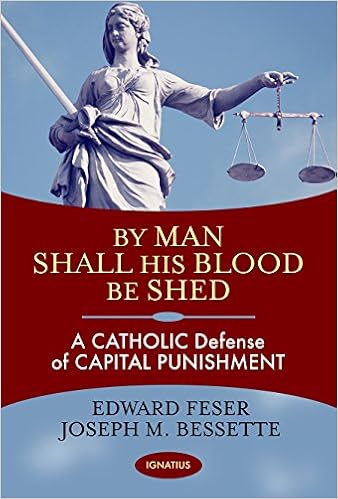
In the WSJ, Joseph Bessette thinks that what Pope Francis did was a mistake. Bessette co-authored with Ed Feser the great book about capital punishment. US HERE – UK HERE

The Pope Makes a Fatal Error
He says the death penalty is ‘inadmissible,’ though not intrinsically evil. He doesn’t note it saves lives.

By Joseph M. Bessette
Aug. 7, 2018 6:58 p.m. ET
When Pope Francis last week declared the death penalty “inadmissible,” politicians pounced. “The death penalty is a stain on our conscience,” tweeted New York Gov. Andrew Cuomo, who proclaimed that he stood “in solidarity with Pope Francis” in “advancing legislation to remove the death penalty from NY law once and for all.”

But the pope’s declaration, which contradicts two millennia of Catholic teaching, allies the church with a public policy that would undermine justice and cost innocent lives.

Consider this example that the philosopher Edward Feser and I recount in our book, “By Man Shall His Blood Be Shed: A Catholic Defense of Capital Punishment”: At a professional conference, a criminologist reported that two burglars had broken into his mother’s apartment and tied her up as they searched for valuables. As they were about to leave, one said: “She has seen us and can identify us. Should we kill her?” “No,” answered the other, “we don’t want to risk the death penalty.” They let her live. One can hardly imagine a clearer example of deterrence.

Another example comes from Sen. Dianne Feinstein of California. In the 1960s she served on the California Women’s Parole Board. At one hearing, Mrs. Feinstein asked an armed robber seeking release from prison why she never used a loaded gun. “So I would not panic, kill somebody, and get the death penalty,” she answered. That convinced Mrs. Feinstein that (in her words) “the death penalty in place in California in the ’60s was in fact a deterrent.”


A third example is recounted by law professor Robert Blecker, who had spent years interviewing prisoners. A veteran criminal told Mr. Blecker that the reason he spared the life of a drug dealer in Virginia whom he had tied up and robbed was because the state had the electric chair. In a similar situation in the District of Columbia, which had abolished the death penalty, the criminal had killed his victim. “I just couldn’t tolerate what they had waiting for me in Virginia,” he said.

These examples are powerful illustrations that the death penalty can and does deter some would-be murderers. Like the rest of us, criminals want to live, and, as the these examples show, they will often adjust their behavior accordingly. Without the death penalty, what incentive would a “lifer” have not to kill while in prison or, if he escaped, while on the run?

There is also a deeper kind of deterrence, largely overlooked in discussions of the death penalty, which doesn’t require rational calculation. When society imposes the ultimate punishment for the most heinous murders, it powerfully teaches that murder is a great wrong. Children growing up in such a society internalize this message, with the result that most people wouldn’t even consider killing another human being.

Here the principle of justice, which demands that malefactors receive a punishment proportionate to their offense, and deterrence of this deeper sort meet. If we abolish the death penalty for even the most heinous and coldblooded murderers, we fatally undermine the idea of justice as the cornerstone of our criminal-justice system. Over time justice will be replaced by a therapeutic or technocratic model that treats human beings as cases to be managed and socially engineered rather than as morally responsible persons.

Apparently, Pope Francis has decided that the death penalty doesn’t save lives. He gives no reasons for reaching this conclusion. We would hardly expect Catholic priests, whatever their rank, to be experts in criminal justice. Unless the death penalty is intrinsically evil—and the pope has made no such claim—then its advisability is a matter for citizens and legitimate public authority. This is what the church has always taught. By falsely claiming that the principles of Catholicism call for rejecting the death penalty in all circumstances, the pope undermines the authority of the Magisterium, pre-empts the proper authority of public officials, and jeopardizes public safety and the common good.

Mr. Bessette is a professor of government and ethics at Claremont McKenna College. He served as acting director of the Bureau of Justice Statistics in the Reagan administration.

Appeared in the August 8, 2018, print edition.

Posted in Hard-Identity Catholicism | Tagged , ,
26 Comments

Your Sunday Sermon Notes – UPDATE: Photos of seminarians Solemn Mass

Was there a good point made in the sermon you heard at the Mass you frequented in fulfillment of your Sunday obligation?

Let us know what it was!

For my part, I am not scheduled today!  However, each year the seminarians of the diocese gather with the bishop for a week.  Today, a couple of the newly ordained will join them for a Solemn Mass in the Extraordinary Form that they themselves organized!  I’ve haven’t lifted a finger, though I will probably hoist my Liber Usualis and join the schola.  It has been while, but I think I can still make out those squiggles.

UPDATE:

Here are some shots from the Solemn Mass the seminarians organized with the newly ordained.  There were a few bumps along the way, but I am unspeakably proud of what they accomplished.  Also, this was the first TLM ever for the 1 year ordained celebrant.  A young priest ordained about 6 weeks was the MC and the deacons were ordained a couple months ago.

Again, they did this and I didn’t have much to do with it at all.  They did it!

I also want to thanks the readers who have participated in the BIRETTAS FOR SEMINARIANS PROJECT.  You can see the fruit of your generosity.  NB: New year… new crop of seminarians.  I’m just sayin’.

Some practice beforehand.


And so Mass begins.   Cope because of the Asperges.

Getting ready for the Epistle.

Before the Gospel is announced.

Consecration.

The Canon continues.

2nd Confiteor.

Anyway, that is a glimpse of how these seminarians had Sunday Mass.

¿Hagan lío?

We’ve gotchyer “lío” right here.

In a way… THIS was my Sunday sermon.

I’m tell you, this works.

Posted in ¡Hagan lío!, "How To..." - Practical Notes, Just Too Cool, Liturgy Science Theatre 3000, Priests and Priesthood, Seminarians and Seminaries, Si vis pacem para bellum!, The future and our choices | Tagged
15 Comments