A story of spectacular complexity, involving shady people, huge money, interlocking directorates, vast loans, and the Papal Foundation.

Read this.

Zenit reports.

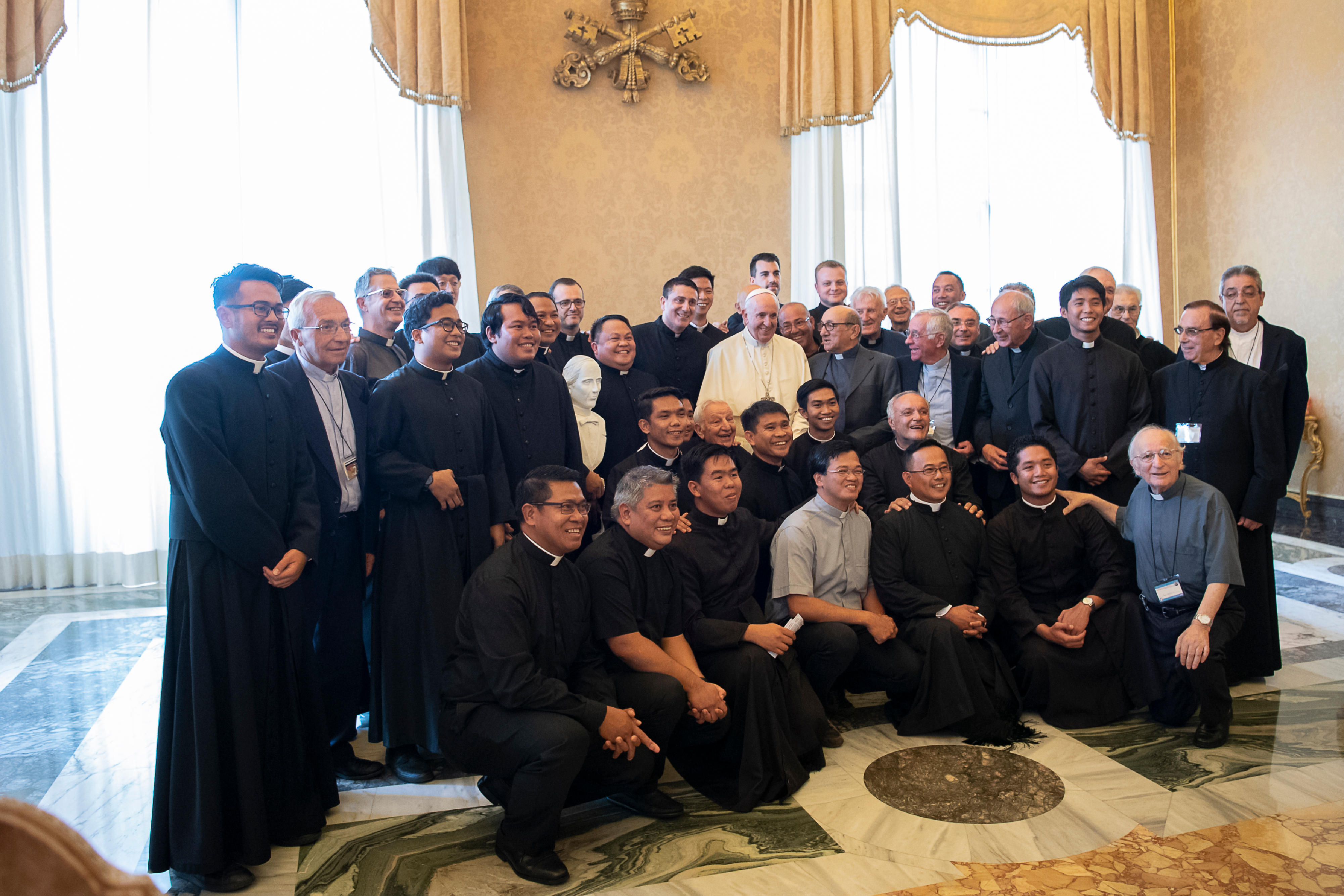
Pope Francis on September 20, 2018, received in the Apostolic Palace Consistory Hall of the Vatican, the participants at the Conference of the Sons of Holy Mary Immaculate on the occasion of the 150th anniversary of the Venerable Joseph Frassinetti death, founder of the Congregation of Santa Maria Immacolata Sons.

Now read this at Crux about the hospital in Rome – called the Immaculate Dermatological Institute or IDI – run by them.

This is a story of spectacular complexity, involving this order, extremely shady people, huge amounts of money, interlocking directorates, vast loans, and the Papal Foundation.

[…]

Left with no alternatives, Pope Francis asked Wuerl to help him find a way to once again fend off the “social catastrophe” of an IDI collapse. The American cardinal forwarded the request to the Papal Foundation, a group of wealthy U.S. benefactors who gave their first grant for charitable initiatives under St. Pope John Paul II in 1990.

Among those pushing for a $25 million grant to be sent to IDI, sources within the foundation said, was also McCarrick, now at the center of a sexual abuse scandal hitting the Church’s hierarchy, and who participated in some sessions of the Papal Foundation until June 2017.

But lay foundation members were not so eager to spend that money, especially since IDI did not release any financial statement or strategy. Speaking to the Wall Street Journal, the former chairman of the foundation’s audit committee, businessman James Longon, called the grant an “irresponsible and immoral stewardship of funds.”

Though ostensibly a dispute about the proper use of funds, the fight over IDI inside the Papal Foundation is also seen by many observers as a proxy battle for the larger war over Francis and his leadership of the Church. Many of the clergy supporting the hospital are also major Francis loyalists, while several of those most skeptical have their doubts about the pope on other grounds as well.

Normally the foundation offers grants for the poor in amounts that rarely exceed $300,000, and its members found themselves at odds with the Vatican’s leadership, to the extent that an audience with the pope last April had to be canceled.

Eventually the lay members capitulated to the request. In July 2017, the first $5 million was approved, followed in January by another $8 million. While these first two payments have already been sent to IDI, the remaining $12 million is still in the foundation’s account, sources within the foundation told Crux.

How those U.S. funds were used by IDI, and the reasons behind the delay of the final payment, remain shrouded in mystery.

[…]

They couldn’t run a bird cage, these people.

Posted in Dogs and Fleas, You must be joking! | Tagged
6 Comments

One Mad Mom spanks James Martin, LGBTSJ – UPDATED

UPDATE:

I had a call from a friend who underscored her real shock at Martin’s ghastly suggestion in his tweets.  The more I think about it, the more loathsome the true content of Martin’s tweets appears.

He told people that they shouldn’t pray or do penance.  The underlying message is that their prayer and penance would not be effective, that their prayers and penances wouldn’t help or do anything.

How twisted is that?


Originally Published on: Sep 18, 2018

One Mad Mom is one mad mom!

She tackles, as well as anyone could, something deeply deceptive that homosexualist Jesuit James Martin, LGBTSJ, said.

In full disclosure, I am one of those leaders who call for the laity to do penance and make acts of reparation for the sins of priests. Now that I know that Martin thinks it is a bad idea (actually, he is doing something far more slithery), I know that I am right.

Fr. Martin – Don’t Be That Guy!

Only from the mind of Fr. James Martin, LGBTSJ, can we get this shocker. I had another post all tee’d up but this one deserved a response.

I understand the desire among some church leaders to call for the church to fast and pray in response to the sex abuse crisis. It’s a recognition that we are all the Body of Christ, the People of God, united as one, in Christ’s name. And we are all called to prayer. However, in this case, to imply that the laity, in any way, should perform any kinds of penances, including fasting, is simply wrong. The laity should not have to do one minute of penance for the crimes, sins and failings of the hierarchy and the clergy. And yes, we are all one, but it’s important, especially in this case, not victimize people all over again. To use the model of the sacrament of reconciliation, it is the sinner, the one seeking forgiveness, who repents, not the one, or ones, sinned against.

Put your eyes back in your head. Yep, he actually said that. It was so fantastical that I screenshot that puppy for you. Oh, Fr. Martin, where in the heck is the Catholicism in this three tweet rant? Sorry, Blessed Mother. All of those times you urged us to prayer, fasting, and penance to hold back God’s wrath and drive the evil out of the world, well, you were wrong. Oh, and your spot at the foot of the Cross was useless, since you were free from sin. Not your problem. And Apostles, you wasted your time, too. Please, please, tell me that even some of the Fr. Martin groupies cocked their head at this one!!!

[…]

You might check out my Sunday Sermon.

.

Posted in Liberals, Sin That Cries To Heaven, You must be joking! | Tagged , , ,
28 Comments

Bishop R. Walker Nickless of Sioux City on #ViganoTestimony

Bishop R. Walker Nickless of Sioux City has made a statement about The Viganò Testimony.

[…]

As I mention our priests, seminarians and deacons, I want to thank the faithful of the Diocese of Sioux City who have offered support, prayers and encouragement to them and to myself. We all know that our beloved Catholic Church is undergoing a purification, and hopefully, a renewal. The news of the Archbishop Theodore McCarrick scandal, the grand jury report in Pennsylvania and the recent “Testimony” of Archbishop Carlo Maria Viganó have given us much to think about and to pray about.

Let me say this about the “Testimony.” In having read carefully the 11-page Testimony of Archbishop Viganó, I support and echo Cardinal Daniel DiNardo, president of the United States Conference of Catholic Bishops, in his statement of Aug. 27, in which he stated, “The recent letter of Archbishop Carlo Maria Viganó brings particular focus and urgency to this examination. The questions raised deserve answers that are conclusive and based on evidence. Without those answers, innocent men may be tainted by false accusation and the guilty may be left to repeat sins of the past.”

I believe Archbishop Viganó and, at the same time, we need more information.

In the matter of transparency in disciplining bishops, no one is above the law; and no bishop, regardless of diocese or rank or standing, may hope to evade the full and exacting moral law of our Lord Jesus Christ and the canonical laws of the church in the exercise of our duties. Therefore, let the harsh light of truth come, with its healing and freeing power.

Moreover, while renewing my respect for our Holy Father, Pope Francis, I join the greater part of my brother bishops in supplicating the Holy Father to make a clearer and fuller answer to the Testimony. My unshakeable loyalty to the Chair of St. Peter prompts me to beg its current occupant, Pope Francis, to undertake the necessary examination for the truth and to lead us courageously. This examination must happen for the church to heal and move forward, and it undoubtedly will happen, if not with our cooperation, then in spite of any attempts to avoid it. We bishops must be open to the truth and accept justice for our misconduct, if any be found.

[…]

Posted in SESSIUNCULA | Tagged , ,
6 Comments

BOOKS RECEIVED: Vatican I: The Council and the Making of the Ultramontane Church

So time ago, I received a new book from a reader about Vatican I. I am not a great fan of the author, John W. O’Malley, who is a liberal Jesuit (tautology).  His book on Vatican II was sharply partisan.

Hence, I hesitated in regard to the new book

Vatican I: The Council and the Making of the Ultramontane Church

US HERE – UK HERE

However, I read a review of O’Malley’s new book at First Things by Russell Hittinger.  He put my mind at ease by saying:

O’Malley gives an accessible, even-handed overview of the council with a minimum of interpretive gloss. He excels in describing the ways in which the council initiated deep changes that still affect the everyday lives of Catholics.

I’ll be digging into it right away.

I am particularly interested right now because of how the word “ultramontane” is being thrown around rather irresponsibly. Right now, ironically, catholic libs who have never spoken well of the last couple Popes, now use “ultramontane” to bludgeon anyone who resists what Francis is up to.

Posted in REVIEWS | Tagged , ,
Comments Off on BOOKS RECEIVED: Vatican I: The Council and the Making of the Ultramontane Church

The upcoming Synod’s “working document”

George Weigel described the guiding document for the upcoming 2018 Synod of Bishops and Non-Bishops.

Anyone looking for a remedy for insomnia might try working through the Instrumentum Laboris, or “working document,” for the XV Ordinary General Assembly of the Synod of Bishops, to be held in Rome next month on the theme “Young People, the Faith, and Vocational Discernment.” The IL is a 30,000-plus-word brick: a bloated, tedious doorstop full of sociologese but woefully lacking in spiritual or theological insight. Moreover, and more sadly, the IL has little to say about “the faith” except to hint on numerous occasions that its authors are somewhat embarrassed by Catholic teaching—and not because that teaching has been betrayed by churchmen of various ranks, but because that teaching challenges the world’s smug sureties about, and its fanatical commitment to, the sexual revolution in all its expressions.

A gargantuan text like this can’t seriously be considered as a basis for discussion at the Synod. No text of more than 30,000 words, even if written in a scintillating and compelling style, can be a discussion guide. The IL for Synod-2018 reads, rather, like a draft of a Synod Final Report. And that is a prescription for a failed Synod.

Posted in SESSIUNCULA | Tagged ,
7 Comments

ASK FATHER: Should we pray for or against the success of the Synod?

I’ve had a few questions in email about the upcoming Synod.   People are worried that it is rigged.   Imagine such a thing!  “Surely NOT!”, you might gasp.

Questions have ranged from the new constitution for the Synod’s operation to whether we can, given the changes and given those whom Francis invited personally to participate, we can support it.

This afternoon Peter Kwasniewski has a piece that is as earnest as it is mordant.   He writes about the upcoming Synod.

A sample:

What this suggests to me is that, at this time in history, the higher one’s position in the institutional hierarchy, the more likely one is to be corrupted and compromised, while simple lay believers are far more likely to be outspokenly committed to traditional faith, morals, and liturgy. This is where future Catholic laity, priests, and religious will come from—not from the Synod machinery of the new German-Italian Axis.

Instead of praying for the success of another rigged Synod, perhaps we need to pray for a real chastisement from God to wake up the Church in its heady echelons. We might consider using the so-called cursing Psalms that were excised from the new Liturgy of the Hours.

What are the “cursing psalms” (aka “maledictory psalms”)?

A standard list of the maledictory psalms will include – and alert that Psalms are numbered differently in various editions of Scripture and in newer and older books you might consult – 5, 6, 11, 12, 35, 37, 40 52, 54, 56, 58, 69, 79, 83, 137, 139, and 143.  Many of these psalms were “edited” or even wholly excluded from the revised Psalter used in the Liturgy of the Hours.   However, there are lots of maledictions, curses and imprecations throughout the Psalter: 5:10; 6:10; 7:9-16; 10:15; 17:13; 18:40-42; 18:47; 26:4-5; 28:4; 31:17, 18; 35:3-8; 40:14; 54:5; 55:9, 19; 56:7; 58:6-10; 59:ll-15; 68:2; 69 (most of the psalm); 70:2-3; 71:13; 79:6, 12; 83:9-17; 104:35; 109:6-20; 129:5; 137:7-9; 140:8-11; 141: 10; 143:12; 149:6-9.

Of special note are Ps 55, 108, and 136 which give libs a serious case of the collywobbles (except perhaps if they use it against defenders of doctrine and law).

So, what to make of these psalms?

First, since they are the inspired word of Almighty God, we can safely say that they are not bad and they can be used for prayer.   

St. Augustine believed that every word of the Psalms was Christ speaking to the Father, but in different voices, as the Head, the Body and both together, Christus Totus.  I’ll go with Augustine.

That said, it might make the Christian scratch her head when we pray “Blessed be he that shall take and dash thy little ones against the rock” (Ps 137:9).

How to use these psalms in prayer in a way that is pleasing to God and that does not imperil our own salvation by spurring us to soul killing hatred?

Isn’t this a serious consideration in these times of political circuses and ecclesial misadventure?

Christ the Lord commanded us to love our enemies (Matthew 5:44).  And yet a couple dozen or so psalms – which all Christians can use for prayer – seem to wish some pretty dire things on our enemies.  And, yes, we have enemies.

Love for “enemy” can be expressed different ways.

Love for our enemies does not mean that we must hope that they prosper or succeed in their wicked ways.  Love, charity, means that we will their true good. We pray for their salvation.  We ask God to use the necessary corrections, chastisements, whatever, to punch through their pride and turn their minds and hearts, even if that means suffering unto loss of limb and life.


One of the best explanations of the maledictory psalms – and therefore how to pray for our enemies – I’ve run across came in a comment made on this very blog under another entry  Namely, …

In the Introduction (by Pius Parsch) to the Baronius edition of the 1962 Roman Breviary [UK HERE], we read that:

As Christians we may never wish evil upon a sinner directly and personally, but [NB] these [curse] psalms have nothing to do with personal enmities. The theme of all our praying is God’s kingdom and sin, and the curse passages in the psalms are expressions of absolute protest against evil, sin and hellTry changing the curses into an expression of divine justice and you pronounce them no longer with your own mouth, but with the mouth of Christ and the Church. The curse thus resembles the woes that our Lord addressed against the Pharisees. There is something quite stirring and grand about these curses. The all-just God steps before us as we pray and warns us of the punishments of hell.  [NB: warns us!]

In regard to Psalm 108 (109)—perhaps the most maledictory of all the so-called curse psalms and omitted entirely from the LOH psalter—he says that

Psalm 108 is a curse formula and very difficult to reconcile with the Christian idea of prayer. Let us suppose that the Church or Christ Himself is praying this psalm. Then the curses become no longer wishes, but rather the solemn sentence of divine justice upon unwillingness to repent. With tears in her eyes the Church prays these terrible words–just as Jesus once declaimed his eightfold “Woe is you . . .” against the Pharisees. At the opening of the psalm, the Church laments. In the following two sections, where curses and punishments are asked for, a picture of the everlasting hell is painted for us. The petition which comprises the fourth part of the psalm can be a prayer of the individual soul; I stand terrified before the picture I have seen: “Have mercy on me, a poor weak mortal!”.

While there is a great deal more to be said about the maledictory psalms, that seems a good place to pause so that I can do my job and admonish you.

We members of the Church Militant have enemies.  Right now, many of them are inside the gates.

There are the relentless, ineluctable foes which are the world, the flesh and the Devil.  There are also the agents of the Devil among us, outside the Church and, verily, inside.

We must strive not to hate enemies, to love enemies with the love that is charity, the love that desires what is truly good for them.  If they are doing great harm to our persons, families, nation and Church, yes, we can pray for their conversion or for their ruin lest they continue to do harm and lest they go to Hell.  For example, HERE. And while we pray for and against our enemies (and bear wrongs patiently), we must see to it that we don’t go to Hell, either.

As we soldier on through this vale of tears, we must constantly field strip our consciences while asking God for all the graces we need to do His will and to conform ourselves to His will and ways.

Posted in "How To..." - Practical Notes, Hard-Identity Catholicism, Si vis pacem para bellum!, The Coming Storm, The Drill, Urgent Prayer Requests |
12 Comments

What passes for important today.

Once upon a time, Roman Pontiffs and the Curia they assembled as hired help concerned themselves with the great issues and questions of the day.   Minor issues were left to others to deal with.

These days, in the age of the feckless, a reversal of sorts can be noted.

Head over to Crisis for Fr. Rutler’s tour de force of apposite factoids and dates.  You might make some popcorn.   Here’s a taste…

These days seem to be a “perfect storm” of events which add up to a fourth crisis, and the faithful trust that “through toil and tribulation” the purging of corrupt elements will result in a stronger Catholic witness. Recently, Pope Francis told the press: “I will not say a word” about some of the most serious allegations of decadence in the Church, and he has long declined to respond to the dubia of some cardinals on the spiritual economy of marriage. Some have thought that such reticence is inconsistent with his dogmatic outspokenness on ambiguous matters such as climate change and capital punishment. On the most recent New Year’s Day, he said: “I would once again like to raise my voice” about immigration, and on Palm Sunday he told young people: “You have it in you to shout” even if “older people and leaders, very often corrupt, keep quiet.” That is why there was eagerness to hear him when in these most tumultuous months, on the fourth day of World Prayer for the Care of Creation, he finally spoke—but it turned out to be a warning about plastic debris in the world’s waters.

On September 1, the successor of Gregory I, who saw Latin civilization crumbling, and Leo IX, who grieved at the loss of Constantinople, and Pius V, who pitied souls lost in the heretical northern lands, implored and lamented: “We cannot allow our seas and oceans to be littered by endless fields of floating plastic. Here, too, our active commitment is needed to confront this emergency.” The struggle against plastic litter must be fought “as if everything depended on us.”

I almost spit my coffee on the keyboard when he reminded us of a 2007 of one of the minor dicasteries (which had to produce occasional documents to remind people – including Popes – of their existence to justify their budget):

 The poignancy of such pastoral solicitude inevitably brings to mind the historic document of the Pontifical Council for the Pastoral Care of Migrants and Itinerant People in 2007 which was entitled: “Guidelines for the Pastoral Care of the Road.” That was precisely the one thousandth anniversary of the no less important peace treaty with the Vikings signed by King Aethelred the Unready. The world will long remember that pontifical document’s opening line: “Moving from place to place, and transporting goods using different means, have characterized human behavior since the beginning of history.” The guidelines also pointed out (n. 21) that “A vehicle is a means of transport…” and observed (n. 23), “Sometimes the prohibitions imposed by road signs may be perceived as restrictions on freedom.”

ROLF!

In the Online Illustrated Dictionary of the Church, this piece might be linked under the voice: “sardonic”.

Posted in SESSIUNCULA | Tagged
9 Comments

YOU are other people.  It’s always someone else… until it’s YOU.

Last night I watched the news for the first time in a few days.

One guy in North Carolina, who lost everything because of Florence, said that he’d seen things like this on TV but he never thought it would happen there.

From time to time, I remind you to make at least basic preparations against the day when you might need to move fast or when disaster strikes.

We don’t know the day or the minute when we will go before our Judge.  Whether it is a natural event like a storm or meteor, or a man-made event like a drunk driver or a nutjob with a rifle, we just don’t know.

Avoid the trap of thinking that these things only happen to other people.

YOU are other people.  It’s always someone else… until it’s you.

You can lose your house and everything you own in a storm, but you can lose your immortal soul from a mortal sin unconfessed.

So, examine your consciences and …

GO TO CONFESSION.

I would also add as a regular feature of your daily prayers that important petition in the Litany of Saints:

“A subitanea et improvisa morte… From a sudden and unprovided death, spare us O Lord.”

Sudden is one thing.  Unprovided is another.  An “unprovided” death is a death without access to the last sacraments, especially absolution from a priest.

That’s a scary thought…. especially if you haven’t been to confession for a  long time.

When did you last go to confession?

Moreover, consider well your living conditions and security.

If you haven’t done so yet, begin to develop a physical situational awareness. Seek advice and training from professionals.

If you haven’t done so yet, begin to develop a spiritual situational awareness.  Seek advice and training from priests.

Also, you should be reviewing what you will do, especially with your loved ones, when the big storm comes.   Will you have food, water, clothing a place to go, a way to keep yourselves safe if you have to move fast?


Posted in "How To..." - Practical Notes, Four Last Things, GO TO CONFESSION | Tagged , ,
3 Comments

ASK FATHER: Are we are in the End Times?

From a reader…

QUAERITUR:

Okay, I know that this is may be “edgy” given the fact it deals with prophesy, so hoping you can pull me back from the ledge. Am I crazy to think that Heaven is literally SCREAMING at us? I see so much about this crisis in the context of the temporal, but isn’t it really a supernatural crisis?

Here’s what I’m looking at:

1) Ven Bartholomew Holhauser’s “7 ages of the church” – we’re apparently in the (end?) of the 5th period.
2) St. Malachi’s prophesy of popes . . . 112th is the last one listed (I know, this one may be sketchy)
3) Marian Apparition after Apparition saying the same thing:

– La Sallete
– Fatima
– Akita
– Our Lady of Good Hope
– Even the messages in Our Lady of America

SO, you read those and they all point to the same things . . . that are happening now:

– Apostasy in the Church
– Apostasy at the highest levels
– War on marriage and the family
– Coming Chastisement (if we don’t reverse course in a darned fine hurry.

Have I crossed over the edge into the “crazy” realm? These are Church approved apparitions, venerated individuals, consistent with church teaching . . . Shouldn’t we listen to our Mother?

Would love you to comment on this. In the meantime, I’ll be over here praying the rosary!

I am sure that readers could add to your lists, and that they will.

Heaven is screaming at us all the time!   Every time you go to Mass and read Scripture and feel movements in your conscience, heaven is screaming.

Every generation of Christians has sensed itself to be in the End Times.  They have been right.  We have been in the end times ever since Our Lord’s feet disappeared into the clouds… I love those medieval illuminations!

We are in the End Times.

But, I think we also have a sense that we are in The End Times.

We are probably witnessing the Great Falling Away.  Sometimes I jest that when we see bloody sacrifice return to the Temple in Jerusalem, I’ll put on that hair shirt.

It seems to me that our response to this echatological spidy-sense must be to redouble our determination to live properly the vocations that God has given us.

God gave us something to do.  Speaking of The End Times, before The Creation, God knew every single one of us, loved us, planned for us.  He brought us into existence at a precisely place and time in his grand plan for salvation.  Hence, we play a role in His plan.  That means that, if we dedicate ourselves with true devotion to our state in life, He will give us every actual grace that we need to live properly and to fulfill His will… no matter what times we live in, peaceful, tumultuous, bellicose, dire, prosperous, whatever.

That we do as individuals.  We must see to our identity and vocations in the sight of God.

Collectively there are things to do as well.   It will not be a surprise if I direct your attention to what I am constantly harping about concerning our sacred liturgical worship of God.

Living our vocations properly is part and parcel in our fulfill our duties according to the virtue of religions.  Collectively, the primary way we fulfill religion is in our collective sacred liturgical worship.

Our vocations are a gift from God.

Our liturgical worship is a gift from God.

Our traditional tried and true, slowly, carefully, organically developed perennial worship is a gift from God.

I will not make that claim about the newer-forms.  First, they were rather artificially cobbled up and they were done so precisely in the way that the Fathers of the Council commanded to avoid.  Also, the newer forms have no track record yet.   The phrase “work of human hands” could not be more ironic.

But let that pass for now.

Our vocations are a gift from God

Our traditional worship is, itself, from God.

Our vocations are the means by which God wants us to be saved.

Our sacraments and the Church’s rites are the means by which God wants us to be saved.

Hence, we have to review and renew our vocations.

Hence, we have to review and renew our liturgical worship.

Going to the heart of each is necessary.  What are the true duties of my state in life?  What is our true form of worship as Catholics?   How do we give ourselves more to both?

These are the questions that we should concern ourselves with.

We don’t know what The End Times will bring.  Should we do some “prepping” in material terms?  Maybe, but we should do a heck of a lot of prepping in spiritual terms.

And if we are not in The End Times, what harm have we do?

None!

We’ve done what we ought to have done, for God’s love, anyway.

Another note about our traditional liturgical worship in the light of the End Times.

The End Times are matters of both present concern and future fulfillment.

Tradition is a matter of both present concern and future fulfillment.

We live in the End Times since the Lord ascended.  He will come again to fulfill definitively what He began.

Tradition was handed down to use from those very same days.  Those who handed it on are now fulfilled in heaven.   The End Times are ahead of us, and, in a sense, Tradition is ahead of us.  The End Times are future and so is Traditional.  Tradition isn’t “past”.  It is present execution – proper use of what we have been given – and future fulfillment.


Posted in Four Last Things | Tagged ,
9 Comments

Fr. Murray’s Open Letter to ex-Card. McCarrick. Wherein Fr. Z rants.

My good friend Fr. Gerald Murray of the Archdiocese of New York posted an Open Letter to ex-Cardinal McCarrick, also originally a priest of the same Archdiocese.

Fr. Murray really lays it on the line, in spiritual terms. It’s strong medicine, friends.  I can only hope that McCarrick will read it, that someone cares enough for McCarrick to give it to him.

It is important, as Catholics, that we foster the virtue of charity, concretely expressed.   When we deal with people like McCarrick, and we consider the devastation that they caused, we may have a knee jerk reaction to want them to be crushed, ground up, brought down so far that they they even wonder where their next meal will come from.   That, however, isn’t an authentic Christian reaction.

Charity compels us to desire that which is the true good on another, our neighbor.  McCarrick remains a neighbor.  He has an immortal soul.  We should never desire Hell for anyone.  We should always desire conversion and repentance from objective sinners.   We should also desire authentic mercy for the sinner.  Think about the rejoicing in heaven at the conversion of a sinner.  The greater the sinner, the greater the conversion, the greater the joy, the more God’s glory is magnified.   God brings good from evil.

Authentic mercy does not obliterate justice.   True mercy does not ignore the truth.

Mercy mitigates justice.  Mercy does not abandon truth.  Mercy exalts the truth and then shows forth the love and might of God in setting aside something of what delicts deserve.

“Behold!  Here are the horrible facts.  Behold the truth!  Now consider the magnificent love of our Savior who bore all of that, loves of still, and always offers grace and forgiveness!”

With the love of God in mind, we should long to preserve always the truth when we are concerned even with the more complicated situations we little people can get ourselves into.

God’s justice we are going to get whether we want it or not.  Mercy, however, must be and can be asked for.  God will be merciful, but we must ask for it.   Mercy won’t entirely mitigate justice and will in no way obscure the truth.  But mercy will attenuate what our sins have truly deserved.

Mercy is honored even more when the truth is preserved.  Hence, the greater the fault to which we apply mercy, the greater God’s love is shown to be.   Mercy underscores God’s omnipotence.     In this earthly life, wounded by Original Sin, there is no perfect charity.  There is, here and now, no perfect justice, no perfect mercy.  Yet, we must strive for it, so that we always have a foot in the City of God even while we still sojourn in the City of Man.

Fr. Murray has offered good priestly advice – openly and for all to read – to ex-Card. McCarrick.   He rightly points out the role of truth for him now, in light of the mercy that God will show in his judgement… which, at his age, will be very soon.

Remember, dear readers, that we are going to be judged soon.   Even if in earthly years you are still among those considered “young”, your judgement, in the grand arc of salvation history, is going to be soon.  Life is fleeting.   Our years pass like the burning of dry grass, like the whipping of the loom’s shuttle.

Some of you reading this are really close to your judgment, because of age, health or unforeseen accidents that can strike at any moment.

GO TO CONFESSION!


Posted in GO TO CONFESSION, Mail from priests | Tagged , ,
3 Comments























