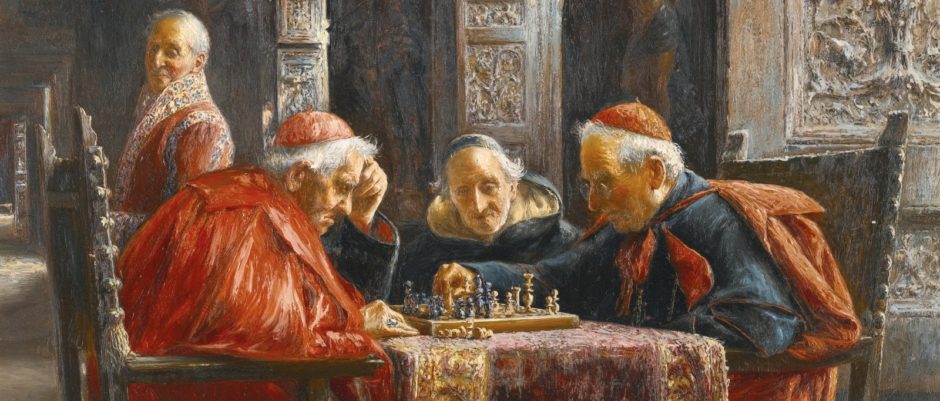
In Casablanca, one of the best films ever, Captain Renault, about to shut down Rick’s Café utters:
“I’m shocked! Shocked to find that gambling is going on in here.”
[a croupier hands Renault a pile of money]
Croupier: Your winnings, sir.
Captain Renault: [sotto voce] Oh, thank you very much.
I was sent a copy of a recent tome The Disastrous Pontificate by Dominic J Grigio
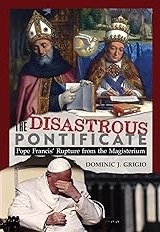
The Disastrous Pontificate: Pope Francis’ Rupture from the Magisterium is an expansive, highly structured critique of the Francis pontificate, written from a traditional Catholic theological standpoint. Published by Os Justi Press in November 2025, this 876-page tome is presented under the penname “Dominic J. Grigio,” a Catholic clergyman who says he wrote anonymously out of undoubtedly realistic concerns about reprisals and the Wrath of the Whatever High Atop the Thing .
What distinguishes the book is not only its severity of judgment but also its method. Grigio says that the core analytical section, “The Errors of Pope Francis” (together with “The Questionable Words and Deeds of Pope Francis and his Appointees” they span 500 pages), is modeled on Ludwig Ott’s Fundamentals of Catholic Dogma: that is, it proceeds in a schematic, doctrinal way, testing Francis’s statements against settled theological categories and prior magisterial teaching. He adds that the accompanying source compendium, “Sources: The Errors in the Light of Scripture, Tradition, and the Magisterium”, is inspired by Heinrich Denzinger’s Enchiridion. In fact, the writer acknowledges at the beginning a site Denzinger-Bergoglio: a reference-style catalogue in which texts from Francis evaluated.
The book therefore functions as more than a polemic. It is presented as a hybrid of dogmatic manual, documentary dossier, and chronological indictment. Its basic thesis is that Francis’s pontificate introduced ambiguity and rupture into Catholic teaching and governance, and that this confusion must be answered by a disciplined return to the Church’s perennial doctrinal sources. In that sense, the volume is best understood as a prosecution of the Francis era, organized with the architecture of Ott and the documentary discipline of Denzinger.
This is not a book for comfortable evening reading as if a novel in an arm chair. That would be too depressing. It serves as a resource. It serves as a public record. It is hard evidence. It is a thorough prosecution.
So, I’m shocked, shocked that there is such a book. I’m as shocked as Capt. Renault.
Seriously, the book is shocking. We can, over years, allow the details of what Francis & Co. did and said to slip away in the rear view mirror. But once they are all recalled, laid out and detailed, the results are truly shocking.
The book is also shocking for me, as a priest and, especially, as a convert. As a new Catholic who came into the Church in the years of the vigorous John Paul II, and who was ordained by him, and who got to know well Card. Ratzinger, I have as Catholics ought a deep respect for the papacy. I venerate the office of the Vicar of Christ and the munus Petrinum because they are willed by God for the good of souls.
I am not shaken in my respect for the office of the Vicar of Christ, the munus Petrinum. We must distinguish between the office and the men who obtain it.
I’ll close with another great screen moment, taken from the video version of I, Claudius, the book by Robert Graves. In his old age, Claudius knows he cannot prevent the beastly Nero from becoming Emperor. Hence he does nothing to stop him or prevent his own murder thinking that when people see how bad Nero is, they will want the Republic back. Old Claudius, in his cups, repeats, “Let all the poisons that lurk in the mud hatch out.”
For a deep cleansing to be possible, everything needs to be exposed.
It is possible that this tome might shake some common sense into our brothers and sisters about the state of things.
¡Hagan lío!































Not much often reduced to using the word, but the tome is indeed awesome. The minute I learned of it was ordered. While I have barely scratched the surface, it is evident that there is a desk in the papal apartment which requires a copy, with wider distribution around the city state seriously desirable.
Who knows, if time is budgeted correctly and unnecessary conversation eliminated, it could even be reading for the plane, though it might exceed weight limitations.
What is more shocking is that it continues under the current pontificate. A smile, a change of clothes, and softer words but still the same message. “The multiplication of the loaves and the fish happened while sharing: that is the miracle.”
And Leo?
Sadly, I very much doubt that fidelity to the Deposit of the Faith will return to the Vatican until all Baby Boomer Bishops are dead. Case in point: Jesus said, “Thou shalt love thy neighbor as thyself,” and “But I say unto you, love your enemies.” Cardinal McElroy goes on national television and says “I hate Donald Trump.” And he receives no rebuke from Pope Leo.
David alludes to a the thought of Pope Benedict who in essence said that this situation will not resolve until those invested with a post-conciliar prejudice of either sort pass away.
It is going to take some serious consequences and more time — neither of which I want to shoulder, but Christ gave His shoulder to get us through this.
Oremus.
The Casablanca reference is one of my favorites.
I always felt that Pope Francis was a desperate “last gasp” of the spirit of Vatican II folk as their efforts to derail Catholicism failed—witness the rise of good, orthodox priests and the growth of interest in Catholic Tradition and its teachings.
As to our current Pope, I believe the “jury is still out” on his pontificate.
Pray for our Pope, pray for our Holy Mother Church!
If anyone were to be remotely tempted to dismiss this book, the back-cover endorsements blew me away. These people were mocked–threatened, for 13 years for merely asking questions civilly, respectfully, faithfully. The skullduggery of those who worked to dismiss many of them with impunity from the positions where they excelled at, particularly comes to mind.
“Let all the poisons that lurk in the mud hatch out.”
So that they might be cured, so that they might be made clean and no longer harmful.
An apt metaphor for confession.
There is nowhere on earth that I approach with such a mixture of gratitude and loathing. Digging out the muddy objects for display is the absolute worst, but there is *nothing* better than getting free of those nasty objects!
An unfortunate and necessary sequel to Henry Sire’s Dictator Pope.
Kyrie, eleison!