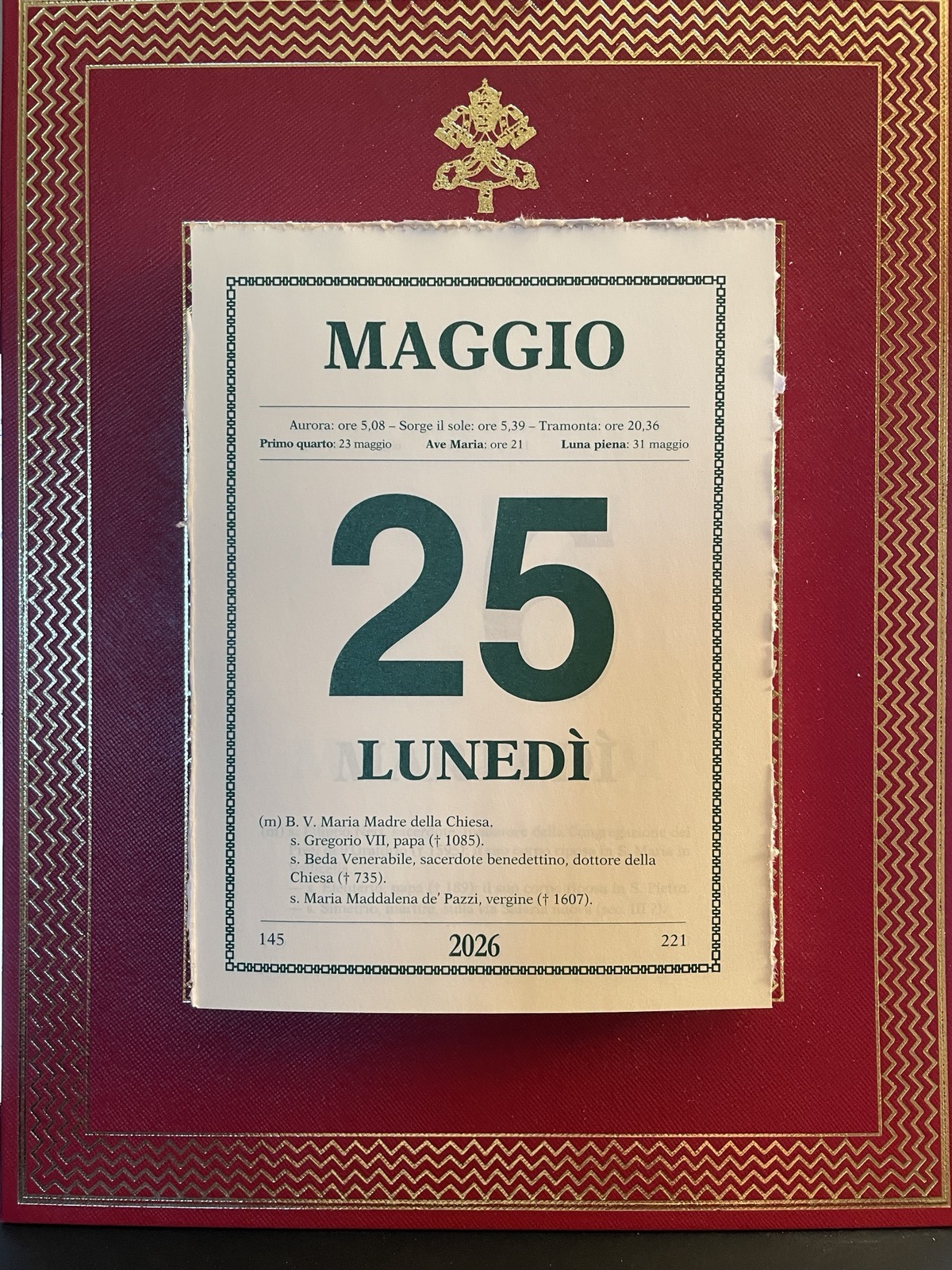
 Liturgically busy day, just as it was in life. I’m getting behind. By the end of the day, I’m…. ugh.
The Roman sun rose at 5:39.
The Roman sun set at 20: 36.
In the Curia the Ave Maria Bell is in the 21:00 cycle. However rang on my phone app while we were having supper last night. Such a great app.
Along with being the 145th day of the civil calendar, it was the Feast of Mary Mother of the Church, of St. Gregory VII, Venerable Bede and Maria Maddalena de Pazzi.
Jammed.
I read the new encyclical. It is not without problems. There are some inconsistencies in it, demonstrating that it was a committee work (they all are now) but also that the editor wasn’t very good. I was disappointed at the overriding anthropocentric turn and the seeming watering down about abortion as being “gravely wrong” rather than “intrinsically evil”. I don’t see how the Church’s “just war” doctrine can be thinned out into “outdated”, given the fact that states have a right to defend its citizenry at several levels and that force must be used to end obvious evil. I’m reminded of Francis once saying that there should never be bombing and then soon after saying that the allies should have bombed to train tracks to the concentrations camps. As a Latininst, I note that who ever worked on this does understand the impact of “novae” in “res novae” as seriously negative in connotation (not neutrall) and that the name of the document Quadragesismo anno is throughout called Quadragesima anno. Really? It is fun to see Tolkien quoted, but one wonders if the author of that section realizes that Gandalf is a fictional character. I also wonder if the contributor to the theme of Nehemiah knew that the workers rebuilding the walls were also armed. Also, how did Nehemiah, who essentially engaged in ethnic cleansing and the disfigurement of those who married outsiders as a paragon of synodality? I could go on.
However, there were some interesting passages and some fair warnings about unbridled use of AI by those who are not responsible to anyone else. And yet, the encyclical, if I got this right, suggests strong oversite by the state. Oh? China?
Enough of that. Many people will look at this in the next few days. Will it succeed in the view of authentic experts in the Church’s social teaching as being integrated into that body? It is economically a little thin, for example. I really didn’t like the suggestions about redistribution. Who is supposed to do that?
Friends, including The Great Roman™ and The Great Roman Wife™ with Midwest Travelers™ and I sought to fend off death by starvation.
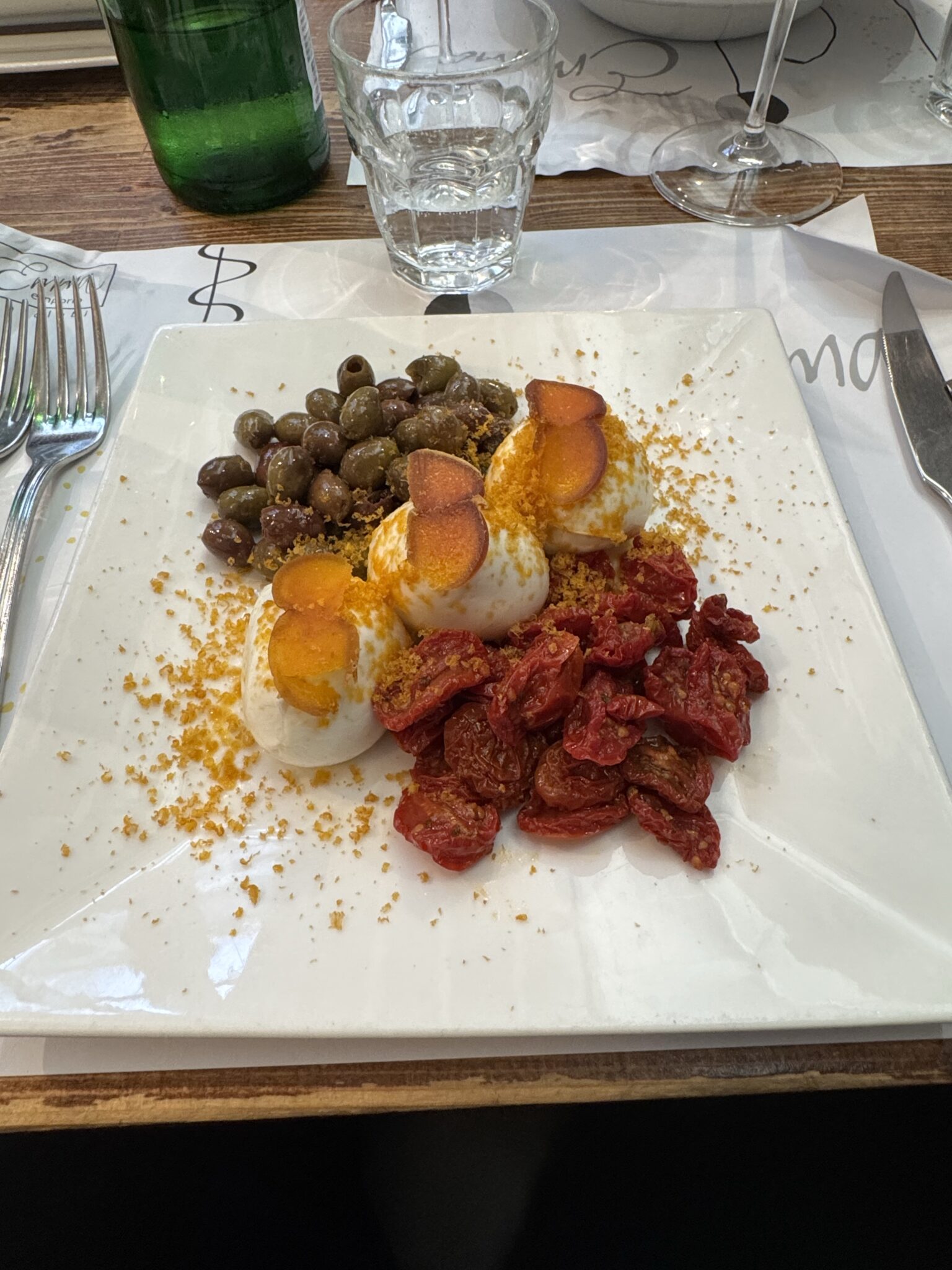
Great salad.

That’s grated bottarga.

Goodies.
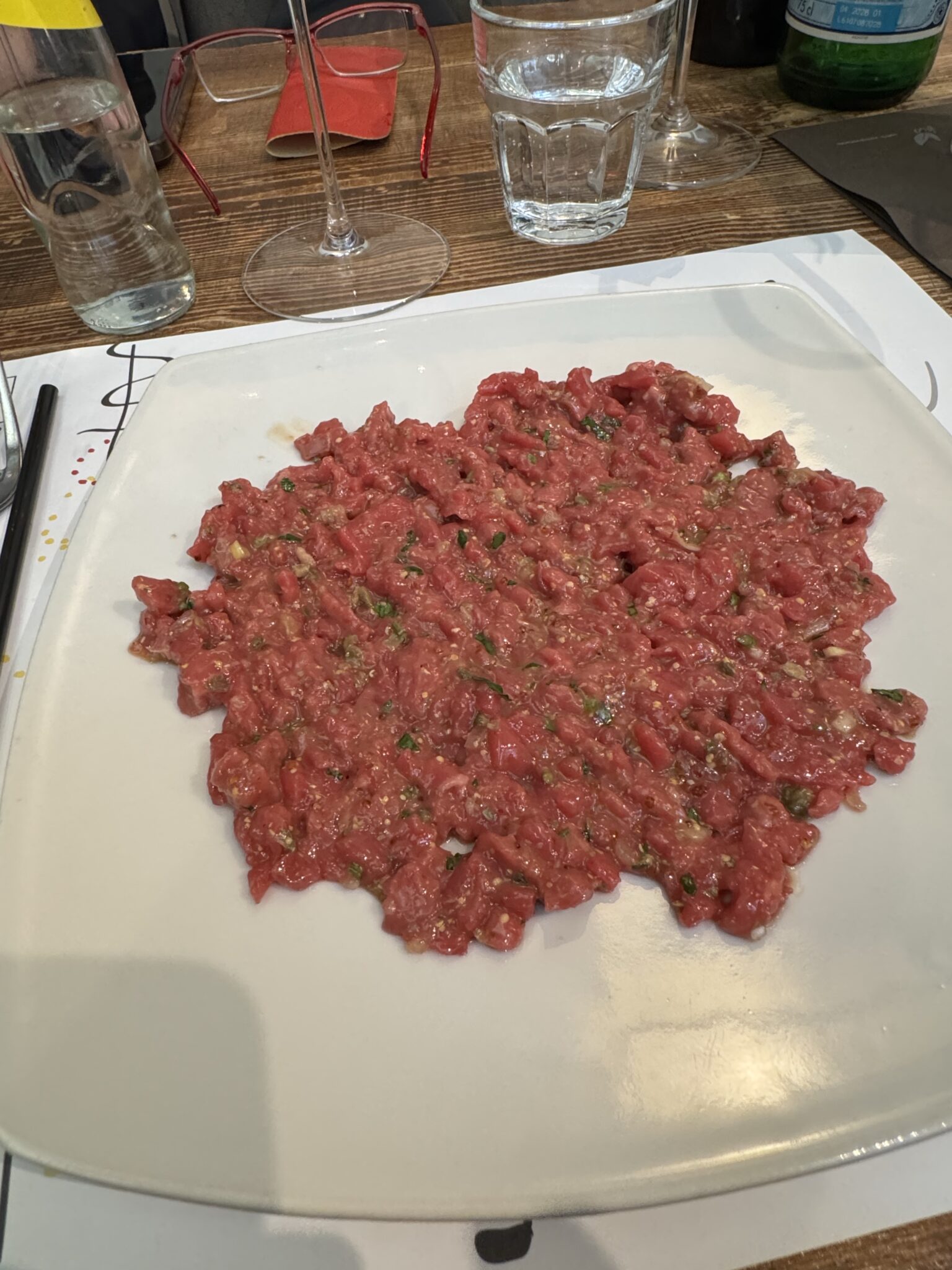
Really good steak tartare.
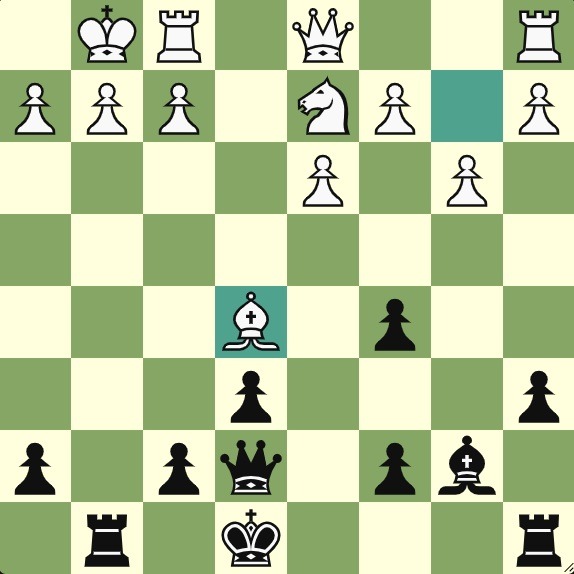
Black mates in 4.































I was taken aback by his describing the building of Jerusalem as opposed to Babel as “brick by brick”.
1. . . . . . . R×b2+
2. K-a1 . R×a2++
If:
3. K-b1 .. R-a1#
So:
3. K×a2 . Q-a4+
4. K-b1 . . Q-a1#
My previous solution used incorrect column designations. Here is a corrected version:
1. . . . . . . . R×g2+
2. K-h1 . . R×h2++
If:
3. K-g1 . . . R-h1#
So:
3. K×h2 . . Q-h4+
4. K-G1 . . Q-h1#
Black to move and mate in 4
1) … Rxg2+
2) Kh1 (forced) Rxh2+
3) Kxh2 (or *1 Kg1 ) Qh4+
4) Kg1 (forced) Qh1#
If *1
3) Kg1 Qg5+
4) Kxh2 (or *2 block via Bg3 or Qg4) Qg2#
If *2
4) Bg3 or Qg4 Rh1#
I have not yet attempted to read it, but when I saw someone noting the Nehemiah reference, a line from the fifth of T.S. Eliot’s Choruses from The Rock came to mind, and I have now looked it up: “Remembering the words of Nehemiah the Prophet: ‘The trowel in hand, and the gun rather loose in the holster.'” The whole Chorus invites rereading, as indeed the context in the play – where Nehemiah appears speaking the words of chapter 4:14-18 of the Second Book of Esdras (though closer to the ‘King James’ than the Challoner Douay-Rheims translation).
Michael Pakaluk has an interesting and devastating critic of the encyclical written with the help of an AI called Claude. Of course Claude could just be his next door neighbor.
https://open.substack.com/pub/michaeljosephpakaluk/p/special-post-on-magnifica-humanitas?r=brpti&utm_medium=ios
The article verifies my impression that the Vatican no longer has anyone with authority who thinks through issues thoroughly. I think this is why Pope Francis did not respond to any questions about his problematic encyclicals and why TC had to be modified by additional comments.
I still haven’t attempted to read it, but the expression “TL;DR” – which Wikipedia cites the OED for telling us that it dates to at least 20o2 – came to mind, and the query, has anyone yet coined “TL;DW”? – too long; didn’t write – arose as well.
How many AI aficionadi (in universities, businesses, institutions) practice TL;DW – followed how often by TL;DR before sending forth? How many committees do the same?
I see the Vatican website has it in nine languages (so far) – none of which is Latin, yet. I wonder in which languages the Holy Father read it, before its promulgation (assuming he did manage to get through it in even one)? There is an enjoyable Yes. Minister episode where the Minister is part of the way through a public speech before realizing it was the one written for the previous occasion and still in his pocket.
Thinking about the incipit (to which the four romance languages come closest, though the German and Polish have the same word order – while the English syntax notably diverges: I have not attempted feeding the Arabic into a translation machine), it occurs to me on the one hand that the noun has a rich technical sense in the ‘Quicunque vult’, and on the other that it seems very uncommon in the Vulgate, always translating the same Greek word (2 Maccabees 6:22 in a very striking context, Acts of the Apostles 28:1, and St. Paul’s Letter to St. Titus 3:4 – in a use ringing throughout the ‘Byzantine’ Divine Liturgy). Turning to Lewis and Short, I find “human nature, humanity, in a good sense […] for the most part only in Cicero”, by transference “humanum genus, the human race, mankind (very rare; mostly post-classical)”, and “Humane or gentle conduct towards others, humanity, philanthropy, gentleness, kindness, politeness (synonyms: comitas, facilitas, mansuetudo, clementia, opposite severitas)” – the latter, might one say, piquant in the circumstances of official responses to the intentions of the FSSPX up till now?
If only His Holiness would follow his own advice with respect to the FSSPX…
“222. To those who have the honor and responsibility of governing, I would like to repeat the words that I spoke at the start of my Pontificate: “The peoples of our world desire peace, and to their leaders I appeal with all my heart: Let us meet, let us talk, let us negotiate! “
I’ll bet Thiel or one of his minions compares Pope Leo’s encyclical to the (pop culture version of the) Galileo affair. Oppression of progress by the pope!
And, I still have not attempted to read it, but Joseph Pearce’s article, “Why Pope Leo Quoted Tolkien’s Gandalf” – and an intelligent ‘nit-picking’ comment there – got me finally looking up the context of the quotation. It is in The Return of the King, Book Five, Chapter 9, “The Last Debate”, and I found someone (in another context) neatly summarizing the setting: “The hearers are the lords of the allies gathered at the gates of Minas Tirith. Denethor and Théoden are dead and Faramir is recovering from his wounds in the Houses of Healing so it is Aragorn, Imrahil of Dol Amroth, Éomer and Elladan and Elrohir, the sons of Elrond who listen to what Gandalf is saying”. The whole ‘debate’ rewards (re-)reading. For one thing, it is ‘just war’ all the way – both with respect to a desperate ruse to hope to distract Sauron and to Imrahil’s insistent call for “prudence” that “Gondor must be protected” – with which Gandalf heartily concurs. With your comment that the encyclical suggests strong oversight “by the state” in mind, I wonder if the Holy Father is in danger of being (unconsciously) more ‘impenitent-Boromir’ minded than Gandalf minded?