
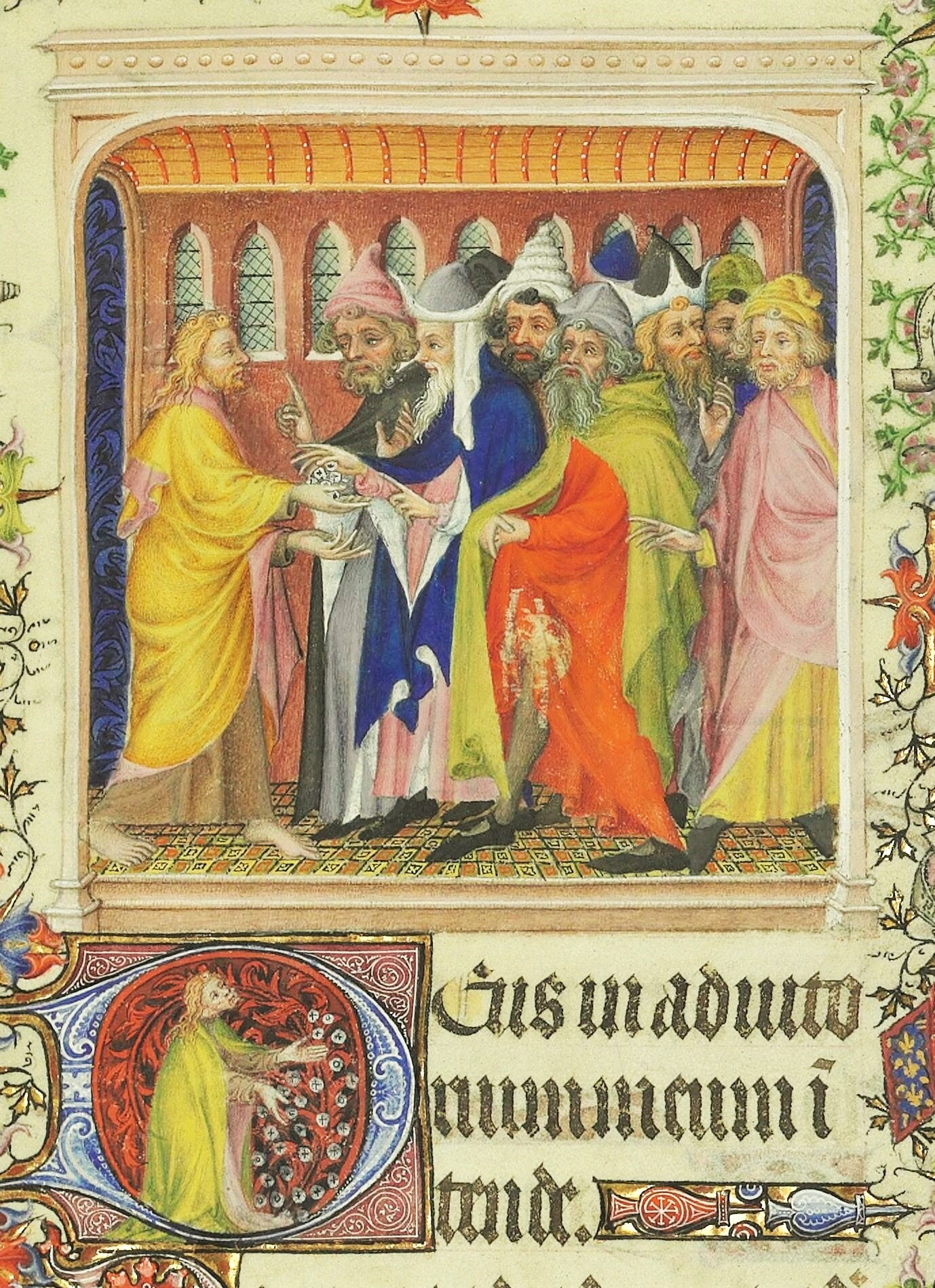
From a reader…
QUAERITUR:
A blessed Holy Week to you!
I noticed that in the Gospel Judas complained that the ointment could have been sold for 300 coins. Are those the same coins with which he was paid later? Is there a special meaning to the coins/amounts used?
Tomorrow is “Spy Wednesday”, but… hey!… let’s drill into this.
In John 12:5, Judas values the ointment at “three hundred denarii.” In Matthew 26:15, he is later paid “thirty pieces of silver.” The Gospel wording itself differentiates between them.
A silver denarius was a typical day’s wage for a laborer. The “pieces of silver” may have been the Temple’s preferred currency which was the The word used in Matthew 26:15 (argýria) simply means “silver coins”, tetradrachms of Tyre, called Tyrian shekels which were 14 grams of 94% pure silver, higher than most coins (cf. Gresham’s Law). Roman coinage was only 80% silver, so the 94% pure Tyrian shekels were required to pay the Temple tax in Jerusalem. The money changers referenced in the Gospels exchanged Tyrian shekels for common Roman currency.
Hence the texts do not present them as the same currency, and still less as the same actual coins. The ointment’s value is roughly a laborer’s annual wage, while the betrayal price of 30 pieces of silver is a separate negotiated sum.
BTW…I did some calculations. 14g of 94% silver at today rate is $29.44 x 30… Judas sold the Lord for $883.20 in today’s value (31 March 2026).
As to meaning of the numbers, the 300 denarii of value in John 12 underscores how lavish Mary’s act was. Judas frames her devotion as “waste,” and John immediately unmasks him: he spoke this way because he was a thief and had charge of the money bag. St. Augustine comments in his Commentary on John 50 Mary’s act became “a sweet savor unto life” for the good but for Judas it was “unto death” for he was already corrupt before the betrayal money was ever paid. St. John Chrysostom likewise treats the episode as evidence that avarice had already mastered him.
The 30 silver pieces carry much more obvious biblical resonance. Matthew’s Passion account links them with the prophetic pattern of Zechariah 11:12–13, where thirty pieces of silver are weighed out and then cast in the house of the Lord for a potter. Matthew 27:9-10 later explicitly connects Judas’s silver and the potter’s field to that prophecy.
There is also the old connection with Exodus 21:32, where thirty shekels of silver is the compensation paid for a slave killed by an ox. That is why many Christian readers have seen in Judas’s price a deliberate note of contempt: the Lord is appraised at the price of a slave.
As for the Fathers:
Augustine, on John 12, does not dwell on a symbolic contrast between 300 and 30 so much as on Judas’s inward rot. He says Judas “was already a thief” before the bribery, so the later betrayal money reveals rather than creates his corruption. Chrysostom, on Matthew 26, stresses the shame of the bargain itself: Judas betrays Christ “for money, and for such a sum of money,” a sign of how completely covetousness had blinded him.
Origen, in the tradition preserved in the Catena on Matthew 26, treats the thirty pieces morally and allegorically: Judas is the paradigm of the man who accepts worldly gain in exchange for handing over the Word. The same Catena also preserves an Augustinian allegory in which the thirty signify a carnal, worldly valuation of Christ (the 5 senses times the 6 ages of the world – 30).
So the short answer is this: no, not the same coins, but, yes, the amounts matter.
The 300 denarii accent the extravagance of Mary’s loving anointing and expose Judas’s hypocrisy. The 30 silver pieces evoke prophecy, contempt, and the “price of a slave,” thereby deepening the deep horror of Judas’ betrayal.
Is there a take away from this?
Judas knew the price of the ointment and he haggled over the price of the Lord. That is what greed does. Greed teaches the soul to count coins and stop counting blessings. Mary, on the other hand, doesn’t think of the cost at all. While Judas measures everything by utility and profit, rather like a conference of bishops or diocesan chancery, Mary pours out what is precious in love. One heart is lavish toward Christ. The other sells Him cheap.
We might ask ourselves: Have I treated prayer, reverence, sacrifice, liturgical participation as a waste? Love does not penny pinch with God. The Christian stops asking, “What will this cost me?” and begins asking, “Who is Christ to me?”































We do not want to emulate Judas in knowing the “price of everything but the value of nothing”.
Thank you for this beautiful and very informed meditation (so it can be called, I think), Father. It’s especially significant as we enter upon Spy Wednesday and the Triduum. Looking forward to pics of the Liturgies in Ssa. Trinità over the coming days, and of Rome – and food (drool).
I have this “headcanon” where I hypothesize that 30 was basically just the going price for a night with a prostitute in the Roman Empire. [Who says?]
And that the whole Roman Hellenistic audience would have figured out exactly what the 30 signified. Without a lot of eisegesis. [Which is exactly what you are doing.] It makes sense, if [if…. I don’t] you stipulate that there are centuries of homiletic tradition that will not even go into these dark corners.
I mean, when is the last time any of you heard a sermon on the overtly sexual overtones of the encounter in John chapter 4? [Nuptial, yes, because of the well and associations with wells in the Old Testament. Sexual? No. That’s weird.]