
 From a reader:
This is from the Archdiocesan website,
“Why do priests anoint candidates for confirmation alongside the bishop?
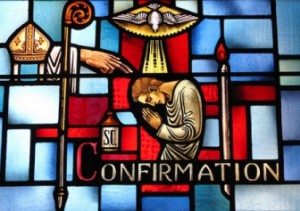
The Sacrament of Confirmation is conferred by the bishop presiding over the liturgy. When there are a
large number of candidates to be confirmed, Church law allows the presiding minister to associate priests
with himself in the celebration of the sacrament, by assisting him with the anointing of the candidates with
chrism. Because these priests are associated with the presiding bishop, the minister of confirmation is the
bishop, rather than the priest assisting him with the anointing.”In this senecio who is the actual Minister of the Sacrament?
Hmmm… in this senecio…. I’ve never seen confirmation conferred in a patch of ragwort. That’s different. There is also a senecio which in Italian is called “pianta del Rosario… a Rosary plant” because of how its leaves are spaced on tendrils.
That said, I’ll work with the “scenario” (?) you sent.
The claim is mostly accurate, but the conclusion needs improvement.
In the Latin Church, the ordinary minister of Confirmation is the bishop. However, a priest who has the faculty to confirm, whether by law or by grant of competent authority, validly confers the sacrament. Can. 882 states: “The ordinary minister of confirmation is a bishop; a presbyter (i.e., priest) provided with this faculty … also confers this sacrament validly.”
Can. 884 is the key text for your senecio … scenario. It says that, if necessity requires, the diocesan bishop may grant the faculty to one or more priests “who are to administer this sacrament.” It also says that, for a grave cause (which can seem a bit “elastic”), the bishop, and even a priest already endowed with the faculty, can “associate presbyters with themselves to administer the sacrament.”
Therefore, when an associated priest anoints a confirmand with chrism and says the sacramental form, that priest is the proximate minister of Confirmation for that confirmand. The bishop remains the ordinary, principal, and presiding minister of the celebration, and the priest acts in association with him and by the necessary faculty. However, the priest is not merely the bishop’s “auxiliary oily thumb” in such a way that the bishop alone is the sacramental minister of each confirmation.
Canon 880 also matters: Confirmation is conferred by the anointing with chrism on the forehead, with imposition of the hand, and the prescribed words. The one who performs that essential sacramental act for a given confirmand is the minister of that sacramental conferral.
The Catechism makes the same distinction. It says the bishop is the “original” and, in the Latin Rite, “ordinary” minister, while priests may be given the faculty to administer Confirmation for grave reasons. It also explains that when a priest confers Confirmation, the link with the bishop is expressed through the priest as the bishop’s collaborator and through chrism consecrated by the bishop. The Compendium states this even more plainly: “When a priest confers this sacrament…,” the episcopal link is expressed through his collaboration with the bishop and the sacred chrism.
So, in the proposed scenario:
For candidates anointed by the bishop: the bishop is the minister.
For candidates anointed by an associated priest: the priest is the minister, acting with the required faculty and in association with the bishop.
Hence, a better formulation of the statement at the top could be:
The bishop is the ordinary and principal minister of Confirmation and presides over the celebration. For a grave cause, he may associate priests with himself to administer the sacrament. Those priests, when they perform the anointing with chrism and pronounce the sacramental form, are true ministers of Confirmation for the candidates they confirm, although they act by faculty and in hierarchical communion with the bishop.
































A wonderful and dearly departed Priest was given the faculties to Confirm when he was a Military Chaplain. Those Faculties were never taken away . Father Confirmed many over the years including My two Daughters. Even our liberal Cardinals didn’t stop him.
Yay.
Sounds like another way to be “nice” and “include” the priest in Confirmation.
IMHO most of these situations will not even come close to satisfying “grave” reasons. (just as the perpetually present “extraordinary ministers of communion” are perpetually present in the most un-extra-ordinary Sundays.)
The bishop can delegate the priest to do Confirmation without his even coming to that Mass, so why share the sacrament with the priest unless there really were grave reasons like an impairment of the bishop or truly amazing numbers of confirmandi.
Sharing the administration of the sacrament is also theologically confusing, especially to the poorly catechized. I’m sure there are also questions of why *my* child was Confirmed by the priest instead of the bishop.
People really need to suck it up and sit through a Mass that takes more than an hour. Something important is going on. After all, most of them wouldn’t think of complaining if the kid’s state championship game went long.
Bruised: You might be limiting your vision of the Church, which extends beyond where you live. There are places in Africa that have hundreds of confirmands waiting and bishops or priests who come from a distance and have many things to do when they arrive after a long absence.
However, we in these wealthier countries are used to seeing a zillion aging women swarm the sanctuary to distribute Communion because it might take Father 5 minutes longer. It’s easy to lose sight of the larger Church.
one of my great regrets is that i did not come to this realization sooner when it could have made a difference. i was received into Holy Church in 2001 with about 30 other souls. as is common at Easter Vigil, the pastor had authority to confirm on this occasion delegated to him by the archbishop. he confirmed me fwiw. however he subdelegated half the confirmations to a visiting priest who i am quite certain never had such authority given his extremely difficult relationship with the then archbishop. in fact a short time later an announcement was made that this second priest no longer had any faculties in the diocese (he had been seeking incardination while leaving the SJ whom he found to be unpalatably reactionary – priest #2 had flat out refused assignment to a parish he deemed undesirable). so there were several confirmations both illicit and invalid. i don’t remember which poor souls were subjected to this abuse. that pastor is since retired, as is his successor in office.
Mea culpa, Fr. Z.
(I’m only just now realizing that I have been to Mass outside the US exactly once, and that in Canada!)
I can see where such situations as you describe might ease things for the bishop and priest. Thank you.
Although, contrary to Fr Z’s point above; in Western countries this sort of move designed precisely (one would assume) for those places in Africa etc. has been…. abused. [“abusus non tollit usum”.]
When I was a kid I was confirmed by the priest of the parish because… reasons, I suppose? Mind you, also at the age of 7 (I think it happened about 2-3 weeks after my First Holy Communion) so the Catholic school didn’t really have to double up on catechesis lessons.
Yes, this was the time when every kid in Catholic school did all of the sacraments – so maybe it was tough for the bishop – and subsequently most ended up falling away from the faith.
It seems that in the church as soon as “exceptional”, “grave necessity”, or even “extra-ordinary” gets bandied about, it then becomes mundane, requires and ordinary.
*that diocese since then has scrapped the confirmation at age 7 approach.
If I understand it correctly (which is doubtful), in the Eastern Rites infants are confirmed (by the priest) at the same time that they are baptized, and then begin to receive Holy communion. Is this difference purely cultural or is there a theological difference driving this difference in practice? I have to believe it is the former, but if it is the latter then an explanation of it would be interesting, at least to me.
I was raised in a small-ish rural / suburban US diocese – maybe 110 parishes, and the bishop had no auxiliaries. So, it made some sense that the bishop didn’t come in person himself each year at each parish.
All the same, I recall my egocentric young-teen sense of aggrievment that the Bishop had come himself for my elder sister’s confirmation but sent ‘only’ Monsignor Somebody (VG or Superintendent of Schools) for mine.
Prof: In the ancient Church it was the practice to give what are in the post-Conciliar Church called the “sacraments of initiation” (baptism, Eucharist, confirmation) continuously when converts were brought it. That continued with infant baptism. The custom was preserved in the East. In the West, they became more separated, perhaps because of the sheer numbers of converts and the time factors involved.
As a Latin Church it has been an odd experience to give communion to a very small child in arms of a couple from an Eastern Catholic Church at their request. Decisions decisions.