Did the young Christ apologize for being “lost” in Jerusalem?

I’ve been so busy in the last days that I haven’t paid much attention to some news stories floating around out there… and I have been the happier for it.

One story, however, could use some drilling, because it is causing some consternation.

On 27 Dec 2015 for the Feast of the Holy Family, Pope Francis said something (HERE) that made me scratch my head a little.  Emphasis mine.

At the end of that pilgrimage, Jesus returned to Nazareth and was obedient to his parents (cf. Lk 2:51). This image also contains a beautiful teaching about our families. A pilgrimage does not end when we arrive at our destination, but when we return home and resume our everyday lives, putting into practice the spiritual fruits of our experience. We know what Jesus did on that occasion. Instead of returning home with his family, he stayed in Jerusalem, in the Temple, causing great distress to Mary and Joseph who were unable to find him. For this little “escapade”, Jesus probably had to beg forgiveness of his parents. The Gospel doesn’t say this, but I believe that we can presume it. Mary’s question, moreover, contains a certain reproach, revealing the concern and anguish which she and Joseph felt. …

Christ “probably had to apologize” for this “scappatella… fling, bit of fun, escapade”.

I think Francis is trying to emphasize the human drama of the moment in the Gospel so as to make the scenario more vivid to the people listening in that moment, rather than add a deeper teaching point to posterity.

For my part, I think people can handle reflections on Christ as Eternal Word made Savior rather than Eternal Word made Ferris Bueller.

No, scratch that.  I don’t recall that Ferris apologized for his scappatella.  He was a bad boy. The young Jesus was a good boy… who would have apologized.  Right?

I’m not sure about that.

This is a good opportunity to drill more deeply into the Mystery of the Finding in the Temple, which I have done in the past in my Patristic Rosary Project.  Let’s drill deeper.

First, consider what the Lord replied (Luke 2 – Douay):

And seeing him, they wondered. And his mother said to him: Son, why hast thou done so to us? behold thy father and I have sought thee sorrowing. And he said to them: How is it that you sought me? did you not know, that I must be about my father’s business? And they understood not the word that he spoke unto them.

In so answering His earthly parents, the Lord teaches that the Father’s will is the only thing to which He must be obedient.  In humility, and according to filial piety/duty, He submitted Himself to Joseph and Mary.  But in truth, a superior filial piety/duty guided Him.

The scene of the Finding in the Temple is one of the only bits of information we have about this era of the Lord’s early life in Scripture. Therefore, great writers and thinkers have given it their consideration.
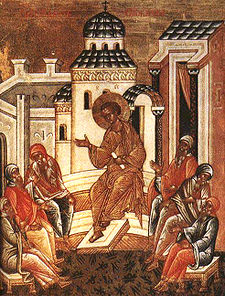
With due respect to the person of the Roman Pontiff, I can’t square this supposition about an apology with what Fathers of the Church have to say about this striking moment in the youth of the Lord.

Frankly, what he suggested initially sounded to me a bit like Nestorianism.  (NB: I’m not saying that Francis is a Nestorian but some dope or two out there will claim that.)  Why?  Nestorianism is Christological heresy that proposes a disconnect between Christ’s human and divine natures.  Nestorius (+450 – influenced by Theodore of Mopsuestia – spit here) wanted to defend two natures in Christ against those who claimed that Christ had only one nature, a divine nature.  Monophysites (“One nature-ites”) propose that Christ’s humanity was entirely absorbed by His divinity and therefore He had only one nature, divine.  Against monophysites, Nestorians propose that Christ has two natures, loosely united in such a way that the Person Jesus is not identical with the God the Son but rather is united with the Son, who lives in him.  A Nestorian Jesus would not have the same unity of intellect and will as the real Jesus.  Such a Jesus could, therefore, be imagined as being apologetic for His acts, as not knowing what He was doing, as acting in His human nature in a way that is not consistent with His divine nature – of doing things for which he ought to have and would have apologized.

On the contrary, I respond, the Lord had nothing to apologize for in being concerned firstly with His higher duty.  The Lord taught this to Mary and Joseph.  Scripture says in a pointed way that Mary pondered Christ’s statement.  “And his mother kept all these words in her heart.”  She learned to see her Son in a new way.

Christ apologizing seems to me to contradict the point of His words to Mary.

Scripture doesn’t say: “And he said to them: How is it that you sought me? did you not know, that I must be about my father’s business? And they understood not the word that He spoke unto them. And therefore spoke Joseph unto Him saying, “Callest thou that an answer? What sayest Thou to Thy sorrowing mother?” And thereafter Mary, sorrowing, said “Thou art sooo grounded.”

And… does Christ apologize anywhere else in Scripture? Even when teaching hard teachings?  His teaching in the Temple to His mother and Father was hard teaching, after all.  Did He say in John 6: “This is the bread that came down from heaven. Not as your fathers did eat manna, and are dead. He that eateth this bread, shall live for ever.  These things he said, teaching in the synagogue, in Capharnaum. Many therefore of his disciples, hearing it, said: This saying is hard, and who can hear it? But Jesus, knowing in himself, that his disciples murmured at this, said to them, Sorry! Hey! Wait! Don’t leave! I apologize!”  Or in Matthew 19: “And I say to you, that whosoever shall put away his wife, except it be for fornication, and shall marry another, committeth adultery: and he that shall marry her that is put away, committeth adultery. His disciples say unto him: If the case of a man with his wife be so, it is not expedient to marry. And He replied, Verily, you are right.  I take it back.  I apologize.”

Let’s move on.

Venerable Bede says in his Homilies on the Gospels 1, 19:

“Clearly the abode in the hearts of the elect of the holy Trinity, the nature of whose divinity is one and indivisible, cannot be disparate. Therefore, when He was Sitting in the temple, the Lord said, “I must be about my Father’s business,” and this is a declaration of His power and glory which are coeternal with God the Father’s.  [That isn’t something to apologize for.] However, when He returned to Nazareth, He was subject to His parents, and this is an indication of His true humanity as well as an example of humility. He was subject to human beings in that human nature in which He is less than the Father. Hence He Himself said, “I go to the Father because the Father is greater than I.”

Ambrose of Milan (+397) helps us sort out the Lord’s dutiful attitude of obedience to Joseph and Mary in view of His duties to God the Father.

In Commentary on Luke II, 65 Ambrose contrasts this moment in the Temple when Christ is still on 12 years old.  Remember: as God the Son, He is eternal, genitus non factus, but as Christ He was born 12 years before.

Could He do less then fulfill to perfection the duties of piety and then we are amazed that He shows deference toward the Father when He subjects Himself to His mother! This subordination does not indicate weakness certainly but only respect. Although the viper of heresy – slithering out of its sinister cave – raises its head and vomits venom from its serpentine stomach. Because the Son affirms that He is sent, the heretic says that the Father is greater than Him in order to claim that the Son is imperfect, if He can have one greater than Him, and demonstrate in this way that the one sent has need of help from another.

Ambrose seems pretty certain that it isn’t correct to see Christ as being subject to His earthly parents in a way that diminishes the truth of His divine nature and its unity with His human nature.

By the way, Ambrose goes on with a beautiful explanation of filial respect.  Check it out sometime.

Sticking with Ambrose, after describing how the Lord had two births, as it were, one divine and one human, the Bishop of Milan compares the finding in the Temple with the moment when Mary asks the Lord for a miracle at the Wedding at Cana.  Ambrose is answering an unspoken question about why the different interactions between Mary and the Lord, at the Temple and at Cana.  By the time Mary and Christ are at Cana, Ambrose says, Mary has learned to ask things from the Lord according to His divine nature (i.e., a miracle). When the Lord was still only 12, Mary still saw Him more through the lens of His human nature than through His divine nature and, therefore, Christ’s enigmatic behavior still leaves her disconcerted, as it can leave us disconcerted.   Remember that after Christ’s answer to Joseph and Mary in the Temple, she pondered His words in her heart.  In other words, Christ taught her and she learned.

John of Damascus (+749) has a point to make in Orthodox Faith 3. 22 about the Finding in the Temple:

He is said to have progressed in wisdom and age and grace, because He did increase in age, and by this increase in age brought more into evidence the wisdom inherent in Him further. By making what is ours altogether His own, He made His own the progress of people in wisdom and grace, as well as the fulfillment of the Father’s will, which is to say, people’s knowledge of God and their salvation.  [He progressed so as to show us that we, too, should progress.  But I digress.]

[He goes after Nestorians…] Now, those who say that He progressed in wisdom and grace in the sense of receiving an increase in these are saying that the union was not made from the first instant of the flesh’s existence. Neither are they holding the hypostatic union, but, misled by the empty headed Nestorius they are talking falsely of a relative union and simple indwelling, “understanding neither the things they say, nor whereof they affirm.” For, if from the first instant of its existence the flesh was truly united to God the Word – rather, had existence in Him and identity of person with Him –how did it not enjoy perfectly all wisdom and grace? It did not share the grace, and neither did it participate by grace in the things of the word. Rather, because the human and divine things had to become proper to the one Christ by the hypostatic union, then, since the same was at once God and man, it gushed forth with the grace and the wisdom and the fullness of all good things for the world.

As John Damascene describes the unity of the natures of Christ, it doesn’t strike me that an apology was due for His actions in Jerusalem when He was 12.  Picture this: “Sorry, Mom.  Sorry, Dad.  I was wrong to gush forth with the grace and the wisdom and the fullness of all good things for the world.  I won’t do it again.”

Did Christ think that He did something wrong in Jerusalem when He was 12?

Or did He simply not know what He was doing?

St. Jerome (+420) said in Homily on Psalm 15 (16):

How does He who is wisdom receive understanding? “Jesus advanced in wisdom and age and grace before God and men.” This means not so much that the Son was instructed by the Father but that His human nature was instructed by His own divinity. There is the seer’s prophecy of him who blossomed from the root of Jesse, “The spirit of the Lord shall rest upon him: a spirit of wisdom and of understanding.”

I’ll go out on a limb and say that Christ knew what He was doing in Jerusalem even when He was 12.

I think the Lord knew the consequences for Mary and Joseph.  Far from forgetting about them, or not caring about their anxiety and hours of searching, I think He intended those consequences for the sake of bringing them to a better understanding of who He was and what their vocation was for Him.  Ambrose writes in his Commentary on Luke, II, 63:

Nor is it idly that, without regard (immemor) of His parents according to the flesh, He who according to the flesh assuredly was filled with the wisdom and grace of God is found after three days in the temple. It is a sign that he who was believed dead for our faith would rise again after three days from His triumphal passion and appear on His heavenly throne with divine honor.

I don’t take immemor to mean, literally, that Christ was “forgetful”, that he forgot Mary and Joseph.  Immemor can mean a range of things, including “regardless”.  He was immemor in the sense that He placed His regard/thought of God the Father before his regard/thought for them.  That doesn’t mean that He didn’t think of them at all.

As the adult Christ was transfigured before Peter, John and James to help them endure His Passion, the young Christ gave Mary and Joseph, a lesson so that they would understand His actions not in an earthly sense, but according to the divine will of the Father.  He helped them to deal with their human sorrow and anxiety in the light of God’s mysterious plan.

St. Alphonsus Liguori (+1787 not a Father of the Church but a Doctor and pretty sharp) writes of this mystery and explains the pain that Mary and Joseph must have felt.  He makes the point, with other writers, in The Glories of Mary, that perhaps the sorrow and pain she felt during this test was greater than that which she felt at all the other times because, in this case, she and the Lord were separated.  She was with Him at His circumcision when Simeon said that a sword would pierce her heart.  She was with Him when they had to flee in fear of Herod into Egypt.

In this episode in Jerusalem, she seeks Christ – Her Son and Lord – with longing that is both humanly maternal, but also perfect in love.  She is the Immaculate Conception and never sinned.  Her pain was not irrational or unhinged.

St. Alphonsus says:

This sorrow of Mary ought, in the first place, to serve as a comfort to those souls who are desolate and do not enjoy the sweet presence they once enjoyed of their Lord. They may weep, but let them weep in peace, as Mary wept in the absence of Her Son. Let them take courage, and not fear that on this account they have lost the Divine favor, for God Himself said to St. Teresa: “No one is lost without knowing it; and no one is deceived without wishing to be deceived.”

If the Lord departs from the sight of that soul who loves Him, He does not therefore depart from the heart. He often hides Himself that it may seek Him with greater desire and love. But those who would find Jesus must seek Him, not amid the delights and pleasures of the world, but amid crosses and mortifications as Mary sought Him. “We sought Thee sorrowing”, She said to Her Son.

By the way, in regard to a rebuke from Mary and Joseph, which would in normal circumstances elicit an apology from a normal 12 year old, the Doctor and great moralist adds:

By these words She did not wish to reprove Jesus, as the heretics blasphemously assert, but only to make known to Him the grief She had experienced during His absence from Her, on account of the love She bore Him. It was not a rebuke, says Blessed Denis the Carthusian, but a loving complaint.

Much of this touches on the old questions about the relationship between Christ’s perfect divine nature and His perfect human nature, about how Christ had to learn, in His human nature, to do all the things we humans do, and yet, simultaneously, He is omniscient God.

Scripture doesn’t tell us what the Lord did on the way back home to Nazareth, but I am pretty sure He didn’t apologize for being about His Father’s business.

In any event, we are shown by the Lord in this mystery that no merely human concern can take precedence over God’s will, that all of us must progress in wisdom and knowledge of our selves, our vocations and our Faith and not merely remain stagnant year after year, that God’s ways are not our ways, that we cannot judge His mysterious works on our terms and that we can – in love – complain to the Lord and tell Him our sorrows and our cares.

Comment moderation is ON.

Posted in Patristiblogging | Tagged
36 Comments

Archbp. Léonard on priestly vocations. Wherein Fr. Z rants.

From Catholic World News:

Former Belgian primate discusses synod, success in fostering vocations

In an interview with a French Catholic weekly magazine, Archbishop André-Joseph Léonard reflected upon his five years as Primate of Belgium and Archbishop of Mechelen-Brussels.

The prelate’s predecessor, Cardinal Godfried Danneels, led the see from 1979 until 2010. On December 12, Archbishop Josef De Kesel was installed as Archbishop Léonard’s successor.

Asked to comment on the steep rise in the number of seminarians– from four in 2010 to 55 in 2015[4 … t0 55 in FIVE YEARS] Archbishop Léonard told Famille chrétienne that he spoke with prospective seminarians personally rather than referring them to the vocation office: “a man who wants to give his life to Christ, a bishop must receive him!”  [What?!?  Was that an accident?  I ask you… speaking to seminarians personally?!?  What was he thinking?  Let’s cut through the B as in B, S as in S. Liberal bishops don’t want priests.  They want women.  Let’s just call it what it is.  If they can find 55 men who want to be priests in Brussels, they can find them everywhere.  Even more proof that what bishops such as the Extraordinary Ordinary, Morlino of Madison, do in regards to vocations … wait for it… WORKS.  There doesn’t have to be a vocation crisis.  The vocation crisis has been engineered for decades now.  By liberals.  It’s not rocket science.]

Asked how he swam against the tide when he faced opposition on account of his fidelity to the Church’s teaching, Archbishop Léonard quoted St. Paul (“do not be conformed to this world”) and said that he would have been concerned if he had not faced criticism, since “Jesus did not promise us success, but rather contradiction.”

Commenting on the recent Synod of Bishops, in which he did not take part, Archbishop Léonard said that he was “disappointed” that the final document had “ambiguity in the most delicate points.”

“I would find it extremely risky if Western countries could have a more flexible discipline,” he added. “What image would give it the Church” if the wealthiest Christians “may also have a more comfortable discipline? It would be a great scandal!”

Discussing his act of consecration of the faithful to the Immaculate Heart of Mary on December 8, he said that Belgium “received two official visits of Mary at Beauraing and Banneux. If Mary took the trouble to bother twice to visit this country, it is probably because it has great need.

Posted in Fr. Z KUDOS, One Man & One Woman, Priests and Priesthood, Seminarians and Seminaries, Wherein Fr. Z Rants | Tagged ,
21 Comments

Wonderful Sisters seeking Priest Chaplain

Mother Teresa Christe, MSSR, wrote saying that the Marian Sisters of Santa Rosa need a priest chaplain.  They would like both the Extraordinary and the Ordinary Form of the Roman Rite.  These are not LCWR nuns.

16_01_03_sisters

I asked for some details and she sent back:

Chaplain of 10 sisters – Daily Mass in convent chapel (Ex Form about 4 x per week, Ordinary Form 2-3 x per week)
– Confessions 1x per week
– Benediction 1 x per week
– Spiritual Direction (light, only as needed), Blessing of items from time to time
– a “day off” each week

Residence in Cathedral Rectory Suite, in Santa Rosa, CA, 5/8 mile from convent- smaller city in Wine Country, near Napa Valley CA, Mediterranean Climate (beautiful vicinity)

Rector of Cathedral may negotiate additional duties of hearing parish confessions and offering an occasional public Mass at the faithful Cathedral Parish depending on whether or not the chaplain would like to be in parish life

Additional Notes: This community of sisters is contemplative/active and was canonically approved by 2012 by Bishop Robert Vasa. [A fine bishop and a great fellow.] There are 4 professed sisters, 4 novices, 1 postulant and several in application/discernment (they are growing)
They have a distinct Marian Spirituality based on St. Louis de Montfort’s total consecration to Jesus through Mary
The sisters’ main apostolates function around 1. Liturgy – Sacristy Work, Liturgical Music (traditional), care of Church
and the spiritual and practical support of the priesthood 2. Communicating the Catholic Faith – Catholic Education, Catechesis, Retreat Talks and the like…They hold respected positions in the diocese and are supported by the
Bishop
The sisters are proficient in the knowledge and practice of liturgical norms, music and ceremonies for both forms of the Roman Rite

Financial offerings for services rendered are very open and negotiable. Room and board are provided and possibly a car if needed.

Inquiry Contact: conventhome@mariansisters.com

Comments are OFF.

Posted in The Campus Telephone Pole |
Comments Off on Wonderful Sisters seeking Priest Chaplain

Feast of the Most Holy Name of Jesus

Today, in the traditional calendar of the Roman Church, is the Feast of the Most Holy Name of Jesus.

Holy NameWhat does the Lord Jesus Himself say about His own Name?

In John 16:23 Jesus reveals His unity with the Father and the power of His Name saying, “Truly, truly, I say to you, if you ask anything of the Father, he will give it to you in my name.”  In Mark 9:38-39 we read an exchange between the beloved disciple and the Lord: “John said to him, ‘Teacher, we saw a man casting out demons in your name, and we forbade him, because he was not following us.’ But Jesus said, ‘Do not forbid him; for no one who does a mighty work in my name will be able soon after to speak evil of me.’”  The Gospel of John says that, “these [signs] are written that you may believe that Jesus is the Christ, the Son of God, and that believing you may have life in his name” (20:31).  His Name – His Person – is our path to everlasting life.  Signs and wonders are connected with Jesus’ Holy Name.  The Apostles and disciples worked many miracles through the Name of Jesus (cf. Acts 2:38; 3:6; 3:16; 4:7-10; 4:29-31; 19:13-17).   The Apostle Paul wrote to his flocks about the Name of Jesus. What he taught reveals a fundamental aspect of God’s will for us His images.

God focuses in the First Commandment of the Decalogue on what we might do wrong with our hands (Exodus 20:4: “You shall not make for yourself a graven image…”) and in the Second on what we might do wrong with our words (Exodus 20:7: “You shall not take the name of the LORD your God in vain; for the LORD will not hold him guiltless who takes his name in vain”).

St.  Paul wrote: “Therefore God has highly exalted him and bestowed on him the name which is above every name, that at the name of Jesus every knee should bow, in heaven and on earth and under the earth, and every tongue confess that Jesus Christ is Lord, to the glory of God the Father” (Philippians 2:9-11).  The Name of God, of God the Father, God the Son Jesus Christ, God the Holy Spirit, is worthy of our fear and our love.

Consider the Holy Name of Jesus.

Keep in mind not only love for the Name but also the fear which is Its due.  Do not exclude the fear which is really reverential awe.

In Scripture forms of words for “fear” occur hundreds and hundreds of times.  This a healthy loving fear.  Scripture is imbued with loving fear of God, indeed, an awe leading to love.  Consider, for example, this passage the Book of Revelation which can teach us timor:  “Then I saw heaven opened, and behold, a white horse! He who sat upon it is called Faithful and True, and in righteousness he judges and makes war.   His eyes are like a flame of fire, and on his head are many diadems; and he has a name inscribed which no one knows but himself.  He is clad in a robe dipped in blood, and the name by which he is called is The Word of God.” (Rev 19:11)   But in the book of Malachi, speaking of the Name of God, we read, “But for you who fear my name the sun of righteousness shall rise, with healing in its wings. You shall go forth leaping like calves from the stall” (Malachi 4:2).

God’s Holy Name is sacred.

“God fearing” men and women need not have terror of the Lord, but speaking and hearing His Holy Name will warm them with His fearful love.

Lord, have mercy, (Christ, have mercy.)
Lord, have mercy, Jesus, hear us. (Jesus, graciously hear us.)
God, the Father of Heaven, (have mercy on us.)
God the Son, Redeemer of the world,
God, the Holy Spirit,
Holy Trinity, one God,
Jesus, Son of the living God,
Jesus, Splendor of the Father,
Jesus, Brightness of eternal Light,
Jesus, King of Glory,
Jesus, Sun of Justice,
Jesus, Son of the Virgin Mary,
Jesus, most amiable,
Jesus, most admirable,
Jesus, the mighty God,
Jesus, Father of the world to come,
Jesus, angel of great counsel,
Jesus, most powerful,
Jesus, most patient,
Jesus, most obedient,
Jesus, meek and humble of heart,
Jesus, Lover of Chastity,
Jesus, our Lover,
Jesus, God of Peace,
Jesus, Author of Life,
Jesus, Model of Virtues,
Jesus, zealous for souls,
Jesus, our God,
Jesus, our Refuge,
Jesus, Father of the Poor,
Jesus, Treasure of the Faithful,
Jesus, good Shepherd,
Jesus, true Light,
Jesus, eternal Wisdom,
Jesus, infinite Goodness,
Jesus, our Way and our Life,
Jesus, joy of the Angels,
Jesus, King of the Patriarchs,
Jesus, Master of the Apostles,
Jesus, Teacher of the Evangelists,
Jesus, Strength of Martyrs,
Jesus, Light of Confessors,
Jesus, Purity of Virgins,
Jesus, Crown of all Saints,
Be merciful unto us, (spare us, O Jesus!)
Be merciful unto us, (graciously hear us, O Jesus!)
From all evil, (deliver us, O Jesus!)
From all sin,
From Thy wrath,
From the snares of the devil,
From the spirit of fornication,
From everlasting death,
From the neglect of Thine inspirations,
Through the mystery of Thy holy Incarnation,
Through Thy Nativity,
Through Thine Infancy,
Through Thy most divine Life,
Through Thy Labors,
Through Thy Agony and Passion,
Through Thy Cross and Dereliction,
Through Thy Sufferings,
Through Thy Death and Burial,
Through Thy Resurrection,
Through Thine Ascension,
Through Thine Institution of the Most Holy Eucharist,
Through Thy Joys,
Through Thy Glory,
Lamb of God, who take away the sins of the world, (spare us, O Jesus!)
Lamb of God, who take away the sins of the world, (graciously hear us, O Jesus!)
Lamb of God, who take away the sins of the world, (have mercy on us, O Jesus!)
Jesus, hear us, (Jesus, graciously hear us)

Let us pray. O Lord Jesus Christ, Who has said: Ask and ye shall receive; seek, and ye shall find; knock, and it shall be opened unto you: grant, we beseech Thee, to us who ask the grace of Thy most divine love, that we may love Thee with all our hearts, words and works, and never cease to praise Thee. Make us, O Lord, to have a continual fear and love of Thy holy Name; for Thou never ceasest to rule and govern those whom Thou doest solidly establish in Thy love. Who livest and reignest for ever and ever. (Amen.)

Posted in SESSIUNCULA | Tagged ,
6 Comments

Your Sunday Sermon Notes

Was there a good point made during the sermon for your Mass of Obligation? Let us know!

NB: These “Your Notes” posts are not about what didn’t happen, or what you wanted to happen. They are not for complaining.

Posted in SESSIUNCULA |
14 Comments

“Let y’all know!” The Epiphany chant announcement of 2016’s liturgical dates

CLICK FOR MORE

CLICK FOR MORE

Someone posted a printable image of the Noveritis (“Let y’all know”) in Gregorian chant notation for the singing of the liturgical dates for 2016 which takes place at Epiphany after the Gospel.  Find it over there.

NB: In this year’s version there are a couple notation errors, but you will figure it out.

The singing of the key liturgical dates in a solemn way, underscores how these dates and seasons are all interconnected, how the liturgical year is a reflection of and on the mystery of our salvation.  Some liturgical dates are movable.  For example Septuagesima (this year 24 January) doesn’t fall on the same date every year because the date of Easter changes each year.

“But Father! But Father!”, you are surely sputtering.  “What does this chant sound like?”

Here is what it sounds like, in case some deacon or priest out there, less familiar with chant, wants to give it a shot.  It sounds rather like the Exultet, sung at the Easter Vigil.  The Noveritis is a little awkward, however.

I’ll allow you to post your own, flawless, accurate and yet smooth English translations.

Posted in Liturgy Science Theatre 3000, PRAYERCAzT: What Does The (Latin) Prayer Really Sound L | Tagged , , , , ,
5 Comments

WDTPRS – Epiphany (Sunday) Collect: transformed by the beauty of Your sublime glory

In the Novus Ordo calendar Epiphany (which is supposed to be 12 days after Christmas – the reason it is called “Twelfth Night”) is sometimes moved to the Sunday.  I suppose that they reasoned that more people would celebrate the important feast that way.  I say that 1) that signals that bishops think that our obligations according to the religion of virtue aren’t that important, 2) the liturgical year isn’t that important, and 3) parishes lose a collection.

In the ancient Western Church and in the East, Epiphany was more important than the relative latecomer Christmas.  Epiphany is from the Greek word for a divine “manifestation” or “revelation”.  There are many “epiphanies” of God in the Scripture.  Think, for example, of the burning bush encountered by Moses.

The Latin Church’s antiphons for Vespers reflect the tradition that Epiphany was thought to be not only the day the Magi came to adore Christ, but also the same day years later when He changed water into wine at Cana, and also when He was baptized by St. John in the Jordan.  In each mysterious event, Jesus was revealed to be more than a mere man: He is man and God.

The Epiphany Collect was in the 1962 Missale Romanum and in ancient sacramentaries.

Deus, qui hodierna die Unigenitum tuum stella duce revelasti, concede propitius, ut qui iam te ex fide cognovimus, usque ad contemplandam speciem tuae celsitudinis perducamur.

Stella duce is an ablative absolute.  The adjective hodiernus means “of this day, today’s”.  In older Latin, celsitudo is “lofty carriage of the body”. In later Latin it is used like the title “Highness”.  In our liturgical context it is a divine attribute, God’s transcendent grandeur, glory.

SUPER LITERAL VERSION:

O God, who on this very day revealed your Only-begotten, a star as the guide, graciously grant, that we, who have already come to know You by faith, may be led all the way unto the beauty of Your glory to be contemplated.

OBSOLETE ICEL (1973):

Father, you revealed your Son to the nations by the guidance of a star. Lead us to your glory in heaven by the light of faith.

NEW CORRECTED ICEL (2011):

O God, who on this day revealed your Only Begotten Son to the nations by the guidance of a star, grant in your mercy, that we, who know you already by faith, may be brought to behold the beauty of your sublime glory.

In Latin prayers species (three syllables) often means “beauty”. It is also a technical, philosophical term about the way the human intellect apprehends things.  Species has to do with the relationship between the thing known and our knowing power.  A species transforms the mind of the one perceiving a thing.  The object we consider acts upon our power of knowing.  Simultaneously, the knowing power acts upon the object known.  Our knowing power’s active and passive aspects meet in the species and the object of our consideration is known directly, without intermediaries.  Easy.

This is what we are praying for, hoping for, living our earthly lives for: to see God face to face, directly and immediately.

In this life we know God only indirectly, by faith, our reason aided by the authority of revelation and by grace.  This is St. Paul’s “dark glass” (1 Cor 13:12) through which we peer toward Him in longing.

Christ is the visible image of the invisible God. He is the Father’s Beauty. He is Truth and Beauty and Glory itself.

St. Hilary of Poitiers (d 367) conceived God’s divine attribute of glory as a transforming power which divinizes us by our contact with it.  After Moses talked with God in the tent of the Ark, he wore a veil over his face, which became too bright to look at.  We pray today, literally, to be brought “all the way to the beauty of glory (species celsitudinis)” of God “which is to be contemplated”.  His beauty will act on us, increase our knowledge of Him and, therefore, our love for Him … for all eternity.   We will be, all the more, the images He intended.

Christ could be understood to be the species celsitudinis of this prayer. Contemplate His truth and beauty.  Christ is the true speaker and spoken truth of every prayer of every Mass.

If eternal Beauty transforms us, “divinizes” us, then beauty in this life changes us too.

Could a fostering of beauty in our churches help us reach people today in a way that arguments or other appeals may not?

Our liturgical worship of the Most High God must lead us to encounter beauty, truth, transcendent mystery.  Holy Mass requires the finest architecture, vestments, music – everything – we can summon from human genius, love and labor.  What we sing and say and do in church, and the church itself, ought to presage the liturgy of heaven, where the Church Triumphant enjoys already the Beatific Vision.  Liturgy should be “epiphany”, wherein we encounter transforming mystery.

Let us celebrate every Mass in such a way that we become shoeless Moses before the burning bush which is never consumed.  Let Mass make us Magi with sight and mind fixed in longing upon the beautiful, true and yet speechless Word, in whom transcendent glory was both hidden and revealed.

Posted in Liturgy Science Theatre 3000, WDTPRS | Tagged , , , , , ,
6 Comments

Your Holy Day of Obligation Sermon Notes

In these USA 1 January is a Holy Day of Obligation.  Not so in some other countries/conferences (e.g.,  such as England and Wales).

Intentionally missing Mass on this day, in these USA, if you could have reasonably attended, is a mortal sin.

Was there a good point made during the sermon for your Mass of Obligation?  Let us know!

NB: These “Your Notes” posts are not about what didn’t happen, or what you wanted to happen.  They are not for complaining.

They are not for anything other than good points made.

Posted in SESSIUNCULA |
39 Comments

HEART WATCH! DAY 16: His Hermeneuticalness’ Health UPDATE

15_12_19_heart_watchHere is your HHH UPDATE for Day 10 of…

HEART WATCH!

Fr. Finigan is in the hospital after a
“Minor Cardiac Episode.”

The other day Father was transferred to a spiffy new clinic whence he has a view of Parliament.

(Thanks for the homage in the tweet!)

16_01_01_finigan_01

The GREAT NEWS is that the surgery went well.

16_01_01_finigan_02

So, everyone, Father isn’t entirely out of the weeds yet.  He still needs your support in prayer and in bottles of Scotch.

Posted in Mail from priests | Tagged
10 Comments

Stats on attendance for Pope Francis’ Angelus and General Audiences

I found this story from Ed Pentin to be pretty interesting.  My friends in Rome and my own experience this out.

Large Fall in Numbers of Faithful Attending Angelus, Regina Coeli

According to figures released today by the papal household, the number of faithful taking part in various Vatican papal events almost halved in 2015 compared to last year, although some of the disparity is due to the large numbers of people who attended the canonizations of Sts. John Paul II and John XXIII in 2014.

Just over 3.2 million faithful attended general audiences, special audiences, Vatican liturgical celebrations, the Angelus and Regina Coeli prayers in 2015. That compares to 5.9 million faithful who took part in the same events last year.

Last year’s historic canonizations meant that 730,000 participated in liturgical celebrations in April 2014 compared to 110,000 in the same month this year.

But the biggest disparity has been at the Angelus and Regina Coeli prayers: 1.6 million attended them in 2015, compared to just over 3 million last year.

One possible reason could be that the Holy Father has spent over double the time away on papal visits this year (37 days compared to 18 in 2014), although it’s debatable how much that influenced the drop in numbers.

The Vatican points out that the statistics do not include the large numbers of faithful who attend other papal events outside the Vatican such as papal trips.

It also stresses that the data is “approximate” and “calculated on the basis of requests to participate in encounters with the Pope and invitations distributed by the Prefecture, which also specifies that estimates are given for attendance at events such as the Angelus or Regina Coeli and for celebrations in St. Peter’s Square.”

There’s more… from the Daily Mail:

Posted in Francis, The Drill |
22 Comments
























