
We read in the Enchiridion Indulgentiarum 26 that, under the usual conditions, people can gain a plenary indulgence by participating in a liturgical praying of the Te Deum for the end of the year.
Is there one in your diocese or parish?

We read in the Enchiridion Indulgentiarum 26 that, under the usual conditions, people can gain a plenary indulgence by participating in a liturgical praying of the Te Deum for the end of the year.
Is there one in your diocese or parish?
 From a priest:
My pastor said to me, “if you give me a good enough reason why I should wear black vestments on All Souls’ Day, I will do it.”
What, exactly, would you recommend I tell him?
My mind is spinning a bit.
Black does not have to be defended. It has been the use of the Church for a thousand years.
Liturgical colors have their meanings.
The use of black, reminds us of how we must die to the things of this world.
It reminds us to pray for the deceased rather than assume that they have automatically entered the bliss of heaven. Masses are for the dead more than they are for some emotional need we might have (or want to avoid).
It reminds us of the reserve and dignity we should have in the moment of a funeral, Requiem.
It reminds us that we, too, must pass through death.
They are beautiful.
 Ven. Pius XII wrote in Mediator Dei:
62. Assuredly it is a wise and most laudable thing to return in spirit and affection to the sources of the sacred liturgy. For research in this field of study, by tracing it back to its origins, contributes valuable assistance towards a more thorough and careful investigation of the significance of feast-days, and of the meaning of the texts and sacred ceremonies employed on their occasion. But it is neither wise nor laudable to reduce everything to antiquity by every possible device. Thus, to cite some instances, one would be straying from the straight path were he to wish the altar restored to its primitive tableform; were he to want black excluded as a color for the liturgical vestments; were he to forbid the use of sacred images and statues in Churches; were he to order the crucifix so designed that the divine Redeemer’s body shows no trace of His cruel sufferings; and lastly were he to disdain and reject polyphonic music or singing in parts, even where it conforms to regulations issued by the Holy See.
I urge priests to use black.
I urge laypeople to request the use of black.
I urge laypeople to rally together and purchase beautiful black vestments for their parishes.
What is your good news these days… these busy days? I am sure that some good things are going on out there.
I, for one, am in the midst of preparing another Supper for the Promotion of Clericalism.
I have ten clerics tonight, for a classic French line up of the 7 courses, which I am doing with a hotplate and a toaster oven. I have two hot plates, actually.
Because of the number of guests, I had to rebuild an old table that belonged to one of the former bishops of the diocese.

Also, I reached out for some help outside my clerical circles. I have some cloths and flatware coming (I have enough for about 4 that matches) and stemware.
My entree is now completed: butternut and apple soup with ginger, thyme and Cayenne pepper.

Now to start on the “plat principal”.
Last night two gals at the grocery did me a good turn by helping me to assemble some of my ingredients. I have found that grocery staff will happily help with special projects when you describe what you need and when.
As I type this, I find that my hands aren’t working so well after dealing with the squash. I have had to retype and retype, so I am stopping here.

And ten apples.

I also have squash hands. 
So, this is good news: more clericalism!
What’s up with you?
Holy Church considers many Old Testament figures to be saints.
Today when you open your trusty copy of the 2005 Martyrologium Romanum you will find, just below the St. Thomas Becket, this interesting entry:
2. Commemoratio sancti David, regis et prophetae, qu, filius Iesse Bethlehemitae, gratiam invenit ante Deum et oleo sancto a Samuele propheta unctus est, ut populum Israel regeret; in civitatem Ierusalem Arcam foederis Domini transtulit ac Dominus ipse mox ei iuravit semen eius in aeternum mansurum esse, eo quod ex ipso Iesus Christus secundum carnem nasciturus esset.
I am sure some of you readers can come up with your renderings of the Latin original, either in a smoother version or perhaps in a slavishly literal way.
Changing tracks slightly, in the Metropolitan Museum of Art there is a series of paintings of Old Testament figures, including King David. These are elements from an altar piece by Florentine painter Lorenzo Monaco (known also as Piero di Giovanni +1422).
Moses is at the top left. Next to him is Abraham. Below him on the bottom right is Noah with his ark.

By thy way, since I took that photo, the paintings have been rearranged… in case you go looking.
Here is David, holding a psaltery. Greek ψάλλω…psallo means “to pluck”. While there are also bowed psaltery, this one is plucked by the fingers rather than bowed or struck with a pick or plectrum.

When you get the audio guide at the Met and listen to experts talk about the works, sometimes you get a sample of period music. In this case, you get to hear some music played on a psaltery.
I dug around a bit and found some psaltery music on Youtube and elsewhere.
You can hear, below, a sample of bowed psaltery together with a small harp, also appropriate to David, as well as plucked psaltery in two versions of a Medieval Lament for Tristan, which would have been in vogue at the time the painter was working on the altar piece.
Listen as you do your translation!
Podcast: Play in new window | Download
Subscribe: RSS
Also, here again is Tristan’s Lament.
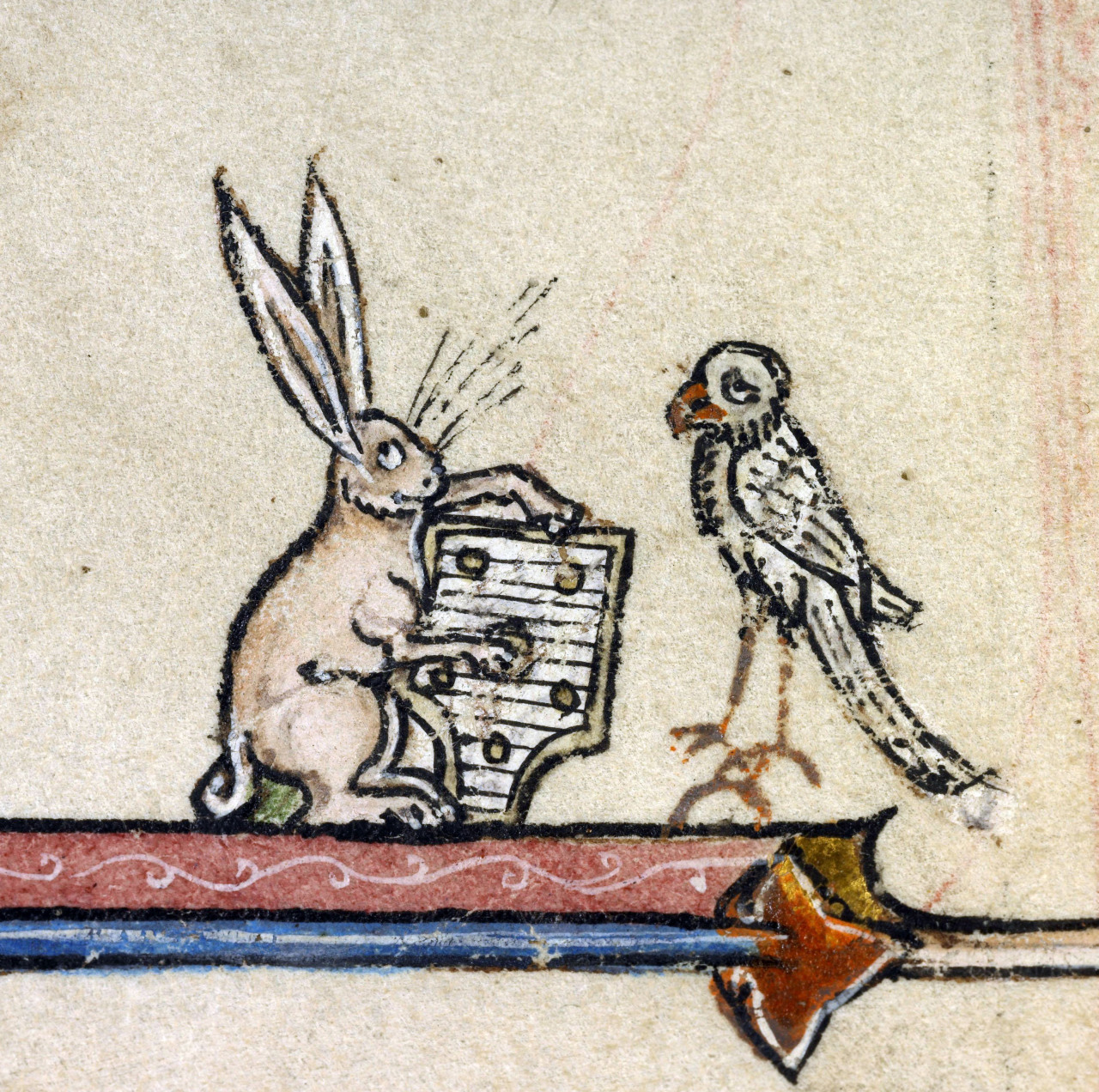
And, just for fun… here is another image of a psaltery bunny from a late 13th c. French manuscript. He even had the audience moved to sorrow.
UPDATE 29 Dec:
It seems that the priest involved has been involved with his diocese in this matter HERE. There is also an article in a local paper which explains the fallout. HERE
In short, Father is sorry that he did what he did and he apologized.
There were 181 views of the video when I posted this. Now there are 65k.
_____ ORIGINAL Published on: Dec 27, 2015 @ 11:56 ____
Words fail…
This occurred at Our Lady Of The Miraculous Medal Parish Church in Binan, The Philippines. The priest is Fr Falbert San Jose.
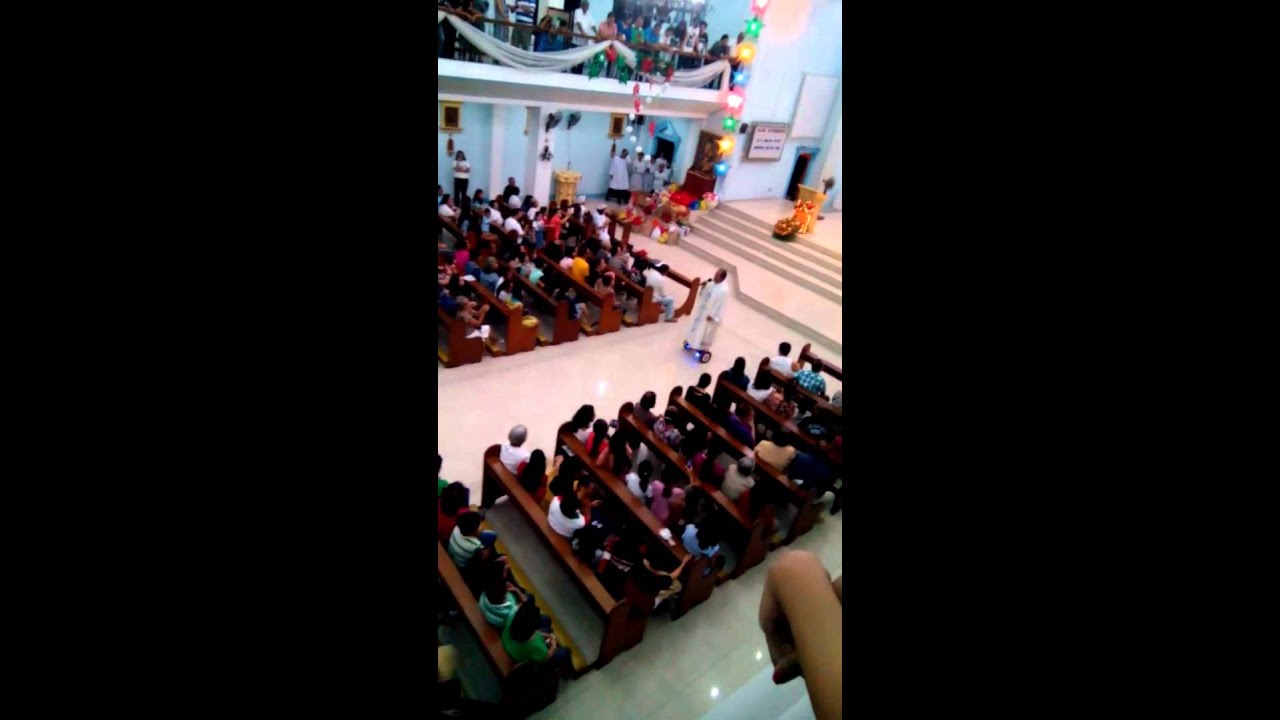

181 views at the time of this post.
It was published on 26 December, so I assume this was for Christmas.
DATELINE: Springfield, IL.
It seems that in a letter to the edition of the local paper someone went after His Excellency Most Reverend Thomas Paprocki, Bishop of Springfield in regard to Communion for the civilly divorced and remarried (CDRs). HERE The writer is identified as being involved with the heretical loonly-left Call To Action and the pro-sodomy Equally Blessed Coalition. It may not surprise you that he is against his bishop and against the Church’s teaching. However, in his letter to the editor he invoked all sorts of blah blah about the Synod of Bishop and quoted Archbp. Blase Cupich of Chicago about leaving Communion to the conscience of individuals blah blah. In sum, the writer painted an inaccurate picture.
In his own turn, Bp. Paprocki responded a few days after with the truth. HERE
With my emphases and comments:
Bishop Thomas John Paprocki: ‘Conscience’ a complicated matter at Communion
Posted Dec. 26, 2015 at 10:00 PM
It is important to set the record straight about some incorrect statements made by John Freml in his letter to the editor (December 21, 2015). He notes that Archbishop Blase Cupich of Chicago has said that people in “irregular” situations, such as those who are divorced and civilly remarried and those who are in same-sex government marriages, should work with a spiritual director to come to a decision “in good conscience” about receiving Holy Communion.
Of course, those who are in “irregular situations” should talk to a qualified spiritual director or a priest in the context of sacramental confession, [but…] but forming a “good conscience” means that they will recognize and repent of their sins, resolve to reform their lives in accord with Christ’s teachings and receive absolution in the Sacrament of Reconciliation before receiving Holy Communion. [That’s the key… if you are sinning, change your life before going to Communion.]
According to the canon law of the Catholic Church, Canon 916 directs those “conscious of grave sin” to refrain from receiving Holy Communion. [AND…] Individuals must form their consciences in accord with Church teaching. Conscience assesses how a person’s concrete action in a given situation accords with Church teaching — not to determine whether one agrees with or accepts Church teaching in the first place. [Exactly. That is what the previous writer was, in essence, asserting.]
Canon 915, however, in contrast with Canon 916, directs ministers of Holy Communion to withhold the Sacrament, not from “sinners” per se (since no one can read the state of another person’s soul), but rather, from those who “obstinately persist in manifest grave sin.” [Can. 916 addresses the communicant. Can. 915 addresses the minister of Communion.] In Catholic tradition, attempting marriage following a civil divorce without a declaration of nullity and entering a “same-sex marriage” are examples of the kind of gravely wrong public action that require ministers not to admit to Holy Communion those who “obstinately persist in manifest grave sin” under Canon 915.
When withholding holy Communion from those whose conduct is described in Canon 915, [NB] a minister is not assessing personal “worthiness,” [because it can’t be assessed with moral certainty] but rather, is acting in accord with an age-old sacramental discipline designed to protect both the Sacrament from the risk of possible sacrilege and the faith community from the harm of scandal caused by someone’s public conduct[public!] that is contrary to the teachings of Jesus Christ.
Thus, when Mr. Freml says that people may receive Holy Communion in such cases “even when the church hierarchy says that they should not,” this is simply not true. It is true that Jesus welcomes everyone. But as Jesus said at the last supper, so we say in the Eucharistic prayer at Mass, Jesus poured out his blood “for you and for many,” since not everyone accepts what Christ offers, just as Judas did not accept what Christ offered him.
Fr. Z kudos to Bp. Paprocki for the clear explanation and willingness to teach and correct his flock.

Today is Childermas, the Feast of the Holy Innocents.
Lully, lulla, thou little tiny child,
By by, lully lullay, thou little tiny child,
By by, lully lullay.
O sisters too, How may we do
For to preserve this day
This poor youngling,
For whom we do sing,
By by, lully lullay?
Lully, lulla, thou little tiny child,
By by, lully lullay, thou little tiny child,
By by, lully lullay.
Herod, the King, In his raging,
Charged he hath this day
His men of might,
In his own sight,
All young children to slay.
Lully, lulla, thou little tiny child,
By by, lully lullay, thou little tiny child,
By by, lully lullay.
That woe is me, Poor child for thee!
And ever morn and day,
For thy parting
Nor say nor sing
By by, lully lullay!
The “Coventry Carol”, a lullaby of mothers to doomed children, dates to the 16th century. It was part of a Mystery Play, “The Pageant of the Shearmen and Tailors”, about chapter two of the Gospel of Matthew. The carol is about the Massacre of the Holy Innocents. The carol came to greater popularity after the BBC broadcast it at Christmas of 1940, after the Bombing of Coventry: it was sung in the ruins of the bombed Cathedral.
 There is sometimes attributed to St. Augustine a quote about the Holy Innocents with some beautiful imagery. Here it is… mind you, attributed to the Doctor of Grace:
These then, whom Herod’s cruelty tore as sucklings from their mothers’ bosom, are justly hailed as “infant martyr flowers”; they were the Church’s first blossoms, matured by the frost of persecution during the cold winter of unbelief.
Lovely, no? Augustine didn’t say that. It was Caesarius of Arles who preached:
Quos herodis impietas lactantes matrum uberibus abstraxit; qui iure dicuntur martyrum flores, quos in medio frigore infidelitatis exortos velud primas erumpentes ecclesiae gemmas quaedam persecutionis pruina decoxit. [s. 222, 2 in CCL 104]
Some interesting things are going on in the Latin. First, you need to know that gemma isn’t just “gem”, but can also be “bud, blossom”. Decoquo is “to reduce by boiling”. I found an interesting reference in Suetonius how Nero made a icy-cold drink decoction, a decocta. Pliny uses decoctum as a medicinal drink. Note the iuxtaposition of the heat indicated in decoquo and the cold of frost. The heat of persecution brought forth flowers before their day. Here is a literal rendering:
Whom the ungodliness of Herod dragged as nursing babies from their mothers’ breasts; who rightly are called the flowers of martyrs, whom the frost of persecution cooked up, grown up in the midst of the cold, bursting forth as the first buds of the Church.
Here is the Collect from the 1962 Missale Romanum:
Deus, cuius hodierna die praeconium Innocentes Martyres non loquendo, sed moriendo confessi sunt: omnia in nobis vitiorum mala mortifica; ut fidem tuam, quam lingua nostra loquitur, etiam moribus vita fateatur.
O God, whose public heralding the Innocent Martyrs professed this very day not by speaking but by dying; mortify in us every ill of vices; so that (our) life might confess Your Faith, which we speak with our tongue, also by (our) morals.
Look at the not-so-subtle change made to the Collect by the cutters and pasters who glued together the Novus Ordo:
Deus, cuius hodierna die praeconium
Innocentes Martyres non loquendo,
sed moriendo confessi sunt:
da, quaesumus, ut fidem tuam,
quam lingua nostra loquitur
etiam moribus vita fateatur.
Can you spell “bowdlerize”?
LITERAL VERSION:
O God, whose public heralding the Innocent Martyrs
professed this very day not by speaking but by dying;
grant, we implore, that (our) life might confess Your Faith,
which our tongue declares,
also by (our) morals.
That lingua nostra could, I suppose, be ablative, but it is probably the nominative subject of loquitur. I originally swerved that into “which we speak with our tongue”. There is a strong temptation to reconstruct these clauses when rendering it into English.
NEW CORRECTED VERSION:
O God, whom the Holy Innocents confessed
and proclaimed on this day,
not by speaking but by dying,
grant, we pray,
that the faith in you which we confess with our lips
may also speak through our manner of life.
Did the translator not get that fateor is deponent? The subject is vita, no? Accusative fidem is the object, not the subject.
What a mess.
OBSOLETE ICEL:
Father,
the Holy Innocents offered you praise
by the death they suffered for Christ.
May our lives bear witness
to the faith we profess with our lips.
I’ll stick with the older Collect in Latin, thank you very much.
St. Thomas Aquinas dealt with the question of how the Innocents could be considered martyrs if they didn’t yet have use of their free will so as to be able to choose death in favor of Christ and if they were not baptized. The Angelic Doctor answered that God permitted their slaughter for their own good and that their slaying brought them the justification and salvation that would also come from baptism.
This was a “baptism of blood”. In their deaths they were truly martyrs. And they were indeed for Christ, since Herod, fulfilling the prophecy of Jeremiah 31:15, killed them from ill-will for the new-born Christ.
Here is a lovely image from a 13th c. French Psalter which I found at discarded images.
During the Octave, contemplate the Infant King.

It is still Christmas. That is, we are in the Octave of Christmas. Holy Church stops her counting of time for a bit so that we can rest with the mystery of the Incarnation and contemplate it from various angles. Consider a trip to, say, Florence and the hall where Michelangelo’s great David is. You would not just walk in straight at it, blink, and then walk out. Instead, you would gaze and then walk around it to see it from different views. If that is how one views that statue, how much more fitting is it to contemplate the Christmas mysteries in a patient way?
That said, for years in my explanations of the Latin of the prayers of Holy Mass in both the Ordinary and the Extraordinary Form, both in print and on this blog, I underscored that subtexts in the vocabulary add additional levels to the texts. For example, sometimes the vocabulary smacks of Neoplatonic thought, sometimes is redolent of agricultural or mercantile or nautical images. Fairly often the vocabulary is strongly military, which seems appropriate for us of the Church Militant.
Appropos the military dimension, I direct the readership’s attention to a piece for Christmas written by my friend Msgr. Charles Pope. HERE He writes about the spiritual war in which the Birth of the Savior played a critical role.
We are at war. The Enemy is relentlessly working for our destruction. We are soldiers on a march.
Msgr. Pope wrote:
Sorry for such a non-traditional message. But something tells me that we Catholics who remain in the midst of the current culture wars have to regain a deeper sense of what was really going that Christmas, and this one too. For the danger is that we have become too nice for our own good and that we fail to recognize the battle to which we are summoned and which was engaged that first Christmas. Jesus the King of the Universe entered the territory of the “prince of this world” and began to take back territory from him.
And while the more paradoxical victory of the Cross cannot be forgotten, neither can the daring raid of Christmas night where the Lord advances against the foes, takes back territory, and inflicts on him the most serious blows. In the wailing of an infant can be heard a great war cry: “The long night of sin is over, the Light begins to shine, Arise O sleeper and Christ will give you light.”
Read the rest there.
I like the image: The cry of the newly born King is a great war cry! The Babe of Bethlehem stretches out His arms for warmth and issues a call to arms.
We all have a role to play in this war. God called each of us into being at a place and time that He determined before the creation of the universe. He knows you and wants you to do something.
So, get your head straight about who you are and who you ought to be. Wake up. Line up behind the banner of our King and Captain. Get to it.
And, of course…
GO TO CONFESSION.

Coat of Arms by D Burkart









A Daily Prayer for Priests


They find you a pro-life agent in your area who commits to giving a portion of the fee to a pro-life group!

PLEASE subscribe via PayPal if it is useful. Zelle and Wise are better, but PayPal is convenient.
A monthly subscription donation means I have steady income I can plan on. I put you my list of benefactors for whom I pray and for whom I often say Holy Mass.
In view of the rapidly changing challenges I now face, I would like to add more $10/month subscribers. Will you please help?
For a one time donation...



Help Monks in Wyoming (coffee – UPDATED LINK) and Norcia (beer) and the wonderful "Soap Sisters" of Summit, NJ!


Please follow me on Twitter!










Visits tracked by Statcounter
since Sat., 25 Nov. 2006:

 Bishop Thomas John Paprocki: ‘Conscience’ a complicated matter at Communion